THE MUSICAL MUSE
Blog dedicated to music education, practice tips, health
&
wellness, and geeking out.

Preparing My Students for Christmas Parties
This year, I decided to bring back Group Class Week at my piano studio. My reasoning was three-fold: First, my students love getting together. Second, there are also concepts that are best taught in a group class setting. Finally, with juggling multiple jobs as well as my studio, I needed to build in some time to catch up on studio administration and planning. Running one group class per teaching night gave me that much needed time to work and/or rest.
The focus for this month's group class was Bulletproofing Your Christmas Music. We explored likely scenarios one could face at a Christmas party, social or community setting...
This year, I decided to bring back Group Class Week at my piano studio. My reasoning was three-fold: First, my students love getting together. Second, there are also concepts that are best taught in a group class setting. Finally, with juggling multiple jobs as well as my studio, I needed to build in some time to catch up on studio administration and planning. Replacing regular lessons with one group class per teaching night gave me that much needed time to work and/or rest.
The focus for this month's group class was Bulletproofing Your Christmas Music. We explored likely scenarios one could face at a Christmas party, social or community setting, such as:
You have been asked to perform and you need to play for a longer amount of time than you are prepared for.
You have been asked to play something that you don't know (well).
You have been roped into playing during a Christmas Carol sing-along and the singers ask for a different key.
You get tossed in with other musicians and are asked to play as a group.
You want to show off something really cool.
Making Your Music Longer
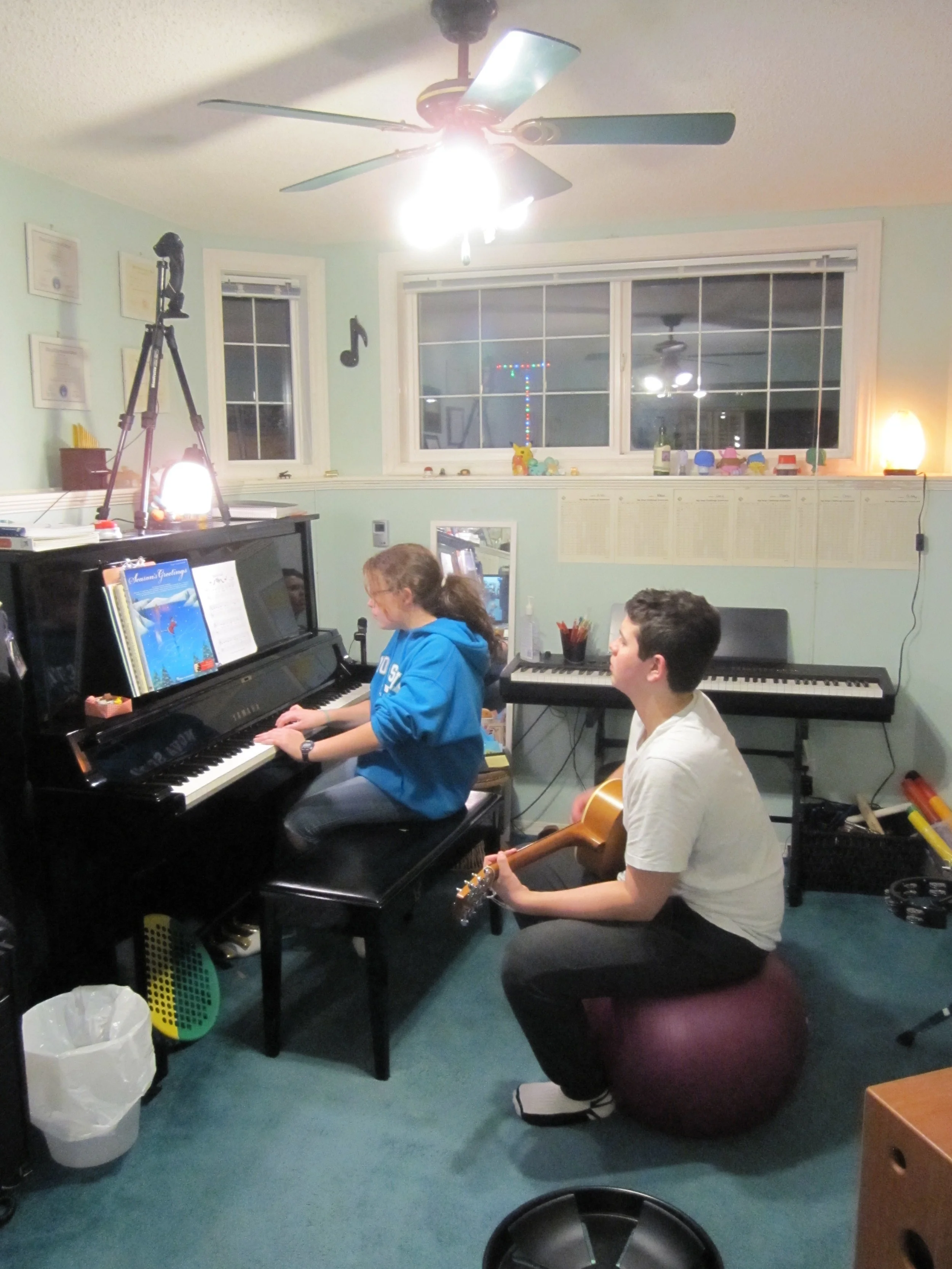
Haley and Grayson brainstorming on ways to vary their Christmas music. Photo credit: Rhona-Mae Arca.
Anyone who has performed at church or a gig knows that sometimes, you need to adjust your playing time on the fly. If the piece is too long, you find a logical place to cut it. But what if you only have a handful of pieces prepared and you are "asked" to play for twice as long as you have pieces?
My students did some brainstorming and experimenting. Everything came down to the same theme: repeat the song and vary it somehow. Here's what they came up with:
Move the piece up or down an octave when you repeat it.
Add embellishments (ornaments) to the melody.
Improvise for a verse and then play it "normally" once again.
Alter the rhythm, articulation, dynamics, or tempo.
Vary the accompaniment.
Playing a Song that You Don't Know (Well)
My students have heard the story of when I was visiting relatives in California. We visited one house with a grand piano. Sure enough, I was asked to play a few songs. I went through my playlist and improvised, but they still wanted me to play. Reluctantly, I opened up the piano bench and began to sight-read kundiman (classic Filipino love songs), while my aunts and uncles sang along. I say "reluctantly" because I disliked sight-reading at the time.
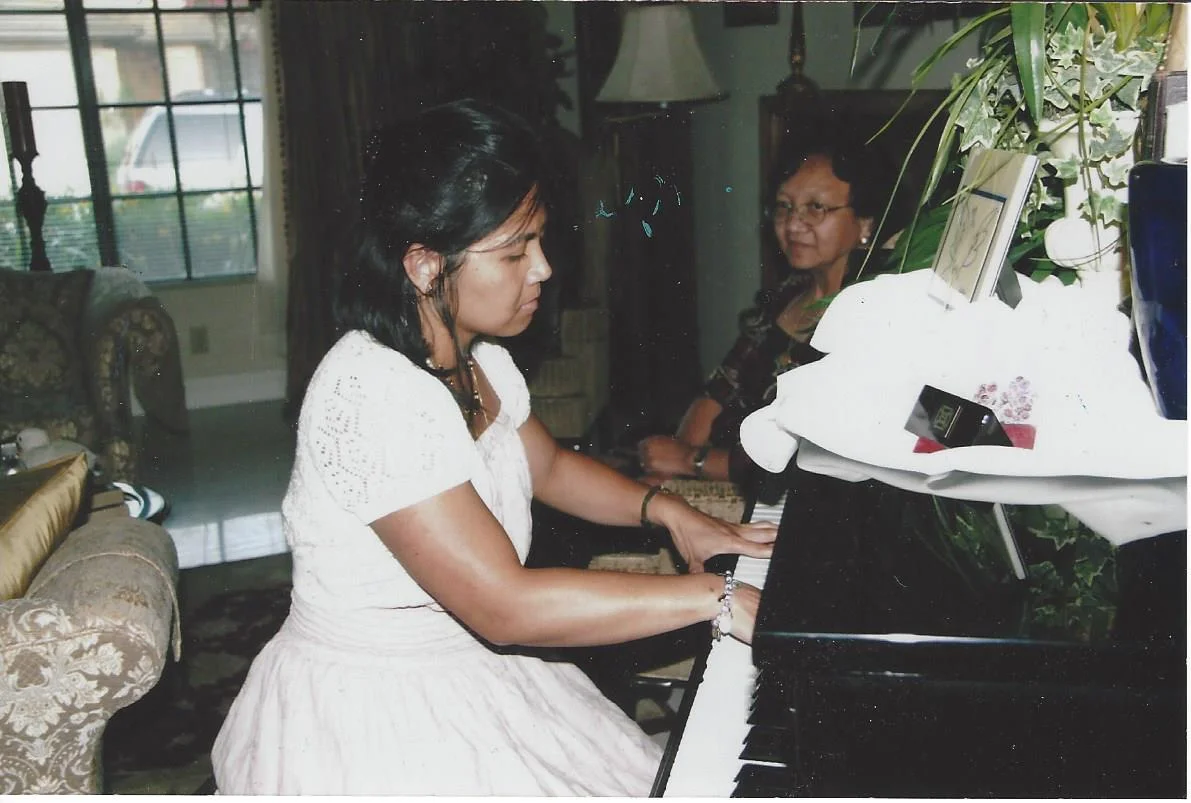
Dragged to the piano to play and not allowed off until the aunts and uncles are happy - if it can happen to me, it can happen to you! Photo: Jun Ancheta.
Then, I had my students work on a Christmas song they weren't familiar with and we discussed different ways to cheat and fake their way through such a performance, based upon their current playing level. These are some of the ideas they came up with:
Play block chords instead of the scored accompaniment.
Play the melody only (for beginners).
Recruit someone else to play through the bass clef notes while you play the treble clef part.
Only play an excerpt of the piece.
Transposing Music on the Fly
Most classically trained music students are taught transposing in music theory. However, they are usually taught how to write out a transposed melody. In the real world, we should be able to transpose on sight at our instrument. Sure, we may be lucky enough to play on a digital piano with a transpose function, but what if there's only an acoustic piano? What if you're playing along with someone whose music is not in concert pitch?
We just glossed through this area as this is best taught one-on-one. However, we did discuss intervallic reading and chording.
Jamming on Christmas Music with Family and Friends
This was perhaps the hardest challenge for most of my students, depending upon what they were playing. The kids on hand percussion and the cajón were fine once I showed them a few rhythms to try. But most had a challenge splitting the piano part up. If someone is playing the melody on flute and the chords on guitar, then as the pianist, you get to explore playing off the page - which is not the norm for today's classical musician.
My beginners were fine with just playing with one hand. Most of my intermediate and advanced students fought with themselves a bit. The desire to play what's on the page was strong. As for my Conservatory Canada Contemporary Idioms students? Generally, it was a piece of cake for them.
Showing off at the Piano
The first thing that comes to mind when I think about showing off at the piano is the Video Game Pianist, Martin Leung, AKA the Blindfolded Pianist:
Other ways of showing off that my students and I discussed included: playing with our hands crossed, playing upside down, and kicking each other off the piano - without missing a beat.
We explored what I called the Jingle Bells Relay. One person began to play this popular Christmas song. Then, one by one, another student would come up to the piano and cut in. The transition had to be sorted out and completed without missing a beat. The ones who successfully did this communicated clearly when and where they would be cutting in. They also kept things consistent by cutting in from one side the piano and exiting off the other.
Oh, there were some fumbles, but hey! They're all learning experiences.
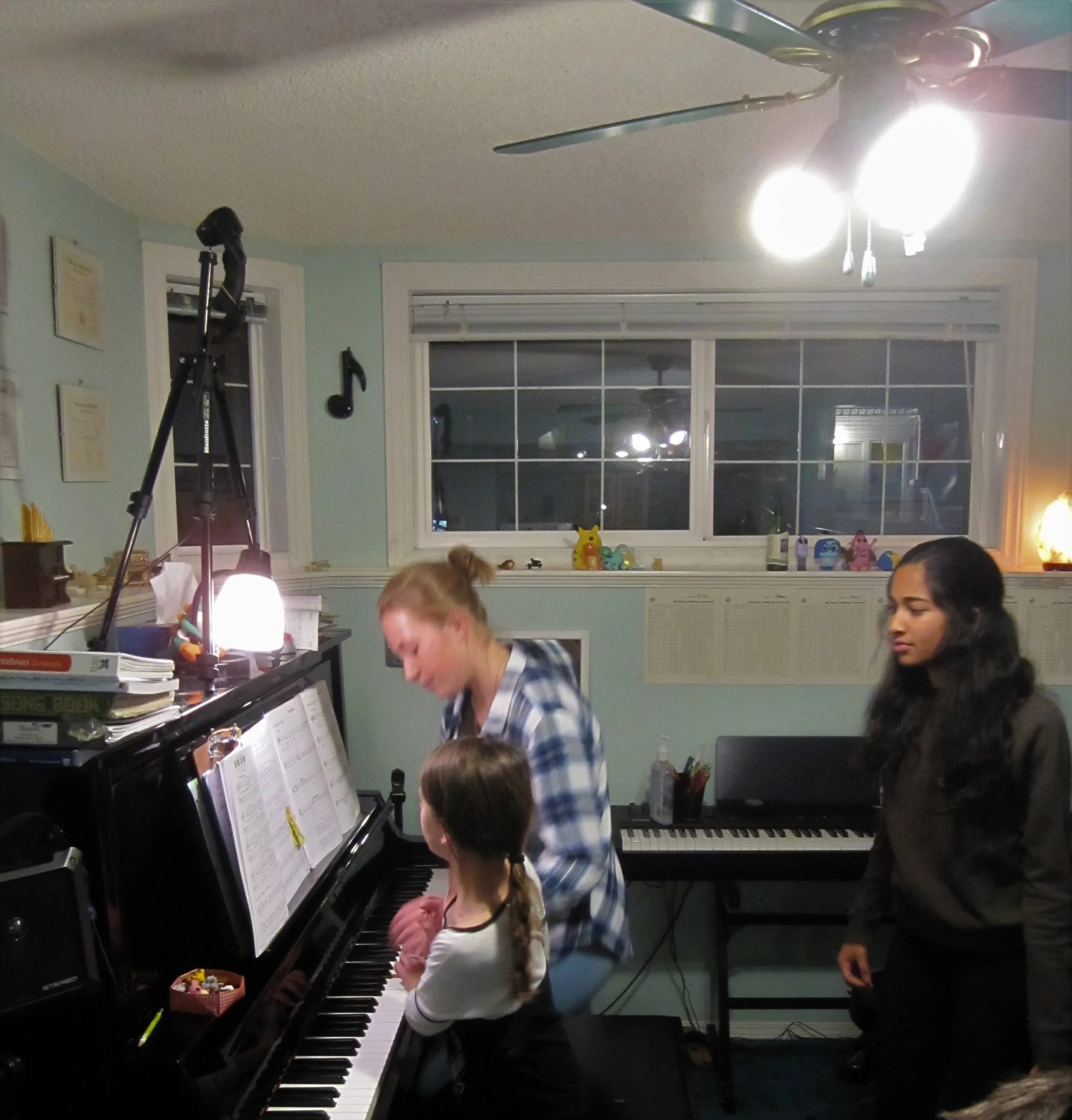
Carly, Claire, and Tanya show off the Jingle Bells Relay in action. Photo by Rhona-Mae Arca.
Over the next few lessons, I will reinforce the one or two group class activities that piqued their interest. I don't expect them to like everything they tried at last week's music group class. However, I do hope that the class opened their ears and minds up to new possibilities. And if they are dragged onto the piano this Christmas Break, at least they aren't going in blind. Forewarned is forearmed.
Using Waveforms in Music Lessons
This week, I tried a new idea out on a student who has trouble playing steadily (and hates the metronome). I showed him our waveforms.
Summer lessons give me a chance to try out new ideas with students. One of my students doesn't pay attention to the rhythm and tempo as carefully as he should. I wanted to find a different way to show him that "steady" and "unsteady" are two different things. Last week, I decided to show him what "steady playing" and "unsteady playing" looks like. Not with the webcams but with the waveforms.
Using Audacity, I recorded both of us playing the same passage. I synchronized them and first asked him to study how well our waveforms lined up. Then, I hit Play.
When I asked him to repeat the passage, he was much steadier!
On Group Classes, Edutainment and Playful Learning
After five rounds of music group classes, it's time to reflect and review before I start planning for the upcoming year. Lots to mull over.
Another Group Class Week has come and gone. As I sit here trying to get my brain around next year, I'm mulling over how to approach group classes going forward.
Some students just aren't into group classes. While some like the idea of trying out something new (e.g. trying to make a radio commercial) but aren't really that interested in learning and honing their skills in those areas. Some like the ensembles. While some are just too busy for group classes and have missed every single one. You get the idea.
I know, we can't please everyone. To that end, I'm contemplating the idea of making the group classes optional and available to outside students.
Now, one comment that I usually hear from students and parents is how "X has so much fun at group classes." Well that's fine and dandy, but as an educator, I feel duty bound to teach them something. I'd like for them to learn something that will help them become better musicians and listeners.
The classes that they enjoyed the most weren't necessarily the ones where they actually learned anything. The aspiration of having the students create a video game theme, record, edit and then present it at the year-end recital? No dice. All the dreams of having them do a singing and accompanying project throughout the year and then perform it at the year-end recital? Nyet.
They fiddled, they made noise, they laughed a lot. Some made a 30-second radio commercial and saved a file. Others spent 90 minutes learning three types of beat patterns, while others played in a piano combo for the first time.
Is anything perform-able in public? Not without hours of tweaking (practice, editing, rendering and re-recording, etc.). Did they learn something that they can execute on their own? Uh-uh.
At least, they tried something new.
One area that started really slowly but gathered momentum was my Music Appreciation 101: Music & Technology class. It evolved each time a little bit to adjust to the next group of students. The students were fascinated with how music listening devices have evolved, especially with the addition of my retro-player:
Not only did this capture their attention, but the topic of copyright interested them too.
Now, the only group activity that saw any thread of progress and continuity was my student band WEDG as they prepared for the Long and McQuade Music Education Contest and later, the APTA Festival. That was an optional activity, which impacted only four students - profoundly enough that they are continuing to work together.
My challenge becomes one of creating group classes that will generate enough interest, yet from a pedagogical standpoint, teach them something useful. I've heard the term "edutainment" thrown around in relation to TV shows. However, that doesn't quite sit right with what I'm trying to do here. I suppose that "playful learning" or "learning through play" would be a closer fit. I suppose that really, they're just different terms on the same continuum of learning.
It's a lot of food for thought.
Group Class Week Round 3 Reflections - 2013 edition
Reflecting upon what worked and what didn't work so well during this week's music group classes at Musespeak and To the Wind Studios.
Another Group Class Week has come and gone. I must say, I am quite grateful that I had to foresight to throw in group classes just before Spring and Easter Break. It's a great way to transition into the break.
The kids have been enjoying the group classes, for the most part. For us music teachers, we're just glad to be able to spend more time with our students on special areas of interest.
This week, some of my brother's and some of my students attended the following classes:
Creative Composition with Strings
Playing with Patterns - Introductory Improvisation
Music Appreciation 101: Music & Technology
Project – Studio
Introduction to Sound & Technology
Piano Combo Class
In my brother's Creative Composition class, the students wrote short compositions with limitations. Some of the limitations could be: write a short song in two minutes, write a jingle for a radio commercial or a video game loop or write a song for only certain instruments. I hear it went well.
In the introductory improvisation class, I gave the students the skeleton of five patterns to improvise on. In truth, I gave them certain modes to jam on. One student would take care of melody, the other played bass. I had to jump in on percussion to keep everyone in time. The group was pretty quiet, so I was unsure of whether they enjoyed it.
I ran the Music Appreciation: Music & Technology Class twice this week. Our students surprised me with what caught their interest. For instance, they perked up while watching a video where a technician started to pull apart a harpsichord. I had to stop the video several times to field questions. Ditto for the magnetic tape segment ("This recording was made with sticky tape and rust.").
The one area that they really surprised me with was copyright. They asked some really good questions. I think that I will have to write a group class plan for Creating and Copyright.
Project - Studio was lively. This is another class that ran twice this week. The students created a radio commercial, from concept to production in 90-minutes. Although Maestro didn't approve of the music selections or sound effects, I can safely say that the students left with smiles on their faces after completing their project.
Introduction to Sound & Technology has evolved since the first time it was offered in August. Last night, the students explored different types of sound recording technology before recording sound effects to go with a short video game clip. The students worked extremely well together and got a lot accomplished.
This was the first time that the Piano Combo Class ran this year. Three keyboards, three students. Each took a turn at working on melody, comping and playing bass. Depending upon their instrument choices, I had to jump in on melodica and try comping on the chords (emphasis on "try"). The kids worked on Ev'rybody Wants to Be A Cat, Tetris Theme A and Bad Romance. The hardest part for them was to approach their instrument from an ensemble perspective and not a one-person band. For instance, I had to remind them (and myself) to comp with rootless chords.
Now that Round 3 is over, we are getting a better picture of what works and what doesn't. For starters, any of the technology projects need more than one class to complete. They are just begging to be set up as a three or four-class course. The same could be said for the accompanying and conducting classes that ran earlier this school year.
Some projects are really hard to figure out running times for. It really depends upon how well the students work well together and how focused they are at completing their projects.
In some cases, two students are ideal in a class. Five is starting to feel like too much. Three or four is just right. That way, they all get a chance to work on the computer or on all the instruments.
Two more rounds to go. One in May and the final round in July. After which, we'll be able to assess which classes to expand on and which ones to cut completely.
Music Group Class Round 1 Reflections
Well, students and teachers of Musespeak Studio and To the Wind Studio have survived the first round of music group classes with this new format. I learned three main lessons
Well, students and teachers of Musespeak Studio and To the Wind Studio have survived the first round of music group classes with this new format. I learned three main lessons:
I have gotten too complacent as far as teacher-student communications go. My students, their parents and I have an established rapport. I'm starting virtually from scratch with my brother's students. Sure, we've chatted at recitals, but a five-minute chat and teaching in 90-minute stretches are two totally different things.
It is important to over-plan and have several back-up activities up your sleeve. My pacing for one of the group classes was perfect. One was all right but could use a few more activities, while the other - well we raced through my lesson plan and I wound up flying by the seat of my pants for a very long time. I have Divine inspiration to thank for the "Let's Make Up a Story with Sound" exercise that I did with yesterday's students when improvising.
When teaching at another studio, have a studio contact list on hand in case you need to contact a parent in the case of an emergency or behavioural issue.
Overall, it was a positive experience. I've learned which students I need to be firm with and which ones I can recruit to take more of a mentoring role with the junior students.
I enjoyed teaching four lovely girls basic conducting gestures and beat patterns. They giggled a lot and had a great rapport with each other.
The "Get into The Groove" class challenged me the most. I will need to plan more rhythm exercises, especially ones where they split off into smaller groups. As for the stubborn ones - let's just say that I'm just as good, if not better at digging in my heels. "The Art of Practicing" also wound up being a great group of music students who were very engaged. In discussing how to practice music, we discussed stretching as well as their learning styles and practicing challenges (e.g. "When I Don't Feel Like Practicing"). The conversation also lead to areas I had not thought of incorporating into my presentation - and they should be. Thanks to them, talking about how to practice when injured and speed learning will be incorporated into my presentation. I look forward to the next round of music group classes.
Social Media Links
archives
- #YYCArts 32
- #YYCEvents 39
- Collaborative Music 25
- Community 11
- Composing & Arranging 6
- Entertainment 139
- Entrepreneurship 53
- Freebies 3
- Gardening 1
- Geeking Out 65
- Health & Wellness 120
- Improvisation 25
- Interviews 28
- Learning Music 188
- Martial Arts 13
- Memorization 7
- Music 230
- Music Careers 9
- Music Education 196
- Music Examinations 7
- Music Exploration 55
- Music Gigs 14
- Music Lessons 6
- Music Performance 32
- Music Theory 13
- Musical Instruments 12
- Musician Health 19
- Pets 57
- Piano Technique 12
- Practicing Music 120
- Productivity 20
- Professional Development 11
- Recommendations & Reviews 93
- Recreation 71
- Social Media 6
- Spirituality 10
- Studio Management 33
- Studio Technology 50
- Teaching Music 146
FOLLOW THE STUDIO on Instagram

Affiliate Links
As a Sheetmusicplus and CD Japan affiliate, I earn from qualifying purchases. The earnings help fund the Studio’s blog and YouTube channels. Your support is greatly appreciated.


FOLLOW Budo no Tabi on Instagram