THE MUSICAL MUSE
Blog dedicated to music education, practice tips, health
&
wellness, and geeking out.
The Sight-Reading Challenge
Drawing inspiration from Alessandra DiCienzo from the Ontario Registered Music Teachers' Association, I have launched a sight-reading challenge in my music studio.

One of the presenters at the CFMTA "Music Inspires" Teachers' Convention, Alessandra DeCienzo, gave an inspiring presentation called, "Love at First Sight". She shared several ideas and activities that she has used in her studio to improve sight-reading.
One of the ideas was a year-round sight-reading challenge. Each week, students would have a sight-reading assignment. Exam students participated in a less strenuous variation of this, completing their sight-reading assignments at their leisure.
I decided to do a variation of her weekly challenge this year. Instead of running it year-round, I have set four stages, which take place in October, December, February and April. That gives all of us a one-month reprieve to explore other areas.
All of us (yes, me too!) have a pin on my game board:

How the Sight-Reading Challenge Works
We all are starting approximately four levels below our current playing level. It is my hope that my students will be able to comfortably sight-read music at their current playing level by April, or get to one level below it. In the process, I also hope that my slower readers will be able to "level up".
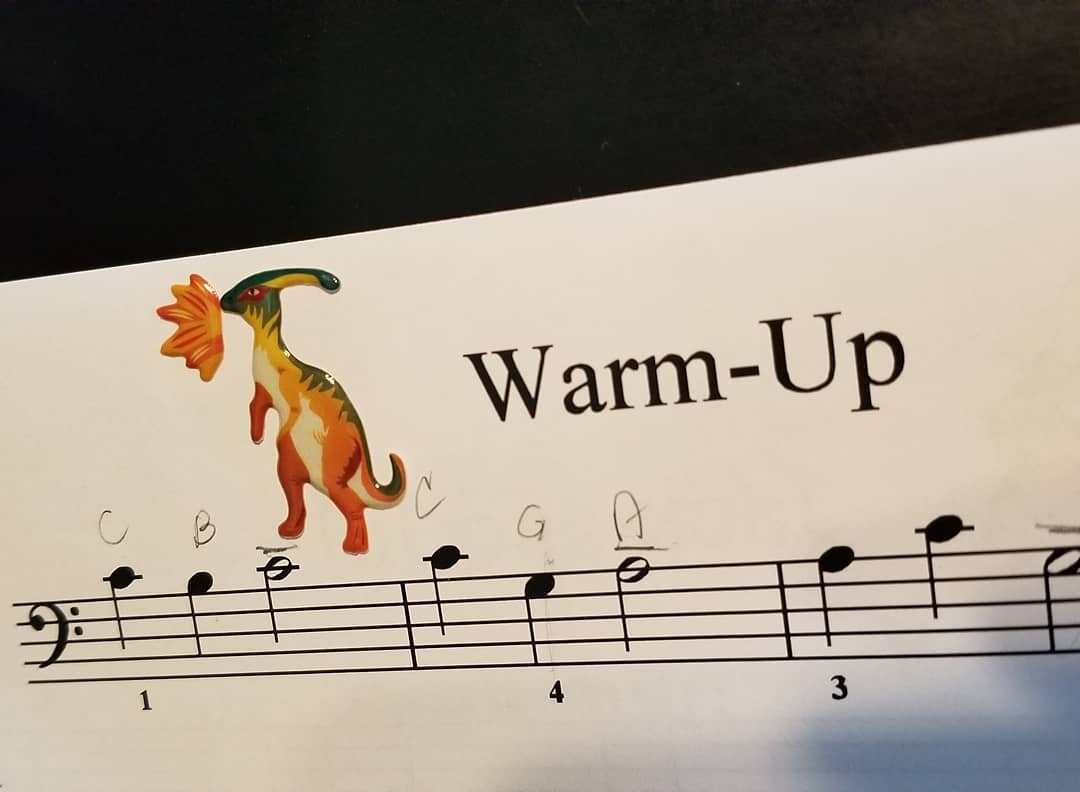
This month, I have been assigning spooky music for sight-reading. My students have the option to officially learn the music once they've "cleared" the sight-reading challenge for a piece. Like Alessandra DiCienzo's students, my students are to play the piece once per practice, without any pauses or corrections.
If they can do that at their next lesson, then they've cleared the challenge of the week and move onto the next one. Some of my students are still on the first challenge, while others are already working on a bonus challenge.
As for incentives, they are working for treats. If they clear only one assignment in the month, they get a small candy. If they complete their four and choose up to three extra songs to do for the bonus challenge, they will the equivalent of a giant chocolate bar.
Repertoire Selection for the Sight-Reading Challenge
Selecting the pieces for the sight-reading challenge has been an adventure and a chore. Thankfully, Alessandra shared some excellent links. Plus I have a growing list of online music teaching resources to draw from. Here are some of them: IMSLP Petrucci Music Library, Wikifonia, Susan Paradis Piano Teaching Resources, G Major Music Theory and Debbie Dee. I keep track of my selections on a spreadsheet saved on Google Drive, complete with the URL's.
In December, we will explore seasonal music: Christmas, Hanukkah and Kwanzaa. We'll either do romantic or wintry music in February and spring-themed music in April.
I have found that this is a great way to introduce students to different styles of music, cultures and different notation (i.e., standard versus a lead sheet or a sheet of chords). In this way, I hope that my students learn that sight-reading doesn't have to be a chore. It can be an exciting adventure.
Using Practicing Personalities in Music Lessons
This summer, I bought Practice Personalities: What's Your Type? by Thornton Cline in the hopes of gaining new information to help my music students practice more efficiently.


When I was at the CFMTA Convention this summer, I spied Practice Personalities: What's Your Type? by Thornton Cline in Long & McQuade's trade show booth. The idea of determining students' practice type and working with that sounded intriguing.
About Practice Personalities: What's Your Type?
Mr. Cline identifies nine practice personalities:
The Perfectionistic Type Student
The Not-So-Detailed Type Student
The Unmotivated Type Student
The Fragile, Easily Discouraged Type of Student
The Overscheduled Way-Too-Busy Type of Student
The Dramatic Type of Student
The Exucse Making, Blaming Type Student
The Over-Exhuberant, Highly Confident Type of Student
Build Your Own Personatily Type of Student
Cline introduces each type before going into more detail for each practice type. Next, he gives a brief (too brief!) chapter with some teaching suggestions for each type. Interspersed throughout the book are interviews with a variety of music educators.
He also dedicates a chapter to motivational rewards and prizes. There is even a chapter on motivational games. Finally, there is a CD in the back, which outlines some of the practice strategies Cline recommends. The back of the book has a handy assessment chart for music teachers to use.
Music Teaching with Practice Personalities
I actually didn't need a full month to complete my assessment. All of my students are a combination of two or more types. To help keep me organized my teaching approaches, I've kept track of how many students are in each group:
The Perfectionist Type Student: 36%
The Not-So-Detailed Type Student: 52%
The Unmotivated Type Student: 24%
The Fragile, Easily Discouraged Type of Student: 24%
The Overscheduled Way-Too-Busy Type of Student: 40%
The Dramatic Type of Student: 20%
The Exucse Making, Blaming Type Student: 16%
The Over-Exhuberant, Highly Confident Type of Student: 20%
I decided to tackle one strategy at a time.
First off: showing students various practice drills to help them fix trouble spots more quickly. To do that, I simply asked my students to pull out their Bag of Tricks and have them choose a couple of appropriate drills to use from their deck, based on what needed to be fixed.
Many of my students have commented that it's fun to pull out their Bag of Tricks that I made for them. I spent the first two to three weeks doing that just to help reinforce how to practice, but also to appeal to everyone's state of busy-ness. "You want to fix this as quickly as you can so you can move onto other stuff, right?" I'd ask.
With the majority of my students being some combination of the Not-So-Detailed, I decided to increase the frequency of doing Record & Review. You can read about that experience in my post on Active Listening.
This week, I'm employing another technique that's good for several practice types, but especially for the Dramatic and the Not-So-Detailed: roleplaying with a bit of dramatic exaggeration thrown in. This tests my aural memory, let me tell you!
I try to play back what they played incorrectly and ask them to tell me what I did wrong. A few students get it right away, "You didn't hold that note long enough," or "You sped up in that line." My reply is, "Well, that's what I heard you do. Now you show me that you can play it better than me."
The other thing I've launched this week is a Sight-Reading Challenge (more on that later). In addition to increasing my students' music literacy, it's also an exercise to challenge my Perfectionist students.
I'll give my students some time to get get used to these approaches. Then, I'll tackle the Excuse-Making and Blaming Students Fragile, Easily Discouraged ones.
It's a neat book. Mr. Cline is a strong writer and the CD is useful.
However, I was disappointed with how few strategies he offered. Let me re-phrase that: I was disappointed in how little new information I gleaned from it. The majority of the strategies are ones that I've already employed.
In short, I'd say that Practice Personalities: What's Your Type? is ideal for a music teacher just starting out. It would also be good for a teacher just looking for some fresh ideas, especially if they don't already use technology in the studio.
Mr. Cline's suggestions simply reinforced for me some of the strategies that I'm already using in my teaching. The main difference is that now that I know which practice type my students are, I can switch strategies more quickly. When combined with knowing my students' VARK learning preferences, it's a powerful combination.
Practice Personalities Publication Details
Author: Thornton Cline
Title: Practice Personalities: What's Your Type
Paperback: 88 pages
Publisher: Centerstream
Publication Date: July 1, 2012
ISBN-10: 1574242814
ISBN-13: 978-1574242812
Price Range: $16.62 - $27.95 CAD
I purchased my copy from Long & McQuade. You may need to special order this book through your local bookstore. Practice Personalies: What's Your Type? is also available online on Amazon, Alibris and Sheetmusicplus.
Using Waveforms in Music Lessons
This week, I tried a new idea out on a student who has trouble playing steadily (and hates the metronome). I showed him our waveforms.
Summer lessons give me a chance to try out new ideas with students. One of my students doesn't pay attention to the rhythm and tempo as carefully as he should. I wanted to find a different way to show him that "steady" and "unsteady" are two different things. Last week, I decided to show him what "steady playing" and "unsteady playing" looks like. Not with the webcams but with the waveforms.
Using Audacity, I recorded both of us playing the same passage. I synchronized them and first asked him to study how well our waveforms lined up. Then, I hit Play.
When I asked him to repeat the passage, he was much steadier!
Distance Learning Degrees in Music Education
Music teachers can further their education in the comfort of their studio. These six universities offer music educators distance learning opportunities.
Music teachers can further their education in the comfort of their studio. These six universities offer music educators distance learning opportunities.
Traditionally, music teachers who wished to explore longer professional development opportunities had take a sabbatical to study abroad. For some teachers, traveling abroad for extended periods in the name of career development is not a viable option.
A growing number of universities offer online degrees in music education. These six universities enable music teachers to further their education in the comfort of their own studio, with minimal disruption to their household and teaching schedules.
Master of Music in Music Education at the Boston University
Founded in 1839 as the Newbury Biblical Institute, Boston University now boasts an enrollment of over 32,000 students. BU is the first university in American history to confer university degrees in music.
Boston University’s School of Music offers an online Master of Music, Music Education. In this 17–20 month program, students explore a diverse curriculum, including analytical techniques, jazz and popular arranging and the philosophy and history of music education.
Master of Music in Music Education From Duquesne University
Located in Pittsburgh, PA, Duquesne University was founded in 1878 by the Order of the Holy Spirit. Duquesne is a private, coeducational Catholic college with an enrollment of over 10,000 students.
DU’s Mary Pappert School of Music offers a three and four-year Master of Music: Major in Music Education. The program incorporates online studies as well as courses that must be taken on campus. Students explore a variety of areas, including the foundations of music education, creativity in school music programs, Alexander Technique for musicians and music education research.
The school also offers a Master of Music in Music Technology program. Students will study Digital Music Pedagogy, Electronic Composition and Electronic Performance.
Master of Arts – Music Education Degree at the University of Hawaii-Manoa
The University of Hawaii at Manoa in Honolulu, HI was established in 1907 and now boasts an enrollment of over 20,000. The university offers a two-year Master of Arts Music Education Degree that can be taken locally or through distance learning.
Applicants should hold a Bachelor of Education (or comparable degree) and be teaching in a public or private school. Students will explore a wide range of topics, including major issues in music education, research in music education, using the Internet and the psychology of music.
Graduate Certificate in Music Technology at the University of Newcastle
The University of Newcastle in Australia was founded in 1965 and has over 30,000 students. It has earned a solid reputation for its accomplishments in making higher education accessible to the disadvantaged, as well as research and teaching innovations. The University earned seven Citations for Outstanding Contributions to Student Learning from the Australian Learning and Teaching Council.
The University of Newcastle offers a Graduate Certificate in Music Technology. Students explore several applications of music technology, including MIDI and sequencing techniques, musical scoring techniques, digital media, sound engineering and computer assisted instruction.
Certificates of Piano Pedagogy and Piano Pedagogy Research at the University of Ottawa
The University of Ottawa in Canada is the largest bilingual university in North America. It was founded in 1848 and now has an enrollment of over 40,000 students.
UOttawa offers an Undergraduate Certificate in Piano Pedagogy and a Graduate Certificate in Piano Pedagogy Research. Like Duquesne University, UOttawa incorporates distance learning and on-campus learning components. Students explore a wide range of pedagogical topics, including an analysis of various piano method books, musician health and injuries and music education research.
MA Psychology for Musicians/MA Music Psychology in Education at the University of Sheffield
The University of Sheffield is among the top universities in the UK, according to "RAE 2008: results for UK universities" from The Guardian (December 18, 2008). It was founded in 1828 and now reports an enrollment of over 24,000 students. Five Nobel prizewinners lead its list of illustrious alumni.
The MA Psychology for Musicians/MA Music Psychology in Education was launched in 1997. Students study diverse aspects of music education and psychology, including the psychology of performance, music research and musical development. This part-time, online degree can be completed within two years.
Music teachers can develop their skills through online courses and distance learning degrees. Masters programs in music research, piano pedagogy, music technology and music psychology are just some of the areas that music educators can explore from the comfort of their own studio.
Originally published on Suite101.com on July 23, 2010. Winner of an Editor's Choice Award for Music Education on Suite101.com. Updated March 24, 2013. All rights reserved by Rhona-Mae Arca.
Piano Pedagogy Links
I haven't started lesson planning for the 2007/08 year yet. I planned to catch up on my bookkeeping and registrations this week before moving onto to lesson plans; but I am taking longer than I thought I would on updating my address book. Of course, it doesn't help that this is the worst month for me and allergies. I refuse to do any bookkeeping when my head is in a perpetual foggy, sniffly, snivelly and sneezy state. However, I'm almost done my address book project and I think I finally found an allergy/sinus combination that is breaking through that fog; so I'll have no more excuses. I will have to do my bookkeeping.
For my colleagues who are doing their lesson planning now (or plan to do so soon), here are a few online resources I've stumbled upon. Hopefully, we can gleam some gems from these:
I may have posted a couple of these in a previous entry, but it would have been a while back.My apologies for the list being piano heavy. Feel free to write submit websites, book titles, periodicals that you use to help with lesson planning - all instruments welcome.
(c) 2007 by Musespeak(tm), Calgary, AB, Canada. All rights reserved.~
Social Media Links
archives
- #YYCArts 32
- #YYCEvents 39
- Collaborative Music 25
- Community 11
- Composing & Arranging 6
- Entertainment 139
- Entrepreneurship 53
- Freebies 3
- Gardening 1
- Geeking Out 65
- Health & Wellness 120
- Improvisation 25
- Interviews 28
- Learning Music 188
- Martial Arts 13
- Memorization 7
- Music 230
- Music Careers 9
- Music Education 196
- Music Examinations 7
- Music Exploration 55
- Music Gigs 14
- Music Lessons 6
- Music Performance 32
- Music Theory 13
- Musical Instruments 12
- Musician Health 19
- Pets 57
- Piano Technique 12
- Practicing Music 120
- Productivity 20
- Professional Development 11
- Recommendations & Reviews 93
- Recreation 71
- Social Media 6
- Spirituality 10
- Studio Management 33
- Studio Technology 50
- Teaching Music 146
FOLLOW THE STUDIO on Instagram


Affiliate Links
As a Sheetmusicplus and CD Japan affiliate, I earn from qualifying purchases. The earnings help fund the Studio’s blog and YouTube channels. Your support is greatly appreciated.


FOLLOW Budo no Tabi on Instagram