THE MUSICAL MUSE
Blog dedicated to music education, practice tips, health
&
wellness, and geeking out.

Work and Budo Modifications with a Back Injury
As some of you know, I injured my back a couple of weeks ago. No, I wasn’t doing anything really cool like one of our awesome Iaido or Jodo kata, or going really wild on the cajón. I was simply sitting poorly at my desk and twisted funny when I got up to grab something from the printer. That’s when I felt a terrible twinge in my lower back. Next thing I knew, my body completely closed in and I could barely walk.
As some of you know, I injured my back a couple of weeks ago. No, I wasn’t doing anything really cool like one of our awesome Iaido or Jodo kata, or going really wild on the cajón. I was simply sitting poorly at my desk and twisted funny when I got up to grab something from the printer. That’s when I felt a terrible twinge in my lower back. Next thing I knew, my body completely closed in and I could barely walk.
Thankfully, I was able to see my chiropractor the following day for an emergency adjustment. He said that I completely jammed up my sacral region. I then compounded things by still using my active sitting discs while doubled up in pain for an additional day, thus aggravating my coccyx (tailbone) while sitting.
“This isn’t going to feel better right away,” he told me. “It will take a few adjustments.” He sent me hobbling off with the following advice, “Keep moving and try to avoid sitting as much as you can.” Well, considering that I need to sit at two of my instruments and work on a computer quite a bit, adjustments needed to be made.
Modifying the Studio for a Back Injury
The first thing that I rolled out of the studio was my exercise ball, which I used as my teaching chair. Next, I raised the stand for my digital piano so that I could play from standing. I spend half my time teaching from standing, so that wasn’t a big deal. However, I needed to come up with a different way to rest my muscles during lessons somehow.
I discovered during one of my shorter ushering shifts was that kneeling and going in and out of seiza was perfectly fine for my back. Seiza is the formal Japanese way of sitting, which we use in martial arts training. It’s more of a kneeling sit, although our buttocks float over our ankles. So teaching from kneeling or seiza made the afternoon and evening lessons go well. And stretching. Lots of stretching. I used these sacral release stretches quit a bit.

I’ve been getting into Child’s pose more regularly since my back injury. Credit: Iveto
My trusty Dr. Ho and Maestro’s old infrared pad have been a great help in the healing process. When I’m out running errands or working at one of my part-time jobs, I use Icy Hot patches.
Five days after my injury, I bought a Coccyx wedge to use in the car. I thought I could use it in the office and studio, but half the time, the wedge went flying off the seat because I move so much.
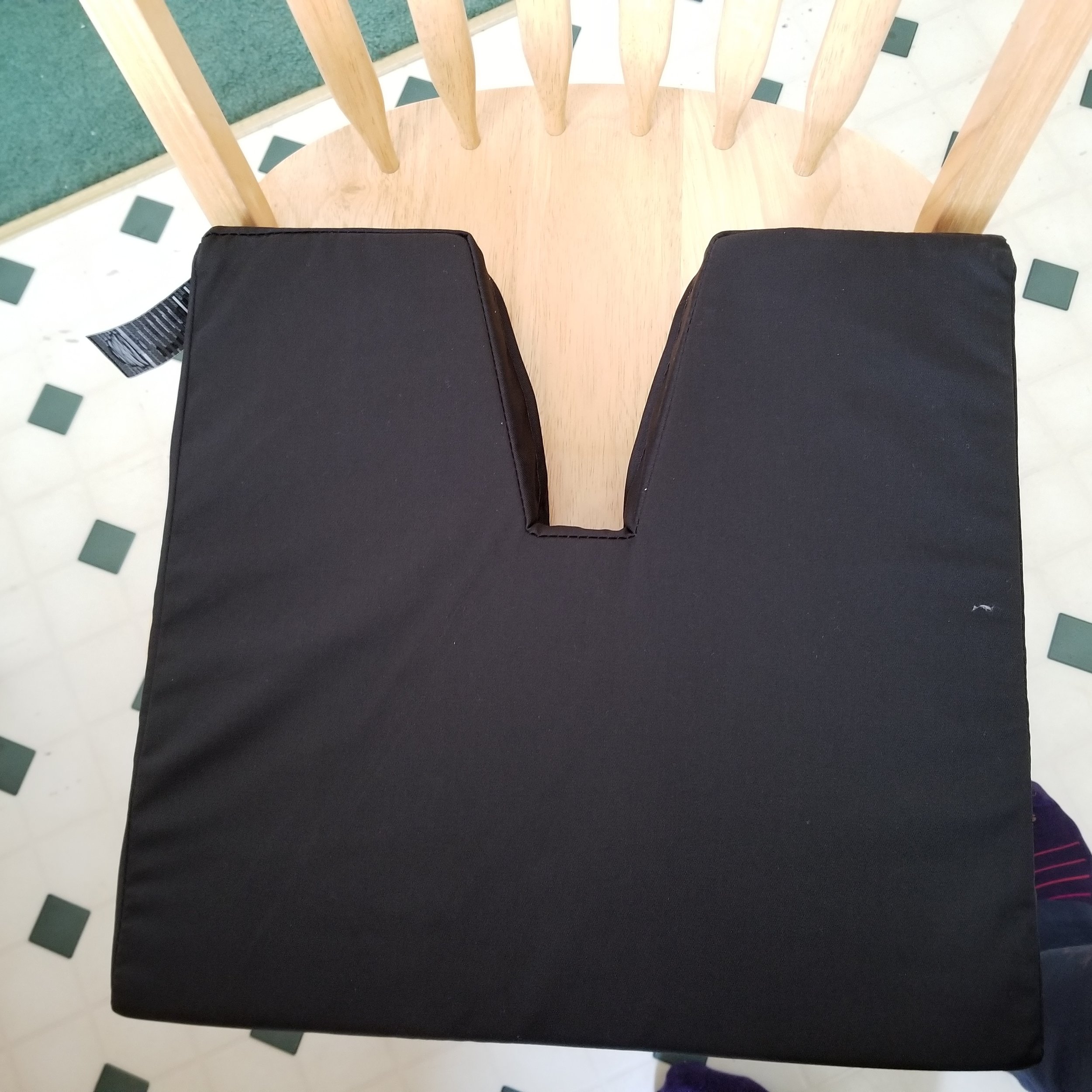
Coccyx cushion. Credit: R-M Arca.
One week after my back injury, I bought a kneeling chair from Staples to use in the office and studio. Too bad I got rid of my original chair a few years back. I am sitting in this one properly though, which is a huge improvement from last time.

Now that I’m using the kneeling chair properly (no slouching), things are going swimmingly. Credit: R-M Arca.
I’m in the process of building up my sitting endurance at the piano and cajón. I sit more or less properly at my instruments, so the only big change is that I still need to do short practice sessions with time to do sacral release stretches in between.

It was extremely easy to reconfigure my piano studio in such as way that I could take it easy on my back. Credit: R-M Arca.
Modifying Budo Training with a Back Injury
My chiropractor and massage therapist probably got tired of me asking, “When can I go back to training?” One visit, my chiropractor asked me describe the movements involved when we train. He was already grimacing when I started to show how we unsheathe our swords. I promptly stopped before my back said, “Don’t make me do sayabiki!”
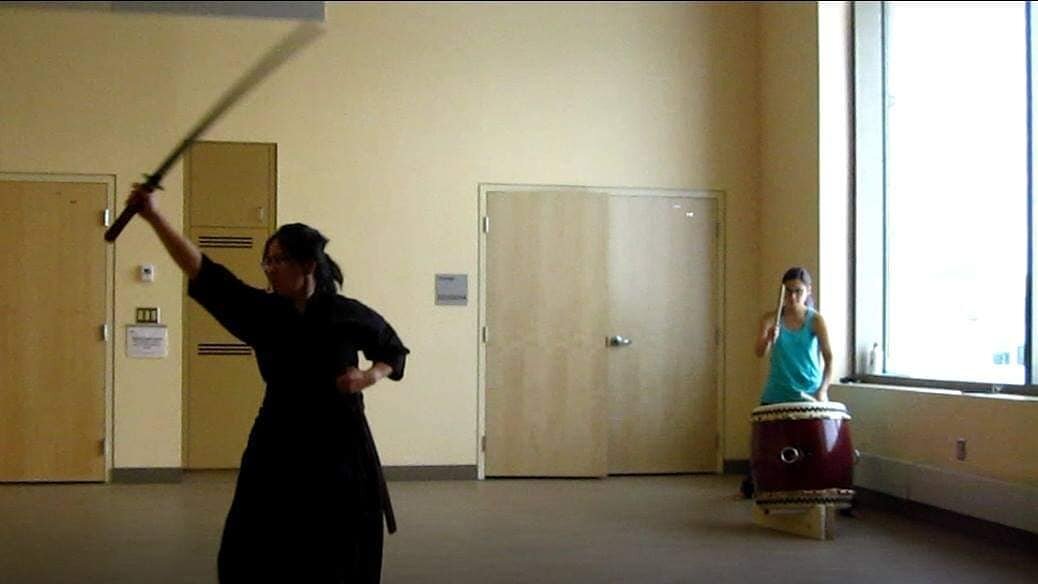
Then, I tried to slowly demonstrate Uke nagashi, our third Iaido kata from the seitei set:
He stopped me very quickly and told me hold off until my back had healed some more. “No twisting.”
I have had to make myself content with practising my footwork and moving in and out of seiza. I have also been drilling small sections in my kata, such as o-chiburi, that don’t involve me to change directions. My visualization isn’t the greatest, but I’ve been mentally reviewing my troublespots and asking sensei questions every few days about something I’ve noticed or read.
However, the main way that I’ve been keeping up with training is studying. I’ve got years’ worth of notes to review, as well as manuals for the four marital arts we practice (Iaido, Jodo, Hyoho Niten Ichi Ryu, and Choken Battojutsu Kageryu). Plus, there are always videos featuring some of of our sensei that I can watch.
Today, my chiropractor cleared me to ease myself back into regular training. I have a feeling that I’ll be doing a lot of solo practice at “Tai Chi slow” speed, taking time to dissect every movement for the first little while.
Lessons Learned from Injuring my Back
If anything, hurting my back has given me the opportunity to assess and adjust how I move and sit. During the first few days, I really had to break down how I did things like get on or off my bed into small segments. I am certainly sitting and getting on and off chairs more carefully these days.
I have definitely become more mindful of my body’s state as a result. Being more mindful can only be good, right?
Reducing Hand and Wrist Tension at the Piano
Lately, I have been harping on my students about their wrist technique. Some are playing with locked wrists or excess hand tension, even with us working on it during their lessons. The bottom line is that we teachers can only help you so much in a lesson, the rest comes down to how you practice at home.
Here are a few videos by some of my esteemed colleagues on hand and wrist technique:
Lately, I have been harping on my students about their wrist technique. Some are playing with locked wrists or excess hand tension, even with us working on it during their lessons. The bottom line is that we teachers can only help you so much in a lesson, the rest comes down to how you practice at home.
Here are a few videos by some of my esteemed colleagues on hand and wrist technique:
Irina Gorin and Wrist Relaxation Exercises:
I showed this to an intermediate student. He started to make some progress after viewing this. Irina has more useful videos on her YouTube Channel.
Josh Wright on Reducing Hand Tension
Although he still has some tension (those pesky octaves!), Josh does have some good points. Let's chalk it up to the fact that he's showing you a section that he is working on, so it's a work in progress.
Robert Estrin on Wrist Technique with Octaves:
Robert Estrin has a treasure chest of wonderful piano tutorials on his website. Every pianists should bookmark his site.
The Allan Fraser Institute's Lecture-Demonstration on Hand Tension and Proper Arm Weight Technique
Thanks to Brian Riker for sharing this one.
I promised my students that I would send them some clips to help them play with more relaxed wrists and a less hand tension.
Sometime during Christmas break, I will record some videos in which I deconstruct my piano technique. When I mentioned this to my students, they immediately asked if we could use the GoPro POV camera and the other cameras to film them as well. What a great way to analyze your basic piano technique!
I think I will start using an elastic band. Up to this point, I've either had my students put their hand on mine (or my forearm) to feel the arm weight and tension I use to play their trouble spots. Or, I'll hold their forearm and won't let go until I sense they have relaxed sufficiently.
We've been using imagery a lot too. That's something you might want to try if your teacher hasn't asked you to yet.
Last night, I asked a student to imagine that he was in a pool and he was dragging his arm back and forth in the water. Then, I asked him to imagine that his arms were made of air and that gravity was pulling his hand down towards the keys.
Make sure you stretch regularly to reduce hand tension and prevent musician injuries. Finally, I will leave you with something I say regularly to my students: Spongy wrists, firm fingertips.
How to Warm Up at the Piano
Not sure exactly how to warm up before practicing piano? Check out Robert Estrin's video and my series of musician stretches.
My colleague Robert Estrin of Living Pianos recently posted a great video tutorial on how to warm up at the piano. There are some great tips for all musicians!
He talks about staying healthy and taking breaks. He also mentions the importance of stretching.
Here is is clip on how to warm up at the piano:
Here are some keyboard warm-ups, courtesy of my colleague Irina Gorin. These are geared towards beginner piano students:
Finally, check out my series on musician stretches:

Back and Shoulder Stretches for Musicians
Many musicians complain of back and shoulder pain. Regular stretching will ease pain in the shoulder and back, increase flexibility and prevent repetitive strain injury.
Many musicians complain of back and shoulder pain. Regular stretching will ease pain in the shoulder and back, increase flexibility and prevent repetitive strain injury.
Musicians sit or stand in the same position for extended periods of time when practicing. Common complaints include:
shooting pain through the shoulder and back
dull ache in the shoulder and back
stiffness
The degree of pain varies from mild discomfort to debilitating. If unchecked, these chronic conditions can end one's musical career.
Musicians are prone repetitive strain injury such as Thoracic Outlet Syndrome, Bursitis and Tendinitis. Pain and injury in musicians stem from poor posture, faulty technique, repetitive strain and overuse. Musicians can alleviate shoulder and back pain and avoid injuries by incorporating stretching exercises into their regular routine.
How Musicians Should Stretch the Back and Shoulder Muscles
Musicians should stretch prior to practicing or performing. Stretches can be done after a shower or after performing light exercises. Musicians should take breaks frequently to stretch. For example, stretches can be done before moving onto a new technical exercise or piece or after drilling a trouble spot.
Refer to the exercises and photos below:

1 Shoulder Shrugs
Purpose: To ease shoulder tension, alleviate shoulder pain and loosen up the shoulder muscles.
Performance:
From a standing or sitting position, shrug your shoulders, drawing them up towards your ears.
Hold your shoulder muscles taut for five seconds.
Relax.
Repeat at least two more times.
2 Shoulder Blade Pinch
Purpose: To ease shoulder tension, alleviate shoulder pain and loosen up the shoulder muscles.
Performance:
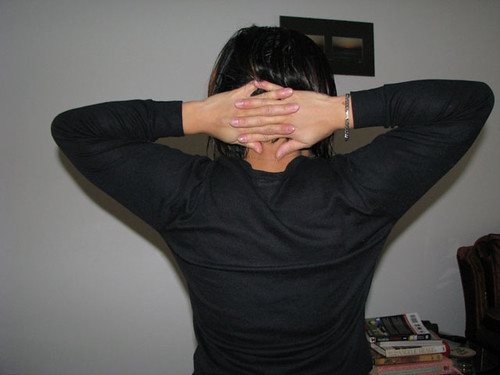
Interlock your fingers and place them behind your head. Keep your elbows straight out to the side.
Pull your shoulder blades together to produce tension in your upper back and shoulder blades.
Hold this position for five to ten seconds.
Relax.
Repeat three to four times.
3 Shoulders & Pectoral Stretch
Purpose: To ease tension in the shoulders and pectoral muscles, alleviate shoulder pain and loosen up the shoulder muscles.
Performance:
Interlace your fingers behind your back.
Slowly turn your elbows inward and straighten your arms.
Hold the stretch for five to 15 seconds.
Relax.
Repeat at least twice.
4 Prayer Stretch
Purpose: To ease tension and provide back pain relief.
Performance:
Kneel on the floor.
Reach out with both arms straight in front of you along the floor.
Lower your body onto your heels.
Hold this position for 20 - 30 seconds.
Relax.
Repeat at least twice.
5 Downward Facing Dog
Purpose: To ease tension and relieve pain in the back.
Performance:
Start on all fours.
Drop your head down.
Raise your buttocks straight up towards the ceiling while straightening out your arms and legs. Keep your heels on the floor.
Allow your spine to sink into your body and lengthen.
Hold this stretch for 20 - 30 seconds.
Relax.
Repeat at least twice.
6 Cat Stretch
Purpose: To ease tension and provide back pain relief.
Performance:
Start on all fours.
Drop your head down.
Raise your spine up between the shoulder blades while maintaining an abdominal hollow.
Allow your spine to relax.
Hold this stretch for 20 - 30 seconds.
Relax.
Repeat at least twice.
6 Standing Forward Bend
Purpose: To ease tension and relieve pain in the back.
Performance:
Stand with your feet hip-width apart.
Slowly bend forward, one vertebra at a time, allowing your head and arms to drop towards the floor.
Keep your knees soft..
Allow your spine to lengthen.
Hold this stretch for 20 - 30 seconds.
Relax.
Repeat at least twice.
7 Cross Spiral Stretch
Purpose: To ease tension and provide back pain relief.
Performance:
Lie on your back, holding your arms outstretched to the side.
Bend your right knee and bring it over to your left side towards the floor, allowing it to drop over your left leg.
Turn your head to the right.
Hold this stretch for 20 - 30 seconds.
Relax.
Switch sides.
Repeat.
For further advice, musicians should speak with a doctor, chiropractor, physical therapist or massage therapist. Alternately, musicians can take a class that involves a high degree of stretching, such as yoga.
An excellent set of stretches is outlined in Madeline Bruser's book The Art of Practicing: A Guide to Making Music from the Heart. You may also find the following articles useful: Oh, My Aching Back!, The Benefits of Yoga and How it Helps Healing, Understanding Musician Injuries.
By dedicating as little as five minutes a day to stretching, musicians can ease shoulder pain, treat back pain and prevent musician injuries.

Arm and Hand Stretches for Musicians
Many musicians complain of numbness and pain in the hand, forearm and arm. They can prevent repetitive strain injury, ease pain and tension by stretching regularly.
Many musicians complain of numbness and pain in the hand, forearm and arm. They can prevent repetitive strain injury, ease pain and tension by stretching regularly.
By nature, learning music involves repeating until a passage or technical exercise until a high level of proficiency, fluency and artistry is achieved. Instrumentalists use their finger, hand and arm muscles extensively when practicing and performing. This makes them especially vulnerable to a repetitive stain injury such as Carpal Tunnel Syndrome, Bursitis and Tendinitis. Musicians can ease arm and hand pain, relieve tension and prevent injuries by incorporating stretching exercises into their daily routine.
How Musicians Should Stretch the Hand and Arm Muscles
Stretching exercises should be done when the muscles are warm. For example, stretches can be done after a shower, after a bath or after performing some light exercises. Musicians should always stretch prior to practicing. They should also take regular breaks when practicing to stretch. For example, stretches can be done before switching to a new piece or after practicing a physically challenging section of music. Musicians should also stretch prior to performing and in between performances.
Stretching Exercises for Musicians
Follow the arm and hand exercises and refer to the photos below:
1 Finger Flicks
Purpose: Prevent Tendinitis and Trigger Finger, relieve tension and increase blood circulation in the hands.


Performance:
Hold your hands in a loose fist in front of you.
Flick your fingers so that your fingers are outstretched. Pretend that you are flicking water.
Hold your fingers in an outstretched position for 10 seconds.
Relax.
Repeat.
2 Wrist Circles
Purpose: Prevent Tendinitis, relieve tension and increase blood circulation in the wrists.
Hold your hands in a loose fist in front of you.
Rotate your wrists in a circle several times in one direction.
Relax.
Rotate your wrists in a circle in the other direction.
Relax.
Variation: Sticking out your thumb as if you were hitchhiking.
3 Fingers Interlaced Wrist Circles
Purpose: Prevent Tendinitis, relieve tension and increase blood circulation in the wrists.
Interlace your fingers together in front of you. Keep track of which thumb is resting on top.
Rotate your wrists in a circle several times in one direction. Start slowly and as you get more comfortable, increase the speed.
Relax.
Reposition your hands so that the opposite thumb is resting on top.
Rotate your wrists in a circle in the other direction.
Relax.
4 Forearm Flexor Stretch
Purpose: Prevent Tendinitis in the elbow and forearm, relieve tension and increase blood circulation.

Performance:
Place your hands together in a praying position.
Push your hands together and push your arms downward until you feel a gentle stretch.
Hold the stretch for 10 - 20 seconds.
Relax.
Repeat at least once.

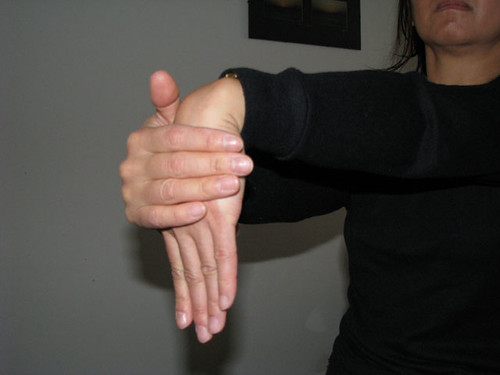
5 Single Arm Forearm Flexor Stretch
Purpose: Prevent Tendinitis in the elbow and forearm, relieve tension and increase blood circulation.Performance:
Hold your left arm straight in front of you with your palm facing forward as if to indicate "stop".
Brace your left palm with your right hand.
Gently pull the fingers in your left hand towards you until you feel a gentle stretch.
Hold for 10 - 20 seconds.
For a deeper, isometric stretch, push your left arm forward, into your right hand, as you pull your left hand towards you.
Relax.
Repeat with the opposite arm.
6 Forearm Extensor Stretch
Purpose: Prevent Tendinitis in the elbow and forearm, relieve tension and increase blood circulation.Performance:
Extend your left arm in front of you, holding your arm straight.
Let your hand flop downward at the wrist.
Place your right palm over your left hand (above the fingers).
Gently push your left hand towards you with your right hand until you feel a gentle stretch.
Hold for 10 - 20 seconds.
For a deeper, isometric stretch, push your left arm forward, into your right hand, as you pull your left hand towards you.
Relax.
Repeat with the opposite arm.
7 Soup Can Forearm Extensor Exercise
Purpose: Prevent Tendinitis in the elbow and forearm, relieve tension and increase blood circulation.
Performance:
With your right forearm on a table and let your right hand flop down.
Place a soup can in your right hand.
Beginning with your wrist level with your forearm, slowly let your hand point downward until you feel a gentle stretch in your forearm extensors.
Hold for 10 seconds.
Steadily raise your hand so that your wrist is level with your forearm.
Relax.
Complete 10 repetitions.
Repeat the exercises with the opposite arm.
8 Tricep Stretch
Purpose: Prevent Tendinitis in the elbow and upper arm, relieve tension and increase blood circulation.
Performance:
Hold your left elbow with your right hand.
Gently pull your left arm towards you until you feel a gentle stretch.
Hold for 10 - 20 seconds.
Relax.
Stretch the right arm.
Repeat this stretch at least once.
Never stretch to the point of pain. Strive for a gentle stretch. If you are already suffering from a repetitive strain injury, consult a doctor, chiropractor, physiotherapist or registered massage therapist (licensed in therapeutic massage) before attempting these exercises.
By spending as little as five minutes a day on stretching exercises, musicians can alleviate symptoms of carpal tunnel syndrome, prevent tendinitis. This can lead to many years of healthy and pain-free years of music-making.
You may find more information through these links: Benefits of Stretching, Face and Neck Stretches for Musicians, The Art of Practicing, Understanding Musician Injuries, Simple Exercises to Strengthen the Wrists and Wrist Exercises.
Social Media Links
archives
- #YYCArts 32
- #YYCEvents 39
- Collaborative Music 25
- Community 11
- Composing & Arranging 6
- Entertainment 139
- Entrepreneurship 53
- Freebies 3
- Gardening 1
- Geeking Out 65
- Health & Wellness 120
- Improvisation 25
- Interviews 28
- Learning Music 188
- Martial Arts 13
- Memorization 7
- Music 230
- Music Careers 9
- Music Education 196
- Music Examinations 7
- Music Exploration 55
- Music Gigs 14
- Music Lessons 6
- Music Performance 32
- Music Theory 13
- Musical Instruments 12
- Musician Health 19
- Pets 57
- Piano Technique 12
- Practicing Music 120
- Productivity 20
- Professional Development 11
- Recommendations & Reviews 93
- Recreation 71
- Social Media 6
- Spirituality 10
- Studio Management 33
- Studio Technology 50
- Teaching Music 146
FOLLOW THE STUDIO on Instagram


Affiliate Links
As a Sheetmusicplus and CD Japan affiliate, I earn from qualifying purchases. The earnings help fund the Studio’s blog and YouTube channels. Your support is greatly appreciated.


FOLLOW Budo no Tabi on Instagram