THE MUSICAL MUSE
Blog dedicated to music education, practice tips, health
&
wellness, and geeking out.

Beats and Budo
Several months ago, one of my fellow iaidoka (AKA, “The Tiny Samurai”) posed a question to Kim Taylor sensei of Sei Do Kai with regards to beats and budo. Taylor sensei shared some of his thoughts here, then made a reference to me (AKA, “The Tinier Samurai”) to try tackling the question.
When I first began my Iai journey in the mid 2000s, I recognized immediately the many shared themes between music and martial arts. Beats and budo, now this is something that I have been grappling with since Day One.
Several months ago, one of my fellow iaidoka (AKA, “The Tiny Samurai”) posed a question to Kim Taylor sensei of Sei Do Kai with regards to beats and budo. Taylor sensei shared some of his thoughts here, then made a reference to me (AKA, “The Tinier Samurai”) to try tackling the question.
When I first began my Iai journey in the mid 2000s, I recognized immediately the many shared themes between music and martial arts. Beats and budo, now this is something that I have been grappling with since Day One. More on that later. First, I’ll touch upon some of Taylor sensei’s other points that resonated with me.
Music as a Metaphor for the Story
Taylor sensei said that music can be used to tell the riai, the story of a kata. That makes a lot of sense to me as a musician and an iaidoka. Whereas books tell stories through words, music tells stories through sound and silence. Of all the performing arts, kata is most like dance, as both tell a story through movement.
I recently stumbled upon a draft of some scores I wrote back in 2007 where I began to translate the kata into music. This is as far as I got.
In Mokuso, I used a major pentatonic scale and quartal harmonies to give an Oriental sound. I gradually slowed the rhythm down to show the progression from having jumbled thoughts to achieving mushin (“no mind”), where I am calm and alert.
In Mae, I used a Locrian mode. I find it the creepiest of all the old church modes. I used two voices. The high voice depicts the iaidoka, while the piano is the teki. Register depicts movement up and down, dissonance and dynamics indicate the sword’s movement, while rhythm represents jo ha kyu. You’ll notice in the score that I even scribbled down what was happening in the kata.
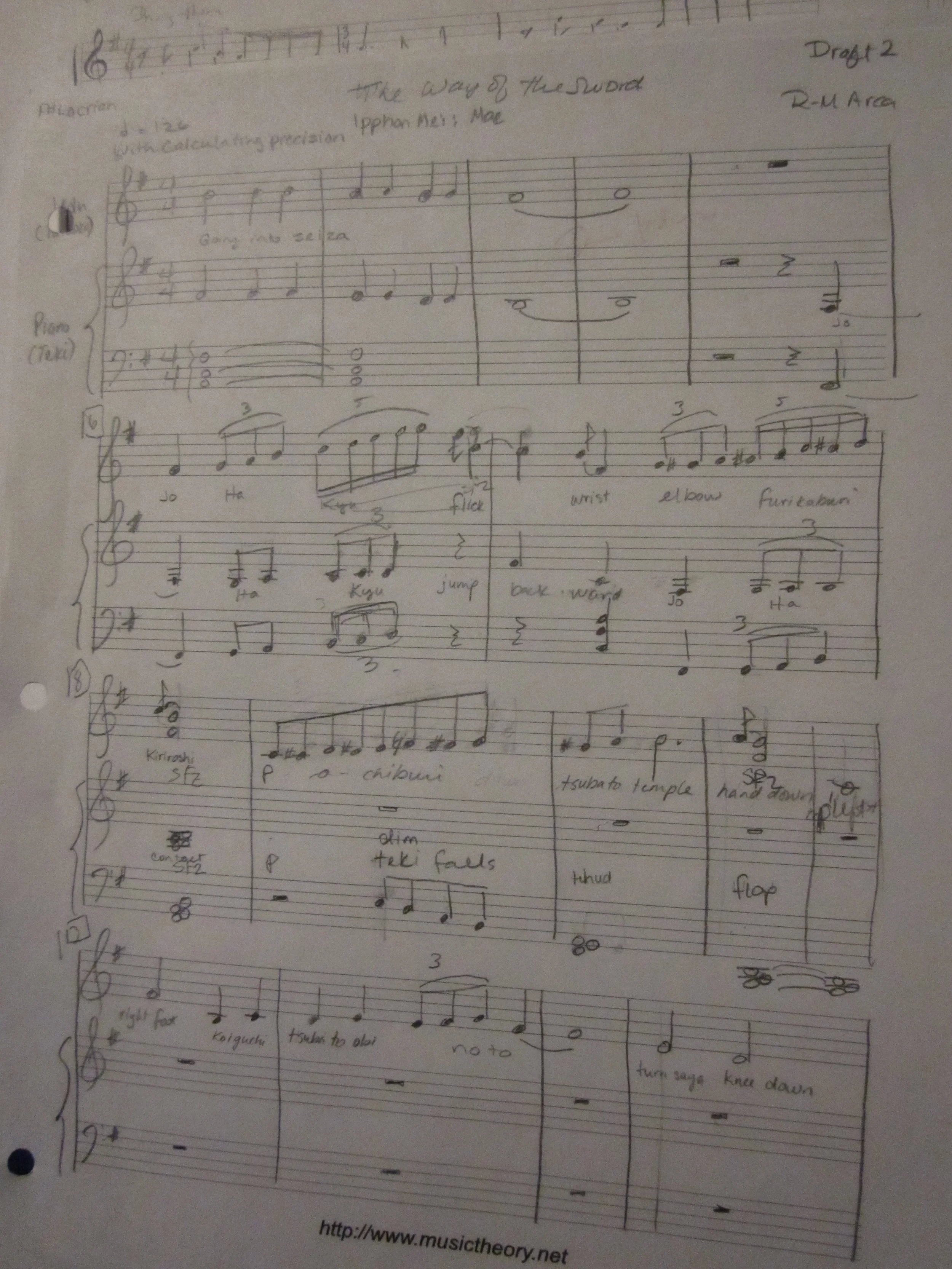
My early scribbles for setting Ippon Me Mae to music. The top staff is the iaidoka, while the bottom two represent teki. Credit: R-M Arca.
Add a training hiatus in the middle of my journey, age, increased knowledge and experience, and I have a slightly different perspective on my budo. These days, I’m really trying to refine my jo ha kyu timing. If I were to translate the kata now, I would take a different approach. Rhythm would play a much bigger role. It would most likely be non-metrical or polymeter. Plus, I’d use one of the Japanese scales I learned earlier this year.
Copying Another’s Performance to Achieve Mastery
In his post, Taylor sensei said that “A perfect copy of James Ehnes is going to be an actor playing the part.” Agreed. Does parroting a famous artist show that you truly understand what’s going on? No. Does it show that you understand the instrument? Nope. Does it show who you are? Not at all.
On a related note: Can a robot perform a piece better than a person? Can a machine completely capture the essence of a person’s performance? Technology can now recreate the performances of famous pianists. Check out the Steinway Spirio:
When I saw the Spirio in action at Steinway Pianos for the first time, my initial reaction was, “Creepy.” Sure, it was cool to see that we can do this, but it just felt like it was a shadow of Gershwin’s actual performance. I was drawn more to Gershwin’s recorded performance on the TV screen versus the piano’s recreation of it. It had more soul to me.
I could see George’s expression, the speed of his attack, his arm gestures, and his breathing. Those little things told me much more about the story and his playing than watching keys being pressed by mechanical means.
Music students who work through either the Royal Conservatory of Music or Conservatory Canada have a set list of repertoire to choose from. Some pieces are more popular than others, so sometimes, teachers, adjudicators, and examiners hear the same pieces countless times from multiple students. The notes are the same, but each student’s interpretation is unique. Not only that, each time they work with their own teacher or obtain feedback from an adjudicator or coach, it undergoes another metamorphosis.
One student make take a piece at the low end of the recommended tempo range, whereas the next may perform it at the opposite end. One may use a heavier touch. Another may use dramatic dynamic contrasts. One may choose to take extra time in Bar 8, while another may push the tempo in that same spot.
It doesn’t necessarily mean that one student has achieved a higher level of mastery than another. For that, one must ask if technical fluency was in evidence and whether the performer convincingly told us the story in a way that is in style with the form and the idiom.
To a practiced listener, it is possible to recognize a musician by their sound, or to recognize a musician’s lineage by how they play. Budo has that too. Although we strive to get our timing in line with “dojo timing,” each of us has a slightly different internal timing. Whenever we run through our Seitei Iaido kata as a club, the group timing differs ever so slightly, depending upon who is leading, who is there, and how focussed everyone is. Regardless, it should still be relatively close to sensei’s timing.
That’s the beauty of it. We don’t want to be carbon copies of someone else. The subtle differences provide some variety to the same story - and that’s what keeps things interesting.
The Same Art but Different Eras or Regions
Perhaps one day, I’ll get around to completing my musical set of Iaido kata. Unfortunately, that day isn’t anytime soon. Real life commitments have a tendency to cut into composing time.
Since The Tiny Samurai posed her question, I have also pondered Iaido kata on a structural and stylistic level. The seitei set reminds me of a Baroque suite of dances. Each dance represents a different country, e.g. a sarabande is Spanish, whereas a minuet is French.
Baroque dances have a set structure, binary or rounded binary. They also have a set order of steps. Some have telltale rhythms. The time signature changes depending upon the dance, but the tonic key remains the same. Very little markings are given in terms of dynamics and expression, leaving room for various interpretations of the same story.
I see the koyru iaido sets as being akin to character or mood music from the Romantic era. These are generally composed in ternary form, although other structures, like through-composed, crop up from time to time. Like certain pieces, e.g. polonaise or lieder, each koryu can represent a different region.
My mind wanders to Modest Mussorgsky’s Pictures at an Exhibition. Each piece depicts a different painting that two characters are viewing and sometimes, debating over:
Another way to describe this musically is to have two pieces with the same title and same overall structure. However, each are completely different:
Leitmotif in Budo
Merriam-Webster Dictionary defines leitmotif as “an associated melodic phrase or figure that accompanies the reappearance of an idea, person, or situation especially in a Wagnerian music drama.” John Williams made good use of it in the Star Wars movies with “Luke’s Theme,” the “Imperial March,” and so on. Taylor sensei also mentioned it in his beats and budo post.
I could see one leitmotif for Muso Shinden Ryu noto and a different one for Muso Jikiden Eishin Ryu. O-chiburi could be notated a little differently from yoko chiburi. Musically, that would provide unity and consistency.
Beats and Budo - Reprise
Beats and budo - Miyamoto Musashi called this rhythm-timing in the Go rin no sho. Ever since reading that, I’ve been playing around with beats. I came up with timing for the opening etiquette, which I waxed poetic on in The Iaido Journal. Here’s the link to the article, entitled Rhythm and Flow.
I’ve been experimenting with the following rhythms for jo ha kyu:
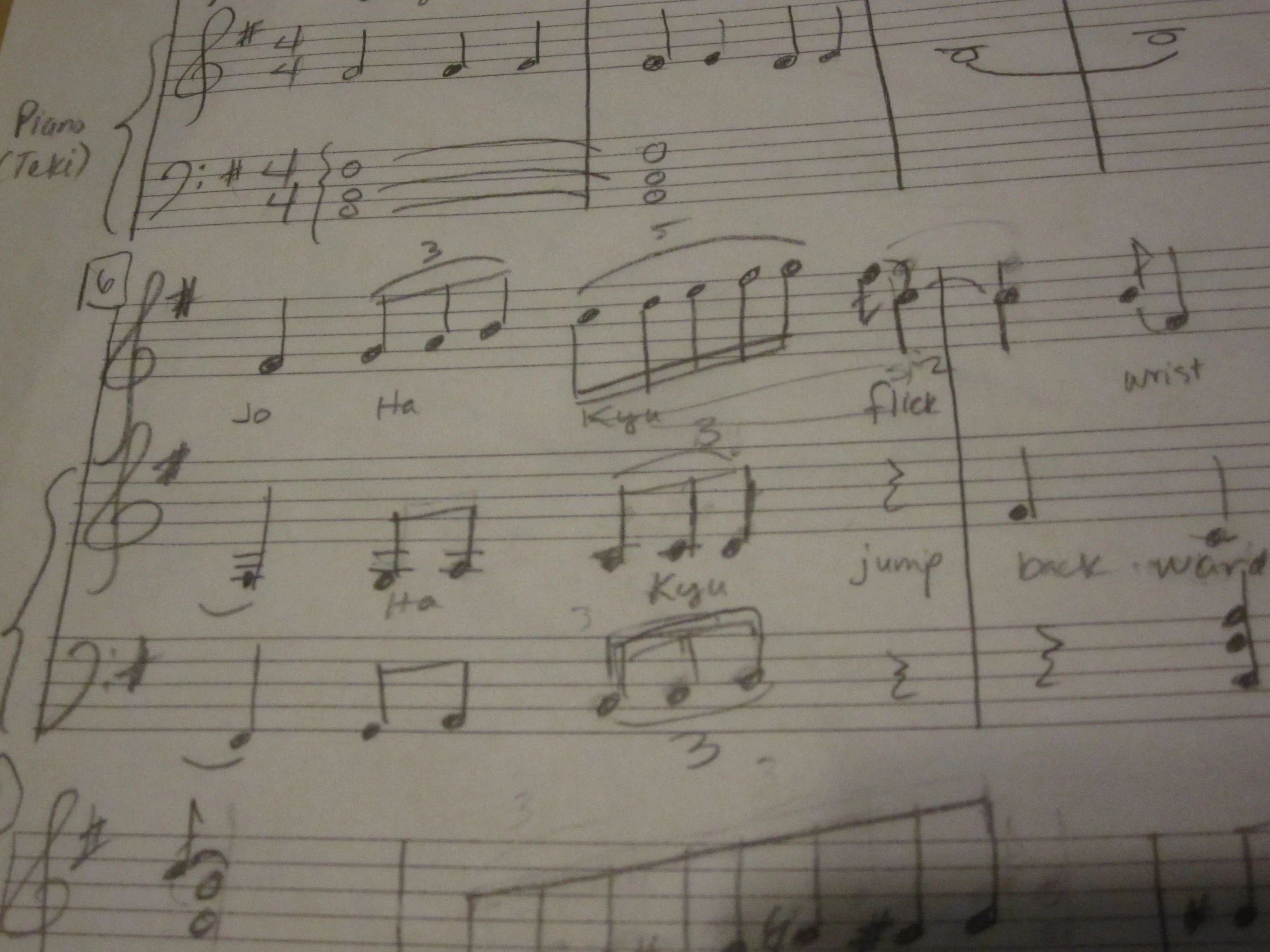
My rhythmic representation of jo ha kyu in 2007. Credit: R-M Arca.
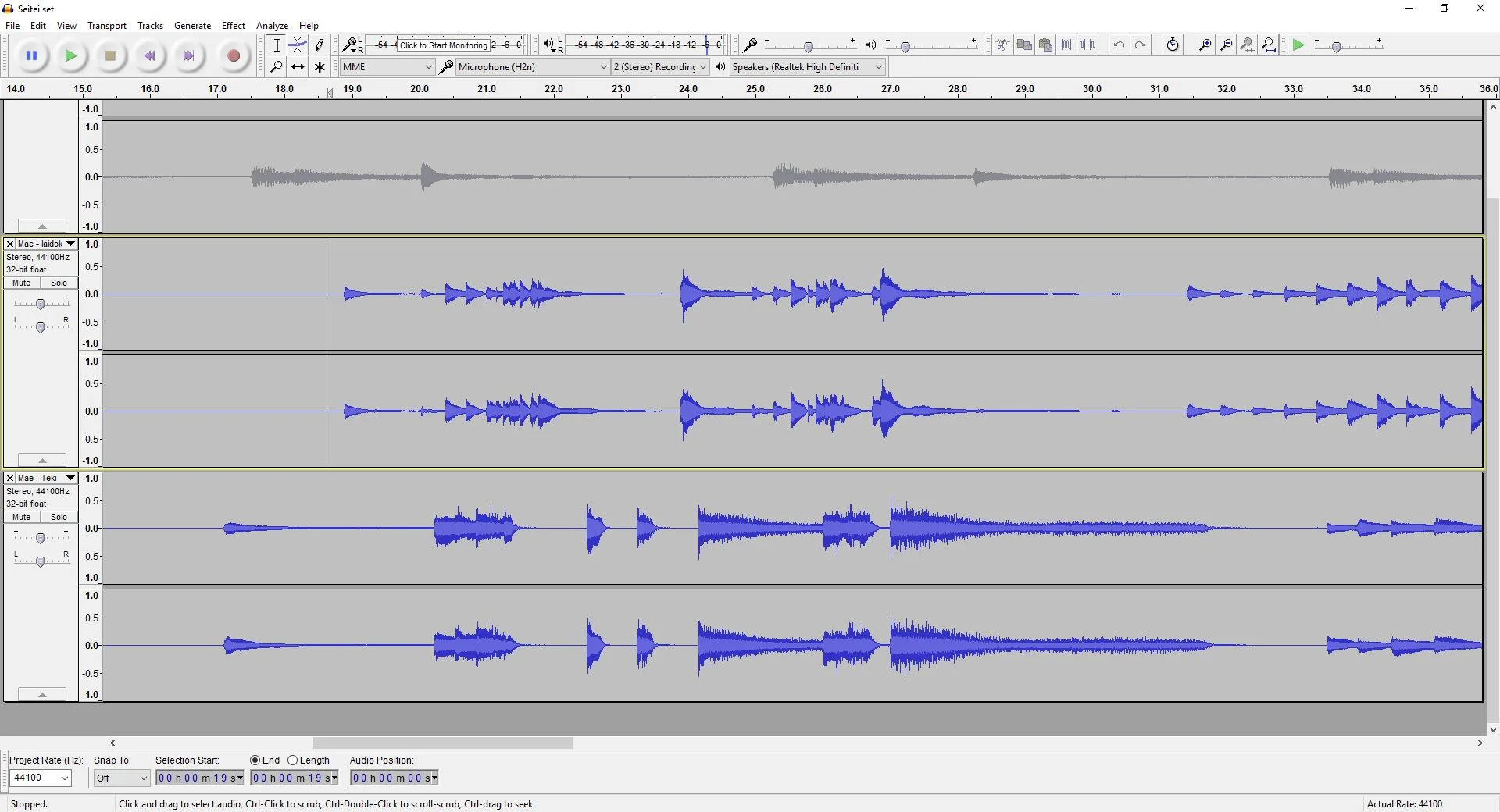
A screenshot revealing the waveforms for that same section of music. The iaidoka's jo starts just after the cursor. Credit: R-M Arca.
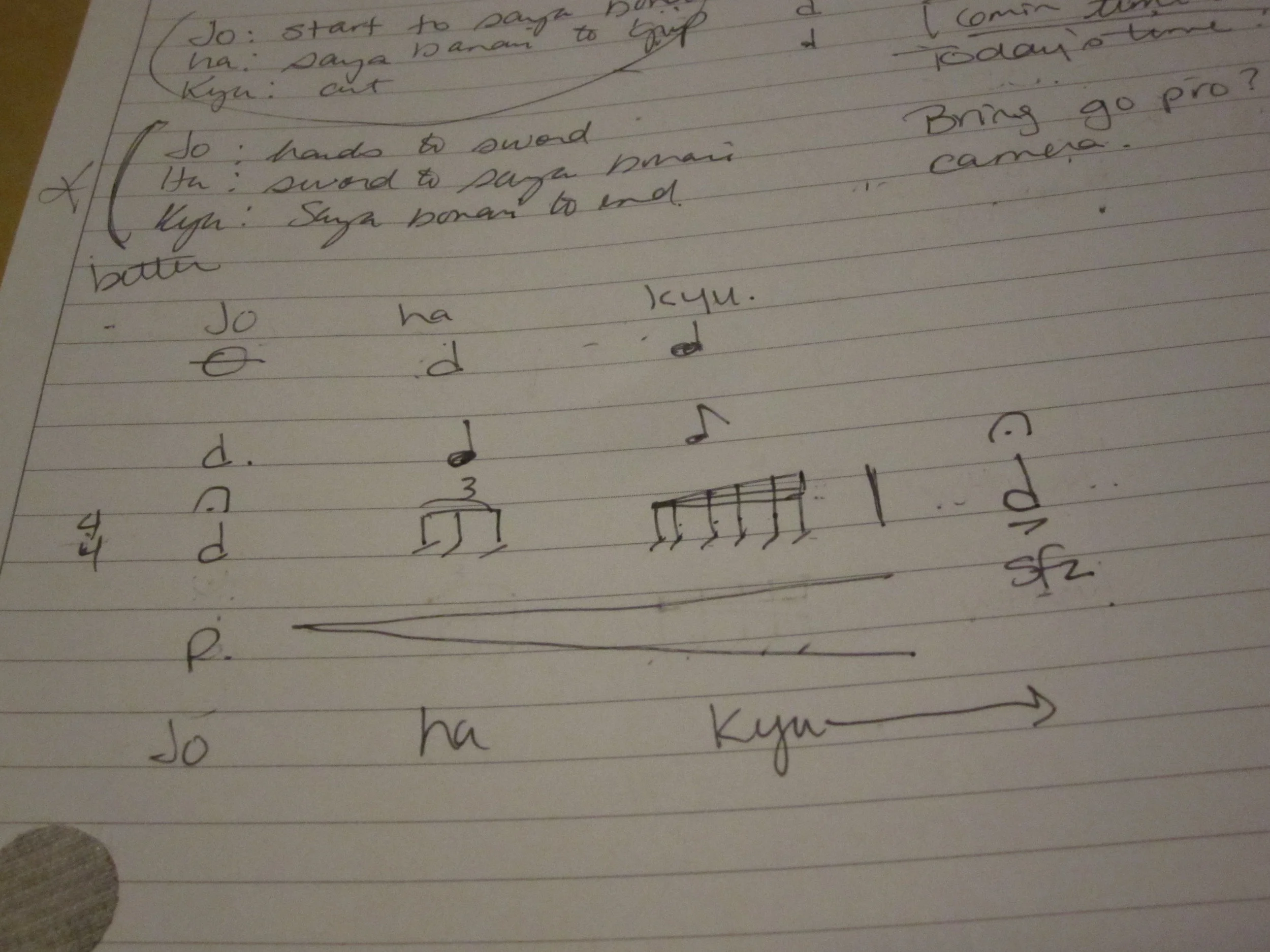
Jo Ha Kyu circa 2016. Credit: R-M Arca.
The last one is the one I’ve been playing around with. I don’t hear pitches. When I’m by myself, I’ll use a bit of singspiel, saying “Jo ha kyu”, in rhythm, from the moment my hands to go my tsuka to nukitsuke in Mae. I use dynamics for intensity.
Last night, I was studying a video of Alex Cook sensei practising Mae and improvising at the piano to it. I used the Hirajoshi scale and a lot of tone clusters. The result isn’t pretty sounding, but then, when you think about the riai for Mae, it’s not supposed to be:
Studying the waveforms made it easier to see how I need to have more ha not only in my iai but in my musical interpretation of the riai.
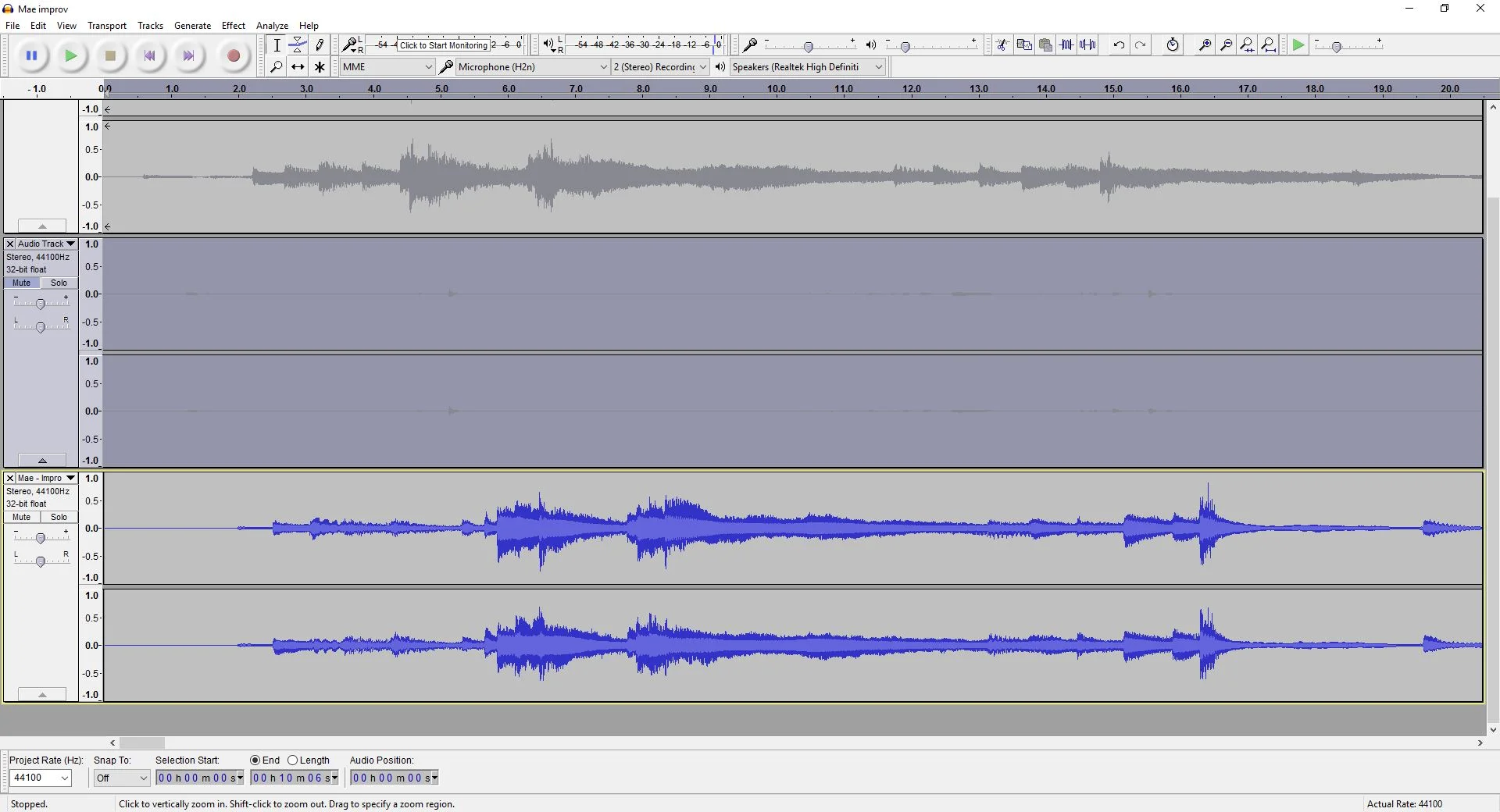
The waveforms reveal the quickening of sound during ha, yet still distinctly shows that there is a ha. This is what I must work on. Credit: R-M Arca.
I will do a bit of rhythmic dictation and attempt to notate sensei’s rhythm. I have a feeling that until I have the rhythm notated in a way that I can count the beats, I will be playing with jo ha kyu for a while longer yet.
Group Class Week Round 3 Reflections - 2013 edition
Reflecting upon what worked and what didn't work so well during this week's music group classes at Musespeak and To the Wind Studios.
Another Group Class Week has come and gone. I must say, I am quite grateful that I had to foresight to throw in group classes just before Spring and Easter Break. It's a great way to transition into the break.
The kids have been enjoying the group classes, for the most part. For us music teachers, we're just glad to be able to spend more time with our students on special areas of interest.
This week, some of my brother's and some of my students attended the following classes:
Creative Composition with Strings
Playing with Patterns - Introductory Improvisation
Music Appreciation 101: Music & Technology
Project – Studio
Introduction to Sound & Technology
Piano Combo Class
In my brother's Creative Composition class, the students wrote short compositions with limitations. Some of the limitations could be: write a short song in two minutes, write a jingle for a radio commercial or a video game loop or write a song for only certain instruments. I hear it went well.
In the introductory improvisation class, I gave the students the skeleton of five patterns to improvise on. In truth, I gave them certain modes to jam on. One student would take care of melody, the other played bass. I had to jump in on percussion to keep everyone in time. The group was pretty quiet, so I was unsure of whether they enjoyed it.
I ran the Music Appreciation: Music & Technology Class twice this week. Our students surprised me with what caught their interest. For instance, they perked up while watching a video where a technician started to pull apart a harpsichord. I had to stop the video several times to field questions. Ditto for the magnetic tape segment ("This recording was made with sticky tape and rust.").
The one area that they really surprised me with was copyright. They asked some really good questions. I think that I will have to write a group class plan for Creating and Copyright.
Project - Studio was lively. This is another class that ran twice this week. The students created a radio commercial, from concept to production in 90-minutes. Although Maestro didn't approve of the music selections or sound effects, I can safely say that the students left with smiles on their faces after completing their project.
Introduction to Sound & Technology has evolved since the first time it was offered in August. Last night, the students explored different types of sound recording technology before recording sound effects to go with a short video game clip. The students worked extremely well together and got a lot accomplished.
This was the first time that the Piano Combo Class ran this year. Three keyboards, three students. Each took a turn at working on melody, comping and playing bass. Depending upon their instrument choices, I had to jump in on melodica and try comping on the chords (emphasis on "try"). The kids worked on Ev'rybody Wants to Be A Cat, Tetris Theme A and Bad Romance. The hardest part for them was to approach their instrument from an ensemble perspective and not a one-person band. For instance, I had to remind them (and myself) to comp with rootless chords.
Now that Round 3 is over, we are getting a better picture of what works and what doesn't. For starters, any of the technology projects need more than one class to complete. They are just begging to be set up as a three or four-class course. The same could be said for the accompanying and conducting classes that ran earlier this school year.
Some projects are really hard to figure out running times for. It really depends upon how well the students work well together and how focused they are at completing their projects.
In some cases, two students are ideal in a class. Five is starting to feel like too much. Three or four is just right. That way, they all get a chance to work on the computer or on all the instruments.
Two more rounds to go. One in May and the final round in July. After which, we'll be able to assess which classes to expand on and which ones to cut completely.
Shining Stars
Week One of the music festivals is nearly over. It's been exhausting driving back and forth from North Calgary to High River to catch students. As soon as I walked into the house, it was back to a full afternoon/evening of teaching and practicing my own songs, soothing ansty parents, pushing stubborn students who are dragging their feet on the exam preparations (and assigning names of students to the influx of white hairs on my head) and collecting registrations for next year
Week One of the music festivals is nearly over. It's been exhausting driving back and forth from North Calgary to High River to catch students. As soon as I walked into the house, it was back to a full afternoon/evening of teaching and practicing my own songs, soothing ansty parents, pushing stubborn students who are dragging their feet on the exam preparations (and assigning names of students to the influx of white hairs on my head) and collecting registrations for next year. My students who have played so far played as well as expected. Some were still scrambling till the last minute to memorize their songs (which were supposed to be memorized two months ago). Not surprisingly, their performances were wobbly. Some succumbed to nerves, while others fell back to bad habits that I had been trying to break for months.
There were a few shining stars. There's my nine-year old student R who is steady as a rock. Steady progress and steady work habits. She got excellent comments at the festival and a mark just a couple of hairs off Honours with Distinction for her composition. Now, we just have to work at getting her rhythm in trouble spots steady as a rock.
Then there's my little showman S. This 11-year old consistently selects toe tapping songs that get the entire audience engaged in the performance. It also helps that he really gets into whatever song he's playing and flirts with the audience with his sparkling eyes and smile.
The next two are opposites: C is a 15-year old with a really good musical ear. She improvises for hours at home. After months of hounding her to write down her song, she finally did for the festival. She just missed Distinction by a couple of hairs also with her composition.
Finally, 12-year old D. She's been with me since the beginning of my teaching career. She's gone from a quiet and shy girl who only wants to play what's on the page, scared to make a mistake to a performer who impressed the adjudicator with her beautiful improvisations based on a catchy tune.
I just have a handful of students yet to perform. Then, my students and I will tear apart their songs a few more times to work on attaining a higher level of passion and technical precision for the next round of recitals and exams.
May 12, 2007 note: I need to add one more "shining star" to this list. Ten-year old R surprised his parents and myself earlier in the year when he expressed his desire to take his Gr. 5 piano exam in June. Since then, we've been working hard on his songs and technique. Fingering and rhythm have always been a challenge for him (or perhaps it's just the detail work). Prior to his performance last Saturday, I had him tap out his opening rhythm to Christopher Norton's Danger Danger. As I thought, the rhythm was a little off. I corrected the rhythm and had him practice it while I went to give two of my students who were also performing a pep talk.
When this guy is "on" he can draw the audience in. And that morning, R was "on". He nailed that rhythm and delivered the strongest performance in his class. (c) 2007 by Musespeak(tm), Calgary, AB, Canada. All rights reserved.
Social Media Links
archives
- #YYCArts 32
- #YYCEvents 39
- Collaborative Music 25
- Community 11
- Composing & Arranging 6
- Entertainment 139
- Entrepreneurship 53
- Freebies 3
- Gardening 1
- Geeking Out 65
- Health & Wellness 120
- Improvisation 25
- Interviews 28
- Learning Music 188
- Martial Arts 13
- Memorization 7
- Music 230
- Music Careers 9
- Music Education 196
- Music Examinations 7
- Music Exploration 55
- Music Gigs 14
- Music Lessons 6
- Music Performance 32
- Music Theory 13
- Musical Instruments 12
- Musician Health 19
- Pets 57
- Piano Technique 12
- Practicing Music 120
- Productivity 20
- Professional Development 11
- Recommendations & Reviews 93
- Recreation 71
- Social Media 6
- Spirituality 10
- Studio Management 33
- Studio Technology 50
- Teaching Music 146
FOLLOW THE STUDIO on Instagram

Affiliate Links
As a Sheetmusicplus and CD Japan affiliate, I earn from qualifying purchases. The earnings help fund the Studio’s blog and YouTube channels. Your support is greatly appreciated.


FOLLOW Budo no Tabi on Instagram