THE MUSICAL MUSE
Blog dedicated to music education, practice tips, health
&
wellness, and geeking out.

Preparing My Students for Christmas Parties
This year, I decided to bring back Group Class Week at my piano studio. My reasoning was three-fold: First, my students love getting together. Second, there are also concepts that are best taught in a group class setting. Finally, with juggling multiple jobs as well as my studio, I needed to build in some time to catch up on studio administration and planning. Running one group class per teaching night gave me that much needed time to work and/or rest.
The focus for this month's group class was Bulletproofing Your Christmas Music. We explored likely scenarios one could face at a Christmas party, social or community setting...
This year, I decided to bring back Group Class Week at my piano studio. My reasoning was three-fold: First, my students love getting together. Second, there are also concepts that are best taught in a group class setting. Finally, with juggling multiple jobs as well as my studio, I needed to build in some time to catch up on studio administration and planning. Replacing regular lessons with one group class per teaching night gave me that much needed time to work and/or rest.
The focus for this month's group class was Bulletproofing Your Christmas Music. We explored likely scenarios one could face at a Christmas party, social or community setting, such as:
You have been asked to perform and you need to play for a longer amount of time than you are prepared for.
You have been asked to play something that you don't know (well).
You have been roped into playing during a Christmas Carol sing-along and the singers ask for a different key.
You get tossed in with other musicians and are asked to play as a group.
You want to show off something really cool.
Making Your Music Longer
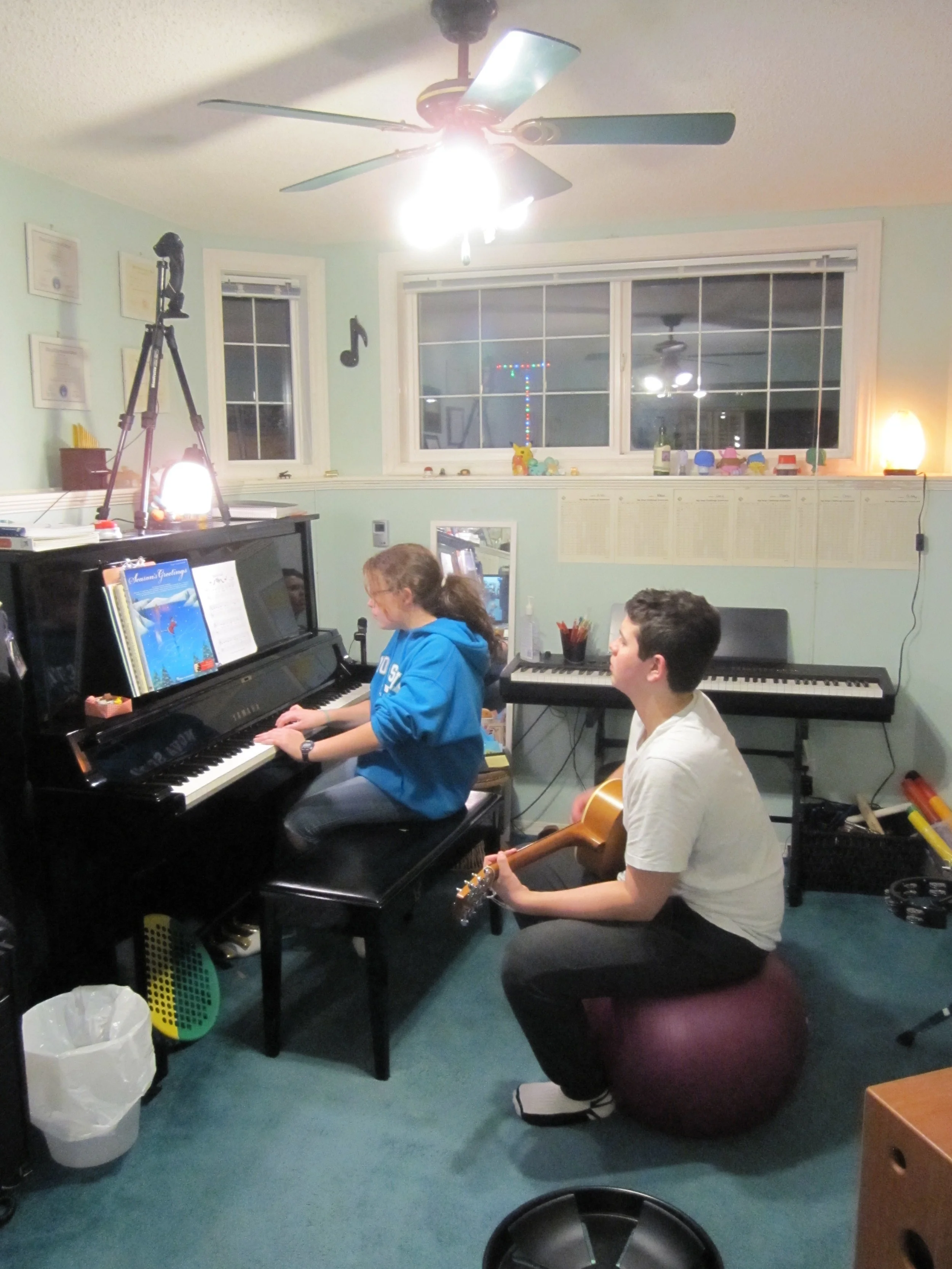
Haley and Grayson brainstorming on ways to vary their Christmas music. Photo credit: Rhona-Mae Arca.
Anyone who has performed at church or a gig knows that sometimes, you need to adjust your playing time on the fly. If the piece is too long, you find a logical place to cut it. But what if you only have a handful of pieces prepared and you are "asked" to play for twice as long as you have pieces?
My students did some brainstorming and experimenting. Everything came down to the same theme: repeat the song and vary it somehow. Here's what they came up with:
Move the piece up or down an octave when you repeat it.
Add embellishments (ornaments) to the melody.
Improvise for a verse and then play it "normally" once again.
Alter the rhythm, articulation, dynamics, or tempo.
Vary the accompaniment.
Playing a Song that You Don't Know (Well)
My students have heard the story of when I was visiting relatives in California. We visited one house with a grand piano. Sure enough, I was asked to play a few songs. I went through my playlist and improvised, but they still wanted me to play. Reluctantly, I opened up the piano bench and began to sight-read kundiman (classic Filipino love songs), while my aunts and uncles sang along. I say "reluctantly" because I disliked sight-reading at the time.
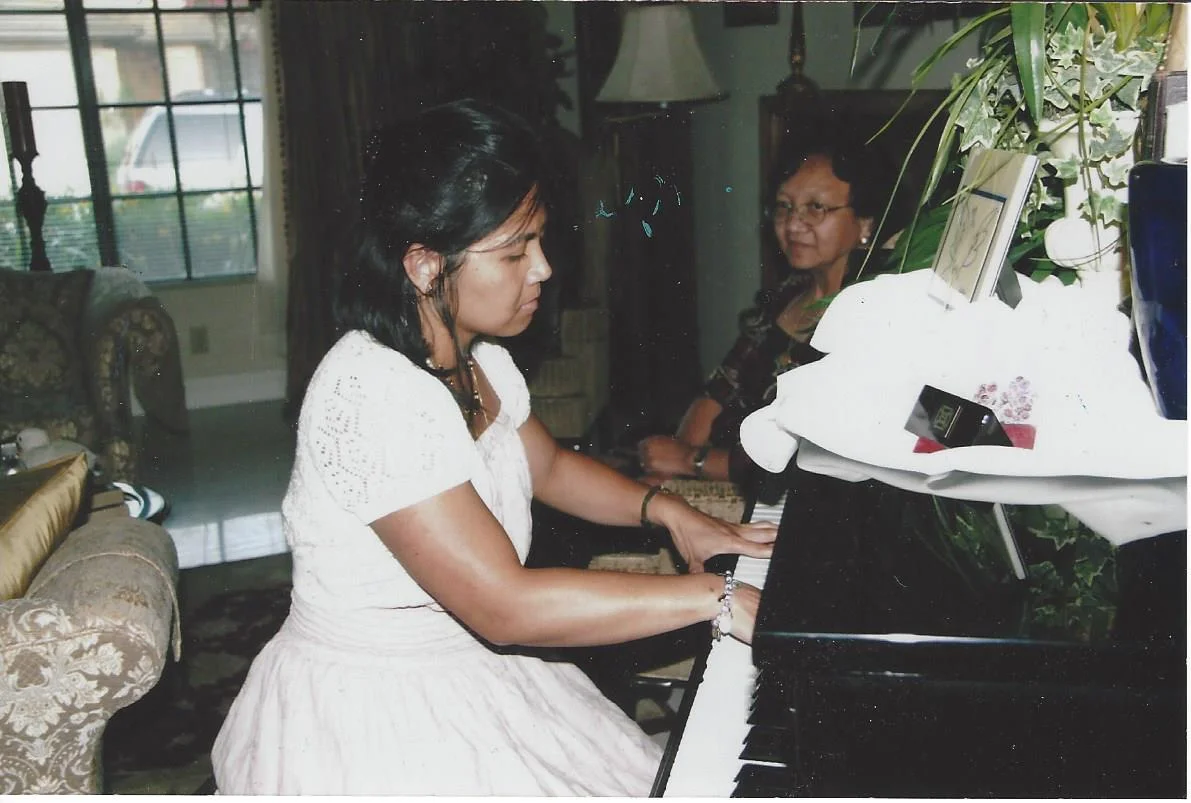
Dragged to the piano to play and not allowed off until the aunts and uncles are happy - if it can happen to me, it can happen to you! Photo: Jun Ancheta.
Then, I had my students work on a Christmas song they weren't familiar with and we discussed different ways to cheat and fake their way through such a performance, based upon their current playing level. These are some of the ideas they came up with:
Play block chords instead of the scored accompaniment.
Play the melody only (for beginners).
Recruit someone else to play through the bass clef notes while you play the treble clef part.
Only play an excerpt of the piece.
Transposing Music on the Fly
Most classically trained music students are taught transposing in music theory. However, they are usually taught how to write out a transposed melody. In the real world, we should be able to transpose on sight at our instrument. Sure, we may be lucky enough to play on a digital piano with a transpose function, but what if there's only an acoustic piano? What if you're playing along with someone whose music is not in concert pitch?
We just glossed through this area as this is best taught one-on-one. However, we did discuss intervallic reading and chording.
Jamming on Christmas Music with Family and Friends
This was perhaps the hardest challenge for most of my students, depending upon what they were playing. The kids on hand percussion and the cajón were fine once I showed them a few rhythms to try. But most had a challenge splitting the piano part up. If someone is playing the melody on flute and the chords on guitar, then as the pianist, you get to explore playing off the page - which is not the norm for today's classical musician.
My beginners were fine with just playing with one hand. Most of my intermediate and advanced students fought with themselves a bit. The desire to play what's on the page was strong. As for my Conservatory Canada Contemporary Idioms students? Generally, it was a piece of cake for them.
Showing off at the Piano
The first thing that comes to mind when I think about showing off at the piano is the Video Game Pianist, Martin Leung, AKA the Blindfolded Pianist:
Other ways of showing off that my students and I discussed included: playing with our hands crossed, playing upside down, and kicking each other off the piano - without missing a beat.
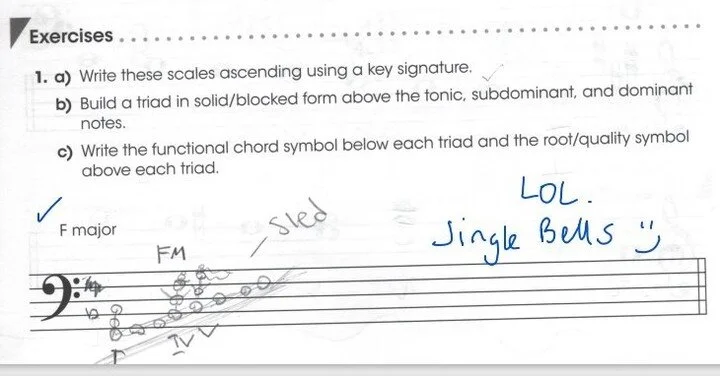
We explored what I called the Jingle Bells Relay. One person began to play this popular Christmas song. Then, one by one, another student would come up to the piano and cut in. The transition had to be sorted out and completed without missing a beat. The ones who successfully did this communicated clearly when and where they would be cutting in. They also kept things consistent by cutting in from one side the piano and exiting off the other.
Oh, there were some fumbles, but hey! They're all learning experiences.
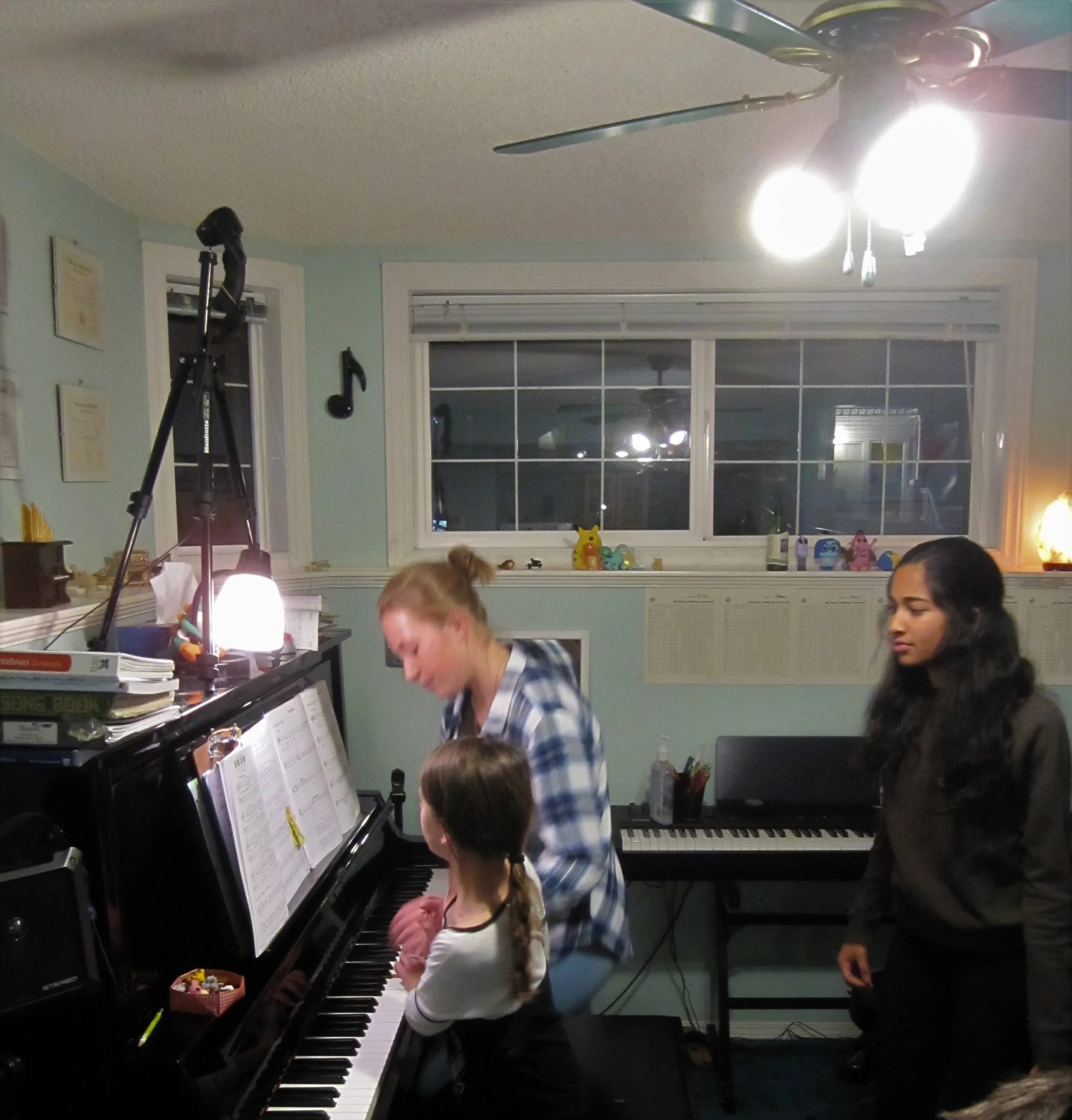
Carly, Claire, and Tanya show off the Jingle Bells Relay in action. Photo by Rhona-Mae Arca.
Over the next few lessons, I will reinforce the one or two group class activities that piqued their interest. I don't expect them to like everything they tried at last week's music group class. However, I do hope that the class opened their ears and minds up to new possibilities. And if they are dragged onto the piano this Christmas Break, at least they aren't going in blind. Forewarned is forearmed.
Who Levelled Up in My First Sight-reading Challenge?
Stage One of my studio's Sight-Reading Challenge is complete. How many advanced? How much chocolate did I buy?

October has come and gone and Stage One of my Sight-reading Challenge is behind us. It was an interesting experience for my students and I. Here are our Stage One Results:
72% did 4/4 weekly challenges
12% did extra songs
40% advanced one level
16% advanced two levels
8% advanced three levels
36 % stayed at the same same level
As for me, I didn't do nearly as well as I had hoped. It took me two weeks to clear my first challenge because of a nasty cold. In the end, I got through three pieces but not well enough to move my pin up a notch on the game board.
My adult students and Grade 12 students were in the same boat as me. There just wasn't enough time or energy to get through all of the challenges. I will have to plan how to make this work more effectively in Stage Two.
I was able to take advantage of the post-Halloween candy sales and give away some of my excess Halloween candy. Not only that, I did get regular and jumbo sized chocolate bars on sale too. It still wound up costing about $30, but I have lots of leftovers.
The funny part about this sight-reading experience is that my students have been asking why they didn't have a sight-reading challenge during Week 1 of our rest period. I suppose they got used to it.
The nice side benefit that I am seeing is that more of my students are taking the initiative to learn some songs on their own. Not just one song, but two or three. Others have taken to signing out some music books from my studio library and sight-reading music from cover to cover on their own.
Another student is using this time off to relearn all of her favourite songs from last year. She thought it was fun. I thought it was a fantastic way for her to relearn and reinforce information and techniques that she had forgotten about.
I have two weeks to prepare for the next sight-reading challenge for my students. It has been a great project for all of my students (and for me too!).
Now that I know how much time is involved with picking out pieces, I will get everything all selected in advance. Wish me luck.
Related Reading:
Efficient Sight Reading by Li-San
Improving Your Sight-reading by Melanie Spanswick
Why Sight-Reading is Important by Robert Estrin
Sight Reading Tips
While cleaning up some archived entries on my teaching blog, I found this one on sight reading tips, called (predictably) Sight Reading Tips. Here are some other articles and vblogs that I've come across that also address how to practice sight reading.
While cleaning up some archived entries on my teaching blog, I found this one on sight reading tips, called (predictably) Sight Reading Tips. Here are some other articles and vblogs that I've come across that also address how to practice sight reading.
This is a pretty good tutorial. I like the driving analogy.
Sight Reading Tips
Busy week - three posts from me. I've had to do some research for students so I have lots of information to share this week. A while back, one of my beginner students (and her dad) asked me why we had to work on sight reading (playing something you haven't seen before). The easy answer? It makes you a better musician.
Busy week - three posts from me. I've had to do some research for students so I have lots of information to share this week. A while back, one of my beginner students (and her dad) asked me why we had to work on sight reading (playing something you haven't seen before). The easy answer? It makes you a better musician.
There is a practical reason to why students are tested in this area.I told my student that there will be times that she's at a social function, ensemble rehearsal or school when someone will place unfamiliar music in front of her and say, "Play this."
I have a handful of students who need work in this area. We've been spending a lot of time lately going through a passage several times, with them focussing on one area (rhythm, touch, melody, dynamics, etc.) before trying to put all the elements together. Some of them look at me funny when I say, "For the first time through, don't bother getting any of the notes right." It helps though because it lifts the pressure off their shoulders to get it perfect.
Sight reading is also one of my weak spots. Since I've been teaching, I have been improving steadily. Some things I've learned along the way are:
Look for patterns, be they melodic, rhythmic or harmonic
Ditch "Every Good Boy Deserves Fudge" and all those other phrases to remember note names. Follow the note heads instead, reading intervallically, e.g., C then up a step, then down a skip, etc.
Getting the rhythm and keeping a steady beat is more important than getting every note right.
You have to practice sight reading - start easy and work your way up.
Learn to play by feel - without having to look at your hands.
Here are more useful tips in these articles:
Some Tips on Sight Reading More Tips on Sight Reading Sight Reading Studio 1.0 Software
(c) 2007 by Musespeak(tm), Calgary, AB, Canada. All rights reserved.
Social Media Links
archives
- #YYCArts 32
- #YYCEvents 39
- Collaborative Music 25
- Community 11
- Composing & Arranging 6
- Entertainment 139
- Entrepreneurship 53
- Freebies 3
- Gardening 1
- Geeking Out 65
- Health & Wellness 120
- Improvisation 25
- Interviews 28
- Learning Music 188
- Martial Arts 13
- Memorization 7
- Music 230
- Music Careers 9
- Music Education 196
- Music Examinations 7
- Music Exploration 55
- Music Gigs 14
- Music Lessons 6
- Music Performance 32
- Music Theory 13
- Musical Instruments 12
- Musician Health 19
- Pets 57
- Piano Technique 12
- Practicing Music 120
- Productivity 20
- Professional Development 11
- Recommendations & Reviews 93
- Recreation 71
- Social Media 6
- Spirituality 10
- Studio Management 33
- Studio Technology 50
- Teaching Music 146
FOLLOW THE STUDIO on Instagram


Affiliate Links
As a Sheetmusicplus and CD Japan affiliate, I earn from qualifying purchases. The earnings help fund the Studio’s blog and YouTube channels. Your support is greatly appreciated.


FOLLOW Budo no Tabi on Instagram