THE MUSICAL MUSE
Blog dedicated to music education, practice tips, health
&
wellness, and geeking out.
Repertoire Exploration Project: Conservatory Canada Pre-Grade 1 Repertoire
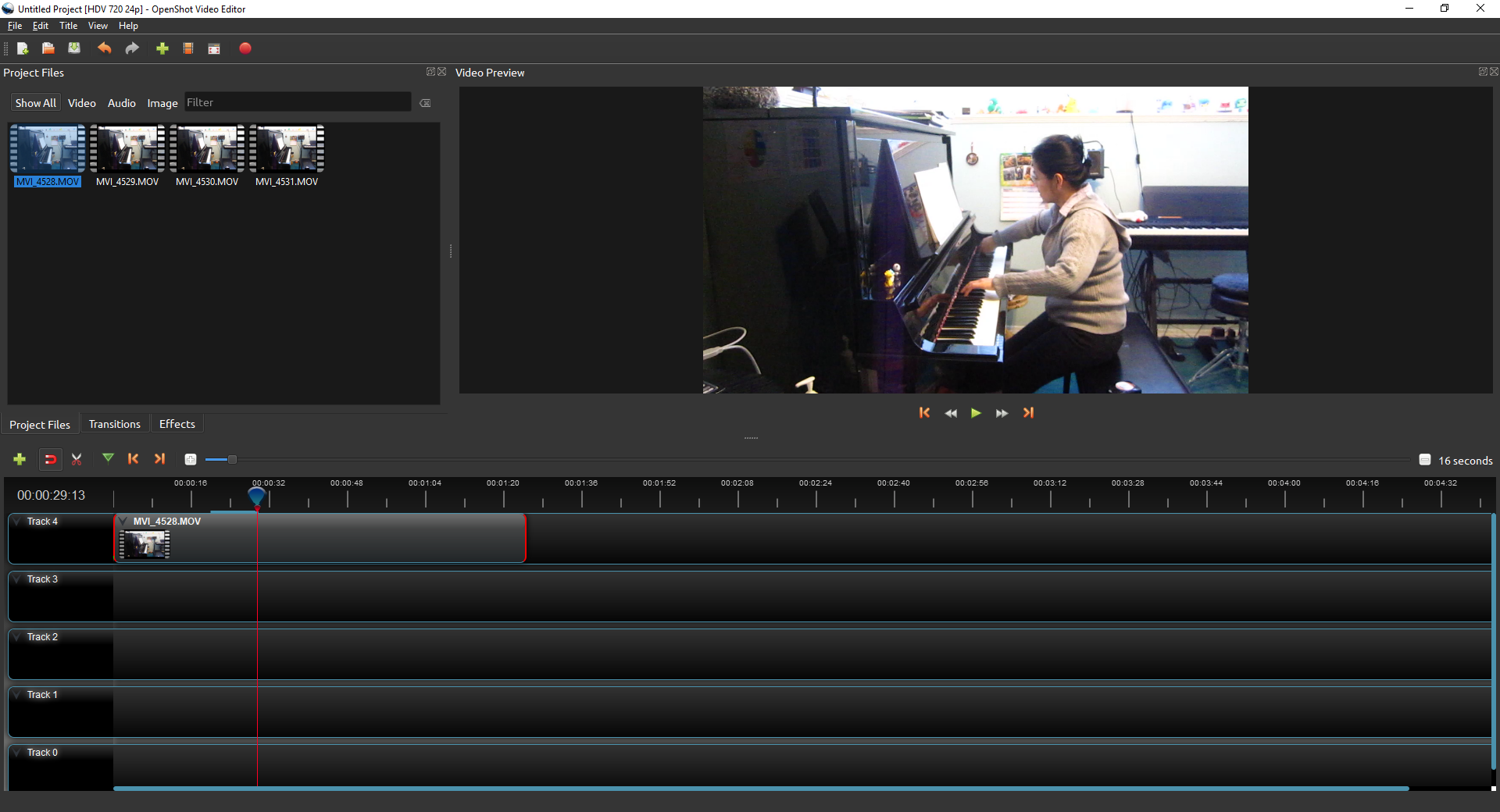
When I was growing up, we had to go to the library to hear various recordings of our pieces. With technology, it is much easier to access various performances of pieces - but only some pieces. I have decided to record my exploration through student repertoire that hasn't received as much screen time (or any at all)...First up: Conservatory Canada's Pre-Grade 1 repertoire.
When I was growing up, we had to go to the library to hear various recordings of our pieces. With technology, it is much easier to access various performances of pieces - but only some pieces. I have decided to record my exploration through student repertoire that hasn't received as much screen time (or any at all). It will take a while, but I hope to playing everything in the Royal Conservatory of Music and Conservatory Canada syllabi.
My students have generally been excited to hear that I'm taking their pieces to the next level by polishing them as well. One of my adult students was so happy to hear the news as it is somewhat disheartening to only see performances of half-pint prodigies playing your piece.
First up: Conservatory Canada's Pre-Grade 1 Repertoire. This was a lot of fun to do, mainly because I didn't have to think too hard about these pieces. I simply had to concentrate on enjoying the music.
There's nothing like playing pieces that show you just how far you've come in your musical journey. And if they help a few piano students and teachers along the way - great.
The playlist is still a work in progress. I've recruited several of my senior students to help me record the duets. I also need to record the songs that were added to the second edition of the Pre-Grade 1 book.
The Conservatory Canada Pre-Grade 1 Book is available at most local music stores. Alternatively, you may order it at Sheetmusicplus via my affiliate link below:
 look inside
|
New Millennium Pre Grade 1 Piano Conservatory Canada NOVUS VIA MUSIC GROUP. 32 pages. Published by Hal Leonard (HL.139032). |
I'll be hopping around in my repertoire review, prioritizing the pieces that my students are currently working on over the rest. Visit the studio's YouTube Channel for updates.

Preparing My Students for Christmas Parties
This year, I decided to bring back Group Class Week at my piano studio. My reasoning was three-fold: First, my students love getting together. Second, there are also concepts that are best taught in a group class setting. Finally, with juggling multiple jobs as well as my studio, I needed to build in some time to catch up on studio administration and planning. Running one group class per teaching night gave me that much needed time to work and/or rest.
The focus for this month's group class was Bulletproofing Your Christmas Music. We explored likely scenarios one could face at a Christmas party, social or community setting...
This year, I decided to bring back Group Class Week at my piano studio. My reasoning was three-fold: First, my students love getting together. Second, there are also concepts that are best taught in a group class setting. Finally, with juggling multiple jobs as well as my studio, I needed to build in some time to catch up on studio administration and planning. Replacing regular lessons with one group class per teaching night gave me that much needed time to work and/or rest.
The focus for this month's group class was Bulletproofing Your Christmas Music. We explored likely scenarios one could face at a Christmas party, social or community setting, such as:
You have been asked to perform and you need to play for a longer amount of time than you are prepared for.
You have been asked to play something that you don't know (well).
You have been roped into playing during a Christmas Carol sing-along and the singers ask for a different key.
You get tossed in with other musicians and are asked to play as a group.
You want to show off something really cool.
Making Your Music Longer
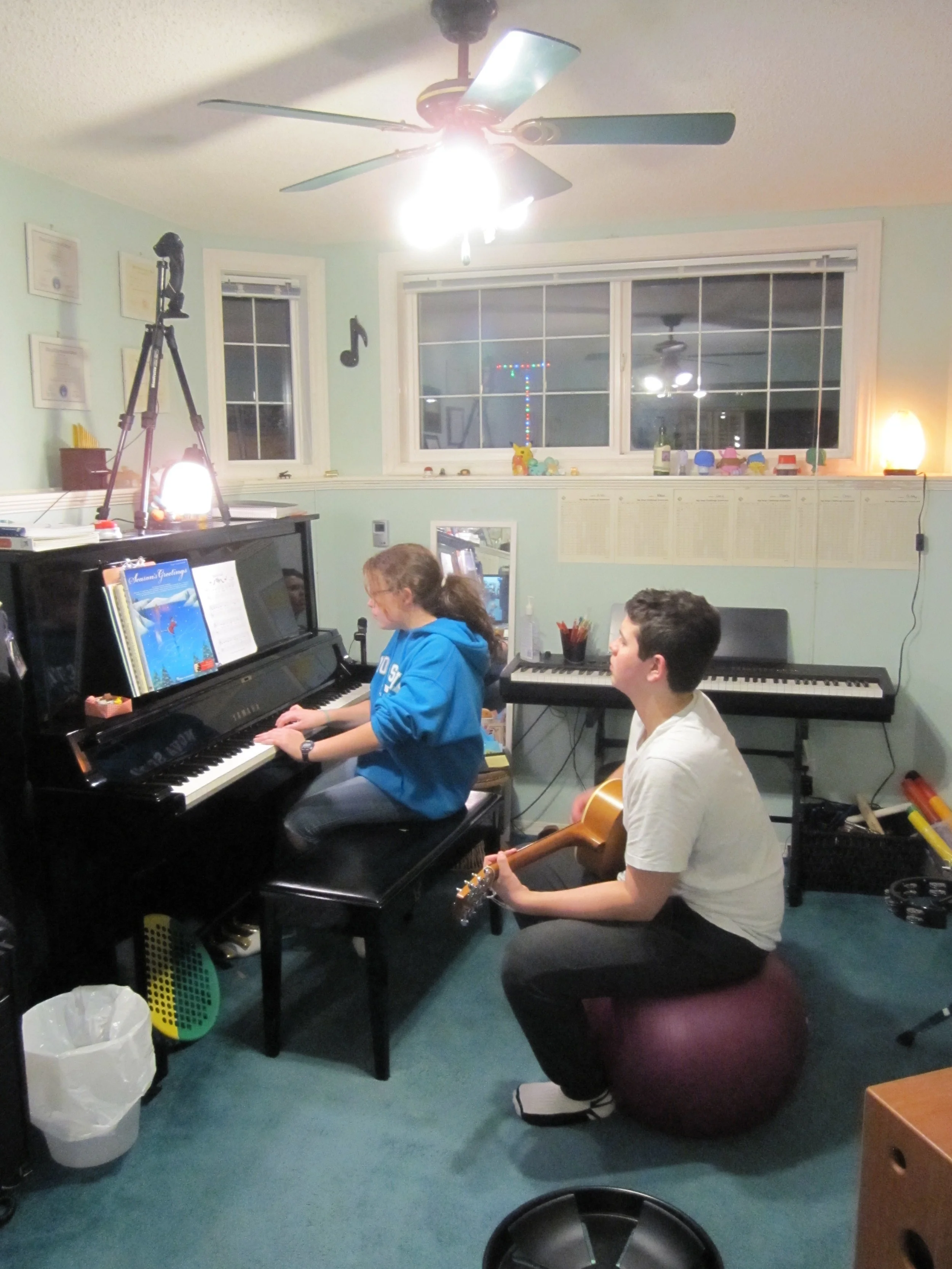
Haley and Grayson brainstorming on ways to vary their Christmas music. Photo credit: Rhona-Mae Arca.
Anyone who has performed at church or a gig knows that sometimes, you need to adjust your playing time on the fly. If the piece is too long, you find a logical place to cut it. But what if you only have a handful of pieces prepared and you are "asked" to play for twice as long as you have pieces?
My students did some brainstorming and experimenting. Everything came down to the same theme: repeat the song and vary it somehow. Here's what they came up with:
Move the piece up or down an octave when you repeat it.
Add embellishments (ornaments) to the melody.
Improvise for a verse and then play it "normally" once again.
Alter the rhythm, articulation, dynamics, or tempo.
Vary the accompaniment.
Playing a Song that You Don't Know (Well)
My students have heard the story of when I was visiting relatives in California. We visited one house with a grand piano. Sure enough, I was asked to play a few songs. I went through my playlist and improvised, but they still wanted me to play. Reluctantly, I opened up the piano bench and began to sight-read kundiman (classic Filipino love songs), while my aunts and uncles sang along. I say "reluctantly" because I disliked sight-reading at the time.
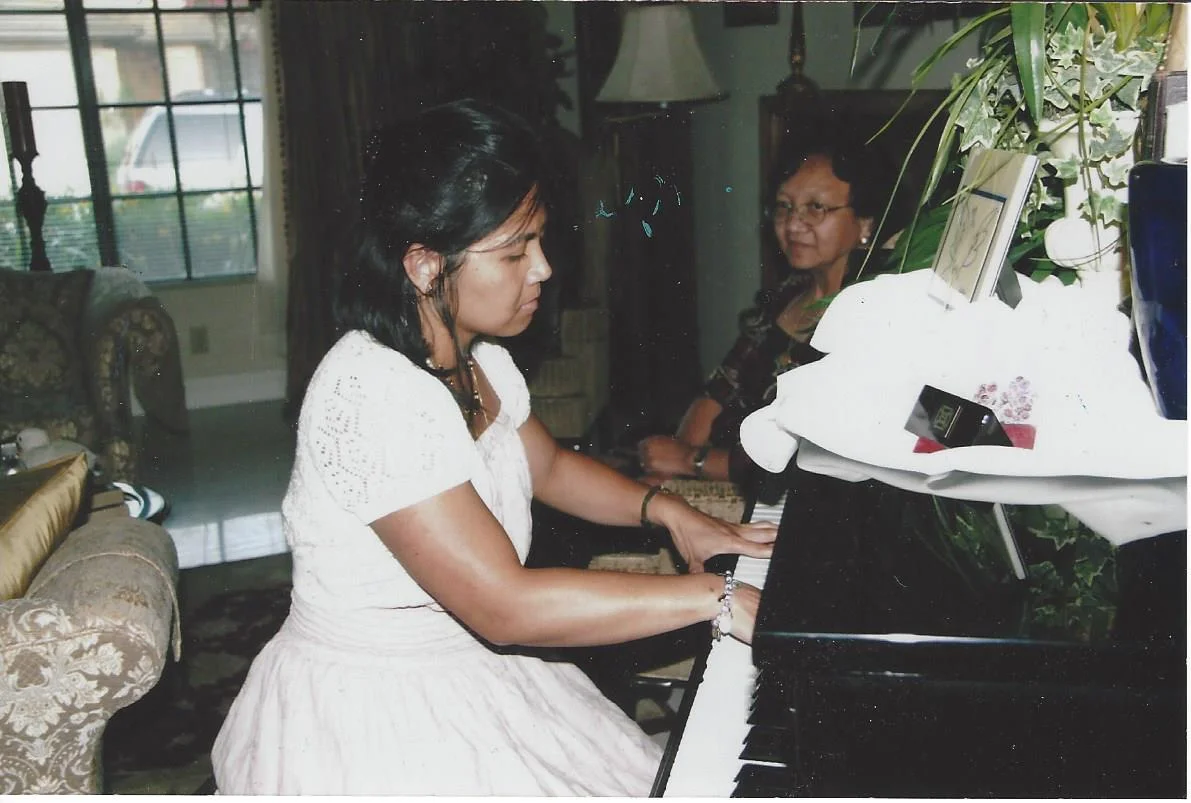
Dragged to the piano to play and not allowed off until the aunts and uncles are happy - if it can happen to me, it can happen to you! Photo: Jun Ancheta.
Then, I had my students work on a Christmas song they weren't familiar with and we discussed different ways to cheat and fake their way through such a performance, based upon their current playing level. These are some of the ideas they came up with:
Play block chords instead of the scored accompaniment.
Play the melody only (for beginners).
Recruit someone else to play through the bass clef notes while you play the treble clef part.
Only play an excerpt of the piece.
Transposing Music on the Fly
Most classically trained music students are taught transposing in music theory. However, they are usually taught how to write out a transposed melody. In the real world, we should be able to transpose on sight at our instrument. Sure, we may be lucky enough to play on a digital piano with a transpose function, but what if there's only an acoustic piano? What if you're playing along with someone whose music is not in concert pitch?
We just glossed through this area as this is best taught one-on-one. However, we did discuss intervallic reading and chording.
Jamming on Christmas Music with Family and Friends
This was perhaps the hardest challenge for most of my students, depending upon what they were playing. The kids on hand percussion and the cajón were fine once I showed them a few rhythms to try. But most had a challenge splitting the piano part up. If someone is playing the melody on flute and the chords on guitar, then as the pianist, you get to explore playing off the page - which is not the norm for today's classical musician.
My beginners were fine with just playing with one hand. Most of my intermediate and advanced students fought with themselves a bit. The desire to play what's on the page was strong. As for my Conservatory Canada Contemporary Idioms students? Generally, it was a piece of cake for them.
Showing off at the Piano
The first thing that comes to mind when I think about showing off at the piano is the Video Game Pianist, Martin Leung, AKA the Blindfolded Pianist:
Other ways of showing off that my students and I discussed included: playing with our hands crossed, playing upside down, and kicking each other off the piano - without missing a beat.
We explored what I called the Jingle Bells Relay. One person began to play this popular Christmas song. Then, one by one, another student would come up to the piano and cut in. The transition had to be sorted out and completed without missing a beat. The ones who successfully did this communicated clearly when and where they would be cutting in. They also kept things consistent by cutting in from one side the piano and exiting off the other.
Oh, there were some fumbles, but hey! They're all learning experiences.
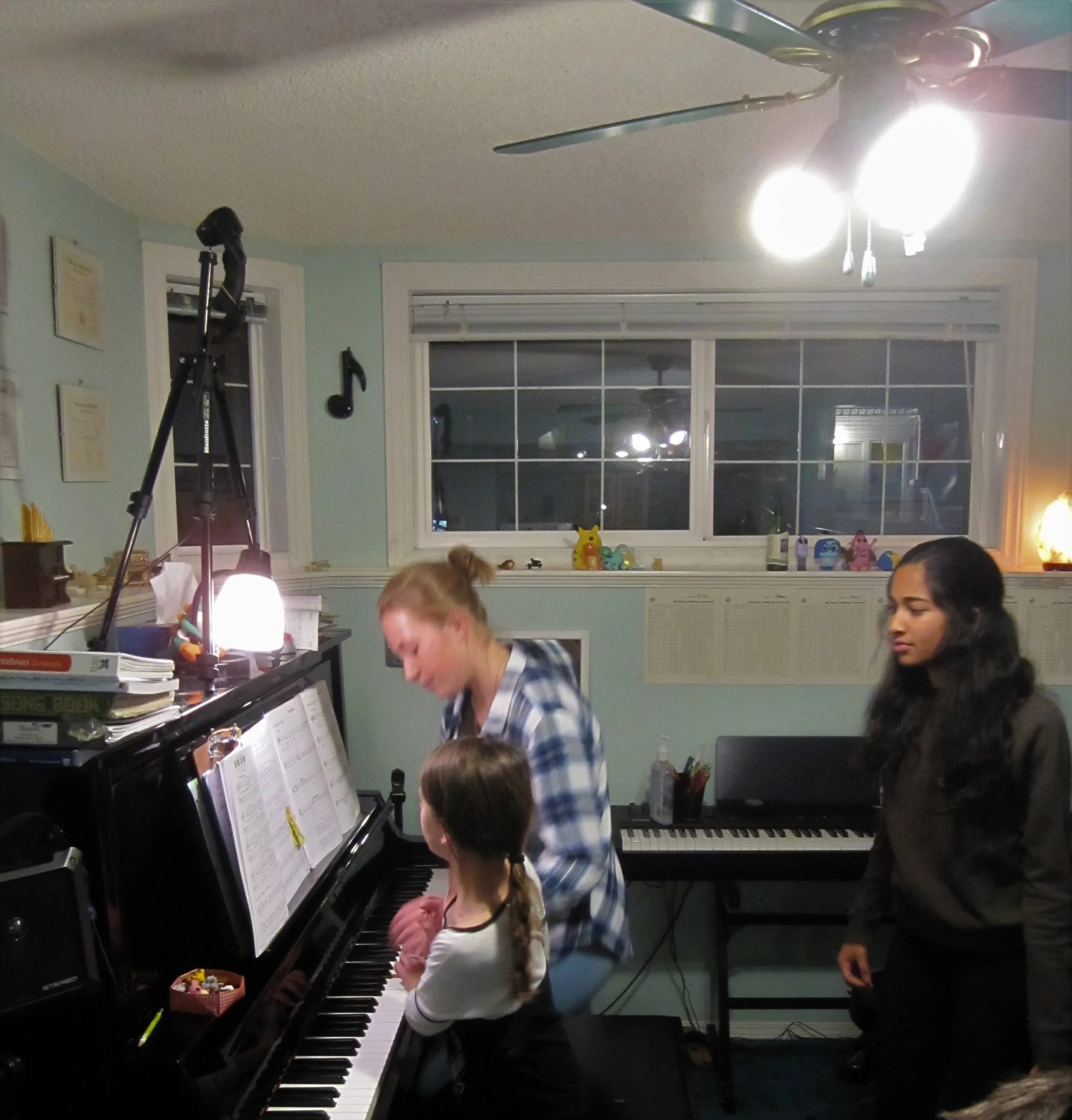
Carly, Claire, and Tanya show off the Jingle Bells Relay in action. Photo by Rhona-Mae Arca.
Over the next few lessons, I will reinforce the one or two group class activities that piqued their interest. I don't expect them to like everything they tried at last week's music group class. However, I do hope that the class opened their ears and minds up to new possibilities. And if they are dragged onto the piano this Christmas Break, at least they aren't going in blind. Forewarned is forearmed.
What does pizza have to do with studying music theory?
My students and I had our first music theory study and pizza party this weekend. It was an enjoyable experience for students and teacher alike.
"Pizza" probably isn't the first word that comes to mind when you think about studying music theory. Now, it's probably the first thing my students will think of whenever they study music theory. The idea of hosting a pizza music theory party came from my colleague, Dorcas Ng. Whenever she shared pictures from her music theory and harmony study sessions, it looked like the students were having a great time studying and eating pizza.
This is my first year teaching music theory as a group class. It didn't take long for me to realize that my Basic Rudiments / Theory 1 class would need coaching on certain areas, in addition to extra help on how to study music theory. It didn't take much convincing to tell them we should have a music theory study party with pizza.

Three out of four of my students in the class attended the music theory party this past Saturday. The party lasted for 2.5 hours. We got to a slow start because everyone slept in. Then, of course, the weather.
Each student bought study snacks to share. I purchased two 12-inch pizzas from Sobeys from the deli section.
The class was also part of an experiment. In October, the students drafted up rules of conduct for the studio. Each time a student exhibited good manners as per "the rules", I added a marble into the Good Manners Jar. If they filled it up to the line (which they did), then I would get them a special dessert for the music theory study party.
The first hour of the music theory study session was dedicated to review. I zoomed in on the typical troublespots: the Circle of Fifths, intervals, rhythm and chords.
My students came up with a unique mnemonic to remember the Circle of Fifths:

We then took a 10-minute break, which gave me enough time to prepare lunch. One student played a game, another jammed on a keyboard, while the third student sketched.
The next part to our "How to study music theory" session was dedicated to working through a practice test. It was open book and I allowed my students to ask each other questions. This way, they could start developing their self-study music theory strategies.
During lunch, we chatted about non-music topics, such as everyone's plans for the weekend. We also discussed history, travelling and inventions.
The final part of the music theory study session was dedicated to vocabulary. My students took turns being the Quiz Master. It was a delight to listen to them give each other hints:
Students A & B: FORTE! FORTE!
Student C: I can't think! You're both too loud.
***
Student A: Rall - en - ta - - - n - - - d - - - - o - - - - - -
Student B: To get slower?
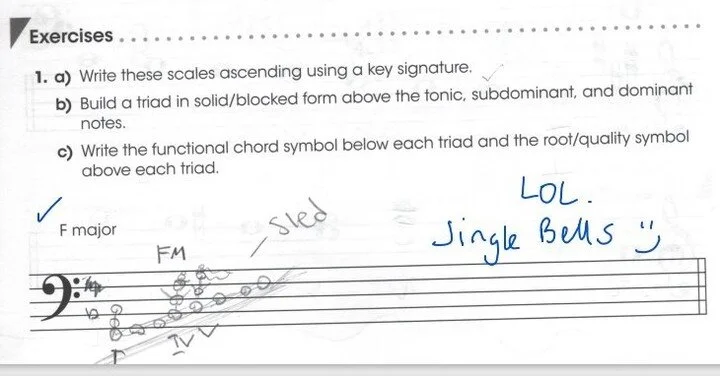
I took a snapshot of a couple of other cute definitions, mispronounciations and study helps that they came up with:

For homework, they are to complete the practice test. On Tuesday, they will write an in-class final examination.
Two of my students will write a music theory examination through either Royal Conservatory of Music or Conservatory Canada. The other two will continue to the next level before writing the official examination.
Afterwards, I asked each of my students if they gained a better understanding of music theory during the study session. The answer was a resounding "YES!" They also had a good deal of fun, whether it was when they were developing the Circle of Fifths mnemonic, drilling vocabulary or telling me, "Are you writing that down? You should post that on your Facebook."
Music theory has been one area that my students have called "boring". Teaching music theory in a class setting was my first step to changing things up. Hosting the music theory study / pizza party was another. It is my hope that the two changes make studying music theory a bit more interesting and enjoyable.
On Music and Technology, Teaching Awards and Future Collaborations
Musing about Virtual Choir and my swanky teaching award for Tech Teacher of the Year.
Last month, I was named the Tech Teacher of the Year. Last week, I got to pick up the hardware on the other side of the country:
The Tech Teacher of the Year Award is the brainchild of Roland Canada, Music for Young Children and Conservatory Canada. It is the first time that this award has been given out. The representatives involved decided to present the award at the Canadian Federation of Music Teachers' Associations (CFMTA) national convention in Halfiax, Nova Scotia, Canada.
The magnitude of the award didn't hit me until I stepped into the ballroom at the World Trade and Convention Centre. The mere thought of standing in front of music teachers from all over North America, many of whom have been teaching for far longer than I, was overwhelming. The realization that I had to come up with a decent acceptance speech was frightening.
Thanks to my previous "lives" - arts marketing and fund development, special events and communications - experience and Divine inspiration kicked in. Ergo, I am familiar with the "lead sheet" of an acceptance speech. All that was left was to decide upon a few salient points while my shaking hands tried to direct my meal into my mouth.
Now I can't remember everything I said. I do remember thanking the sponsors for coming up with the idea and for paying my transportation and accommodation to the convention. I vaguely remember mentioning how difficult it was to put the submission together (my first take was over 10 minutes long!). As well, I mentioned how my students are equally fascinated with old technology, tasking me with finding an old magnetic tape recorder.
My last point is one that I've made several times here: technology doesn't have to be scary. It took me years to get my studio to where it is today. Even then, it wasn't until my involvement with Eric Whitacre's Virtual Choir last year that I upped my game on the music and technology front.
Roland Canada hosted a dinner for the participants who were in attendance at the convention. It was inspirational to just meet and chat with this bright individuals and to express the desire to work together.
When I was able to tell the world that I had won the award, I shared my news on Eric Whitacre's Facebook Wall. I know I shouldn't be surprised that he replied. After all, Eric has nurtured a great relationship with his fans and members of Virtual Choir - to the point that he drops into the odd Virtual Choir Google Hangout and has dinner with 10 VC members who decide to go to Vancouver to catch him in concert:
However, knowing how busy he must be, it's still a bit shocking to get a reply from him.
What's next on the horizon? Who knows? I just know that now that I'm back from Halifax, I have to fight the urge to incorporate all the neat ideas I picked up - all at once.
Rhona-Mae Arca Named Tech Teacher of the Year
It's official - I've been named Tech Teacher of the Year by Roland Canada, Conservatory Canada and MYC. What a huge honour!
It's official, I've been named Tech Teacher of the Year by Roland Canada, Conservatory Canada and Music for Young Children. Click here for the official press release.
Applicants had to submit a three-minute clip describing how digital technology is used in their music studio, as well as how digital technology impacts their students as well as themselves. Here is my submission:
This announcement comes on the heels of my latest music and technology project. Last week, my students and I prepared, recorded and submitted videos for Eric Whitacre's Virtual Choir 4.0 - Bliss. A record number of over 8,200 videos from nearly 6,000 singers and 100 countries were submitted. Some of my students and I even helped out on tech support during the final days prior to the submission deadline.
Thank you so much to the sponsors: Roland Canada, Conservatory Canada and Music for Young Children for this opportunity. Hats off to my fellow teachers who also made a submission as they are also leaders in working technology into music education.
See you all in Halifax!
Social Media Links
archives
- #YYCArts 32
- #YYCEvents 39
- Collaborative Music 25
- Community 11
- Composing & Arranging 6
- Entertainment 139
- Entrepreneurship 53
- Freebies 3
- Gardening 1
- Geeking Out 65
- Health & Wellness 120
- Improvisation 25
- Interviews 28
- Learning Music 188
- Martial Arts 13
- Memorization 7
- Music 230
- Music Careers 9
- Music Education 196
- Music Examinations 7
- Music Exploration 55
- Music Gigs 14
- Music Lessons 6
- Music Performance 32
- Music Theory 13
- Musical Instruments 12
- Musician Health 19
- Pets 57
- Piano Technique 12
- Practicing Music 120
- Productivity 20
- Professional Development 11
- Recommendations & Reviews 93
- Recreation 71
- Social Media 6
- Spirituality 10
- Studio Management 33
- Studio Technology 50
- Teaching Music 146
FOLLOW THE STUDIO on Instagram

Affiliate Links
As a Sheetmusicplus and CD Japan affiliate, I earn from qualifying purchases. The earnings help fund the Studio’s blog and YouTube channels. Your support is greatly appreciated.


FOLLOW Budo no Tabi on Instagram