THE MUSICAL MUSE
Blog dedicated to music education, practice tips, health
&
wellness, and geeking out.
When a student leaves: making the most of the time you have left
One of my students terminated lessons before the end of the year. We ended our time together by recording a CD.
One of my students terminated lessons. Really, it came as no surprise that his parents were pulling him out. Music lessons are not for everyone. Private lessons aren't for everyone. His parents have enrolled him in other activities, that I feel are a better fit for him. For his final month of lessons, I gave him a set of Halloween songs to work on. They didn't really stick. That's when I thought of making a CD. I asked my student to choose his three favourite songs and relearn them. If they weren't good enough to record, then they wouldn't make the cut. "No one wants to own a CD that sounds bad, do they?" I asked him.
He nailed his three songs on the first take. That gave us enough time to add some special effects to each of his tracks and burn the CD.
That was probably his strongest performance of that old folk melody.
We didn't have time to design a CD jacket or create any CD art. I'm sure that if he wants to, he can handle that on his own.
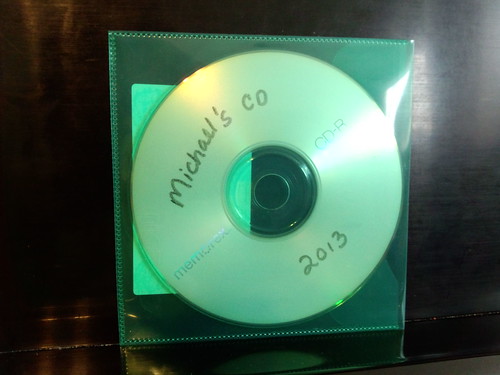
Our little CD project is a nice way to end lessons. It gives all of us a little souvenir of our time together. It was also a joy to hear my student rise to the challenge to get his pieces ready for recording.
On another note, this has inspired me to try this with a few other students. Perhaps with the challenge of a deadline, they too may rise to the challenge. If they wind up with something neat to present their parents for Christmas, Hanukkah or Kwanzaa, that would be a wonderful gift.
The Sight-Reading Challenge
Drawing inspiration from Alessandra DiCienzo from the Ontario Registered Music Teachers' Association, I have launched a sight-reading challenge in my music studio.

One of the presenters at the CFMTA "Music Inspires" Teachers' Convention, Alessandra DeCienzo, gave an inspiring presentation called, "Love at First Sight". She shared several ideas and activities that she has used in her studio to improve sight-reading.
One of the ideas was a year-round sight-reading challenge. Each week, students would have a sight-reading assignment. Exam students participated in a less strenuous variation of this, completing their sight-reading assignments at their leisure.
I decided to do a variation of her weekly challenge this year. Instead of running it year-round, I have set four stages, which take place in October, December, February and April. That gives all of us a one-month reprieve to explore other areas.
All of us (yes, me too!) have a pin on my game board:

How the Sight-Reading Challenge Works
We all are starting approximately four levels below our current playing level. It is my hope that my students will be able to comfortably sight-read music at their current playing level by April, or get to one level below it. In the process, I also hope that my slower readers will be able to "level up".
This month, I have been assigning spooky music for sight-reading. My students have the option to officially learn the music once they've "cleared" the sight-reading challenge for a piece. Like Alessandra DiCienzo's students, my students are to play the piece once per practice, without any pauses or corrections.
If they can do that at their next lesson, then they've cleared the challenge of the week and move onto the next one. Some of my students are still on the first challenge, while others are already working on a bonus challenge.
As for incentives, they are working for treats. If they clear only one assignment in the month, they get a small candy. If they complete their four and choose up to three extra songs to do for the bonus challenge, they will the equivalent of a giant chocolate bar.
Repertoire Selection for the Sight-Reading Challenge
Selecting the pieces for the sight-reading challenge has been an adventure and a chore. Thankfully, Alessandra shared some excellent links. Plus I have a growing list of online music teaching resources to draw from. Here are some of them: IMSLP Petrucci Music Library, Wikifonia, Susan Paradis Piano Teaching Resources, G Major Music Theory and Debbie Dee. I keep track of my selections on a spreadsheet saved on Google Drive, complete with the URL's.
In December, we will explore seasonal music: Christmas, Hanukkah and Kwanzaa. We'll either do romantic or wintry music in February and spring-themed music in April.
I have found that this is a great way to introduce students to different styles of music, cultures and different notation (i.e., standard versus a lead sheet or a sheet of chords). In this way, I hope that my students learn that sight-reading doesn't have to be a chore. It can be an exciting adventure.
On Note-Tab Reminders in Music Lessons
I almost walked right past these in the store. These Post-it Note Tabs are a neat way to put important lesson reminders where my music students will look at them!
I'm sure that I'm not the only music teacher out there to bemoan the fact that many of their students do not read their assignment books. Or, that they do but only just before their lesson. Post-it flags work as bookmarks for songs, but I've had limited success with regular post-it notes. Until now.
Last week, I found Post-it Note Tabs at Staples. I decided to try them with students who do not check their homework book (the ones who don't check off their goal list to show what they worked on).
When I showed them to my Monday and Tuesday students, they got a bit excited. "That's really neat!" one said. "Yeah, that should work," said another.
I've started writing short phrases to jog their memory. If the student writes quickly enough, I ask them to write the reminders. We post it on one of their pieces that they are sure to practice. The little tab sticking out says, "Reminders", so it's hard to miss.

Seeing as they don't read their assignment books often, I simply jot down the song or exercise titles. Fingers crossed that this works!
The Tickle Trunk of Textures
Inspired by Dr. Jennifer Snow, Frances Mae Balodis, Karen King and Mr. Dressup, I've put together a Tickle Trunk of Textures to teach touch. (A 6-word Alliteration Combo - AWESOME).
At the CFMTA Music Teachers' Convention, Dr. Jennifer Snow shared some fantastic teaching ideas. One of them was her fabric board of textures. Her students are "imagination gardeners". Frances Mae Balodis expanded upon this in her talk about imagination. It was one of those ideas that I filed away and didn't think of again until Karen King posted about the Imagination Gardener on her blog. Last week, I finally made it to the fabric store:
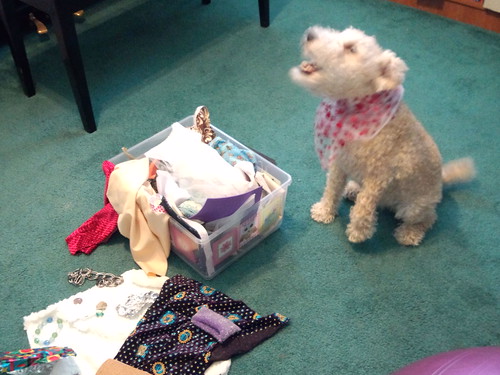
I just couldn't picture a board of fabric swatches in my studio. That's when Mr. Dressup popped into my head. Aha! A Tickle Trunk of Textures (yes, I like alliteration).
Now, I spent way too much on fabric (that .2m minimum and 1.0 m minimum for fabrics on sale). For approximately $50, I bought enough fabric and trinkets to make not one, not two, not three, but FOUR Tickle Trunks. Thankfully, my brother is also a music teacher, so we split the bill and each have a spare set of fabric.
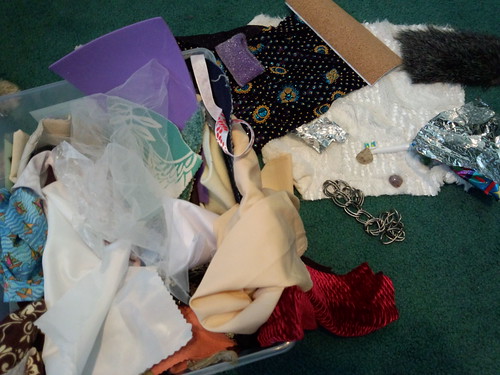
I am amazed at how well it works! Especially for the students who have trouble playing softly.
When I first show off the Tickle Trunk, I ask my students to pick something and we talk about what kind of song it could describe. That usually gets their imagination going.
Now if only I could get Maestro to let go of the fabric swatch with hearts on it.
Lesson Planning - A Work in Progress
Part of me is worried that I haven't buckled down to do some major planning for the upcoming teaching year, but as I declutter, I am making some progress in the planning department.

The big decluttering project continues. It's taken years to amass all this paper and stuff so I guess I shouldn't be surprised that it will take a while to clean up my mess. It seems though, that no sooner do I get my office tidied up that it becomes a bigger mess as soon as I tackle a new section in my office. Case in point:
Amidst the chaos however, plans are beginning to emerge. As I file handouts and documents from the previous teaching year, ideas for new handouts and teaching strategies are percolating in my mind.
However, I don't want to break the flow of my clean up (I refuse to start another teaching year with a messy office); so, I have three medium-sized coloured sheets, labelled: "Lesson Strategies/Planning", "Handouts to Make" and "To Do" on top of one of the binders in the lower LH corner.My tin of Crayola® markers are also close by.
So far, I've jotted down things like, "How to make technique more fun," "Strategies for helping the Keyboard Geography/Hand-Eye Coordination Challenged Students" and a long list of optional activities.
For the time being, I just grab the appropriate sheet and jot down a phrase. Once I get that tower beside my desk emptied out, then I can hunker down and transform the ideas into something tangible. I imagine that by the time I reach that point, I'll have more than three sheets of ideas. At least, it will be easier to focus as by then, I'll have a less cluttered workspace.
Social Media Links
archives
- #YYCArts 32
- #YYCEvents 39
- Collaborative Music 25
- Community 11
- Composing & Arranging 6
- Entertainment 139
- Entrepreneurship 53
- Freebies 3
- Gardening 1
- Geeking Out 65
- Health & Wellness 120
- Improvisation 25
- Interviews 28
- Learning Music 188
- Martial Arts 13
- Memorization 7
- Music 230
- Music Careers 9
- Music Education 196
- Music Examinations 7
- Music Exploration 55
- Music Gigs 14
- Music Lessons 6
- Music Performance 32
- Music Theory 13
- Musical Instruments 12
- Musician Health 19
- Pets 57
- Piano Technique 12
- Practicing Music 120
- Productivity 20
- Professional Development 11
- Recommendations & Reviews 93
- Recreation 71
- Social Media 6
- Spirituality 10
- Studio Management 33
- Studio Technology 50
- Teaching Music 146
FOLLOW THE STUDIO on Instagram

Affiliate Links
As a Sheetmusicplus and CD Japan affiliate, I earn from qualifying purchases. The earnings help fund the Studio’s blog and YouTube channels. Your support is greatly appreciated.


FOLLOW Budo no Tabi on Instagram