THE MUSICAL MUSE
Blog dedicated to music education, practice tips, health
&
wellness, and geeking out.

Let’s Play Practice Bingo!
Last month, I was mulling over different areas that I want to focus on in lessons for the remainder of the school year. I concluded: practice consistency, practice efficienty, technical skills, ear, rhythm and sight reading, and finally - theory and keyboard harmony. Find out how I’m challenging my students to tackle these aspects of music learning.
Last month, I was mulling over different areas that I want to focus on in lessons for the remainder of the school year. I concluded: practice consistency, practice efficiency, technical skills, ear, rhythm and sight reading, and finally - theory and keyboard harmony.
The thing is, how to make what students normally find “boring” fun? The answer, turn it into a game! Bingo, to be precise.

Febrary Challenge: Practice Bingo
Feburary’s praactice challenge focused on practice consistency. Some of the challenges were pretty easy (“Logged into My Music Staff student portal”), while others were harder (:"Practiced for 60 minutes without distractions””.
Homemade cake pops were on the line. They were a huge hit. So much so that they are now items in Maestro’s Market that students can “order”.

Flexing with Cake pops.
This month, they are working on practice efficiency. Some of the practice drills they are working through are part of Maestro’s Music Tricks, the game-ified practice aid I developed in conjunction with my students a few years ago.
Check out the Practice Bingo cards, along with Maestro’s Music Tricks in the Studio’s Ko-Fi Shop. Check the store at the beginning of each month from now till June for a new Practice Bingo card.

Maestro's 2018/19 Studio Challenges
During my brainstorming, the following themes came through: technique, ear/rhythm/sight-reading, and practice frequency. To be honest, those are the key themes every year, but these are areas I really want my students to shine in this year. So, I had to tweak the student challenges and incentives a bit.
Towards the end of summer, I thought about what improvements to make to Maestro’s Top Dogs, my student incentive program that still bears Maestro’s name. Students earn Maestro Bucks throughout the year, which they can spend on prizes at Maestro’s Market.
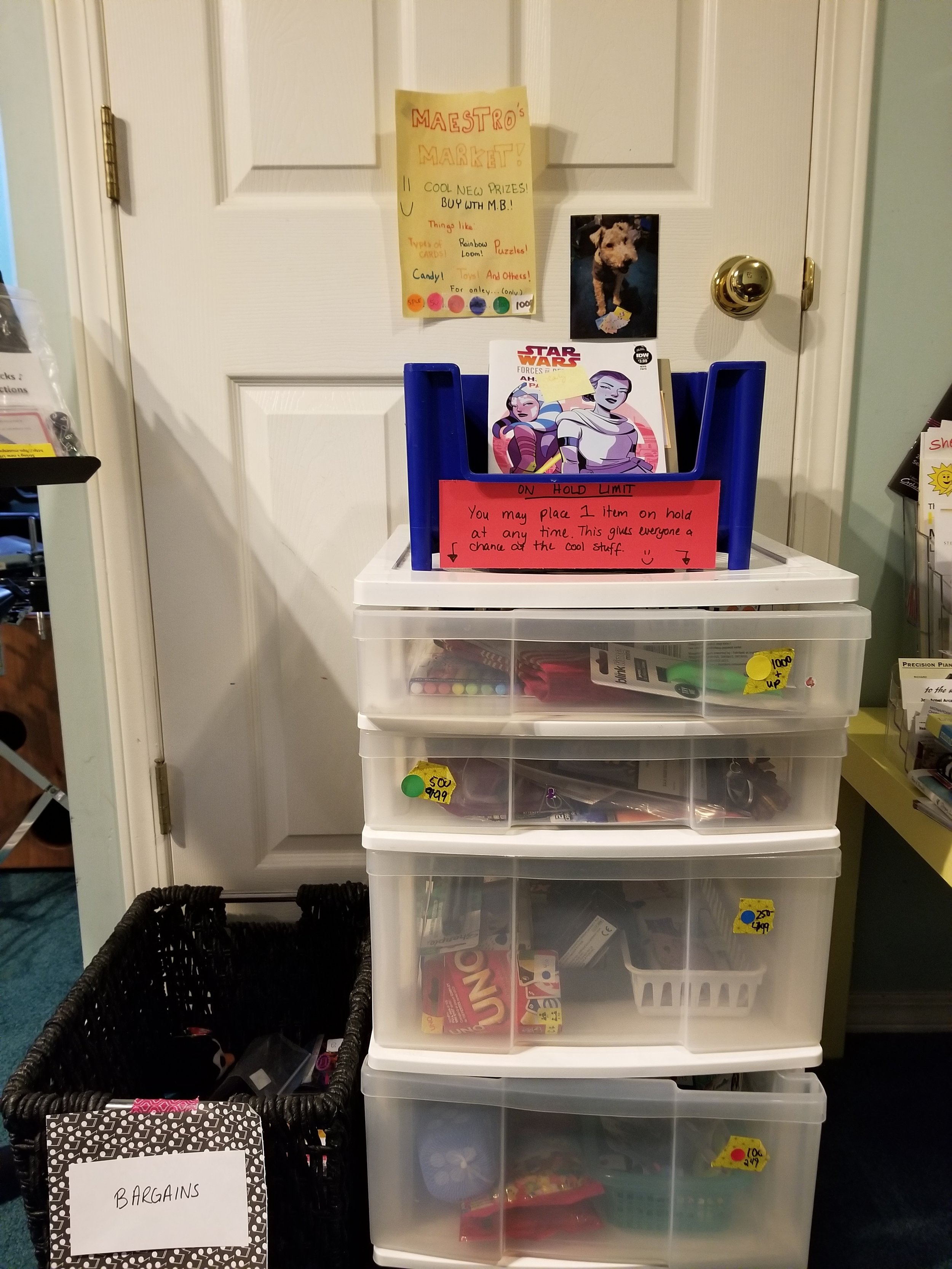
Maestro’s Market - full of fun prizes that range from $1 to $15. Credit: R-M Arca.
During my brainstorming, the following themes came through: technique, ear/rhythm/sight-reading, and practice frequency. To be honest, those are the key themes every year, but these are areas I really want my students to shine in this year. So, I had to tweak the student challenges and incentives a bit.
Maestro’s Technique Challenge
Those who knew Maestro knew that he was really picky about piano technique. If you had one too many stumbles in your scales, chords, or arpeggios, he stomped out of the studio, only to return when he heard something that pleased him. As you can see here, Maestro didn’t make an exception for me:
In my brainstorming bubbles, I jotted down, “Don’t send them home until their fingering doesn’t suck.” To accomplish this, we are going to focus on only one or two technical exercises in a lesson (more if this is a strong area for them). My students will have to clear “Play with correct notes and fingering,” challenge at the lesson. I have them work on different ways to play that exercise as they try to clear that first challenge, varying the articulation, tempo, touch, rhythm, and dynamics. My students may not be thrilled that we are going to spend more time on technique in the lesson, but at least they’ll have a better idea of how to practice it at home; and I can feel a bit more confident that even if they only get to it once or twice at home, fingering and/or notes should hold.
The other challenges are: play hands separately, play hands together, play at a steady tempo and play at the minimum required tempo for their playing level. Some students have cleared two or three challenges already for the exercise of the week. Others - it will take a few weeks at first. In the end, practising them at home should become easier since we’ve tackled the hardest part in the lesson.
Students will earn Maestro Bucks (MB) for each cleared exercise, for each key, commensurate with their playing level (Beginners - Grade 2: $5 MB/challenge, Grade 3 - 6: $10 MB/challenge, Grade 7+: $20/challenge).
Maestro’s Music Moxie Challenge
I don’t think I altered this from last year. Students will earn Maestro Bucks in the following ways:
Each time they add to their Bulletproof Musician Playlist, which is their go-to set list of mastered repertoire ($10 MB/beginner - Pre-Grade piece, $20 MB/Grade 1 - 5 piece, $40 MB/Grade 6 - 8 piece, $50 MB/advanced piece),
$20 MB per solo or collaborative piano performance
Each piece that is memorized (same breakdown as the Bulletproof Musician Playlist)
$25 MB for each concert/music review they submit,
$25 MB for each composition or arrangement they do.
Maestro’s Practice Challenge
I think this is going to be the hardest challenge for all of us, but not impossible.
Inspired by various colleagues who launched 100 Days of Practice Challenges in their studios, I decided to set up something similar. However, we’re going to work our way up to it, starting with a 30 Days of Practice Challenge and a 60 Days of Practice Challenge.
The basic premise of all these challenges is the same: you must commit to practising music every single day, except for when you’re too sick to get out of bed. Some teachers actually specify a recommended practice time. I’m not going to as for me, it’s the practice frequency that I want to see improvement on. Any artist, athlete, and budo practitioner will tell you that it’s the repetitions and practice frequency that results in consistency and steady progress.
I know just as well as the next person that it’s impossible to commit to practising the same amount of time, seven days a week. Some days are going to be short practices. Some will have to take place far away from the piano (e.g. travelling to Hawaii).
After my students’ eyes boggled at the idea, I told them that there’s actually a lot of wiggle room. If they don’t have a lot of time to practice, or are away from the piano, they can get their daily practice in by:
doing a bit of music theory
do a music puzzle
work on music games/apps like Note Rush, Music Note Flashcards, Simply Music, Perfect Ear, Noteworks, Flashnote Derby, Tenuto, etc.
listen to their pieces
scorestudy (look at the patterns, structure, markings, etc.)
clap out the rhythms to their songs
read about a composer
ask someone to quiz them on their music knowledge (key signatures, vocabulary, etc.)
If they miss a day, my students have to restart the count. As I said, if they’re too sick to get out of bed, then that doesn’t affect the count. Stay in bed and get well first.
My students will have to do a better job at tracking their practising this year. It’s no big deal for the ones who are good at keeping a practice log. I did wrack my brains to figure out something easy peasy for those who aren’t good at keeping a practice log. The Practice Buddy app was what I found.
Practice Buddy is a free app available for iOS and Android devices. Literally, the hardest part is deciding how to set up your practice cards. Then, the rest is like magic. Students have to click on a practice timer. But here’s the best part: students can record one minute of their practice session and it pops up on my phone to review it and provide feedback (and stickers). Check out my videos below on how to set up Practice Buddy:
I do have some students who asked for a paper Practice Diary. I did design one just in case.
With the practice timer, students will be forced to learn how to manage their time more effectively. You can have an extremely productive, mindful 10-minute practice, and a crappy 60-minute practice. It comes down to setting specific goals for your practice, and being mindful when you practice.
Also, I decided to join them on this challenge as well. Here’s hoping that I practice my second, third, and fourth instruments more regularly. When it comes to the 100 Day challenge, I think I’ll follow Hilary Hahn’s format on Instagram.
Check out what my colleagues have done with their 100 days of practice challenges:

Mid-Year Checkpoint on My Student Incentive Program
This year, I've made minor changes to Maestro's Top Dogs, my student incentive program. These changes have led to progress in two key areas: technique and performance. Here's a quick rundown on what I changed and how things are working out so far.
This year, I've made minor changes to Maestro's Top Dogs, my student incentive program. These changes have led to progress in two key areas: technique and performance. Here's a quick rundown on what I changed and how things are working out so far.
To bring new readers up to speed, the gist of my student incentive program is that students earn Maestro Bucks in various ways throughout the year. They get to spend their money at Maestro's Market. The Top Dogs in the four areas (Technique, Practice, Bulletproof Musician Playlist, and Music Moxie) will earn a special prize at the end of the year.

Practice hard, earn Maestro Bucks.
Maestro's Technique Challenge
Everyone who knew Maestro knew just how picky he was about technique. He was famous for stomping out of the studio if he deemed any scales, chords, and arpeggios sub-par (including mine).
The big change is that I adjusted the reward for each cleared technical exercise according to playing level: beginner to Pre-Grade students earn $10 Maestro Bucks (MB) per exercise, Grade 1 - 5 students earn $20 MB each, Grade 6 - 8 students earn $40 MB each, while Grade 9 and 10 students earn $50 MB each.
In the past, students earned the same amount of MB for an exercise, regardless of level. This resulted in the younger students learning all of their pentascales quickly, while the more advanced students took much longer. With this year's change, my students are progressing more steadily - on the whole.
Of course, there are some students who still balk at practising their scales, chords, and arpeggios. I struck a compromise with them. As this small group is not on the exam track, I have modified their technical exercises to focus on learning the I-V-vi-IV-I chord progression in each key. We "review" their scales and modes at their lessons. Believe it or not, they actually do practise the chord progression at home (probably because this is the progression used in nearly every pop song).
As for my exam track students, they have learned all their technical requirements much earlier compared to years past. This gives them plenty of time to secure tempo and memory. Since they already know their technical exercises for their level, their weekly incentives are tied to tempo and memory.

Maestro was extremely proud of his market. He'd be happy to know that it's still in operation in his name.
Maestro's Practice Challenge
In the past, I awarded $2 MB per completed goal. This year, I wanted to encourage practice frequency as well as give a bigger payoff for mastering a piece. As a result, students earn $5 MB for each day practiced (theory homework can also be logged).
Here's the practice sheet that we have been using this year. My students have been tweaking it throughout the year.
My students have a Bulletproof Musician Playlist, which contains songs they have mastered, plus songs that all musicians should know, like Happy Birthday and O Canada. As they master a song (as in, they can play it fluently versus perfectly), it gets added to their Playlist. This list becomes their go-to set list whenever someone puts them on the spot to play a song (thus, making them bulletproof).
For ease, the breakdown is identical to Maestro's Technical Challenge. This change has evened the playing field immensely. The beginner students wind up with longer Playlists than their seniors, but the advanced students will earn more each time they add to their list, because let's face it, their pieces are more difficult.
One interesting observation: my students are generally learning their repertoire at a faster rate than they did last year.
Maestro's Music Moxie Challenge
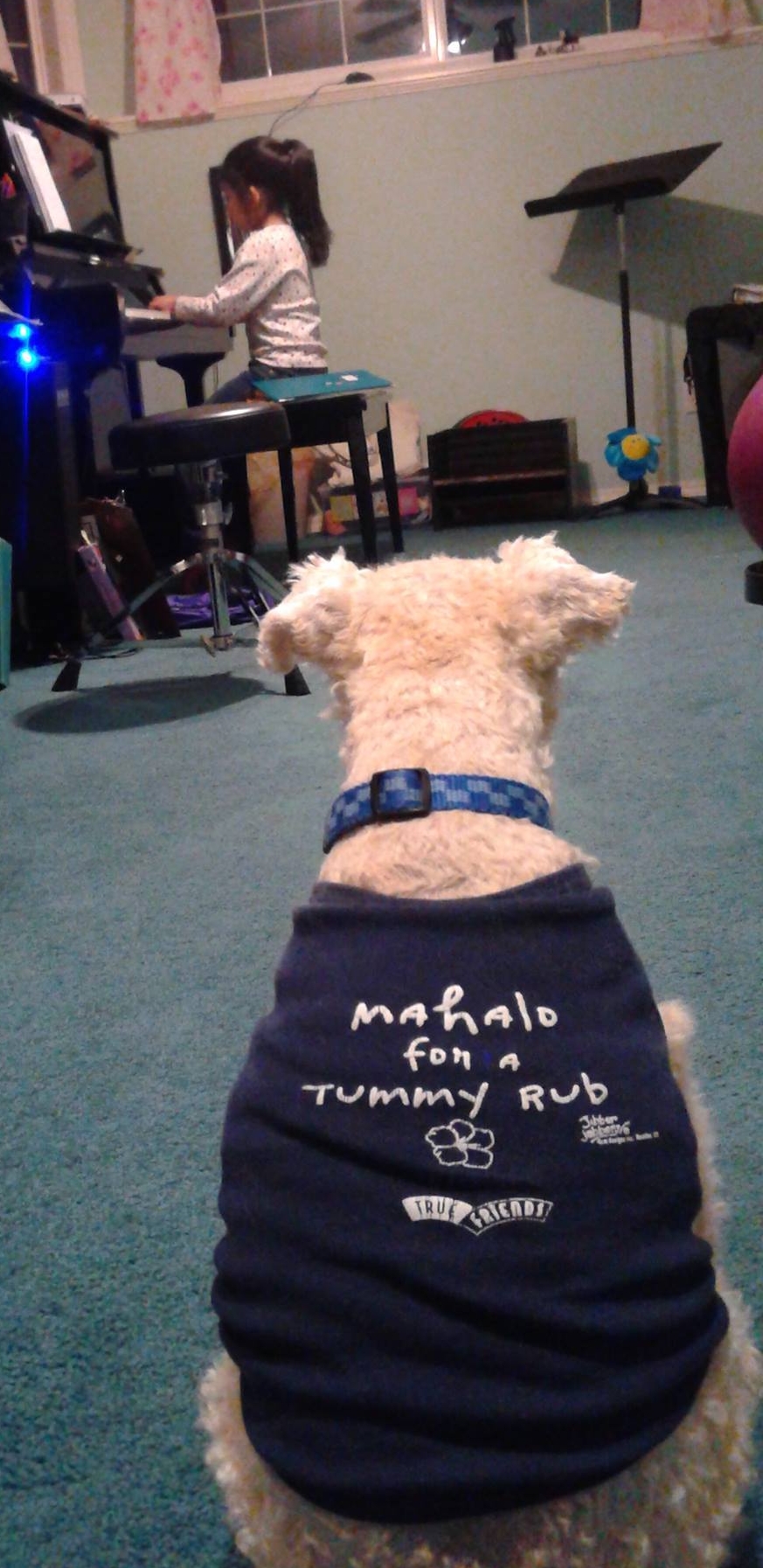
Maestro loved a good performance just as much as the next canine studio assistant.
This area underwent a few changes as well. The main change is that I wanted to better recognize the extra effort required to do something above and beyond their regular work:
$20 MB for each solo or collaborative piano performance
Memorization bonus ($10 MB/beginner piece, $20 MB/Grade 1 - 5 piece, $40 MB/Grade 6 - 8 piece, $50 MB/Grade 9+ piece)
$10+ MB each time you help out in the studio
$25+ MB per composition
$25+ MB for each concert you attend or studio workshop you participate in
The biggest change I've seen is that students are performing more this year.
Next up: Find out about my 20 Piece Polishing Challenge. Post will be out later this week.
Reviewing My Student Incentives
This year, I modified my incentive program slightly to incorporate "musician survival skills". These are the areas that we as teachers and performing musicians know are necessary: aural skills, sight-reading, chording, transposition, improvising, technical skills, and practice frequency. They are also the areas that most students either gloss over or ignore.
Throughout the years, I've tried several kinds of student incentive programs. The one that has been the most successful is Maestro's Top Dogs. This year, I modified my incentive program slightly to incorporate "musician survival skills". These are the areas that we as teachers and performing musicians know are necessary: aural skills, sight-reading, chording, transposition, improvising, technical skills, and practice frequency. They are also the areas that most students either gloss over or ignore.
We began the year with aural, note-reading, sight-reading, rhythm, and technical skills. Most of my students enjoyed the speed note-reading challenge using Music Tutor Sight Read and NoteWorks. Some students made it their goal to beat my score. None have, but a couple have come close.
All of my students learned all 24 major and minor pentascales by Halloween. Most are sight-reading two to three levels below their current playing level.
Now that we are in month three, the challenges are more personalized. I got the idea of personalizing the challenges from Michiko Yurko, creator of Music Mind Games.
For instance, a student who doesn't normally practise his or her technical exercises will find that they will earn $10 Maestro Bucks each day that they do. Another student, who isn't as strong with his note-reading (and happens to dislike the note-reading apps) now earns $10 (or is it $15) each time he prepares for the sight-reading challenge.
Is the new student incentive program working? It's working more than the Top Dogs program did on its own. Now, with the two programs combined, a hard working student can walk out of a lesson with over $342 Maestro Bucks, while a less inspired student can still earn approximately $15.
My students get to spend their Maestro Bucks at Maestro's Market. Speaking of which, I'm due for a shopping trip to stock up on their student incentives.
Now, the moment you have been waiting for: freebies! Here are free handouts of the sheets I created for Maestro's Top Dogs and the Musician Survival Skills Challenges.
Maestro's Top Dogs & Musician Survival Skills Challenge Information Sheet
Survival Skill Challenge: Stage 1 (used in September)
Survival Skill Challenge: Stage 2 (used in October)
Survival Skill Challenge: Stage 3 (used from now until the end of the school year)
Teachers, if you would like a pdf of the Maestro Bucks to use for these student incentive programs, please contact me. I'd rather not tempt my students by making the document available online where they could find it.
Past versions:
A Rainbow of Handouts and Studio Incentives
A few tweaks and new bells and whistles make this year's student incentive program and practice aids a rainbow of colours and very much, game inspired.
Now that my website issues have been resolved (knock on wood), I can get back to the business of writing and teaching. You can read all about it here. I've wanted to share some of the tweaks I've made to my studio incentive program:

What's New:
First off, I changed the name from "Maestro's Musical Quest" to "Maestro's Top Dogs". It makes sense, since the Top Dogs in each category will party it up with Maestro at the Top Dog Party.
I also reformatted the Piano Progress Card. The booklet format was nice, but students misplaced it. Now, all the elements that were in the Progress Card are printed on 8-1/2 X 11" coloured sheets (lilac, pink, green and blue) and placed in their binders.
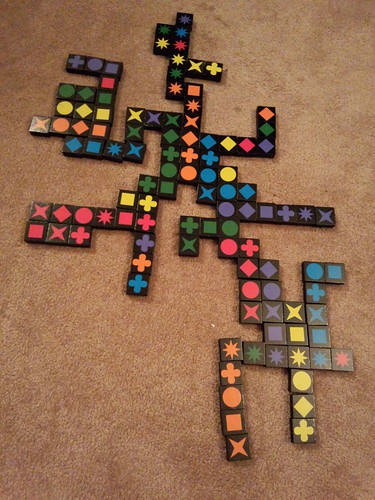
In the top LH corner in the photo above, you'll see two cards with shapes in a grid. That's the new technique challenge. Inspired by Qwirkle, a game created by MindWare, my students will work their way through the card, building Qwirkle-like rows ("Twirkles", perhaps?). Whenever they master six technical elements in a row, they collect $15 Maestro Bucks to spend at Maestro's Market. Students who complete the card (major minor keys) will be inducted into Maestro's Technique All-stars.
Upgraded Studio Incentives - Sticking to a Theme
One thing I noticed with last year's "Gig Card" is that some students either performed a lot or hardly at all. I suspect that some lost their steam for performing 20 times before seeing $100 Maestro Bucks. This year, they will earn $25 Maestro Bucks for each five performances.
That transferred over to the Music Moxie (formerly the "Music Maestro") and the Music Mastery cards. I decided to keep it simple and have $25 Maestro Bucks for five on all of them. The goals setting incentive remains the same as last year.
Handouts and a Bag of Tricks
This year, my students and I are going to explore practice strategies based upon their "practice personality". This is inspired by a book I bought at the CFMTA Convention, entitled Practice Personalities: What's Your Type?: Identifying and Understanding the Practice Personality Type in the Music Studentby Thornton Cline.
Instead of the Practicing 101 handouts of years past, I decide to repackage the info for my predominantly Visual and Visual-Kinesthetic learners. Once again, I drew inspiration from some of the tabletop games and video games I've played.
All students, young and young-at-heart, received a Bag of Tricks:

The original set contains 24 practice drills. One side of the card shows you how to do the drill. The reverse side tells you when to use the practice strategy and what it can be used to fix.

Some of my students were very excited when they read what the cards contained. Others looked skeptical, to which I'd say, "They're good for when you're stuck and you need to change up how you're working on something."
One of my fellow gamers enthusiastically read the cards out loud to his mother. When he got to the part where it said, "Repeat until you can play this spot cleanly five to seven times in a row," his mother said something like, "Well, duh!"
Then, one of my Grade 12 students looked at them and said, "Dude, that's a lot of work." Well, if more of my students improve because of them, then I'd say that it's worth it. At any rate, I hope that they have as much fun with their materials, practice aids and practice incentives as I had making them.
June 13, 2014 update:The musical bag of tricks has undergone significant testing and revisions, as well as a new name. I am pleased to announce that the Canadian product release of Maestro's Music Tricks (MMT) is June 30. There are 34 practice drills. MMT is currently available on pre-order. Stay tuned for details on the international product release.
MMT website: http://mmt.musespeak.com
MMT FB page: https://www.facebook.com/maestrosmusictricks
Social Media Links
archives
- #YYCArts 32
- #YYCEvents 39
- Collaborative Music 25
- Community 11
- Composing & Arranging 6
- Entertainment 139
- Entrepreneurship 53
- Freebies 3
- Gardening 1
- Geeking Out 65
- Health & Wellness 120
- Improvisation 25
- Interviews 28
- Learning Music 188
- Martial Arts 13
- Memorization 7
- Music 230
- Music Careers 9
- Music Education 196
- Music Examinations 7
- Music Exploration 55
- Music Gigs 14
- Music Lessons 6
- Music Performance 32
- Music Theory 13
- Musical Instruments 12
- Musician Health 19
- Pets 57
- Piano Technique 12
- Practicing Music 120
- Productivity 20
- Professional Development 11
- Recommendations & Reviews 93
- Recreation 71
- Social Media 6
- Spirituality 10
- Studio Management 33
- Studio Technology 50
- Teaching Music 146
FOLLOW THE STUDIO on Instagram

Affiliate Links
As a Sheetmusicplus and CD Japan affiliate, I earn from qualifying purchases. The earnings help fund the Studio’s blog and YouTube channels. Your support is greatly appreciated.


FOLLOW Budo no Tabi on Instagram