THE MUSICAL MUSE
Blog dedicated to music education, practice tips, health
&
wellness, and geeking out.

Online Music Game Review: Chord Drops
A student review of Chord Drops - an online ear training game created by Theta Music Technologies.
The following is a guest post by my student M of Chord Drops, an online music game available at Theta Music Trainer:
Chord Drops: A Student Review
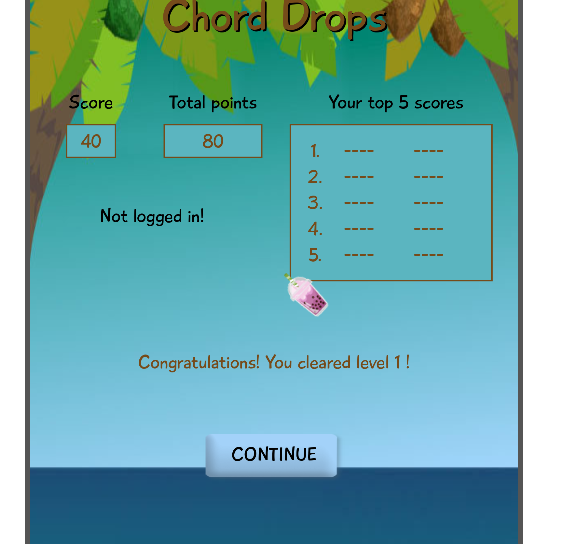
Chord Drops is about recognizing chords. It has you choose what chord you think it sounds like. It mainly practices your ear. It had different levels of difficulty and you could choose if you were a beginner . Or pick a different mode.
It was really interesting, and it is a fun way to practice your ear. I liked the icons and how easy it was to play.
I think that it is a fun game for ear training and that it is fun yet very useful
I would have liked a bit more to it because after a while it can get a bit boring. The icon is a coconut.
Chord Drops: Teacher First Impressions
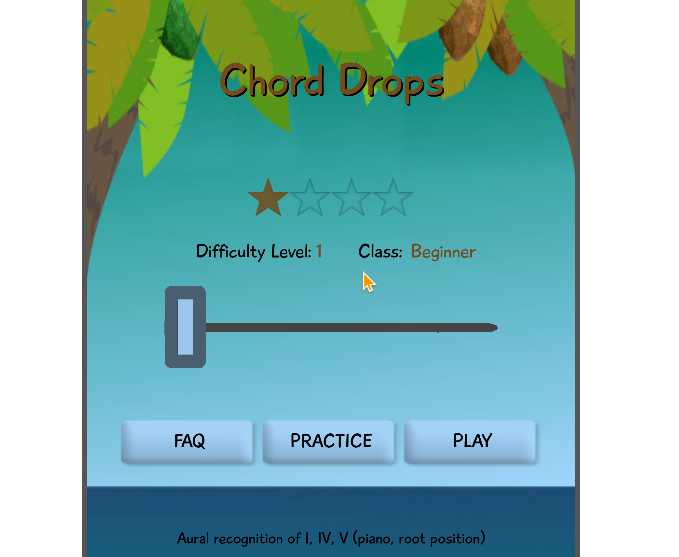
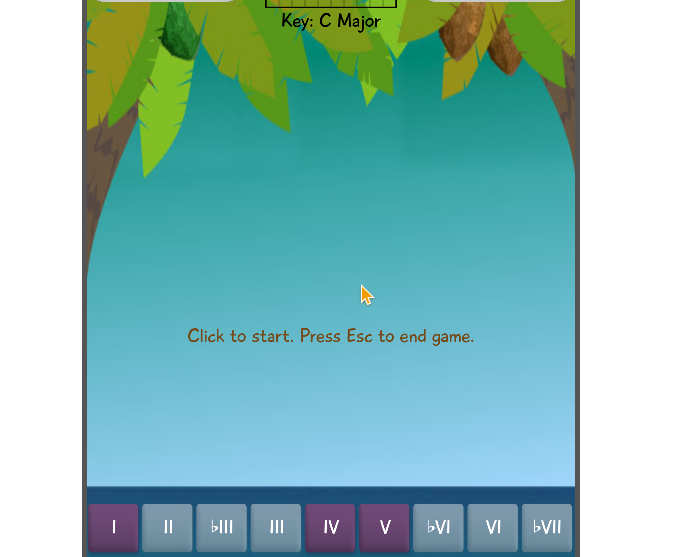
Chord Drops has 20 levels of difficulty, from Beginner to Expert. There is also a Practice Mode and Play Mode.
In Play Mode, You have five lives and are being scored. If you set up an account through Theta Trainer, your high scores could make it onto the High Score page.
It’s a neat, simple, flash game that gets students to develop their chord recognition in the context of harmonic function.
Check out my gameplay walkthrough livestream of Chord Drops:
Five Free Music Websites to Improve Ear Training
A guide to some free music websites available on the Internet to help music students do well on music examinations and help all musicians develop their inner ear.

A guide to some free music websites available on the Internet to help music students do well on music examinations and help all musicians develop their inner ear.
Practicing ear training exercises can sometimes be difficult without a teacher, family member or friend assisting. However, help is not always readily available. That makes preparing for a practical music examination challenging, especially for a young musician.
Ear training exercises recorded on a CD are somewhat helpful but can only be used for a limited time (until the student memorizes the order of the questions).
Thanks to the Internet, there are several interactive and dynamic ear training websites available for musicians to use during their music practice. The following list is just a sampling of what is available with a brief overview of each site.
Online Ear Training Websites
Musictheory.net
In Ricci Adams' Musictheory.net, Adams' has developed a comprehensive online theory and ear training aid. Under the "Trainers" tab, musicians can choose from three ear training exercises: Interval Ear Trainer, Chord Ear Trainer and Scale Ear Trainer. Users can customize which elements to be tested on, choose harmonic or melodic intervals and decide whether or not to include chord inversions. The Trainers keep track of your score and users can check the report to see which elements require more work. The website also includes flash tutorials under the "Lessons" section for a theory refresher and staff paper under the "Utilities" section.
Inside Music Lessons
Inside Music Lessons (formerly Practicespot.com) contains a wealth of ideas and tools for music teachers and students to use. Under the "Free Tools" section, students can use the Rhythm Gym to "clap-back" exercises and download cheat sheets to help with identifying intervals and chords.
eMusicTheory.com
Practice rhythmic dictation, identify scales and chords by ear and practice clap-back exercises online under the "Free Theory Drills" section or download the eMusicTheory software program. The site contains a student portal, a teacher portal and discussion forum. There are also pages to help with fingering (for string and keyboard instruments).
Good-Ear.com
The Good Ear website contains a wide variety of ear training drills, ranging from Beginner to Advanced exercises. Music students and professionals alike can practice identifying intervals, chords, cadences, scales, jazz chords and perfect pitch. The site also contains a drill to practice note location or geography.
iwasdoingallright.com
I Was Doing all Right is a jazz blog that contains an online ear training program. Under the "Search" window, click on the "Ear Trainer v2.0" link to use the free online ear training tool. Users can choose from practicing intervals, chords, melody play-back and rhythms. What is advantageous about this site is that listeners can specify which note direction, inversions and specify melody length. For a student preparing for an upcoming examination, this is the most comprehensive ear training tool on the list.
Online Ear Training Resources – Just the Tip of the Iceberg
Music students, music teachers and professional musicians can benefit from practicing ear training on a regular basis. Each of these websites listed contain a variety of drills and tools to aid musicians develop a "good ear" and help students improve their ear training mark on an exam. There are other sites out there, like musicalhearing.com and ossmann.com's Big Ears program. Explore the many sites available and choose what sites work best for one's ear training and music practice needs.
For more information on practicing music, read Five Free Music Websites to Improve Note Reading, How Much Practice is Required to Learn Piano at Different Levels? and Motivating Students to Practice.
Originally published December 22, 2009 on Suite101.com. Updated on March 22, 2013. All rights reserved by Rhona-Mae Arca.
Playing By Ear
It's around this time of year that music students and music teachers alike feel a bit brain dead. I try to change things up a bit so that my students are learning, but learning music in a different way - playing by ear. Playing by ear is a great way to practice your ear training and brush up on your music theory.
It's around this time of year that music students and music teachers alike feel a bit brain dead. I try to change things up a bit so that my students are learning, but learning music in a different way - playing by ear. Playing by ear is a great way to practice your ear training and brush up on your music theory. My ConCan students would tell you that this is just a step up from their Keyboard Harmony and Transposition requirements for their piano exam.
Shortly after Halloween, my students started working on Christmas music. A couple of my older students wanted a bit of a change, so they opted for Hanukkah and Kwanzaa music. One week, I asked them to pick out the tune to one of their favourite songs. Subsequent weeks involve adding the harmonies. Then, if they wanted to sing along with their song, I would ask them to transpose the song into their range. It doesn't have to be seasonal music. Popular music is great for this exercises - the melodies have narrow ranges and most likely, you only have four chords to deal with. The one thing I've noticed with songs I've learned by ear is that I tend to remember them longer than pieces I've learned primarily through note reading and repetition.
Mastering the Art of Playing & Singing
Here are some sites my students and I have been using for our chording and singing purposes:
My student Bianca has been working on accompanying herself singing, either with piano accompaniment or guitar. She's become pretty good at it, to the point of inspiring her examiner to clap and say "Brava!" at the end of her examination performance of "Teardrops from My Guitar". She's been one of my inspirations for doing the same - for gigs though, not exams. Here are some sites my students and I have been using for our chording and singing purposes:
As I mentioned in a previous post, it's a great way to practice ear training. It's really tricky trying to sing on pitch while only playing chords.
September 3, 2020 update: I updated some of the links as the old links were defunct.
Musings on the First Week of of the Fall Term
Since everyone is adjusting to their fall schedule, my main priorities this week were to reconnect with returning students, to get to know new students and assess who did their homework (and who needs extra review). I gave all the kids some origami that I made over the summer. Their first homework assignment is to compose or improvise a short song about one or both of their origami. It will be a musical carnival of the animals, with songs about whales, seals, fish and various birds.
After a summer off from teaching, my colleagues and I are very glad to have the weekend. Over the summer, we forgot how hectic the pace is during the school year. Poor Maestro has to memorize a whole new schedule (it's too bad dogs can't read). I have to give him credit though. After one week, he catches on to who is supposed to come when. Since everyone is adjusting to their fall schedule, my main priorities this week were to reconnect with returning students, to get to know new students and assess who did their homework (and who needs extra review).
I gave all the kids some origami that I made over the summer. Their first homework assignment is to compose or improvise a short song about one or both of their origami. It will be a musical carnival of the animals, with songs about whales, seals, fish and various birds.
Next week is a whole other story. They'll be hit on the head with musical math to review rhythm, sight-reading (presented under the guise of trying out the pop and jazz books I recently bought), scales, chords and arpeggii to get their fingers back into shape. We'll also fine tune the songs I assigned them for homework.
Things are gearing up once again with ARMTA Calgary. One committee meeting down for the month, three more to go.
(c) 2007 by Musespeak(tm), Calgary, AB, Canada. All rights reserved.
Social Media Links
archives
- #YYCArts 32
- #YYCEvents 39
- Collaborative Music 25
- Community 11
- Composing & Arranging 6
- Entertainment 139
- Entrepreneurship 53
- Freebies 3
- Gardening 1
- Geeking Out 65
- Health & Wellness 120
- Improvisation 25
- Interviews 28
- Learning Music 188
- Martial Arts 13
- Memorization 7
- Music 230
- Music Careers 9
- Music Education 196
- Music Examinations 7
- Music Exploration 55
- Music Gigs 14
- Music Lessons 6
- Music Performance 32
- Music Theory 13
- Musical Instruments 12
- Musician Health 19
- Pets 57
- Piano Technique 12
- Practicing Music 120
- Productivity 20
- Professional Development 11
- Recommendations & Reviews 93
- Recreation 71
- Social Media 6
- Spirituality 10
- Studio Management 33
- Studio Technology 50
- Teaching Music 146
FOLLOW THE STUDIO on Instagram


Affiliate Links
As a Sheetmusicplus and CD Japan affiliate, I earn from qualifying purchases. The earnings help fund the Studio’s blog and YouTube channels. Your support is greatly appreciated.


FOLLOW Budo no Tabi on Instagram