THE MUSICAL MUSE
Blog dedicated to music education, practice tips, health
&
wellness, and geeking out.

Fostering Self-Assessment with Cross-Training
For someone who trains in four somewhat rare martial arts, the Zoominar was a priceless opportunity to work with some of the top instructors in Canada, to listen to one of the highest ranking instructors in the world from his home in England, and to meet practitioners from around the world.
The focus of all the sessions was to give attendees tools to take ownership of their physical distancing training. Immediately, I could see how these self-assessment tools and drills could be adapted to help music students do the same. Here are some of the tools and tips that my students and I have added into our practicing.
Originally published in the July 2020 edition of APTA News & Views.
One of the positives from the COVID-19 pandemic is that we are able to attend classes and seminars from the comfort of our own homes. On the May long weekend, I was able to participate in an international martial arts seminar that was hosted in Guelph, Ontario. For someone who trains in four somewhat rare martial arts, the Zoominar was a priceless opportunity to work with some of the top instructors in Canada, to listen to one of the highest ranking instructors in the world from his home in England, and to meet practitioners from around the world.
The focus of all the sessions was to give attendees tools to take ownership of their physical distancing training. Immediately, I could see how these self-assessment tools and drills could be adapted to help music students do the same. Here are some of the tools and tips that my students and I have added into our practicing.
Galligan Sensei’s Quadrants
Carole Galligan sensei is the highest ranking female in Canada for Iaido, the art of cutting from the sword draw. With her preparing for her 7th degree black belt grading, she shared how she was continuing to train without the benefit of being in the same room as her sensei. Like music teachers, sensei normally physically adjust arms, hands and body position or demonstrate concepts via partner work.
She held up this diagram while saying that each of our techniques contain these elements. Then she led us through various exercises to identify our dominant quadrant. Our weakest quadrant lays kitty-corner to it.

Galligan sensei holds up her quadrants for us to work through during the 2020 Guelph Seminar.
In discussion with my students, this is how we adapted sensei’s quadrants for music:

My teen and adult students have set out to identify their overall dominant quadrant, as well as their dominant for each piece. That done, they are now focussing their practices on “levelling up” their weakest. The younger students are picking one quadrant to focus on per practice.
Whether my students think that Galligan sensei is cool or they love the tool, I am seeing and hearing immediate results.
What’s Wrong with this Picture?
Galligan sensei also showed us several photos of her doing various techniques incorrectly and asked us to identify what was wrong. She then challenged us to do the same when reviewing photos and videos of ourselves practising. Some practitioners admitted that they were uncomfortable watching themselves. Sensei recommended they start by studying photos and videos of other people.
This translates extremely well to music practice. This past week, I have played videos of other people performing my students’ repertoire, asking them to identify what was good (and not so good) about the performances. Some of them have already jumped to Stage 2, which is to record and review their own practices.
Play it Backwards Drill
Galligan sensei confused several of us when she asked us to execute a kata (form) from end to start. It jolted us all out of complacency, forcing us to really concentrate. By the time we performed the kata normally, we noticed that overall, we were cleaner and smoother.
Several of my students have jumped onto this drill, immediately applying it to all of their troublespots. Others needed more repetitions or smaller practice chunks. The improvement has ranged from noticeable to incredible.
Green Sensei’s Adaptability Drill
In his session, David Green sensei (6 degree black belt in Iaido) covered changing one or more elements in our practice space and routine to jolt our brains out of complacency and challenge our ability to adapt. For example, training on a different surface or facing a different direction.
With us being housebound we, along with our students, have lost a bit of our adaptability savvy developed from performing on different pianos. My students came up with these changes to practice adaptability: change the lighting, practice with eyes closed, move objects and music to a different spot in the room, change chairs, and to record practices.
Tribe Sensei’s Tips on Dealing with Conflicting Advice
Eric Tribe sensei (6 degree black belt in Iaido and Jodo) is the CKF Head Examiner for Jodo in Eastern Canada (the art of the Japanese short staff), as well as the President of Jodo Canada. In his session, he presented video clips from two different instructors on the subject of technique.
On the surface, it seemed like they were coming at it from opposite sides. Tribe sensei had us try the technique, following the advice of each instructor. He then asked us to find the common ground between the two viewpoints. Between the commonalities and discussing what felt natural and logical, we were able to find our middle ground.
This also translates very well for music. My teen students have been listening to three or more performances of their pieces. Not only have they been comparing and contrasting, but they are also gaining ideas for experimentation. *
It has been a lot of fun adapting these drills and tools for music practice. My sensei have all been encouraging of this type of cross-training. Perhaps there is something that you do as a hobby or for exercise that you can adapt and use with your students. Or maybe there is something that your students do that can have applications to music. A little cross-training is good for everyone.

Iaido - The Art of Traditional Japanese Swordmanship
A brief introduction to the Japanese martial art of drawing the sword - Iaido.
Another one of my Suite101.com articles that got cut in The Big Purge. I'm not entirely sure why this one didn't make it but as you can see, not concerned enough to dispute it:
In times of war, samurai honed their swordsmanship skills on the battlefield. Iaido was developed as a means for samurai to maintain their skills during times of peace. Today, it is a martial art that attracts practitioners seeking moving meditation. Iaido is related to Kendo and Jodo.
Like its siblings, Iaido involves traditional Japanese weaponry. Unlike Kendo and Jodo, Iaido is a solitary, non-combative martial art. One common translation of the kanji for "Iaido" is the one used by Chris Gilham sensei of Ka Muso Kai: “the way of harmonizing one's self in action at all times and in all conditions.”

An iaito, or practice sword is custom-made to the users tastes and size. Photo by R-M Arca.
Iaido Clothing and Equipment
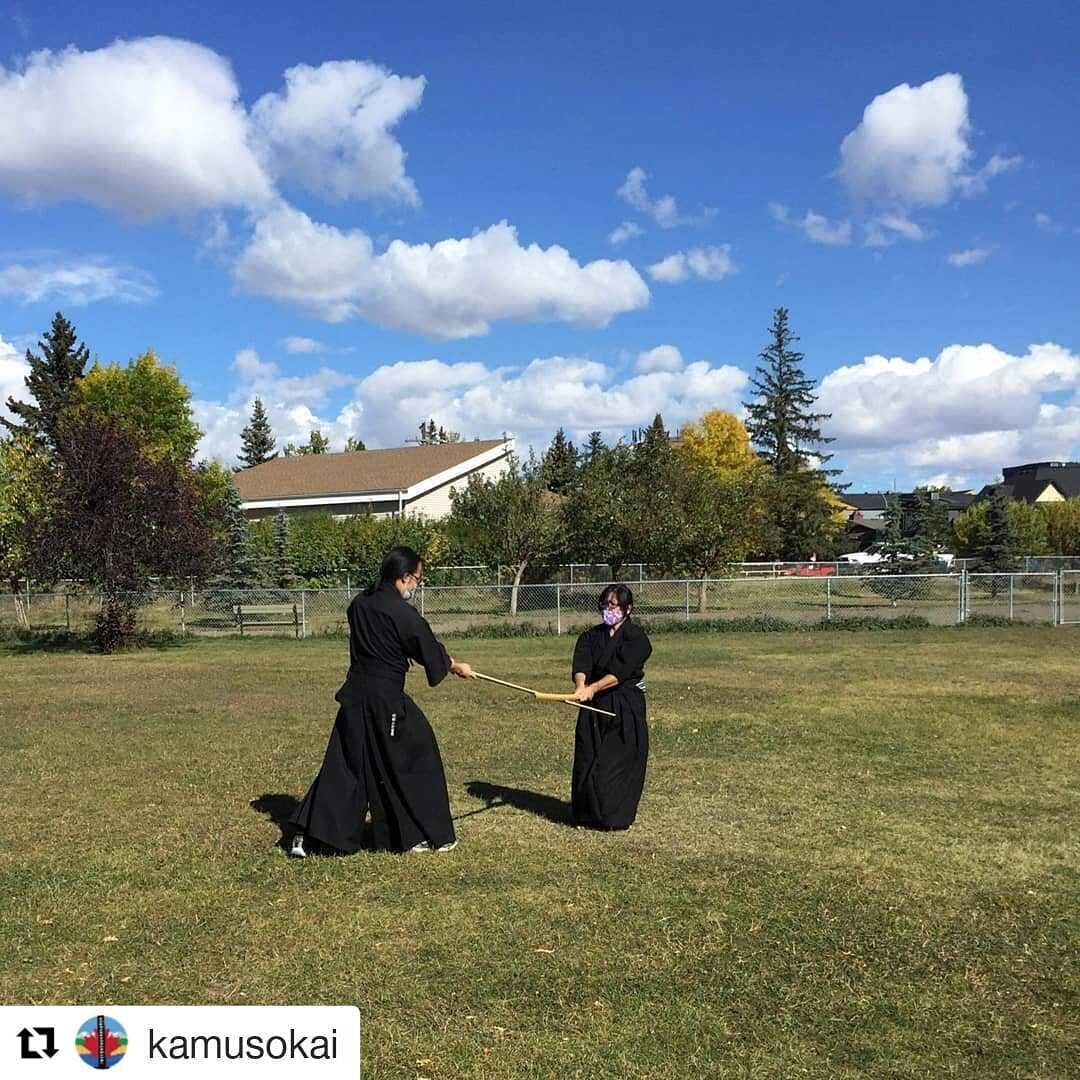
Iaido practitioners, called "iaidoka", begin training with a wooden practice sword (bokuto or bokken). As training progresses, they invest in an iaito, a dull-blade training sword. Advanced practitioners can use a shinken (live blade). Only iaito and shinken are allowed when grading. The Iaido uniform consists of a black gi, hakama and obi. The sheathed sword is inserted through the obi. The sheath (saya), is secured to the uniform by tying a silk or cotton cord (sageo), to the hakama.
Iaido Customs and Etiquette
The newest students in the dojo are responsible for set-up and clean-up of the training space. Upon entering the dojo, Iaido practitioners bow towards the shrine (shinzen or kamiza). While in the dojo, iaidoka traverse barefoot and in straight lines. They walk along the periphery of the dojo as a safety precaution.
The instructor is addressed as “sensei” (teacher) while the more senior students are called “senpai” (seniors). Junior members are called “kohai.” When responding to one another, practitioners respond affirmatively in Japanese. When greeting or thanking one another, iaidoka bow to each other as a sign of respect.
Iaido Training and Techniques
Iaido training is comprised of reiho (etiquette), warm-up exercises and kata (forms). Opening and closing reiho involve bowing to the shinzen, sensei and sword. Warm-up exercises include sword cuts in various positions. The sensei introduces a technique to a student and then leaves the student to practice. Periodically, the sensei and senpai check on a kohai's progress. Once a student masters a technique to the sensei's satisfaction, a new one is taught.
Iaido kata are patterns that represent everyday situations a samurai might have faced, such as drinking with someone who suddenly draws his sword. Iaidoka perform these kata while facing an imaginary opponent (teki). From a state of relaxed awareness and with the eyes focused on the horizon (metsuke), the Iaido practitioner reacts to an envisioned threat.
There are five parts to every kata:
Nukitsuke: drawing the sword and making the initial cut,
Furikaburi: raising the sword overhead,
Kiri-oroshi: killing cut,
Chiburi: shaking the blood from the blade and
Noto: re-sheathing the sword.
Each kata is completed by returning to one’s original position. Jo-ha-kyu is integral to the rhythm-timing in Iaido. Forms should be executed with fluidity, efficiency and precision, all while the practitioner's eyes are focused on the opponent.
There are 12 forms in the Seitei Iai Gata: mae, ushiro, uke nagashi, tsuka ate, kesa giri, morote zuki, sanpo giri, ganmen ate, soete zuki, shiho giri, sou giri and nuki uchi. After mastering these kata, Iaido practitioners learn older styles of Iaido, such as koryu and okuden.
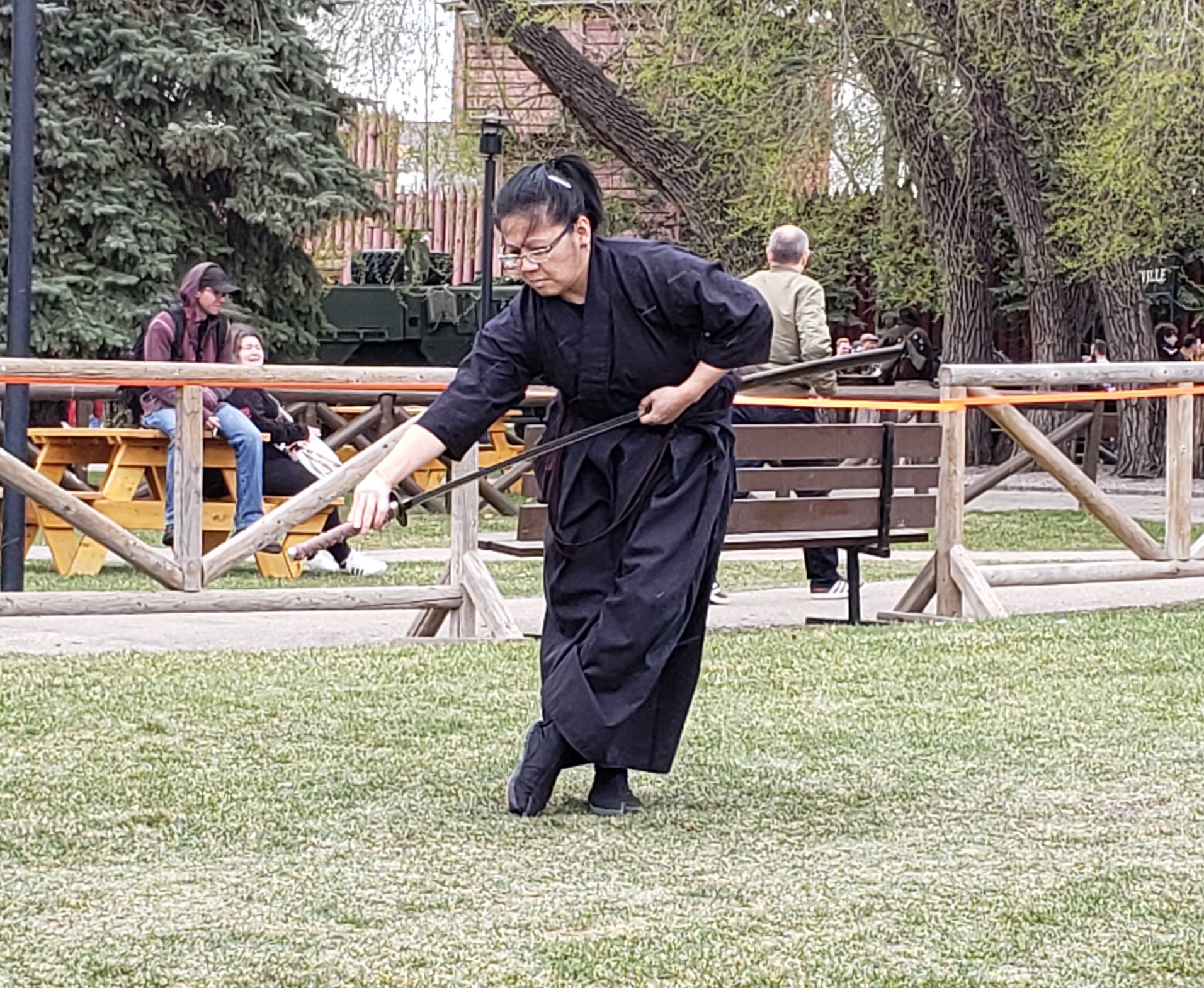
Iaido is the art of of Japanese swordmanship. Photo by Jonathon Wilkes.
Iaido practitioners can participate in tournaments and grading. The All-Japan Federation adopted a -kyu ranking for lower levels and a -dan ranking system for grading black belt levels in Iaido. Many federations, such as the Canadian Kendo Federation, the British Kendo Federation and the All United States Kendo Federation, follow this system.
History of Iaido
Iaido can trace its roots to a Japanese swordsman named Hayashizaki Jinsuke Minamoto no Shigenobu, who lived from 1546 - 1601. His sword techniques were called Batto-Jutsu, Shin Muso Hayashizaki Ryu, Junpaku Den, Shigenobu Ryu and Iai-jutsu.
Upon Hayashizaki's death, his style was carried on by the first Soke (headmaster), Tamiya Taira-no-Hyoe Narimasa, who instructed Tokugawa Ieyasu. By the eleventh Soke, two distinct sword styles emerged: Shimomura-ha and Tanimura-ha. These later evolved into Muso Shinden Ryu and Muso Jikiden Eishin Ryu, two popular styles of Iaido today. The term "Iaido" was first used by grand master Nakayama Hakudo in 1932. He was involved with codifying the techniques for both schools.
Once a means for samurai to maintain their swordsmanship skills during times of peace, Iaido is now a non-combative martial art. Although it is a sword-based art, Iaido is a form of meditation in motion, in which the practitioner strives to reach "mushin" (no-mindedness).
Sources:
Chris Gilham sensei (4th dan), Colin Pitman (4nd dan) and Alex Cook (4nd dan) of Ka Muso Kai.
Aukland Kendo Club: History of Iaido (accessed June 30, 2010).
Fighting Arts: Iaido (accessed June 30, 2010).
Fighting Arts: From the Beginning: The Importance of Reishiki in Iaido (accessed June 30, 2010).
The Iaido Journal: An Introduction to Iaido: Its Purpose and Benefits (accessed June 30, 2010). Copyright Rhona-Mae Arca, 2010. All rights reserved.
Friday Fun Link #15 & A List to Make Your Head Spin
My head’s starting to spin again. This week, I’ve been organizing next week’s Piano Group Class (a behind the scenes tour of the Southern Alberta Jubilee Auditorium), preparing for Monday’s Calgary ARMTA Executive meeting (Barb, I’ll get my reports done before Saturday!), reminding and coaching students and their parents to register for their piano/theory exams and the APTA Music Festival…
My head’s starting to spin again. This week, I’ve been organizing next week’s Piano Group Class (a behind the scenes tour of the Southern Alberta Jubilee Auditorium), preparing for Monday’s Calgary ARMTA Executive meeting (Barb, I’ll get my reports done before Saturday!), reminding and coaching students and their parents to register for their piano/theory exams and the APTA Music Festival, creating contracts with milestones for the exam students, parents and I to commit to, restraining myself from screaming at students who don’t practice (and trying not to look bored when they stumble through a piece they’ve had for far too long), fielding calls from parents looking for a piano teacher, fielding calls from brides looking for wedding music and trying very hard to keep up with lesson planning, practicing and paperwork.
All this while dealing with a dog with a bad case of sniffles (but really wants his walkies), a short story contest deadline looming, passing along sad news to my fellow U of L music alum (and then trying to track down contact info for classmates who are MIA), re-recording a student whose recital performance was full of static, looking for Iaido clothing that fits petite women, designing a photo waiver for the Iaido Club, practicing Iaido, getting used to life without a car (retired to Car Heaven), setting up networking lunches, dealing with a weird company about digestive enzymes that caused a nasty reaction and what else? Housecleaning. Whoa. I am out of breath just reading that. Now that is called a run-on sentence. I certainly need a Friday Fun Link to lighten the mood. This week’s link is CyberParodies. I’m listening to “Carbs” (a parody on “Cars”). Pretty wacky, just like my list.
And that’s that. Back to paperwork, practicing and practicing. Have a good weekend everyone!
© 2006, Musespeak™, Calgary, AB, Canada. All rights reserved.
I’ve got rhythm…do you?
" Rhythm is everywhere. It surrounds us constantly in our environment and lives continuously within us." ~ Craig Cooke, CEO and Co-Founder, Rhythm Interactive, Inc.
I found this particular quote apropos for this week. Rhythm is extremely important in music but have you ever noticed rhythms in your everyday activities and environment?
" Rhythm is everywhere. It surrounds us constantly in our environment and lives continuously within us." ~ Craig Cooke, CEO and Co-Founder, Rhythm Interactive, Inc.
I found this particular quote apropos for this week. Rhythm is extremely important in music but have you ever noticed rhythms in your everyday activities and environment?
From the soft breathing of a sleeping baby to a car alarm blaring in the night; from an egg jiggling in a pot of boiling water to Maestro’s “roll-roll-check” rhythm to force treats out of his Have-A-Ball -- these steady rhythms are soothing and comforting. They give us a point of reference.
I began studying the martial art of Iaido this month. Right away, I learned that there is much to gain by figuring out a steady rhythm to my movements. For instance, it takes five beats for me to complete a basic cut with my bokuto (wooden sword) and ten to complete first half of hajime no saho (beginning etiquette). The steadier the beat, the more fluid my movements became. The more fluid I became, the closer I came to attaining a state of mushin (no thought). Yes, it’s active meditation. I won’t dare go further because I am still learning the basics and don’t want to lead anyone astray.
Most people pay little or no attention to the rhythm in their lives. Only when the rhythm is off do they notice. A dancer automatically stumbles if the music is cut off suddenly or changes speed, a student may forget her lines in Romeo & Juliet if she hears a noise, while a daily commuter will notice the difference in the flow of traffic on the way to work if he wakes up ten minutes late.
As I say to my students, pay attention to the rhythm. Teachers often ask students to tap out tricky rhythms before they even attempt to play the notes. For if they don’t have the rhythm right from the beginning – it will always be off.
Social Media Links
archives
- #YYCArts 32
- #YYCEvents 39
- Collaborative Music 25
- Community 11
- Composing & Arranging 6
- Entertainment 139
- Entrepreneurship 53
- Freebies 3
- Gardening 1
- Geeking Out 65
- Health & Wellness 120
- Improvisation 25
- Interviews 28
- Learning Music 188
- Martial Arts 13
- Memorization 7
- Music 230
- Music Careers 9
- Music Education 196
- Music Examinations 7
- Music Exploration 55
- Music Gigs 14
- Music Lessons 6
- Music Performance 32
- Music Theory 13
- Musical Instruments 12
- Musician Health 19
- Pets 57
- Piano Technique 12
- Practicing Music 120
- Productivity 20
- Professional Development 11
- Recommendations & Reviews 93
- Recreation 71
- Social Media 6
- Spirituality 10
- Studio Management 33
- Studio Technology 50
- Teaching Music 146
FOLLOW THE STUDIO on Instagram

Affiliate Links
As a Sheetmusicplus and CD Japan affiliate, I earn from qualifying purchases. The earnings help fund the Studio’s blog and YouTube channels. Your support is greatly appreciated.


FOLLOW Budo no Tabi on Instagram