THE MUSICAL MUSE
Blog dedicated to music education, practice tips, health
&
wellness, and geeking out.
Roots CD Review
At only 21 years of age, Alex Goodman shows the world why he's a force to be reckoned with in the Canadian jazz scene with his first jazz album, "Roots".
At only 21 years of age, Alex Goodman shows the world why he's a force to be reckoned with in the Canadian jazz scene with his first jazz CD, "Roots".
"Without question, one of the most gifted guitarists of his generation," said Tim Ries of the Rolling Stones after hearing Alex Goodman perform. Together with Jonathan Kay on saxophone, Justin Gray on bass and Josh Park on drums, they form The Alex Goodman Quartet.
Alex Goodman - A Rising Star
Alex Goodman is a Canadian jazz guitarist, pianist and composer. He studied jazz performance at the Schulich School of Music at McGill University before transferring to the University of Toronto where he attended on a full scholarship. He has received numerous awards and accolades including a Banff Program for Jazz and Creative Music merit award, recognition as a CBC/Galaxie 2008 “Rising Star.” He studied performance and composition with international jazz greats Ben Monder, Wayne Krantz, Jim McNeely, Rich Perry, Tim Ries and Ethan Iverson.
He composed and played on the soundtrack for the award winning film Goodbye Rosebud which was screened at the Cannes’ Film Festival. He also wrote, arranged and performed all music for Reality Check, a TV film that aired nationally on Global in 2007.
Alex has performed in Canada, Thailand, India, Spain and the United States.
Roots - An Analysis
Bloom is a catchy track that alternates between a charming jazz waltz and an quick Latin groove. Jonathan Kay keeps up with the switches styles ably, maintaining a full and warm tone on the tenor sax. Alex Goodman demonstrates his technical precision by throwing in rapid rhythms that switch gears from one style to the next in the blink of an eye in his jazz improvisation.
The Cantus begins with a punchy rhythm played by the drums and bass. The piano and alto sax soon join in with a quick, highly syncopated melody. The saxophone solo fires up and down the register as the rest of the combo maintains punchy comping rhythms.
Things slow down a bit with Validation, which has a soulful feel like Round Midnight by Thelonious Monk. It gains a bit of momentum by the 1:00 mark. The piano solo uses classical-style sequences with jazz harmonies and steadily kicks up the momentum another notch with some rapid flourishes. The bass solo, in contrast, is calmer and introspective. The sax matches the gentle tone at first and then builds the intensity, gradually moving higher up the range. The drums play around with rhythms, starting simple and then getting more complicated, before easing back.
Recordame is a Joe Henderson classic. Its bossa roots aren't as evident in this version. This is also the first track on the CD to feature the guitar, which really does change the tone of the piece. The use of the guitar and the alto sax give this track an easy-going feel.
Nihilism contains some bebop melodic shaping but keeps things at an easygoing tempo - at first. The solos quickly push the mood from calm to excited. The interplay of the combo during the sax solo complemented the sax without stepping on the solo.
Out of Nowhere is another laid back track. The saxophone's range is explored in depth during the solo. The guitar solo is very "scat-able".
Perito Moreno begins with a fast bebop groove in the bass and drums. The sax truly lets loose with some virtuosic passages that fly high and low during the solo. The piano solo is filled with syncopation and rapid passages. The bass and drums maintain the intensity with their driving lines.
The final track, Winter, is slow and dreamy, like Vince Guaraldi's Christmastime is Here. It opens with just the piano and a gentle brush groove by the drums. The head, played by the sax is sultry and melancholic, while the bass continues with an pensive solo. The piano solo incorporates some rhythms and harmonies reminiscent of Impressionist music but maintains the calm feel.
Roots Track Listing
Bloom (A. Goodman)
The Cantus (A. Goodman)
Validation (A. Goodman)
Recordame (J. Henderson)
Nihilism (A. Goodman)
Out of Nowhere (J. Green/ E. Heyman)
Perito Moreno (A. Goodman)
Winter (A. Goodman)
Produced by: Alex Goodman
Recorded with: Central Audio Productions
Released: 2007
Roots - The Verdict
Roots is a solid debut CD, showcasing the versatility of this jazz combo as well as Goodman's compositional style. Their cohesion is pretty tight and it's hard to believe that these young jazz musicians are barely into their 20's. Alex Goodman and Jonathan Kay truly shine in this CD. However, as able as Justin Gray and Josh Park were, it would have been nice to hear them really let loose. Perhaps in their next CD.
Since releasing Roots, The Alex Goodman Quartet has become The Alex Goodman Quintet. To find out more about Alex Goodman visit his website and his MySpace page.
Although Roots doesn't appear to be available, the jazz combo's latest album, Bridgesis. It was nominated for a 2013 JUNO Award for Contemporary Jazz Album of the Year. Alex Goodman is currently pursuing his Masters in Music at the Manhattan School of Music.
Originally published on Suite101 on December 21, 2009. Updated March 11, 2013. All rights reserved by Rhona-Mae Arca.
Finding Harmony With the Right Music Teacher
Signing up for music lessons involves a long-term commitment. Great care should be taken to find a music teacher that is a good fit for the student.

Signing up for music lessons involves a long-term commitment. Great care should be taken to find a music teacher that is a good fit for the student.
Whether the goal is to develop one’s artistic ability, prepare for a career in music or play for recreation, music lessons can benefit musicians at any age and level. When someone signs up for music lessons, they enter into a long-term relationship with a music teacher that can last several years. For it to be a fruitful relationship, great care should be taken to find a teacher who is a good fit for the student and his or her family.
What Prospective Students Should Think About Before Taking Music Lessons
There are several considerations a student and his or her family should make prior to registering for music lessons:
whether the prospective student is ready for music lessons
which instrument to study
the family's commitment and attitude towards music lessons
Having a clear sense of where one stands with respect to each of these areas will make it easier to determine the best teacher for the student and the family.
Looking for a music teacher is similar to shopping for the perfect hairdresser. At the core, a student will blossom with a teacher they “click” with and who does good work. Parents will appreciate working with a teacher whose teaching philosophies and operating procedures complement their vision for their child's musical education
Types of Music Lessons, Learning Environments and Instructors
Music students may study privately (one-on-one) or in a group class. There are several beginner music class programs available, such as Music for Young Children, the Kodály method, the Suzuki method, Yamaha and Kindermusik.
Lessons are offered on a variety of instruments. The most common instruments people choose when commencing their musical education are the piano, voice, guitar and violin. Lessons in music theory, a specific genre (e.g. jazz), improvisation or music composition are also available.
Music lessons are offered in several venues. Students can study at a music school affiliated with a music store, a music school affiliated with a conservatory, at a private music teacher’s studio or in the comfort of their own home.
There are several types of music instructors, each offering their unique blend of experience, knowledge and teaching approaches:
Certified teachers who have completed their post-secondary education and some have taken pedagogical training and are members of a professional music teachers’ association.
Student teachers who are advanced students in the process of completing their professional accreditation.
Professional musicians who regularly perform and/or have done commercial recordings.
Teachers who lack accreditation; however, their skills, education received and experience are exemplary and enable them to offer quality music instruction.
Tuition varies depending upon the teachers’ educational and performance background, professional affiliations, track record, teaching experience and how their studio is set up. However, good chemistry with the teacher, qualifications, high quality education and complementary vision should rate more highly than cost when making a final decision.
Tips on How to Find a Music Teacher
The easiest way to find a music teacher is to ask around. The benefits of talking to one’s family, friends and colleagues are two-fold: not only can they give names and contact information; one’s contacts can provide details on their first-hand experience with a particular teacher.
Another method to finding a music teacher is to contact a music teacher’s association. Many teaching associations such as the Canadian Federation of Music Teachers’ Associations (CFMTA), the Music Teachers National Association (MTNA), the National Association of Teachers of Singing (NATS) and the European Piano Teachers Association (EPTA) have an online directory.
Checking advertisements is a third option when searching for a music instructor. Some teachers place advertisements in a community newsletter or newspaper, while other teachers put up posters in local stores.
After the audition-interview, the teacher also considers whether the student and family are a good fit for the studio. The music teacher may recommend another teacher if he or she feels that the student's and family's interests best lie with a teacher with a different background or approach.
If there are any special needs, such as a health condition, learning disability or if the student is an adult, these should be addressed when first inquiring about lessons or during the audition-interview. It is acceptable to inquire about the teacher’s experience in an area of special consideration.
Music lessons are a long-term investment. Taking the time in advance to find a teacher that is qualified, has a good track record, “clicks” with the student and shares a complementary vision with the student’s family goes a long way to making the relationship a harmonious one.
Sources:
Alberta Registered Music Teachers’ Association website and Membership Renewal Package (accessed June 30, 2010).
Canadian Federation of Music Teachers’ Associations (accessed June 30, 2010).
Music Teachers National Association (accessed June 30, 2010).
Originally published on Suite101 on June 30, 2010. All rights reserved by Rhona-Mae Arca.
Understanding Lakeland Terriers
Small and cocky, sturdy and smart, Lakeland Terriers approach any task with zeal; whether they are working as a watchdog, vermin hunter or your personal assistant.

Maestro, my Lakie, is a working dog. He takes his job as K9 Studio Assistant very seriously. Photo by R-M Arca.
Lakeland Terriers, affectionately called “Lakies”, possess a larger than life personality. As any Lakeland Terrier owner can attest, these dogs possess a great sense of humor, an insatiable thirst for excitement and like many terriers, are alert and incredibly stubborn.
History of the Lakeland Terrier
The Lakeland is one of the oldest known terrier breeds, originating in the 1800’s. The breed was developed in the Lake District of England by farmers who crossed several breeds together. The exact mix varies depending on the source. However, the breeds commonly cited as the Lakie's ancestors are the Border, Bedlington, Fox, Dandie Dinmont, and Old English Black and Tan Terriers.
Their job was to accompany farmers on hunts and prevent fox and other vermin from destroying their sheep herds. Littlemac Lakeland Terriers gives a historical account on their website about Jock, a three-year old Lakie who killed an 18 pound vixen in her den. Jock was trapped in the foxhole for 73 hours because his victim blocked the only exit. Once rescued, Jock had some bread and milk before laying down by the fire for a well-deserved rest.
Lakelands are sometimes referred to as the "new and improved" Fell Terrier, Cumberland Terrier or the Patterdale Terrier.
Breed Information for Lakeland Terriers
Lakies possess a small, yet square build. Resembling an Airedale Terrier or Welsh Terrier, Lakelands can be wheaten, grizzle, red, blue and tan, black and tan. Some sport a dark saddle-like patch. Their coat lightens with age. The face of a Lakeland Terrier is rectangular. Their eyes are almond shaped and ears are V-shaped. Lakeland Terriers are typically 14-1/2 inches tall from the withers and weigh approximately 17 pounds. They are generally a healthy breed.
The Canadian Kennel Club and American Kennel Club provide resources on how to find a well-bred dog and care for one.
Lakeland Terrier Grooming and Exercise
Lakelands have a dense wiry coat and a soft undercoat. Shedding is minimal. Brushing should be done weekly. Traditionally, their coat is hand stripped. Companion dogs that do not compete in dog shows can be clipped. Frequent shampooing softens their wiry coat. It is best to rinse their fur with water and only shampoo periodically.
Lakies require regular exercise and a great deal of mental stimulation. Brisk daily walks or intense playtime sessions are a must. Earthdog Tests and Agility Training are popular activities for Lakelands. Playing hunting games with stuffed toys and Hide and Seek are also enjoyable activities for Lakies.
The Lakie Temperament
In her 2000 article "Lakeland Terriers: What's good about 'em, What's bad about 'em" on YourPurebredPuppy.com, Michele Welton describes terriers as “quick to bark, quick to chase, lively, bossy, feisty, scrappy, clever, independent, stubborn, persistent, impulsive, intense.” This applies to many terrier breeds. The Lakeland is no exception.
It is these qualities that can make obedience training and housebreaking challenging at times. Gentle, firm training is extremely effective as Lakelands are sensitive to voice inflection. They respond to praise well. Training a Lakeland requires a good deal of patience and creativity to provide a variety of activities to occupy their busy minds. It helps if the owner is equally stubborn, leads a fairly active lifestyle that a Lakeland can be part of, has a fenced yard and a good sense of humor.
By the same token, those same characteristics will instill a great deal of adventure, laughter and charm into your life. Lakies make great family pets and watchdogs but should be supervised around small children. Lakelands do well in an urban or rural setting and can live in an apartment.
Due to their terrier nature, many Lakelands will not coexist harmoniously with another pet such as animals from the rodent family or cats. Lakelands consider these to be "prey".
Youtube has over 500 videos showing the crazy antics of Lakeland Terriers. If you are unfamiliar with this breed, watching some of these videos will give you a glimpse into the Lakie personality.
Famous Lakeland Terriers

Comedian Bill Cosby co-owned Champion Revelry's Awesome Blossom, the top winning Lakeland Terrier in the history of the breed. Stingray of Derrybah was the first dog to win Best in Show/Supreme Champion at both the top US and UK shows.
In the entertainment industry, Zelda Van Gutters is Nickelodeon Magazine’s Roving Reporter/Mascot., while Kevin the Lakeland is owned by Neil Tennant of the Pet Shop Boys.
Maddie the Mad Dog was the first Lakeland on the worldwide web.
Is a Lakeland Terrier Right for You?
If you are considering a Lakeland Terrier as a pet, it is recommended that you do your research ahead of time. Speaking with and visiting reputable dog breeders or a Rescue Club are also good ways to determine if a Lakie is a good fit for your household. These dogs thrive in an environment where they are part of the family and can be a part of the action. If you do find that a Lakeland is a good fit for your family, you are in for equal doses of fun and challenges, as well as a daily laugh.
References:
Lakeland Terrier Club: Profile of the Lakeland Terrier
Originally published on Suite101.com on January 6, 2010. All rights reserved by Rhona-Mae Arca.
So You Want to Get Into Voice Acting
So, you're thinking about doing some voice acting? First things first: be honest about why. Then read about what it takes to just get into the business.

This came through my news feed earlier this week. It's about voice actors talking about the business and not getting into "The Anime Trap". If you're thinking that it's all fun and games, glitz and glamour - you are so very wrong.
As with any art form, voice acting involves a lot of hard work and taking on a variety of gigs. Many have another job to pay the bills. Read on:
The Anime Trap, or, Why Do You Really Want To Be A Voice Actor?

Face and Neck Stretches for Musicians
Doing regular neck and face stretching exercises improves musician health, leading to increased flexibility, dexterity, coordination and blood circulation.
Doing regular neck and face stretching exercises improves musician health, leading to increased flexibility, dexterity, coordination and blood circulation. Musicians are prone to injuries stemming from tension, poor posture, improper technique, repetitive strain and overuse. All musicians use their facial and neck muscles extensively, making them susceptible to Temporomandibular Joint (TMJ) Dysfunction and Thoracic Outlet Syndrome. These injuries can be prevented by incorporating stretching exercises for musicians into their daily routine.
How Musicians Should Stretch the Face and Neck Muscles
Musicians should stretch prior to practicing or performing. They should be done after the muscles have had a chance to warm up. For example, stretches can be done in the shower, after a shower or after doing some light exercises.
Musicians should take breaks during practice sessions to stretch. After drilling a “trouble spot” numerous times, it is advisable to do some stretches before tackling a new section or piece. Stretching backstage between performances is also beneficial.
Follow these seven exercises and refer to the photos below:

1 Big Mouth Stretch
Purpose: Loosen up the jaw muscles, increase blood circulation and help prevent TMJ Dysfunction.
Performance:
Begin with your head level and facing forward.
Sit in a comfortable position.
Breathe in, raise your eyebrows and open your mouth wide as wide as possible.
Close your mouth after exhaling while keeping your jaw centered.
Hold stretch for 5 – 10 seconds. Repeat up to 10 times.

2 The Squinch
Purpose: Increase blood flow and relax the muscles in the face and jaw.
Performance:
Begin with your head level and facing forward.
Sit in a relaxed position.
Exhale and “squinch” or “scrunch” your entire face.
Hold this position for three seconds then relax.
Repeat.

3 Isometric Jaw Exercise
Purpose: To relax the jaw muscles.
Performance:
Begin with your head level and facing forward.
Make a fist and place it directly underneath your chin.
As you slowly open your jaw, provide some resistance by gently pushing your fist upwards.
Hold this position for 10 seconds.
Release.
Repeat 10 times.
4 Lip Flutters
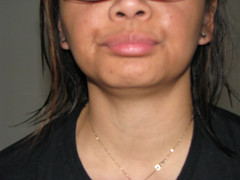
Purpose: Strengthen vocal folds and relax facial muscles.
Performance:
Keep your teeth slightly open, lips a little bit forward and face soft.
Take a low breath from the diaphragm.
Pretend to blow a bubble and allow the air in your lungs to make your lips vibrate.
Try to sustain the sound for as long as possible, until you run out of air.
Don’t pucker your lips.
Gently place your fingers on either side of your mouth if you are having trouble.
Repeat several times, trying the following variations: lip flutters without sound, staccato lip spurts without sound, lip flutters with sound (try to imitate a small motor purring), pitched lip flutters (flutter your lips while vocalizing a scale or a song).

5 Side Neck Stretch
Purpose: Relaxes your neck and shoulder muscles.
Performance:
Begin with your head level and facing forward.
Slowly tilt your head towards the right ear to stretch the left side.
Hold the stretch between 10 – 20 seconds.
Repeat, stretching the right side.
Stretch both sides at least two more times.
6 Front to Back Neck Stretch
Purpose: Relieves tension in your head, neck, back, hips and shoulders.
Performance:
Begin with your head level and facing forward.
Imagine that there is a small ball tucked under your chin.
Gently tilt your head downward, being mindful of your imaginary ball.
Hold this stretch for 5 – 10 seconds.
Repeat up to five times.
7 Side to Chin Neck Stretch
Purpose: Provides pain relief in your head, neck, back, hips and shoulders.
Performance:
Begin with your head level and facing forward.
Slowly tilt your head towards the right ear to stretch the left side.
Gently turn your chin downward towards your shoulder.
Hold the stretch between 10 – 20 seconds.
Repeat, stretching the right side.
Stretch both sides at least two more times.
Strive for a gentle stretch. Never stretch to the point of feeling pain. If your jaw makes any clicking or popping sounds when you open and close your jaw, consult a dentist before trying these exercises. Seek professional help from a doctor, physiotherapist or chiropractor if you need further guidance.
Dedicating as little as five minutes a day to stretching will ease tension, relieve jaw pain, ease neck pain and increase flexibility in musicians. If done regularly with proper technique, musicians can enjoy many years of pain-free and injury-free music-making.
Related Articles
Understanding Musician Injuries | Arm and Hand Stretches | Back and Shoulder Stretches
The Art of Practicing | Musician's Yoga: A Guide to Practice, Performance, and Inspiration | | Playing (Less) Hurt: An Injury Prevention Guide for Musicians
Social Media Links
archives
- #YYCArts 32
- #YYCEvents 39
- Collaborative Music 25
- Community 11
- Composing & Arranging 6
- Entertainment 139
- Entrepreneurship 53
- Freebies 3
- Gardening 1
- Geeking Out 65
- Health & Wellness 120
- Improvisation 25
- Interviews 28
- Learning Music 188
- Martial Arts 13
- Memorization 7
- Music 230
- Music Careers 9
- Music Education 196
- Music Examinations 7
- Music Exploration 55
- Music Gigs 14
- Music Lessons 6
- Music Performance 32
- Music Theory 13
- Musical Instruments 12
- Musician Health 19
- Pets 57
- Piano Technique 12
- Practicing Music 120
- Productivity 20
- Professional Development 11
- Recommendations & Reviews 93
- Recreation 71
- Social Media 6
- Spirituality 10
- Studio Management 33
- Studio Technology 50
- Teaching Music 146
FOLLOW THE STUDIO on Instagram


Affiliate Links
As a Sheetmusicplus and CD Japan affiliate, I earn from qualifying purchases. The earnings help fund the Studio’s blog and YouTube channels. Your support is greatly appreciated.


FOLLOW Budo no Tabi on Instagram