THE MUSICAL MUSE
Blog dedicated to music education, practice tips, health
&
wellness, and geeking out.

Music Examination Systems in Canada
An overview of the music conservatories used in Canada and the music examination boards, including RCM, ConCan and CNCM.
An overview of the music conservatories used in Canada and the music examination boards, including RCM, ConCan and CNCM.
Music examinations have played an intrinsic role in Canadian music education since Confederation. Music teachers, music students and their parents can benefit from learning more about the various curricula available so as to adopt a system that complements the teachers’ vision and the students’ goals.
The Royal Conservatory of Music – Canada’s Oldest Music Examining Board
The Royal Conservatory of Music of Toronto (RCM) was established in 1886. Notable alumni include 15-time Grammy Award winner David Foster, former Governor General Adrienne Clarkson and jazz legend Oscar Peterson.
Preparatory to Grade 10 practical examinations are available for all brass, percussion (including piano), strings and woodwind instruments, as well as accordion, speech arts and voice. Exams are offered for all levels of music theory and musicianship.
Associate Teacher/Performer (ARCT) and Licentiate (LRCM) certification are available. High school accreditation is granted for Grades 6 – 8.
Examinations can be taken worldwide in December/January, April, May/June or August. In the US, RCM Examinations is known as the National Music Certificate Program.
For practical exams, students prepare four to seven contrasting pieces from different musical periods (Baroque, Classical, Romantic, Impressionism/Late-Romantic and Modern Classical). They are also tested on aural, sight reading, rhythm and technical proficiency.
Traditional and Contemporary Music Examinations Through Conservatory Canada
Conservatory Canada (ConCan) is a merger between two regional conservatories that stemmed from amalgamations of older systems:the Western Ontario Conservatory of Music (founded in 1891) and the Western Board of Music (established in 1934).
Grade 1 – 10 Traditional practical examinations are offered for all brass instruments, clarinet, classical guitar, flute, organ, piano, saxophone, teacher development, violin, viola, violoncello and voice. Associate Teacher/Performer (ACCM) and Licentiate Teacher/Licentiate Performer (LCCM) certification are available. ConCan also offers music examinations for Levels 1 – 10 in piano, guitar and voice through its Contemporary Idioms syllabus.
Examinations are held throughout Canada in February, June and August. Partial examinations are available for the higher grades. Music theory exams are available for all levels.
Conservatory Canada offers recital assessment, teacher development and mini-lessons with the examiner. Students can apply their examination marks for high school credits in music.
Music students prepare six to eight contrasting pieces, from Baroque to 21st Century Classical for Traditional examinations. They prepare four contrasting pieces for Contemporary Idioms, ranging from ragtime to rock. They are also graded on improvisation and lead sheet playing.
For both formats, students must perform a supplemental piece. They can select one song from the other program, improvise or perform their own composition. Technical tests also assess fluency of chords, as well as jazz scales, church modes, whole tone, pentatonic and octatonic scales (much more than just traditional major/minor scales). Bonus marks are awarded if one piece is performed with a CD back-track or live jazz musicians. Aural, sight reading, harmonization, rhythm, transposition and musical knowledge are also graded.
Comprehensive Exams Through the Canadian National Conservatory of Music (CNCM)
CNCM was founded in 2002. Introductory Level – Grade 10 practical exams are offered for piano and voice (strings program in development). Certification is available in Early Childhood Music Education, Pedagogy, Associateship in Music (A. Mus.), Licentiate in Music (Lic. CNCM) and Fellowship.
Students can take a Performance Exam, where they perform a full recital programme for the examiner, family and friends (other components are tested separately). Alternately, students can take a Workshop Examination, in which all requirements are performed privately for an examiner. The parents and the teacher can attend the interactive workshop.
Students can do a “theme examination”, such as an all-Disney recital or a Canadian composer programme. As with all music examinations, solo performance is graded. However, it is possible to perform a collaborative work, such as a piano duet or a jazz combo in a theme examination.
Students must prepare at least seven works and one encore. Aural, vocalization, sight reading, harmonization, rhythm, transposition, improvisation and musical knowledge are also assessed.
Music examinations are held throughout Canada in February, May/June and August. Partial exams are available. Music theory testing is offered for all levels. CNCM has applied for Prior Learning Assessment and Recognition to grant high school accreditation.
Some Canadian music teachers and students follow a British curriculum. Two popular conservatories are the London College of Music and Media (LCM) and the Associated Board of the Royal Schools of Music (ABRSM).
Each music conservatory has something to offer; therefore it is impossible to say that one is “the best”. Music teachers contemplate several factors when deciding which system(s) to use, from their teaching philosophies and approach to their students’ skills, aptitude, interest and commitment level. These grading systems and curricula offer music teachers and students a broad spectrum in music education.
Sources:
Canadian National Conservatory of Music. Canadian National Conservatory of Music Piano Syllabus. Markham: Mayfair Montgomery Publishing, 2002.
Conservatory Canada. Conservatory Canada Piano Syllabus, 1999 Edition. Waterloo: Waterloo Music, 1999.

The Royal Conservatory of Music. he Royal Conservatory of Music Official Examination Syllabus, 2008 edition. Mississauga: The Frederick Harris Music Co. Ltd., 2008.

(2011 Edition). By The Carnegie Hall Royal Conservatory Achievement Program. For Piano. This edition: 2011. Piano. Official Syllabi of The Royal Conservatory of Music. Level 1-9 (Level 1-9). Book. 36 pages. Published by The Frederick Harris Music Company (FH.S34)
A Look at Alfred's Basic Keyboard Chart
Alfred's Basic Keyboard Chart can help music students learn how to play the piano when they are unable to be near their instrument.
Alfred's Basic Keyboard Chart can help music students learn how to play the piano when they are unable to be near their instrument.
I picked up one of these for the fun of it. However, it has proven to be a handy practice aid not just for my piano students, but for me as well. If you're going away on a trip, or need extra work on your keyboard geography, this music aid is worth checking out.
What is Alfred's Basic Keyboard Chart?
It's a simple fold-out piano keyboard made out of card-stock. One side has Alfred's Basic Keyboard Chart. If you're struggling a bit with note reading or keyboard geography, this really breaks it down for you: The note on the staff is printed right on the matching note on the keyboard.
Flip it over and you get Alfred's Basic Practice Keyboard. It's just the piano keys, all 88 of them. Full-sized too.
Ideas on How to Use Alfred's Basic Keyboard Chart
The first time I used this keyboard chart was when I was on a trip. I wasn't sure if I would have access to a piano and couldn't afford to not practice.
It was a true test to how well I knew my pieces by taking away one of my senses (hearing). I had to rely more on muscle memory and analytical memory.
Since then, I've picked up two or three "cardboard keyboards" for my students to borrow when they are away. Their biggest complaint is that they can't hear anything. I usually respond by telling them about some of the great Russian pianists who practiced mostly on a cardboard keyboard. If they can do it, then they can too.
This year, I started using it with my students who need to work on their keyboard geography. On the keyboard chart side, I labeled the notes by their keyboard number, e.g. Low C is C2. Middle C is C4.
The Good, the Bad and the Ugly About Alfred's Keyboard Chart
The good: Alfred's Keyboard Chart is compact. The four panels fold up so that it's approximately 5-1/2 inches by 12 inches. Perfect to stuff in a binder or a suitcase.
The bad: It doesn't show how notes are notated two lines above or below the staff. Nor does it show bass clef ledger line notes above Middle C or treble clef ledger line notes below middle C.
The ugly: Why are the note names and notes on the staff written upside down on the keys? Wouldn't be easier for visual learners if they were printed facing the same direction?
Alternatives to Alfred's Basic Keyboard Chart
Alfred's Basic Keyboard Chart is not the only cardboard keyboard on the block. You could also buy Hal Leonard's Keyboard Chart (approx. $1.99 USD), which tops the Amazon Best Seller List for keyboard charts. There is also Willis Music Reference and Keyboard Chart (approx. $1.76 USD). At $3.95 USD, Alfred's is the most expensive in the market.
If you want to go more high-tech, there are roll-up rubber practice keyboards, like this one:

Some are battery operated and/or come with a power adaptor. Others plug into your computer or tablet via USB.
Where to Buy Alfred's Basic Keyboard Chart
You can buy Alfred's Basic Keyboard Chart online from Amazon or Sheet Music Plus (below):
 look inside
|
Alfred's Basic Keyboard Chart Composed by Willard A. Palmer and Bill Hughes. Piano - Teaching Supplement; Posters/Charts; Resources. Other. Alfred Music #00-196. Published by Alfred Music (AP.196). |
Most local music stores carry this keyboard chart as well. In Canada, music students can check out Long & McQuade, Empire Music and Tom Lee Music.
Alfred's Basic Keyboard Chart - The Verdict
It's simple. It's compact. It's relatively inexpensive. In short, it does the trick when you are away and need to practice piano. It can help you study your note-reading and keyboard geography, if you're OK with having the keyboard upside down in relation to the note names and staff.
The Best of Soul Eater CD Review
For fans of the popular fantasy-shonen anime Soul Eater, "The Best of Soul Eater" is a great collection of theme songs, OST tracks and character songs.
For fans of the popular fantasy-shonen anime Soul Eater, "The Best of Soul Eater" is a great collection of theme songs, OST tracks and character songs.
Soul Eater fans can rejoice. As the title says, The Best of Soul Eater CD does contain the most popular tracks from the popular anime Soul Eater. Excalibur is nowhere to be heard; just 51 minutes' worth of J-Rock and J-Pop hits sung by popular artists such as T.M. Revolution and Stance Punks, as well as character songs performed by the original voice actors (seiyuu) from the Japanese production.
About Soul Eater the Anime
Soul Eater is a supernatural shonen anime based on the long-running manga created by Atsushi Okubo of the same name. Soul Eater the animated series is produced by Bones/Square Enix (Japanese) and FUNimation/Media Factory (ADR, English).
Students of the Death Weapon Meister Academy are classified as weapons or weapon meisters. There, they learn the skills and knowledge to defeat wayward souls before they turn into something worse. Weapons and meisters are paired together based on soul compatibility. They work together to collect the souls of 99 monsters in the hopes of transforming the "weapon" partner into one of Lord Death's Death Scythes. The story centers around three teams: Maka and Soul, Black Star and Tsubaki and Death the Kid and the Thompson sisters, Liz and Patty.
Punk, Rock and Pop in The Best of Soul Eater the CD
It is difficult to put The Best of Soul Eater into one classification. It's edgy J-Rock. Then, it's punk rock and then it turns into sweet and sugary J-Pop.
The Best of Soul Eater contains full versions of all the intro and outro theme songs from Soul Eater. There's "Resonance", a driving rock song performed by T.M. Revolution. Punk rock band Stance Punks perform the first outro theme "I Wanna Be", which starts simply with voice and broken chords played by the guitar. That quickly switches to a strong punk groove.
The character songs sung by the Japanese seiyuu are a welcome addition. These were first released as CD singles. "Maurve iro no Sympathy" (Mauve-colored Sympathy) is a fast J-Rock number sung by Chiaki Omigawa (Maka Albarn) and Kouki Uchiyama (Soul Eater Evans).
"My Star" is also a quick number, with more of a "battle-mode" groove, sung by Yumiko Kobayashi (Black Star) ad Kaori Nazuka (Tsubaki Nakatsukasa). One could almost picture Black Star circling his opponent and then launching in "Speed Star" mode in concert with the driving percussion.
"Sore ga Bokura no Michishirube" (It is Our Guide) is a catchy J-Pop tune sung by Mamoru Miyano (Liz) , Akeno Watanabe (Death the Kid) and Tarumi Nakahira (Patty) . Their weaving melodic lines are well-balanced. One could say, it's symmetrical (Death the Kid's obsession).
Memorable tracks from the Soul Eater anime soundtrack (Soul Eater OST) also made the cut, such as "Psychedelic Souljam" and Death the Kid's theme song "Bang! Bang! Bang! Bang! Have a Nice Dream". The CD wraps up with one bonus track, "Soul's Crossing". This is the theme song from the game Soul Eater Monotone Princess, performed by T.M. Revolution.
The Best of Soul Eater Track Listing
resonance
I Wanna Be
Style.
PAPERMOON
Bakusou Yume Uta
STRENGTH.
Mauve iro no Sympathy
My Star
Sore ga Bokura no Michishirube
PSYCHEDELIC SOULJAM
harmoNIZE
Bang! Bang! Bang! Bang! Have a Nice Dream
soul's crossing (Bonus Track)
The Best of Soul Eater Album Details
Featured Artists: T.M Revolution, Stance Punks, Kana Nishino, Tommy heavenly6, Diggy-MO', abingdon boys school, Lotus Juice and Shinya.
Music Director: Akiko Yodo, Reo Kurosu
Recording Producer: Ryo Ohyama, Keiichi Tonomura
Label: Sony Music Entertainment (Japan) Inc., Miya Records Co. Ltd.
Released: April 22, 2009
Also included: 46 page booklet containing the lyrics, performing artist, production credits.
The Best of Soul Eater CD - as Catchy, Edgy and Fun as the Anime
For fans of the anime Soul Eater, there are no "misses" on this CD. It is a well-balanced compilation of the most popular J-Pop and J-Rock songs from this hit anime. Fans of anime music and even listeners unfamiliar with the world of Soul Eater could enjoy the CD for its diversity, sound quality and artwork.
Source:
Anime News Network (accessed June 1, 2010)
September 2, 2020 Update: The Best of Soul Eater is no longer available at CD Japan and Amazon. However, you may purchase the Soul Eater Original Soundtrack 1 through Amazon.
Interview with Julie Souin of Virtual Choir 3.0
When I wrote for Suite101, I had the opportunity to interview Julie Souin from Eric Whitacre's Virtual Choir 3.0 to discuss Eric Whitacre, DCINY's Sing with Eric and Virtual Choir.
When I wrote for Suite101, I had the opportunity to interview Julie Souin from Eric Whitacre's Virtual Choir 3.0 to discuss Eric Whitacre, DCINY's Sing with Eric and Virtual Choir.
Julie Souin of Rhode Island, USA, recorded four voice parts to Eric Whitacre's Virtual Choir 3 project: “Water Night”. A total of 3,746 videos were submitted by singers from around the world. Souin sat down with Suite101 on April 25, 2012 via Skype to talk about Eric Whitacre's music, Virtual Choir and Sing With Eric.
Julie Souin on Recording Virtual Choir 2 and 3
“I obsessed over my recording with Sleep,” she recalled. “It wasn't good enough. No, I could do better.” She recorded 50 times before submitting her final video for VC2.
“I knew that it wasn't great and I could probably do even better; but it was the best I could do at the time, with the equipment that I had.” With a triumphant voice, followed by a hearty chuckle, she added, “I just felt like I conquered the world when I pressed 'Submit.' ”
Julie felt more relaxed while preparing for VC3, but had other challenges to contend with. “I had all the external issues, like my dogs making noises.” In another take, it was someone else. “My kids came home right as we're holding that last note. I'm holding one hand up to the door as they got the key in the door making a chick-chick-chick...I still submitted it!
“I think with Sleep, I would have never done that. I would have said, 'I wrecked it at the end.' With this, it was 'No, it's an OK recording'. I think I was much more forgiving with those kinds of things the second time around, knowing that a lot the little tiny things don't matter.” Turning reflective, she said, “But you do want to bring honour to the whole project and you want to bring honour to yourself in submitting the best possible production.”
Julie Souin on DCINY's Sing with Eric
In 2011, Julie's daughter auditioned and was selected to sing at Sing with Eric. This annual workshop is presented by Distinguished Concerts International – New York. “At the parent meeting,” she recalled, “I kind of jokingly said, 'Do you take parent singers?' The guy said, 'See me afterwards. I actually have a spot for you.' ” With a laugh, she added, “I was freaking out. Not only do I get to go hear this music live but now, my daughter's participating; and now I'm participating. It was a dream come true.”
Julie enjoyed herself so much that she participated again in Sing with Eric 2012, which was held March 30 – April 1, 2012 in New York, NY. Three days of intensive rehearsals with Eric Whitacre culminated with a performance at the prestigious Carnegie Hall. “To sing with the composer and to sing the music as closely as it's intended to be sung – to the best of your ability – is really a dream come true.”
Julie Souin on The Virtual Choir's Online Community
“So much of this is hard to put into words,” Julie said. After some thought, she elaborated, “The relationships that have blossomed out of this are, I feel, as real as the people I have met in real life. The people that I haven't – that I only know virtually, whether it's Google Hangouts or Skype or typing – they're like, real friendships and I would have never expected that. It was a very unexpected perk.”
Julie is full of admiration for her Virtual Choir friends. “These friends are artistic, very open people. Open to share of themselves. To give of themselves...They're very loving people.”
In addition to singing in Virtual Choir, Julie is a member of the Virtual Choir Army, a small group of singers who helped fellow VC members as they prepared their submissions. “My son is on his first deployment in Afghanistan,” she shared. “Helping people gather the courage to learn “Water Night” for VC 3.0, record and upload videos was extra rewarding. I really needed a healthy distraction from thinking about my son and his safety. Reaching out to others as well as learning and memorizing the music for our Carnegie Hall concert was just the thing. I am so grateful.”
The Water Night Premiere and Meeting Virtual Choir Members in New York
The world premiere of Virtual Choir 3.0: “Water Night” took place on Monday, April 2, 2012. It was fast on the heels behind Sing with Eric as well as the release of Eric Whitacre's latest CD, also entitled Water Night. Julie Souin attended both events.
“I'm sitting with all these people who have this vested interest,” she recalled. “A lot of them sang in the Virtual Choir. Everybody is heavily anticipating this moment and to watch it in the same room with all of them was really special.”
Another highlight for Julie was the opportunity to meet fellow Virtual Choir members in person. “Oh my gosh!” she gushed. “That was a cool thing itself. I spent a lot of time with Jack [Rowland] because we're really good friends. I picked him up at the airport. It was like we have known each other our whole lives from the get-go. From the second I saw him, there was this comfort level like a brother and sister.
“It wasn't until after the concert at Carnegie Hall and there was the rest of the gang all waiting. I met up with them and that moment was completely unreal. I saw Jack, Lynna [Schaefer] and Kevin [Callahan] and Jen [Christensen]. Then Dennis [Scannell] and Maria [Petrova].
“There were other people that joined us that I didn't know as well or I haven't known as long. The entire gang, no matter who showed up, whenever we went out or we were together, everybody was like one big happy family. It was almost like we had known each other since high school and we were having a high school reunion.”
Julie Souin on Meeting and Working with Grammy Winning Composer Eric Whitacre
When Suite101 asked “What is Eric like in person?” Julie quickly replied, “Special. Really, he's special. Not just the music he creates, but as a person. He really is super-grounded, down-to-earth, very genuine. Everything that you see in interviews? It's real.
“He's very respectful to each person he meets. He gives each person as much time as he can possibly give, in whatever situation they are approaching him.”
Julie firmly believes that Eric Whitacre's personal qualities come through in his music. “You feel that sincerity when you hear his music.”
Julie Souin on Eric Whitacre's CD Water Night
One of Julie's favourite tracks is “When David Heard”. “I can't imagine that you can make a piece that long out of so few words and it remains interesting; and you feel what the parent would feel if you were in that situation. It makes you feel something deep down. It really reaches the soul.”
When asked about the CD, Julie answered in revered tones. “I love it. It's everything I hoped it would be and thought it would be. Probably more.”
Originally published on Suite101.com on May 26, 2012. All rights reserved by Rhona-Mae Arca.
Understanding Musician Injuries
The Types, Causes and Prevention of Music-Related Injuries: Musicians are prone to injury from repeating a motion countless times when practicing. A better understanding of music injuries is vital for musicians' health.
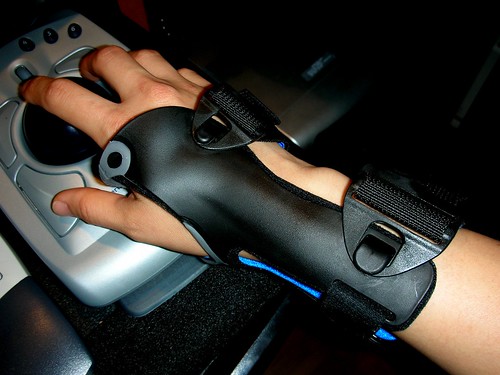
Musicians are prone to injury from repeating a motion countless times when practicing. A better understanding of music injuries is vital for musicians' health.
Common symptoms of a musician repetitive strain injury are similar to computer-related and speech-related injuries:
Numb fingers, arms, wrist, jaw, neck, shoulders and back
Shooting pain up the arms, shoulder and back
Cramping muscles or stiffness
Dull ache experienced in the fingers, arms, back, jaw, throat, wrist, shoulders and back
Hoarseness
If left unchecked, can become chronic conditions. They can potentially lead to long-term disability or end one’s musical career.
Common Types of Music Injuries
Common music-related injuries include:
Bursitis: inflammation of a bursa (fluid-filled sac which lubricates the movements of tendons, muscles and bones at joints)
Carpal Tunnel Syndrome: inflamed or irritated hand flexor tendons
Larynx Contact Ulcers: raw sores on the mucous membranes covering the cartilage attached to the vocal chords
Cubital Tunnel Syndrome: inflamed or irritated tendons affecting the inner side of the forearm and the pinky side of the hand
Laryngitis: inflammation of the larynx
De Quervain's Tenosynovitis: inflammation of the tendons on the side of the wrist beginning at the base of the thumb.
Tendinitis: inflammation of the tendons
Thoracic Outlet Syndrome: compression of the thoracic outlet, the nerve pathway and/or blood vessels between the base of the neck and the armpit
Trigger Finger: inflammation of the index finger tendons
Vocal Nodules & Polyps: small, inflammatory or fibrous growth on the vocal cords of people who strain their voices.
How Music Injuries are Caused
Overuse: Advanced musicians practice between one to ten hours a day.
Repetitive Strain: Musicians repeat a technical exercise or section of music countless times until it comes together.
Improper Posture: Some musicians slouch, sit too close or too far from their instrument and remain in the same position for long periods of time.
Non-Ergonomic Technique: Some musicians hold their body and/or instrument in an uncomfortable position, don’t move their hand and/or body in the direction that their fingers are moving, push their fingers or vocal chords beyond what they can comfortably do.
How to Prevent Music Injuries
Do Your Research: Find out more about the various types of music-related injuries.
Assess Your Instrument: Is your instrument the right size, shape, weight and height for you? Would an adjustable chair, footstool, strap or cushion make you more comfortable?
Know Your Body: Choose pieces that are reasonable for your body to play. If you have small fingers, playing repertoire that requires you to stretch beyond your finger span is a recipe for disaster. However, if you really want to learn a particular piece (or you need to learn it), make adjustments to make it easier to play. If you are a student, let your teacher know right away whether a piece or technical exercise is causing you pain.
Appraise Your Playing Technique: Is your body relaxed? Are your hands, arms, neck, head and core positioned to allow for fluid and comfortable playing or singing? Are you moving with the music? Are you using excess movements? Is your fingering logical and comfortable? Videotaping yourself is a valuable method to assess your playing technique.
Evaluate Your Non-Musical Activities: Desk and computer work, sports, dancing, carrying heavy objects (or dependents) and hobbies can adversely affect your body.
Do Warm-Up Exercises and Stretches: Musicians are sometimes called “small muscle athletes”. Stretching exercises and gentle warm-ups result in increased range of motion, strength, coordination and flexibility.
Take Breaks: One’s muscles, ears and vocal chords need regular breaks to return to their relaxed state. Not doing so tricks the body into thinking that “tense” is the “relaxed state”, resulting in chronic pain and stress.
Engage in Active Sitting: Most musicians remain in a seated position for extended periods of time. Active seating helps ease chronic back pain, promotes correct posture and maintains general health.
Seek Professional Advice: Speak to a doctor, chiropractor, massage therapist, Alexander Technique specialist, music instructor, otolaryngologist or ergonomic specialist for further information or treatment.
Be Proactive in Maintaining Musician Health
With an increased understanding of the types, causes and prevention of music injuries, musicians can be more proactive in maintaining their first instrument: the body. Musicians dedicated to maintaining musician health can look forward to many years of pain and injury-free music-making.
The Rest of My Series on Musician Injuries
Face and Neck Stretches for Musicians | Arm and Hand Stretches for Musicians | Back and Should Stretches for Musicians
Additional References:

The Art of Practicing: A Guide to Making Music from the Heart, Madeline Bruser (New York: Bell Tower, 1999)
Musicians' Injuries: Types and How to Avoid It, Espie Estrella
Musicians and Injuries, UN-L Engineering Electronics Shop, University of Nevada
Originally published on Suite101.com on November 20, 2009. All rights reserved by Rhona-Mae Arca.
Social Media Links
archives
- #YYCArts 32
- #YYCEvents 39
- Collaborative Music 25
- Community 11
- Composing & Arranging 6
- Entertainment 139
- Entrepreneurship 53
- Freebies 3
- Gardening 1
- Geeking Out 65
- Health & Wellness 120
- Improvisation 25
- Interviews 28
- Learning Music 188
- Martial Arts 13
- Memorization 7
- Music 230
- Music Careers 9
- Music Education 196
- Music Examinations 7
- Music Exploration 55
- Music Gigs 14
- Music Lessons 6
- Music Performance 32
- Music Theory 13
- Musical Instruments 12
- Musician Health 19
- Pets 57
- Piano Technique 12
- Practicing Music 120
- Productivity 20
- Professional Development 11
- Recommendations & Reviews 93
- Recreation 71
- Social Media 6
- Spirituality 10
- Studio Management 33
- Studio Technology 50
- Teaching Music 146
FOLLOW THE STUDIO on Instagram


Affiliate Links
As a Sheetmusicplus and CD Japan affiliate, I earn from qualifying purchases. The earnings help fund the Studio’s blog and YouTube channels. Your support is greatly appreciated.


FOLLOW Budo no Tabi on Instagram