THE MUSICAL MUSE
Blog dedicated to music education, practice tips, health
&
wellness, and geeking out.
Excited About My New Accompaniment Gig
Playing ensemble music reminds me of the Tamil Indians. You create something different each time you play with a different group or a different song. I'm looking forward to my newest accompanying project. Four really fun tunes.

I can see why my friends and colleagues who gig regularly enjoy playing with different groups of musicians. The easiest way for me to explain how it makes me feel is to use an analogy from anthropology:

The Tamil Indians believe that all living and inanimate substances are fluid essences. That is, me typing on studio computer keyboard, staring at my computer screen make up a new "joint" substance. Every music ensemble and every project is akin to this.
This week and next, I am working with a school choir in preparation for their in-school music festival. I've worked with the music teacher before but with a different choir. Different context. Different ensemble. Totally different music.
The pieces are simply charming. I'm having a great time learning the music. It's energizing as it's different from what I've been working on lately.
First, there's Antonio by Jay Broeker:

By Jay Broeker. For 2-part voices and piano. Concert. Octavo. Published by Santa Barbara Music Publishing (SB.SBMP-873)
It's the trickiest of the bunch. The lyrics are funny and tune sticks in your head for hours.
Nick Page's Fairest Lady is a beautiful ballad:

((No. 7 from The Nursery Rhyme Cantata) CME Beginning). By Nick Page. For Choral, Chorus, Piano (UNIS). CME Beginning Series. 8 pages. Boosey & Hawkes #M051471799. Published by Boosey & Hawkes (HL.48004859)

(1)
Spirits by Douglas Beam is deliciously spooky. The fourth piece is Pirate for a Day by Roger Emerson:


By Roger Emerson. For Choral (2-Part). Youth Sing Out (Choral). 12 pages. Published by Hal Leonard (HL.8564233)
It makes me giggle whenever I practice it. Every. Single. Time.
I am enjoying my work with the choirs so far and look forward to hearing what kind of music we create together onstage.
Tips for Practicing Music - Speed Linking
Many musicians DON'T practice properly. Save yourself some headaches by checking out some of these practice tips.

Sometimes, it may seem like we music teachers are harping on the same things. Well, there's a reason for that. We've been where you are right now and we hope that some of our pearls of wisdom, learned from years of learning and practicing music help you to learn your music more quickly and more effectively.
Here are some tips from other music teachers and pro musicians on how to practice music:

An Introduction to Music Examinations
Learn about what is involved with music exams, from exam requirements to pros and cons and from examination types to what examiners are looking for.
Learn about what is involved with music exams, from exam requirements to pros and cons and from examination types to what examiners are looking for.
According to the Royal Conservatory of Music of Toronto (RCM), over 100,000 students register for an exam annually through RCM Examinations (National Music Certificate Program in the US). As there are other music examination systems, the true figure is even higher. Before registering for a music test, having a basic understanding of what is involved can help with preparations.
What Happens in a Music Examination?
There are two types of music examinations: practical and music theory. In a practical exam, students prepare several contrasting pieces for their instrument. Genres include Baroque, Classical, Romantic, Impressionism/Late-Romantic, Modern Classical, pop/rock, jazz and Latin.
Music students should be able to execute technical exercises with a high level of fluency and accuracy. They are also tested on aural, rhythm and sight-reading skills. Depending upon the exam system, students may be tested on improvisation, keyboard harmony, oral questions, transposition and memorization.
All music conservatories have a syllabus for each instrument which lists recommended repertoire for each grade. Syllabi also include a detailed description of technical requirements and music theory co-requisites.
Music theory exams are generally written examinations, although some conservatories offer keyboard harmony tests. Beginner and intermediate students are assessed on rudiments, while advanced students take exams in music history, harmony, counterpoint and analysis.
The Pros and Cons About Music Examinations
Music teachers in professional associations, such as the Canadian Federation of Music Teachers’ Associations and discussion groups like LinkedIn have debated about the benefits and downsides to music examinations.
The benefits of taking a music examination are varied. In Recognition of Accomplishment, RCM states some of the benefits as being:
certificates and awards
high school credits for music classes
motivation to achieve a goal
personal growth through achievement
post-secondary school eligibility
Music examinations aren't for everyone. They can be stressful, especially if one is unprepared. They require a strong commitment from the students, parents and teacher. Students preparing for an examination require more practice time than recreational students. Supplemental repertoire sometimes gets pushed aside to focus on the examination requirements.
All practical examinations test solo performance. However, two Canadian systems, Conservatory Canada and the Canadian National Conservatory of Music do allow the examination candidate to perform a collaborative work to a CD track or live combo (some restrictions apply).
Although there are grading standards, marking is highly subjective in music exams. At music teacher workshops, conferences and discussion forums, music educators have discussed examination issues such as inconsistent customer service and marks that don’t reflect the examiner’s comments.
The music examining boards used in Canada offer slightly different programs. Music teachers will generally specialize in one or two conservatory systems. Students interested in taking music exams can inquire at the audition-interview which conservatory the teacher follows.
About the Music Examiners
Music examiners are music professionals with at least an undergraduate degree in music. These educators have taught for many years and have prepared students for music examinations.
They must also have experience adjudicating at music festivals or competitions and be members of good standing in a professional teaching association. Some are composers, performers and sought-after clinicians for pedagogical workshops and conferences.
To be a member of the College of Examiners, candidates must complete the conservatory’s training program. Music examiners grade exclusively for one conservatory.
What are Examiners Looking for in a Music Exam?
For practical examinations, examiners look for a high level of proficiency in exam pieces, technical exercises, aural, rhythm and reading tests. They assess articulation, dynamics, fingering, notation fluency, phrasing, rhythm, tempo, tone and an understanding of the musical style.
For music rudiments, students are tested on various aspects of music, including musical terms, scales, chords, intervals, rhythm, key recognition and analysis. Advanced music theory exams test students’ knowledge of various areas, including musical periods, structure, composers, significant pieces of repertoire and harmonic analysis.
For all music conservatories in Canada, 60 – 69% merits a passing grade. Honours is awarded for marks between 70 – 79%, First Class Honours is given for marks between 80 – 89% and First Class Honours with Distinction is given to students who earn 90% or higher.
Regardless of the motivation for taking music examinations, preparing for and taking an exam can be a stressful experience. However, with solid practice habits, a supportive teacher and family, taking a music exam can also be a rewarding experience. It is beneficial to have a good understanding of what the requirements, concepts and commitment involved are before preparing for a music exam.
References:
Canadian National Conservatory of Music. Canadian National Conservatory of Music Piano Syllabus. Markham: Mayfair Montgomery Publishing, 2002.
Conservatory Canada. Conservatory Canada Piano Syllabus, 1999 Edition. Waterloo: Waterloo Music, 1999.
Royal Conservatory of Music: College of Examiners (accessed August 11, 2010).
Royal Conservatory of Music. The Royal Conservatory of Music Official Examination Syllabus, 2008 edition. Mississauga: The Frederick Harris Music Co. Ltd., 2008.
Originally published on Suite101.com on August 11, 2010. All rights reserved by Rhona-Mae Arca.
Interview with Chad Ohman of Virtual Choir 3
Last year's interview with Chad Ohman of Virtual Choir 3.0 makes it to its new home on my blog.
Suite 101 met Chad Ohman of Canada, one of the 2,945 singers who submitted 3,746 videos for Eric Whitacre's Virtual Choir 3.0, "Water Night".

Saxophonist and vocalist Chad Ohman is one of the 2,945 people from 73 countries who submitted a video for Eric Whitacre's Virtual Choir 3.0 project: Water Night.
Ohman, a second-year music education major at the University of Alberta, submitted four videos for VC3.0: Tenor 4, Bass 1, 2 and 3. He sat down with Suite101 on April 18, 2012 to talk about VC and music's impact on his life.
Chad Ohman on Discovering Virtual Choir
“It was right after they closed submissions that I heard about Virtual Choir 2.0,” Ohman recalled. A friend who also sang with him in Edmonton's Kokopelli Choir told him about it. When he watched the virtual performance of Whitacre's “Sleep”, he was amazed.
“This is incredible for people to sit in their bedrooms, in their closets, in their cars. Wherever they could find a quiet place and sing. To have their voices come together and make this gorgeous sound that is like a choir sitting in a loft somewhere,” he remarked.
Chad Ohman on the Virtual Choir Community
In December 2011, composer Eric Whitacre announced on his website that the song chosen for Virtual Choir 3.0 was “Water Night” from his Grammy Award-winning album Light and Gold.
“December came along and I started working on “Water Night”,” the dual instrumentalist said. “January came around and then I started helping people because I noticed other people were helping people get their videos together.” He soon met other people who volunteered to answer questions and help singers troubleshoot right up to the final hours of submission. One small group of helpers formed what Eric Whitacre calls the “VC Army”.
“I started meeting these people that were helping,” Ohman commented. “These are some really stellar people. Full, big hearts.”
The VC Community continues to blossom on Skype, Facebook and Google Hangouts. What began as technical and moral support has developed into friendships and in Ohman's case, something more.
“I would never have thought in December that I would meet all of these people.” Ohman reflected. “That I would talk to these great people from all over the country, all over North America and all over the world...and learn so much from them. Nor would I have ever thought in December that I would meet this girl who would eventually fly up here for her spring break.”
“Water Night” World Premiere at Lincoln Arts Center
A total of 3,746 videos were submitted from around the world which were put together into one virtual “performance” that was unveiled on April 2, 2012. The event, which took place at the Lincoln Arts Center in New York, NY, was streamed live all over the world.
Ohman recalled the moment he watched Virtual Choir 3.0 for the first time. “Finally, the video dropped and we were sitting in the Hangout, just in awe,” he reminisced. “We were listening to Eric talk. We were listening to John Corigliano and Chris Anderson – the guy from TED – talk about the idea of Virtual Choir and what it's done to the choral area of music: bring people together and get people to sing who haven't sang in 30 or 40 years. I think that is the coolest thing ever."
“It's allowing people to sing again. It's letting people sing in a group again, especially in areas where they don't have a choir to sing with,” he added.
Chad Ohman On Future Projects
Chad Ohman, along with several members of the VC Army from Canada, the United Kingdom, Puerto Rico and Australia continues to work on multi-track projects. The first was a video wishing Eric Whitacre good luck prior to the 2012 Grammy Awards.
Ohman recorded the conductor track and is editing the group's current project, Morten Lauridsen's O Magnum Mysterium. The experience is teaching him some lessons. “I came to the conclusion that it's not going to sound perfect,” he stated.
“The more videos and the more voices that I've put into it, the better it sounds and the more full it sounds,” he said. “The harmonies come out where they should. If you stop the player and stop it for a second and listen to the separation of voices and the pitches, it sounds really good.
“Then you play the whole thing and then you hear some missed entrances,” he continued. “There's some late exits. There's some esses here and there. I think it's really cool because it adds character to the music.
“That's the whole reason we came together – to sing together. Who cares if it doesn't sound perfect? It's all of us singing together and that's all that matters.”
After some thought, he added. “Music isn't supposed to sound technically perfect. That's why I love performances. Those little tiny mistakes make the music for me. That's what adds personality. That's what adds character to the music.”
Chad Ohman on Lessons Learned from Music
“We could go on about this for a while,” he said with a laugh. “Definitely to be more tolerant of people...as well to be more accepting of people and their beliefs,” he added.
“Music isn't all about competing and who sounds the best," said Ohman. "It's about sharing music, hearing new music, appreciating another group for what they're singing or what they're playing. What they're bringing to the table. What qualities they possess that you don't possess and how you can learn from them and make that a part of what you're doing.”
Upon a moment's reflection, Ohman added, “Music has really changed my life in the people that I've met and what I've learned from them. I can't let that go.”
Post script: Although Chad's career focus has changed since this interview, music continues to play an active role in his life.
Originally published on Suite101.com on April 23, 2012. All rights reserved by Rhona-Mae Arca.
Red and White Calgary Comic and Toy Expo 2010 Review
Star Wars shirts, vintage comics and memories abounded for collectors at the 2010 R&W Club Comic & Toy Expo, held Sunday, October 17, 2010 in Calgary, AB.
Star Wars shirts, vintage comics and memories abounded for collectors at the 2010 R&W Club Comic & Toy Expo, held Sunday, October 17, 2010 in Calgary, AB.
For one day each year, Calgary’s Red & White Club is transformed into “geek heaven” for fans of vintage comics, toys and collectibles. 2010 marks its 16th year, making this Calgary’s oldest comic expo.
Artist Alley Provided Relaxed Atmosphere to Chat with Guest Artists
This year’s special guests at the Red & White Comic and Toy Expo were comic illustrators Cary Nord and Riley Rossmo. Nord is well recognized for his work for Marvel Comics and Dark Horse Comics. His illustrations have appeared in Ghost Rider: Crossroads, Star Trek: The Next Generation and Conan the Barbarian.
Rossmo has worked for AIT/Planet Lar, IDW Publishing and Image Comics. His credits include Proof and Cowboy Ninja Vikings. He graduated from ACAD and got his start doing generalist illustrator.
“I really love comics and migrated from there to comic books,” he said during a brief chat with Suite 101. His first break in comics was in 2006 for Seven Sons, a graphic novel.
Although he has been to other comic book conventions in Calgary, Seattle, Toronto and San Diego, Rossmo prefers the laidback atmosphere at the R&W Comic & Toy Expo. “I have more time to just relax and talk to people. I don’t have to rush.”
Contests and Giveaways at the Red & White Calgary Comic and Toy Expo
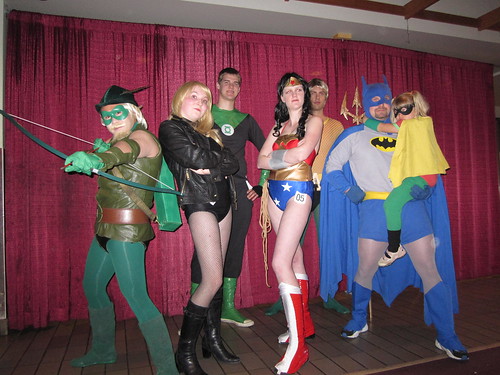
Nineteen fans, representing a diverse mix of shows, comics and ages, entered this year’s costume contest. They paraded around the 13,400 square foot room for all vendors and visitors to see.
Among the entries were Black Canary (Jessica Lowe), Aqua Man (Dave Cunningham) and Wonder Woman (Katie Herrington). This was the second year Herrington and Cunningham attended the show, while 2010 marks Lowe’s third time.
“I planned this since Comic Con,” said Herrington, who began making embellishments and improvements to the original Wonder Woman costume she purchased in the summer. The belt was her pride and joy.
“I found out about this last night,” admitted Bailey Parker, who cosplayed a Timelord from Dr. Who. She spent 18 hours making the ornate headdress out of craft foam and hot glue. Although her costume is a work in progress, it was good to earn an Honorable Mention.
Viking Venom also received an Honorable Mention. Third place went to Batman & Robin, while two Halo marines snagged second place. First place went to young Aurora Quilliams, who portrayed Dalek from Dr. Who.
All of the cosplayers acted for the camera while independent filmmaker Phil Spink (The Godchild) captured the action. Spink also conducted on-site interviews with visitors and vendors.
A variety of door prizes were awarded throughout the day. These were donated by the vendors.
A Treasure Trove of Video Games, Cool Shirts and Old Comics
There was an eclectic mix of comics, toys and collectibles up for grabs at the R&W Comic and Toy Expo, including Pac-Man belt buckles, Kingdom Hearts tee-shirts, mint condition issues of Battle of the Planets and an old LP featuring the original Spock from Star Trek, Leonard Nimoy. Gamers could buy old computer and video games, such as Tetris and Street Fighter, as well as old game systems.
John Quong, owner of the Treasure Cove, has been a vendor at the Comic & Toy Expo since its inception. He left his career in criminal law to take a brief sabbatical to indulge in his passion, comics and toys. “All of a sudden, the two-year sabbatical turned into 23 years in the business,” he chuckled.
His experience has been extremely positive. “This is my love. This is my era. I love dealing with this stuff and the people that know what it is and appreciates it just as much as I do.”
For Sid Olivier, 2010 marks his debut at the Red & White Club Comic & Toy Expo. He sells old collectibles and toys at Where on Earth Did You Get That?, Southern Alberta’s largest antique mall. “I have a personal fascination with what I call the “hunt”. The thrill of the hunt,” he explained. “Making the find has always been a kick. I love the history. I love the research element to it.” One of his unique finds on display was an old Ronald McDonald phone that was given only to store managers.
Although there was a voluminous selection of comics new and old, there was a limited selection of anime and manga merchandise. “We didn’t see much in the way of anime,” remarked Alina Zaitsoff, an anime and manga otaku and first-time attendee at the expo. “A few random figures. The only one that popped out was Vash the Stampede but it was poor quality.”
The Red & White Comic ad Toy Expo – No Hollywood Glitz, Just a Place to Buy Stuff
“A lot of the shows are veering off into celebrities, autographs and photographs and that’s fine,” said Michael Pavlic, one of the organizers of the Calgary Comic and Toy Expo. Pavlic, who owns Purple Gorilla Comics, joined forces with Ben Falconer of Phoenix Comics this year to organize the event after Steve Fuller stepped down.
“There is a demand in this town, in Southern Alberta for folks who want to come and buy some comics and toys. They don’t care about autographs; they don’t care about any of the rest of that stuff. They’re here to buy some swag. That’s what we’re all about.”
Like many avid comic collectors, Pavlic’s love for comics goes beyond being a hobby. “It’s been a lifelong passion, not hobby. Passion.”
Pavlic’s passion for comics was fueled by a childhood memory. “I was visiting my aunt who was at university at the time,” Pavlic explained. “One of her room-mates had a bunch of comic books. He handed them to us and I looked through one. There’s this one image in this issue of Fantastic Four that burned into my brain.”
He never forgot the experience of looking at that one illustration. When he began collecting comics years later, he set off to track down that issue. “It took me eight years to find out which one it was.”
Final attendance figures for 2010 are 850, comprised of 600 adults and 250 kids. In previous years, the Red and White Comic and Toy Expo entertained between 500 – 700 attendees a year. This year’s event, which took place on October 17, 2010 at the Red & White Club featured comic artists Cary Nord and Riley Rossmo. Vendor tables triggered waves of nostalgia with cool shirts, old computer and video games, vintage comics and figurines.
Originally published on Suite101.com on October 21, 2010. All rights reserved by Rhona-Mae Arca.
Social Media Links
archives
- #YYCArts 32
- #YYCEvents 39
- Collaborative Music 25
- Community 11
- Composing & Arranging 6
- Entertainment 139
- Entrepreneurship 53
- Freebies 3
- Gardening 1
- Geeking Out 65
- Health & Wellness 120
- Improvisation 25
- Interviews 28
- Learning Music 188
- Martial Arts 13
- Memorization 7
- Music 230
- Music Careers 9
- Music Education 196
- Music Examinations 7
- Music Exploration 55
- Music Gigs 14
- Music Lessons 6
- Music Performance 32
- Music Theory 13
- Musical Instruments 12
- Musician Health 19
- Pets 57
- Piano Technique 12
- Practicing Music 120
- Productivity 20
- Professional Development 11
- Recommendations & Reviews 93
- Recreation 71
- Social Media 6
- Spirituality 10
- Studio Management 33
- Studio Technology 50
- Teaching Music 146
FOLLOW THE STUDIO on Instagram



Affiliate Links
As a Sheetmusicplus and CD Japan affiliate, I earn from qualifying purchases. The earnings help fund the Studio’s blog and YouTube channels. Your support is greatly appreciated.


FOLLOW Budo no Tabi on Instagram