THE MUSICAL MUSE
Blog dedicated to music education, practice tips, health
&
wellness, and geeking out.

20 Piece Polishing Challenge Video #2: Bourée in F Major
For the second piece in my challenge, I chose a piece that would juggle nicely with Easter Triduum music and getting speed and memory secure in Typhoon. I picked Telemann's Bourée in F Major.
For the second piece in my challenge, I chose a piece that would juggle nicely with Easter Triduum music and getting speed and memory secure in Typhoon. I picked Telemann's Bourée in F Major.
ABOUT BOUREE IN F
Composer: Georg Philipp Telemann (1681 - 1767), Germany
Source: RCM Level 7 Repertoire
Notable Score Markings: M.M. = 88 - 100 to the half note, devoid of expression and dynamic markings
Prior Experience with the Piece: I've taught this lively piece many times as it is a favourite choice amongst my Royal Conservatory students.
Learning Challenges: Jumps, voice balance, fingering, speed
My Practice Log
Day 1: Ran through the entire piece. Reviewed patterns and structure. Identified fingering and coordination trouble spots. Did a bunch of blocked chord drills while yelling out the chords. Remembered to record practice videos to show how I drilled the trouble spots.
Day 2: Did a full run-through - cold. Tempo was just a few notches below the recommended tempo but wasn't able to maintain it during the trouble spots. Played around with ornaments and terraced dynamics. Will try a couple of different coordination and flow drills next practice.
Day 3: During my student's lesson, I showed her how I worked on her trouble spot in bars 10 - 12 using the Twice as Hard Drill. We dissected the harmonic structure in the B section.
Day 4: Did some slow run-throughs with and without the metronome, using the Every Other Bar Drill to work on flow. Decided to record a snippet of running through the second page for Instagram account. Naturally, I picked a spot where I wasn't swearing at myself for messing up.
Day 5: Did a full run-through of the piece at around while stopping to drill spots where I stumbled. Tried playing through again at a slower tempo (approximately 70 beats per minute). It was flowing fairly well. Dynamics and shaping is all there, if I can get the flow more consistently, then we're good enough to perform.
Day 6: Played with the metronome set at 66 beats per minute to start. Got up to approximately the 76 bpm range sounding confident and fluent. Piece felt rushed and wobbly at a faster tempo.
It is important to note that most Baroque music is devoid of markings. That leaves tempo, dynamics, and expression up to the musician, based upon their knowledge of Baroque music and performance practices. Although the RCM book does specify a tempo marking, note that it's only a recommendation.
Bourée the piece is based on bourée, the old Baroque dance. The important things to convey are the characteristics of the dance - upbeat and bouncy - along with the period characteristics of terraced dynamics and ornamentation. If that can be conveyed at a slightly slower or faster tempo than what RCM recommends, that's perfectly fine.
Having said that, I felt comfortable and confident enough with my Bourée in the the mid 70s range and decided to record. I wound up with a strong run-through on the first take. I did try for a second take in hopes of getting a cleaner performance but the magic was gone. This is still a fluent performance, so I'll take it.
Piece number #3 is in the works. I tried recording a practice video today but my camera batteries died and I wasn't too happy with my webcam and mic either. A clear sign that it's time for me to move on to practising music for this weekend's Easter services.
You can follow my progress with this challenge by checking out these two playlists:
My 20 Piece Polishing Challenge Playlist - contains the video performances
My Practice Videos - show how I work through some of the common trouble spots
The practice drills I have referenced are part of Maestro's Music Tricks - a deck of cards with practice drills that I have put together with my students' help. It's going to be getting a reboot later this year. Stay tuned for details.
Check back here for my thoughts and musings as I work through the pieces.

Repertoire Exploration Project: Conservatory Canada Pre-Grade 1 Repertoire
When I was growing up, we had to go to the library to hear various recordings of our pieces. With technology, it is much easier to access various performances of pieces - but only some pieces. I have decided to record my exploration through student repertoire that hasn't received as much screen time (or any at all)...First up: Conservatory Canada's Pre-Grade 1 repertoire.
When I was growing up, we had to go to the library to hear various recordings of our pieces. With technology, it is much easier to access various performances of pieces - but only some pieces. I have decided to record my exploration through student repertoire that hasn't received as much screen time (or any at all). It will take a while, but I hope to playing everything in the Royal Conservatory of Music and Conservatory Canada syllabi.
My students have generally been excited to hear that I'm taking their pieces to the next level by polishing them as well. One of my adult students was so happy to hear the news as it is somewhat disheartening to only see performances of half-pint prodigies playing your piece.
First up: Conservatory Canada's Pre-Grade 1 Repertoire. This was a lot of fun to do, mainly because I didn't have to think too hard about these pieces. I simply had to concentrate on enjoying the music.
There's nothing like playing pieces that show you just how far you've come in your musical journey. And if they help a few piano students and teachers along the way - great.
The playlist is still a work in progress. I've recruited several of my senior students to help me record the duets. I also need to record the songs that were added to the second edition of the Pre-Grade 1 book.
The Conservatory Canada Pre-Grade 1 Book is available at most local music stores. Alternatively, you may order it at Sheetmusicplus via my affiliate link below:
 look inside
|
New Millennium Pre Grade 1 Piano Conservatory Canada NOVUS VIA MUSIC GROUP. 32 pages. Published by Hal Leonard (HL.139032). |
I'll be hopping around in my repertoire review, prioritizing the pieces that my students are currently working on over the rest. Visit the studio's YouTube Channel for updates.

On Becoming a Bulletproof Musician
The theme at last week’s group classes was becoming a bulletproof musician. The idea has been percolating in my mind ever since I discovered Dr. Noa Kageyama’s blog on performance anxiety and mindful practice, called The Bulletproof Musician.
The theme at last week’s group classes was becoming a bulletproof musician. The idea has been percolating in my mind ever since I discovered Dr. Noa Kageyama’s blog on performance anxiety and mindful practice, called The Bulletproof Musician.
Naming Our Fears
“Named must your fear be before banish it you can.” ~ Jedi Master Yoda
Each class had a different set of fears. I compiled everything that gives them performance anxiety below:
Everyone is watching
Making a mistake and everyone knowing it
Family teasing after making a mistake
Another student (known for giggling)
Messing up
Getting stuck
Stumbling and not being able to continue
Forgetting the music
Losing control
Not being ready (or able) to perform
People crowding too close to the piano
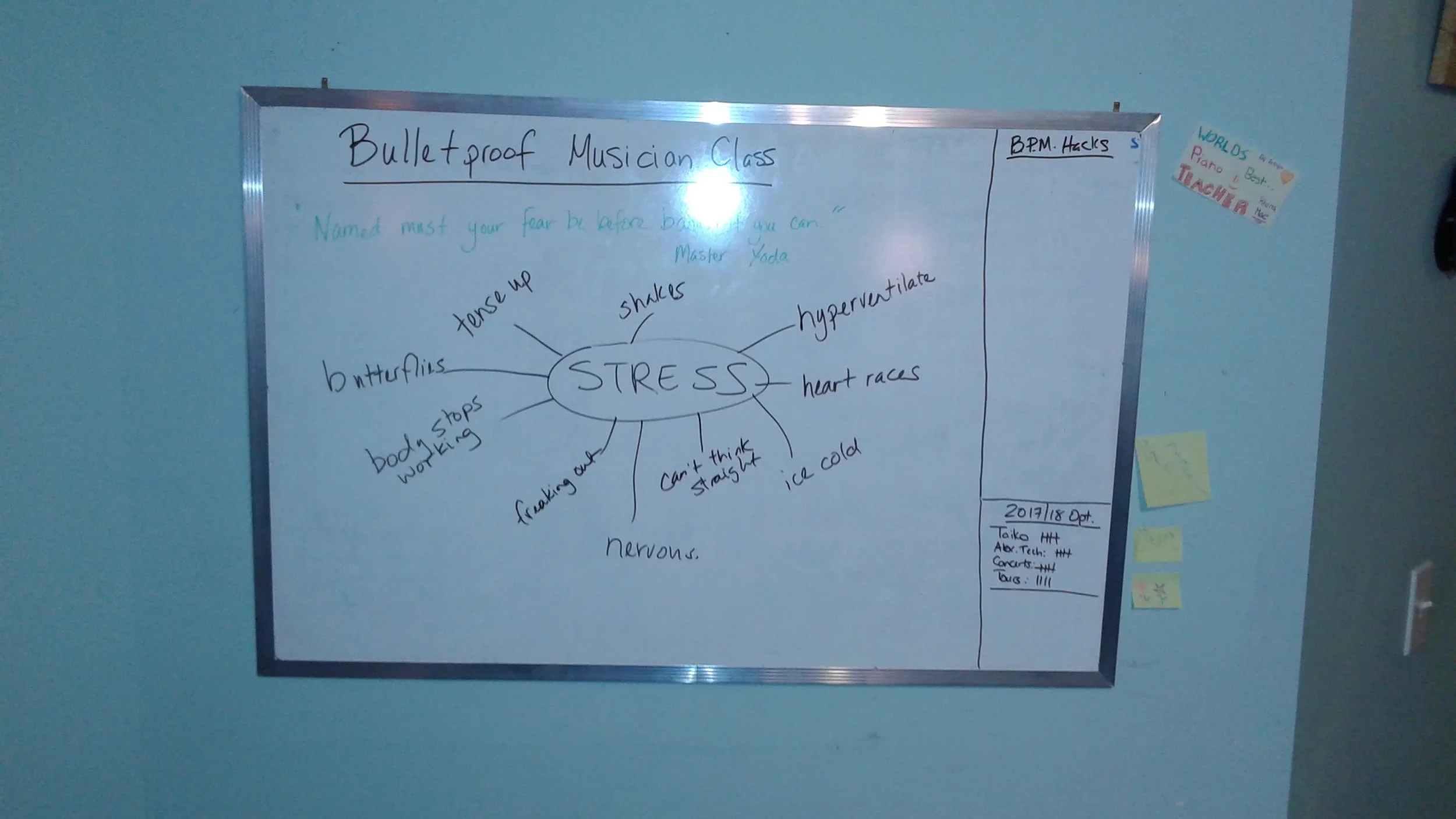
Most people share the same reactions when the body is under stress. Credit: Rhona-Mae Arca.
We discussed how our body reacts to performing under pressure or stress. To generate a paradigm shift, I showed my students this video by author and motivational speaker, Simon Sinek on performing under pressure:
It really comes down to convincing ourselves that yes, we really can do this. With a few practising and performing hacks, we can train ourselves to rush forwards to the stage with excitement rather than fear.
Creating the Ultimate Pre-Performance Routine
We all have our pre-performance routines. It could be lining up your pens, pencils, eraser, and ruler in a particular way before writing a test. Or wearing your lucky suit for a job interview. They’re little things, but they reduce our stage anxiety by helping us feel comfortable, grounded, and strong.
I read out professional tennis player Rafael Nadal’s 12-step pre-game routine. Most of my students giggled by the fifth (flicking the dirt of the hash mark with his left shoe). They were downright incredulous by the time I read out #10 (the order he wipes the sweat off his nose).
My students immediately poked holes in the routine: “What if both balls are fuzzy?...What if the ref tells him to hurry up?” I asked, “What if it’s raining?”
I then shared with them some of my pre-performance routines, starting with Mr. Buffalo. For most, it was the first time they heard about why there’s a photo of a buffalo sculpture above the piano.

Mr. Buffalo helped me ground myself before performing in master classes and recitals. Credit: Rhona-Mae Arca.
At my first piano lesson with Elinor Lawson at the University of Lethbridge, I was so nervous that I couldn’t focus. Elinor told me to take a deep breath, look out the window, and focus on a point. Standing stoically on the coulee, was the buffalo sculpture.
It got to the point where I either had to go outside before performing to commune with Mr. Buffalo, or just imagine him. Prior to my junior recital, one of my profs told me that I was too tightly strung up. He told me to go outside, scream, and shake it all out. That helped too.
Although I don’t need to do any of those stress busters these days, my photo of Mr. Buffalo just serves as that quick visual cue to ground myself. These days, my pre-performance routine includes: having a light practice the night before, eating one of my favourite meals for supper, doing something relaxing the night before, getting a good night’s sleep, picking out and testing a performing outfit that matches the mood of my piece(s) - and having a back-up, eating light prior to performing, stretching, and breathing exercises.
Then, it was their turn. Here are some of my student’s pre-performance ideas: jump, roll on grass, pack a lucky charm, sit in a sauna, swim, scorestudy, read a book, do something unrelated to the performance/test/presentation, keep your cool, sleep, watch TV, play video games, meditate, be at home and, be peaceful.
My students took a few minutes to come up with their own pre-performance routines and a mantra. Some notable mantras include:
Iz all gud.
I got this.
Nothing can stop me.
Calm down.
Play like you practiced!
I can do it.
What’s the worst that could happen?
Did I remember to turn off the stove?
Let’s go!
I am the captain of my own soul.
Let’s rock and roll!
Be aware of everything.
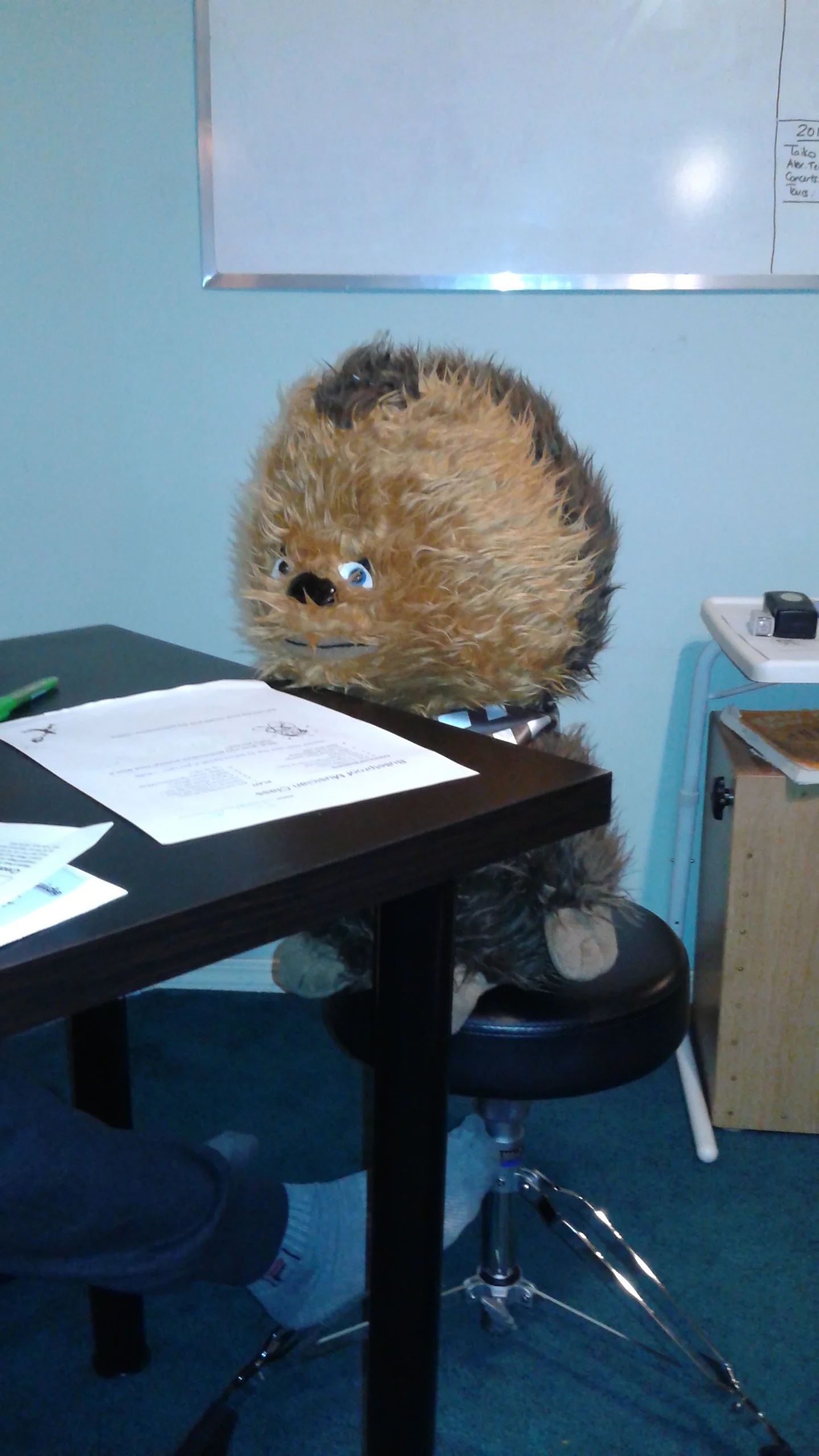
One of my younger students decided that Chewbacca had to participate in last week's group class. Credit: Rhona-Mae Arca.
Although some of my students are too young, I addressed the challenges of using drugs or alcohol to calm down nerves. Two teens looked at me, shocked. “But Miss Rhona! We’re not old enough.” I replied that I knew that, but that I also know that underage drinking does exist. There's always someone out there who just may try it.
Performance Savvyness
Next up, looking good on stage. We covered everything from showing up early enough to scope out the area and to find a place to relax. We discussed the pros and cons of being in the hall to hear the other students perform (depends upon the performance). Most importantly, we talked about owning the stage from the moment we get up from our seat until the moment we are off the stage, which covers: the walk, the bow, taking time to make adjustments (seat, music, bench), taking a few deep breaths, and approaching/leaving the keys in a way that matches the mood or character of your piece.
Telling a story through body language and sound. Credit: Rhona-Mae Arca.
Students came up, described their piece to the class and then played the opening. Their peers responded with how well their actions lined up with the piece. This turned out to be a fun exercise for all, trying to get the opening to look and sound epic or like little bunnies.
Exploring Practice & Performing Hacks
“The terror of performing never goes away. Instead, you get very, very comfortable being terrified.” ~ Eric Whitacre
We explored several performing hacks, which should alleviate some performance anxiety. One was an adrenaline drill. One student ran on the spot for approximately 40 seconds. Then, they had to quickly sit down and start playing. More often than not, the student had their hands in the wrong place. After taking a breath to clear their mind and recalling some of the performance savvyness aspects discussed earlier, they tried it again. Success.
Another performing hack we explored was a tempo drill. My students played a section of their piece at their desired tempo. Then, the others increased the metronome marking, bit by bit, while the one on the hot seat had to try playing at that tempo.
One student who has grappled with stage fright since day one, really connected with the visualization exercise. I asked her to engage all of her senses - imagine how the keys feel, how the room smells, what sound she wanted to create with her opening notes, etc. and then play.
In another class, a student shared this grounding exercise:
Think of:
Five things you can see,
Four things you can hear,
Three things you can feel or touch,
Two things you can smell, and
One thing you can taste.
One of the most popular exercises was the Roll the Dice Drill, which my students and I came up with when developing Maestro’s Music Tricks. As one student played, another would roll one of my polyhedral die and call out a bar number. The student on the hot seat had to quickly and smoothly transition to the new bar and carry on, not knowing when another student would call out another bar number.
Another popular exercise was the Play through Distractions Drill. Not only did that challenge the student performing to keep playing, but it challenged them to maintain his composure while the others flitted around, giggling and poking.
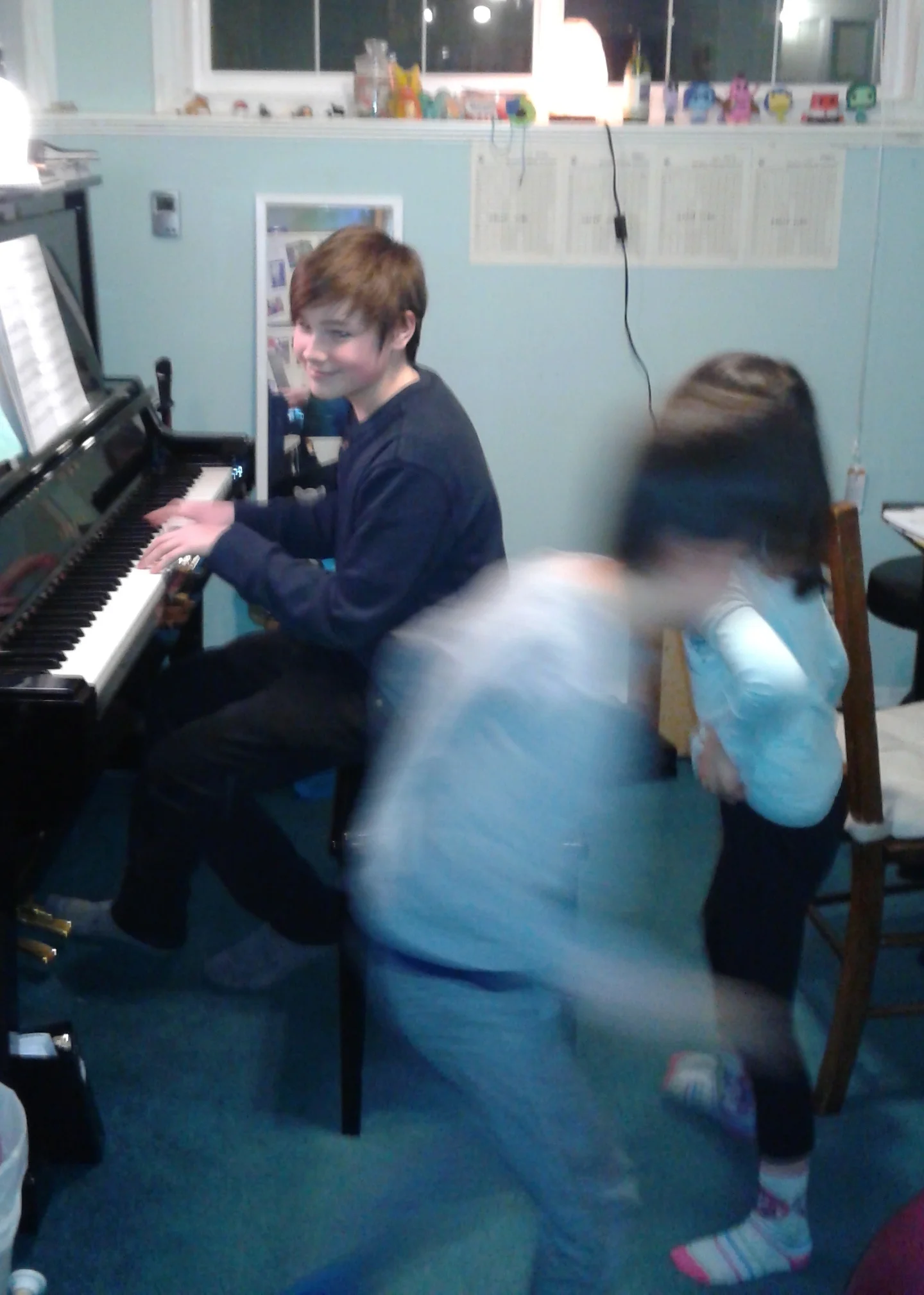
The Playing through Distractions Drill. Credit: Rhona-Mae Arca.
There were a couple of practice hacks that we quickly talked about, with the intent of working on it more in their piano lessons. One was studying the structure of their music, while the other was playing on a silent keyboard.
We wrapped up the class with my newest tabletop game, Cat Tower by IDW Games. It’s proving to be a popular game with my studio kids.
All in all, the kids found it a great class. It was comforting for my stage shy students to hear that they really aren’t alone with regards to performance anxiety. It was empowering to see them take charge and help each other level up their performance savvyness and bulletproof their music.
Now, if my students start performing a piece at the same speed as their on-stage heart rate, or someone’s phone rings in the middle of their piece, they should be able to “keep calm and carry on,” because they’ve prepared themselves for it through mindful practising, bulletproofing drills, and training their mind.

New Site, New Blog
Sometimes, we just need a fresh start. Managing a Wordpress multsite with several blogs while juggling music teaching, freelancing gigs, and trying to get Maestro's Music Tricks off the ground simply wasn't working.
Sometimes, we just need a fresh start. Managing a Wordpress multsite with several blogs while juggling music teaching, freelancing gigs, and trying to get Maestro's Music Tricks off the ground simply wasn't working.
My webmaster hat and writer's cap have collected quite a bit of dust over these past few months. A bit of website decluttering and reorganizing was well overdue.
When I undertook the project of revamping my dojo's website, my dojo mate in Saskatoon and I settled on using Squarespace. We found the process of building a new site that could be managed by members from our different training locations a relatively smooth process. Web maintenance has been a snap because Squarespace manages all the plugin and framework updates. I can only assume that they are dealing with brute force attacks because we haven't had any issues with our club site.
It's been working so well, that I decided to take the plunge and migrate my site to Squarespace. So, here we are.
The other big decision I made was to consolidate all of my blogs. All six of them. The separation by topic to do different branding only makes sense if one has time to put into branding them individually, which I don't. As for the "new" blog name, as much as I loved the names for all my blogs, The Musical Muse is the only one that could cover all the topics I write about.
It will take some time to tidy up the blog posts to make them fit their new home. It will also take some time to get the Maestro's Music Tricks e-store built. so please be patient. In the meantime, if you would like more information on my gamer-inspired music practice aid, please drop me a line.
Photo credit: Philip Wilson
Music Practice Tip: All Musicians Should Sing the Music
This music practice tip is something I should get my students to do more regularly: sing the music. Too often, we get hung up on the mechanics of music, that is, the notes and the rhythm. Well, that’s all good and dandy, but we’re not robots. When we bring music to life, we are telling a story through sound and silence.
This music practice tip is something I should get my students to do more regularly: sing the music. Too often, we get hung up on the mechanics of music, that is, the notes and the rhythm. Well, that’s all good and dandy, but we’re not robots. When we bring music to life, we are telling a story through sound and silence.
At university, one of my piano teachers told me that if I couldn’t sing the opening phrase of the Chopin Impromptu in G-flat Major, I had no business playing the piece. I thought she was joking. She wasn’t.
Through that exercise, I learned phrasing and expression. I learned where Chopin wanted the climax and where he wanted me (or any pianist) to pull back. I learned where to breathe.
Another benefit is that you internalize the music. Strangely, I learned this with interval ear training. It took work, but I drilled playing a note and singing a certain interval above or below it.
I applied this to my last piano exam, Level 7 in Conservatory Canada’s Contemporary Idioms syllabus, which I took a few years ago. I scored the highest I ever have in my piano exam history.
All I could think of was, “Why didn’t I do this when I was younger?” I would have aced ear training!
Musician Graehme Floyd lists several benefits to singing and internalizing the music with your voice. The top three should be enough to convince you: internalizing your music by singing cuts down on your learning time, your memorization time and boosts your confidence on stage. You can read the rest in his article, “Every Musician Should Sing”.
To read more about this music practice tip, check out: Robert Rawlins, Ph. D.’s article “Young Instrumentalists Should Learn to Sing So They can Learn to Hear” and “Learning to Listen: Dame Emma Kirkby's Collaborative Technique” by Jessica Chow.
Social Media Links
archives
- #YYCArts 32
- #YYCEvents 39
- Collaborative Music 25
- Community 11
- Composing & Arranging 6
- Entertainment 139
- Entrepreneurship 53
- Freebies 3
- Gardening 1
- Geeking Out 65
- Health & Wellness 120
- Improvisation 25
- Interviews 28
- Learning Music 188
- Martial Arts 13
- Memorization 7
- Music 230
- Music Careers 9
- Music Education 196
- Music Examinations 7
- Music Exploration 55
- Music Gigs 14
- Music Lessons 6
- Music Performance 32
- Music Theory 13
- Musical Instruments 12
- Musician Health 19
- Pets 57
- Piano Technique 12
- Practicing Music 120
- Productivity 20
- Professional Development 11
- Recommendations & Reviews 93
- Recreation 71
- Social Media 6
- Spirituality 10
- Studio Management 33
- Studio Technology 50
- Teaching Music 146
FOLLOW THE STUDIO on Instagram

Affiliate Links
As a Sheetmusicplus and CD Japan affiliate, I earn from qualifying purchases. The earnings help fund the Studio’s blog and YouTube channels. Your support is greatly appreciated.


FOLLOW Budo no Tabi on Instagram