THE MUSICAL MUSE
Blog dedicated to music education, practice tips, health
&
wellness, and geeking out.
Just Get it Done
Fighting with your parents or yourself about practicing or - insert blank here - is a pointless waste of energy. Learn from the pros and - just get it done, get it out there and strive to make next time better.

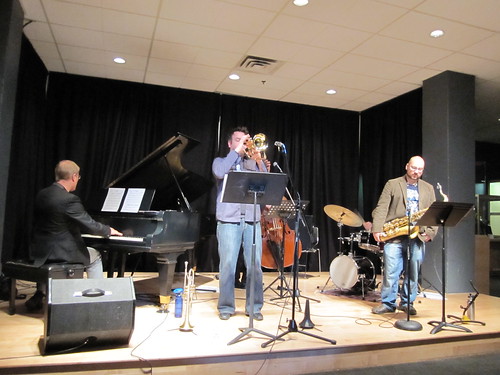
Recently, I attended a concert by the Calgary Jazz Orchestra. It was a fabulous concert and featured some new works. Afterwards, I had a great chat with one of the composer-arrangers, CJO director Johnny Summers.
One of the things that came up in our chat was the difference between a hobbyist and a professional musician. Well, there's the obvious difference in that a professional artist pays the bills with his or her creative pursuits, whereas a hobbyist doesn't.
One difference that we spoke of was the "Just get it done" work ethic. Hobbyists, generally speaking, take their time to learn their skills or a piece. There's no looming deadline for getting that song done.
For pros and semi-pros, time is usually limited. That gig has a fixed date. Ditto with ensemble rehearsals and movie premieres. The band doesn't have the time to wait for you to finish composing a piece. They need enough time to learn the music before the performance. The movie director isn't going to wait patiently for his movie score from you. The audience doesn't care if you spent months searching for inspiration to write a piece they paid to hear.
Once a music student makes that switch from hobbyist to amateur musician, they start to experience this to some degree. The audience doesn't care if you had a lot of homework the week before, they expect you to play that Beethoven Sonatina to the best of your ability. The examiner doesn't care how much you hate the e-flat minor melodic scale, if he or she asked you to play it for the exam, you need to play it.
So all that fighting with your parents (or yourself) to practice your instrument? A pointless waste of energy. In reality, no one cares about the excuses. It sounds callous and mean, doesn't it? But it's the truth.
Just get your work done to the best of your ability and strive to make next time better. If you are preparing for an exam, talent show or competition, then you know that takes more time and effort on your part if you want to succeed.
Your parents and teachers can only help you so far. It really comes down to you. Do yourself a favour, save yourself some time and tears - and just get it done - whether it's practicing music or your homework, your chores or [insert blank here].
THWOMP Interview: On Gigs Past, Present and Future
In Part Five of this originally-published-for-Suite 101 exclusive interview, Brad Stanton and Dave Marshall of the Nintendo® cover band THWOMP discuss gigs past, present and future.
In Part Five of this originally-published-for-Suite 101 exclusive interview, Brad Stanton and Dave Marshall of the Nintendo® cover band THWOMP discuss gigs past, present and future.
Calgary-based Nintendo® cover band THWOMP is gearing up for two exciting projects. They will rock Edmonton on August 6, 2010 at Animethon 17. In the fall, they will release their debut CD. Brad Stanton and Dave Marshall stopped by to discuss gigs past, present and future.
THWOMP's Take on Bar Gigs
The band has had its share of bar gigs over the years, which the guys are glad to put behind them. "We used to play around town a lot, actually," said Brad. "It’s kind of easy to play Calgary out. There just aren’t that many decent bars to play at."
Bars and clubs tend to attract regulars and only occasionally draw in new patrons, while family and friends go only so far. "Once it’s your fifth gig in three or four months, it’s harder to get all of your friends to come out to it," explained Brad. "They’ll all come out to the first few, because they love you."
The other downside of bar gigs is the low return on investment. Dave said, "They pay almost nothing and the people who go to the bar don’t go to the bar and expect to spend $50 on merchandise, so nobody buys merchandise either."
THWOMP members made a conscious decision to stop doing bar gigs and focus on conventions. They have not looked back since.
THWOMP on Cool Gigs
Dave recalled one of their favorite gigs, "One of our funny, semi-regular gigs is at the Canmore Hotel, which is a heritage building. I think it’s 120 years old, at least, and you can tell…We turn it into a pretty big party and there’s some band stories from those gigs that I don’t think we’ll share with you."
"What happens on the road stays on the road," added Brad.
THWOMP's Current Gigs
Anime conventions, gaming conventions and comic conventions are ideal stages for THWOMP. "The conventions really have our exact demographic – sitting there – already dressed up," said Brad. "We have made some crazy fans over the last two summers."
THWOMP plays regularly at Otafest, Calgary's annual anime convention and Edmonton's annual anime con, Animethon. In 2009, the band gave its debut performance at the Calgary Comic & Entertainment Expo.
The last gig had some bumps. "We were they only band they’ve ever had and you can tell," said Brad. "They had no idea what to do with us."
THWOMP on Dream Gigs
"I think we can all die happy if we played the Penny Arcade Expo," said Dave. The Penny Arcade Expo, or PAX for short, is held semi-annually in Seattle, WA. It is a gaming festival that hosts tournaments, freeplay areas, concerts and panels over the span of three days. "It’s probably the biggest gaming expo in the world, now that E3’s gone," added Dave.
Another dream gig for THWOMP would be MAGFest, held in Alexandra, VA. MAGFest is a video and computer gaming festival. Concerts by video game bands and jam sessions are featured prominently. "Too bad it’s about 3,000 miles away," said Brad.
Transcontinental gigs are hard for bands. "It’s not about the money but not losing money to get there," explained Dave. "Once you’re carting gear across the continent, it becomes very expensive."
Plus, being a niche band doesn’t make it any easier for bands like THWOMP. "It’s hard to stop at bars along the way and play to pay for your gas and food money," said Dave. "A lot of bars don’t want bands that don’t have singers and for good reason. That’s the world we live in. Ultimately, the more conventions we can regularly play the better."
Touring Japan, Korea and Southeast Asia is another "ultimate dream" for the band. "Getting paid to wander around Japan and play video game music would be really nice," added Brad.
THWOMP is a Nintendo® band comprised of Calgarians Brad Stanton (lead guitar), Colin Mitchel (lead guitar), Scott Munro (bass), Scott Moffat (drums), David Marshall (keyboards/percussion) and Kirk McVean (keyboards). For more information about THWOMP, the band or to listen to audio clips, visit their website and Myspace page.
Full interview series: Part 1 – THWOMP’s Origins | Part 2 – Band Names & Niches | Part 3 – Songwriting | Part 4 - Hey! Listen! CD Release | Part 5 - On Gigs | Part 6 - Convention Gigs | Part 7 - Video Games | Part 8 - Fun & Food
Music Degree Programs at Colleges and Universities in Alberta
An overview of the various post-secondary music degree programs and diploma programs available in Alberta, Canada at accredited colleges and universities.

Traditionally, a career in music centered around teaching and performance. Now, there is a growing number of careers in music, from recording arts to jazz and popular music. These seven colleges and universities in Alberta have responded to this development by offering diverse degree programs and diplomas in music.
From Bachelor to Doctorate of Music at the University of Alberta
Established in 1908, the University of Alberta boasts an enrolment of over 37,000 students (2009/10 figures). U of A has a well-recognized reputation worldwide. It's computing science program was ranked third in Canada and 55th in internationally in 2010, while its School of Business ranked 89th.
U of A offers three undergraduate music programs: Bachelor of Arts (Honours) with a Music Major, Bachelor of Music and, like the University of Lethbridge, a combined Bachelor of Music/Bachelor of Education. Students can major in composition/theory, history, performance or world music. The Faculty of Music also offers a post-degree in music.
Students gain invaluable ensemble-playing experience by joining one of U of A's 13-plus music ensembles. These range from the Wind Ensemble and Symphony Orchestra to the Madrigal Singers and the Indian Music Ensemble.
The University of Alberta also offers a Masters in Music, Masters in Arts (in Music) and Doctorate in Music. Graduate students can specialize in academics, applied music, choral conducting or composition.
A Music Degree and a Christian Education at Ambrose University College
Ambrose University College's history is rooted in several older post-secondary institutions, including the Canadian Nazarene College, the Canadian Theological College and the Alliance University College. Founded in 1921 as the Calgary Bible Institute, the institution focused on educating young adults to serve in the church or overseas missions. It received university accreditation in 1999 and in 2007, began operating as a single entity called Ambrose University College.
Located in Calgary, Alberta, AUC boasts one of the largest private academic libraries in Western Canada and has received a Government of Alberta Award for Educational Travel. With an enrollment just over 600, Ambrose's faculty-to-student ratio guarantees small classes.
Ambrose University College offers a four-year Bachelor of Music program, as well as a three- and a four-year Bachelor of Arts program (Music Major). Students receive lessons on their primary instrument, music theory, aural training and performance.
Students gain valuable ensemble experience by joining the Chamber Singers, College Singers, Community Singers, Chamber Orchestra, Jazz Ensemble, Brass Ensemble or Guitar Ensemble. The programs offer some flexibility in area of study as well as various leadership development opportunities (e.g. practicum and conducting).
Jazz and Contemporary Popular Music at MacEwan University
MacEwan University in Edmonton, Alberta, was founded in 1971 as Grant MacEwan College. The school has over 42,000 students. MacEwan U offers over 60 programs, including applied degrees, undergraduate degrees, certificates, continuing education, corporate training and diplomas. It 2009, MacEwan College became an accredited university.
In 2011, MacU unveiled a new Bachelor of Music in Jazz and Contemporary Popular Music program. It is the first post-secondary institution to offer a university degree that combines jazz and contemporary popular music. Students study basic techniques, history and music theory. They can focus on one or two of the following concentrations in their final two years of education: composition, performance, recording arts and comprehensive (combining two majors).
As with all music programs at the post-secondary level, students must participate and perform in a musical ensemble, such as the jazz ensemble, showcase band, jazz combo, jazz choir, guitar ensemble or percussion ensemble. The faculty also offers a two-year Music Diploma and four-year Bachelor of Music.
Study Classical and Jazz Music at Mount Royal University
Located in Calgary, AB, Mount Royal University was founded in 1911 as a college. Today, it boasts an enrollment of 14,000 credit students and offers bachelor’s degrees, applied degrees, university transfer courses, diplomas and certificates. MRC became MRU in 2009.
Mount Royal U offers two music performance diploma programs, the Classical Diploma and Jazz Diploma. Both streams focus on honing students' performance skills while providing a solid foundation in music history, theory, composition and improvisation.
There are several ensembles at Mount Royal including the Kantorei Choir, guitar ensembles, jazz combos, flute ensembles, percussion chorus and jazz vocal ensemble. The MRU Conservatory also has several youth ensembles. Many of its ensembles perform throughout western Canada. Distinguished alumni include opera singer Daniel Okulitch, the composer for the 2010 Olympic Winter Games, David Pierce and violinist Andrew Dawes.
As of April 2013, the MRU Jazz Program is one of the post-secondary programs on the chopping block in response to the drastic cuts to education in the Alberta 2013 budget. Efforts to save the program are well underway. Please visit Save our Fine Arts for updates.
Red Deer College's Music Diploma and Music Preparatory Program
Established in 1964, Red Deer College offers over 75 programs, including degrees, diplomas and university transfer programs. According to “Universities in Canada” on Study in Canada's website, Red Deer College has over 10,000 students enrolled.
RDC offers a two-year Diploma in Music that provides students a solid foundation in ear training, music history, music theory, performance ensembles, private music instruction and recording technology. Like MRU, students can concentrate on the classical stream or contemporary genres. They may also do a combination of both streams.
Red Deer is the only college in Alberta to offer a one-year preparatory program in Music, geared towards musicians with either little or no formal music training. Students learn the basics in listening, performing and composing music. After completing this program, students must audition into the diploma program.
Doctoral, Bachelor and Masters Degree Programs in Music at the University of Calgary
The University of Calgary is one of Canada’s top seven research universities in Canada. Established in 1966, U of C offers over 100 undergraduate, graduate and professional degrees and boasts an enrollment of over 29,000 students.
The University of Calgary Department of Music offers undergraduate and masters degree programs in Music. At the undergraduate level, students can enroll in the Bachelor of Arts (Music Major), Bachelor of Music (majoring in Composition, History and Theory of Performance) and a Bachelors of Music in Integrated Studies (combination of two disciplines).
Students can study composition, musicology, performance and telemedia arts in U of C's masters degree program. The U of C also offers a PhD program in Musicology or Composition.
The achievements of U of C's ensembles include touring throughout North America, airing on CBC Radio and performing at the Honens International Piano Competition and Festival. Notably, the Wind Ensemble has performed at the CBDNA National Conference and the World Association for Symphonic Bands and Ensembles (WASBE) Conference.
Digital Audio Arts and Combined Degrees in Music at the University of Lethbridge
Founded in 1967, the University of Lethbridge offers 150 undergraduate and graduate programs and serves nearly 7,000 students. This institution prides itself on its liberal arts education programs. Students can study a combined degree, graduating with two degrees within five years.
U of L offers several undergraduate music programs, including a four-year Bachelor in Music, B. Mus. in Digital Audio Arts, Bachelor of Arts (Music Major) or a Bachelor of Fine Arts (BFA). Students may also combine their music degree with another, such as a business management or education degree, in a five-year combined degree program.
Students can also enroll in a two- or three- year post-diploma B. Mus. Program. U of L's Masters Degree in Music and Master of Arts in Music is offered in voice, piano, collaborative piano, French horn, violin, conducing and composition.
Notably, University of Lethbridge's Bachelor of Music in Digital Audio Arts is the first degree program of its kind in western Canada. Its audio school combines academic courses with hands-on experience in first-class audio studios and labs.
Admission Requirements for Studying Music at the Post-Secondary Level
Music students not only need to meet the general admission requirements for university or college, but also the audition requirements to be accepted into a music program. Therefore, prospective students in music should speak with their music teacher and school guidance counselor as early as junior high to prepare.
A high level of performance is expected. The requirements differ from one instrument to another, but they are fairly similar when comparing music schools. For instance, at U of C, it is expected that pianists and vocalists be at Grade 10 (Royal Conservatory, Conservatory Canada or similar institution) or higher. Other instrumentalists should be at Grade 8 or higher.
Auditions are usually generally scheduled in the winter and spring. Alternatively, prospective students can submit their audition on DVD.
Music students have more options available to them at colleges and universities. Jazz and popular music, digital audio arts, music teaching and composition are just a few of the music programs available at universities and colleges in Alberta. Regardless of where a student plans to study music, he or she should thoroughly research various programs and admission requirements and speak with his or her guidance counselor and music teacher to ensure that all requirements will be met well before the audition.
Originally published April 2, 2011. Updated April 30, 2013. All rights reserved by Rhona-Mae Arca.
THWOMP Interview: Hey! Listen! CD Release
In Part Four of this interview I did originally for Suite 101, Brad Stanton and Dave Marshall of the Nintendo® cover band THWOMP discuss their upcoming CD release.
Calgary-based Nintendo® cover band THWOMP is gearing up for two exciting projects. They will rock Edmonton on August 6, 2010 at Animethon 17. In the fall, they will release their debut CD.
THWOMP is comprised of Calgarians Brad Stanton (lead guitar), Colin Mitchel (lead guitar), Scott Munro (bass), Scott Moffat (drums), David Marshall (keyboards/percussion) and Kirk McVean (keyboards). Band members Brad Stanton and Dave Marshall took time out from THWOMP’s rehearsal schedule for an exclusive chat with Suite 101. Last time, they discussed their songwriting process. In this segment, they discuss the band’s upcoming CD release.
THWOMP Debut CD Release Fall 2010
"It’s sort of is in and odd state of being officially and not officially released yet," explained Dave. "I don’t think CD’s are officially released until you have a CD release party, which we haven’t done."
The recording for THWOMP's debut CD was made during the band's early years (pre-Dave and pre-Kirk). Their friend Brian (who performs with Dave and Brad in another group) took several recording courses did the recording. "Just live off the floor, everybody playing at the same time and hoping that nobody would screw up in a 15-minute song," said Dave. "That didn’t go that well, so it actually took a few retakes."
Then, the material sat in stasis for a few years. By the time the group had a chance to review the recording, they weren't happy with the quality.
The band realized that there is a huge opportunity to sell merchandise at anime conventions and comic conventions. "We decided to just get off our asses and finish it," said Dave. This time, they called upon their buddy Ryan Sadler of Spectratone Studio to re-engineer it. "We recorded my tracks on top because when it was originally recorded, I wasn’t in the band yet."
The CD artwork was done by a talented family friend, "Kaitlin Reckord. She’s only 16. She’s a student in an art school in town...She did a great job," chimed in Brad.
With THWOMP's Animethon 17 performance on August 6, 2010, they guys have their hands full. They will nail down details for their fall CD release party (to "officially" release their CD) and begin designing a new t-shirt after Animethon.
They also have set their sights beyond Alberta. "We’re going to set our minds into getting into some conventions we haven’t been in yet, like the ones out in Vancouver and hopefully the ones in Washington, if possible," added Dave.
THWOMP is a Nintendo® cover band that brings to life the music from classic Nintendo® and Super Nintendo® video games. The band is comprised of Calgarians Brad Stanton (lead guitar), Colin Mitchel (lead guitar), Scott Munro (bass), Scott Moffat (drums), David Marshall (keyboards/percussion) and Kirk McVean (keyboards). To learn more about THWOMP, the band or to listen to audio clips, visit their website and Myspace page.
To find out about THWOMP's CD, entitled "Hey! Listen", check out my album review. Ordering information is also there.
Full interview series: Part 1 – THWOMP’s Origins | Part 2 – Band Names & Niches | Part 3 – Songwriting | Part 4 - Hey! Listen! CD Release | Part 5 - On Gigs | Part 6 - Convention Gigs | Part 7 - Video Games | Part 8 - Fun & Food
DVD Review - The Music Instinct: Science & Song
Driven by curiosity to find out where goose bumps come from, neuroscientist Daniel Levitin, musician Bobby McFerrin and a team of scientists explore why music moves us.

"One of the last frontiers is the human brain," said Robert J. Zatorre, neuroscientist at McGill University. "Music serves as a gateway to understanding human cognition." Zatorre and Daniel Levitin teamed up with colleagues from around the world to unravel the secrets of the brain in The Music Instinct: Science & Song.
Also featured in this PBS Network DVD documentary are physicist Brian Greene, neuroscientists Lawrence Parsons and Jamshed Bharucha, archeologists Steven Mithen and Nicholas Conard, ethnomusicologist Kay K. Shelemay, researchers Sheila C. Woodward, Kathleen Wermke and Tom Fritz, psychologist John Sloboda, neurologists Gottfried Schlaug, Oliver Sacks and Tom Cicoria, neurobiologist Aniruddh Patel and author Steven Pinker.
Musicians interviewed include singer Bobby McFerrin, deaf percussionist Evelyn Glennie, violinist Daniel Bernard Roumain, conductor/pianist Daniel Barenboim, British rockers Jarvis Cocker and Richard Hawley, cellist Yo-Yo Ma, blind pianist Hwaen Ch'uqi and Lebanese singer Christiane Karam.
Cutting Edge Technology Reveals How Music Affects the Brain
With Functional Magnetic Resonance Imaging (FMRI) and PET technology, scientists can track blood flow and brain activity when subjects are listening to music, improvising, composing and collaborating. This helps them map various areas of the brain that are used.
In The Music Instinct, scientists discovered that the body is a barometer of our musical response to music. When listening to frightening music, our body responds by exhibiting the "flight or fight" response. When we listen to music we like, dopamine, the neurotransmitter for pleasure, is released. A recent discovery is that multiple areas of the brain are involved in processing music.
Music Teaches Us about the Brain, the Brain Teaches Us Music
"If you look at music performance, there's no activity that we do that allows the brain to do so many things at once, with such a complicated coordination and at such depth," said Parsons. His team discovered brain activity is higher when performing in collaboration versus performing solo. Playing an instrument engages the brain more than just listening to music.
"Music - probably one of the most distinctive characteristics of humans," said Mithen, who set out to discover how this compulsion for musicality evolved. He traveled to Germany, where Conard showed him an ivory flute from the Ice Age. The ancient artifacts found seem to indicate that music was as much a part of their life as it is now and that they used a similar scale in their music.
Woodward and Wermke found that babies can hear sound within their mother's womb and that they prefer consonance. Wermke learned that babies cry using melodic intervals, commonly using a perfect fifth, major and minor third and perfect fourth.
Both found that children of deaf parents performed similarly. This is significant as children of deaf parents were subject to less sound stimulation in the womb.
Is Music Universal?
Researchers learned that there are three intervals that are most common worldwide: the perfect fifth, perfect fourth and the perfect octave (the third is next). Ethnomusicologists also found that art music and lullabies from around the world possess common traits.
One interesting study showed the Mafa tribe in Africa. This civilization is far removed from modern technology and Western music. Researchers asked the Mafa to listen to musical excerpts from around the world and identify each as being "happy", "sad" or "scary". Their response was identical to people from Western cultures.
However, Shelemay warns viewers against claims of anything being "universal" in music. "Conceptions vary," she said.
Neurologists and other scientists found that playing music with a strong pulse helps patients with Parkinson's Disease learn to walk again. They also discovered that music helps stroke patients improve their speech and motor skills. Music that mimics the sound of a mother's heartbeat soothes premature babies, while it helps slow down the progress of dementia.
A Well Done Piece that Leaves Viewers with More Questions
Will this take away the mystery of music for you or whet your appetite for more information? Watch it and decide for yourself.
This PBS documentary features an impressive team of scientists and musicians. However, as the team admits, they face challenges and controversies moving forward. Are music and language two sides of the same coin or can they be separated? How much of what we know is learned and how much is "music instinct"? Does music move us or do the memories we attach to a song move us?
To find out more about Daniel Levitin's studies on science and music, visit Why Music Moves Us, Why Do People Sing?, DanielLevitin's website and The Music Instinct on PBS.
If you haven't figured it out yet: goose bumps come from the brain.
Release Date: 2009
Running Time: 120 minutes
MPAA Rating: Not Rated
Director: Elena Mannes
Executive Producers: Elena Mannes & Margaret Smilow
Special Features: 12 additional interviews and performances
Where to buy The Music Instinct:
Originally published on Suite101.com on December 19, 2009. Updated April 2, 2013. All rights reserved by Rhona-Mae Arca.
Social Media Links
archives
- #YYCArts 32
- #YYCEvents 39
- Collaborative Music 25
- Community 11
- Composing & Arranging 6
- Entertainment 139
- Entrepreneurship 53
- Freebies 3
- Gardening 1
- Geeking Out 65
- Health & Wellness 120
- Improvisation 25
- Interviews 28
- Learning Music 188
- Martial Arts 13
- Memorization 7
- Music 230
- Music Careers 9
- Music Education 196
- Music Examinations 7
- Music Exploration 55
- Music Gigs 14
- Music Lessons 6
- Music Performance 32
- Music Theory 13
- Musical Instruments 12
- Musician Health 19
- Pets 57
- Piano Technique 12
- Practicing Music 120
- Productivity 20
- Professional Development 11
- Recommendations & Reviews 93
- Recreation 71
- Social Media 6
- Spirituality 10
- Studio Management 33
- Studio Technology 50
- Teaching Music 146
FOLLOW THE STUDIO on Instagram


Affiliate Links
As a Sheetmusicplus and CD Japan affiliate, I earn from qualifying purchases. The earnings help fund the Studio’s blog and YouTube channels. Your support is greatly appreciated.


FOLLOW Budo no Tabi on Instagram