THE MUSICAL MUSE
Blog dedicated to music education, practice tips, health
&
wellness, and geeking out.
Independent Japanese language study: Muzukashii, desu ne?
Though it pains me to admit it, I've fallen off the wagon with my independent Japanese study. Hontouni muzukashii desu yo ne!
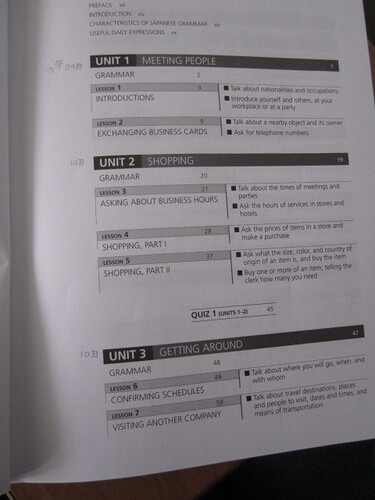
Though it pains me to admit it, I've fallen off the wagon with my independent Japanese study. I began the year with gusto by creating milestones and a study log check list. These are the milestones I set out to accomplish in my Japanese for Busy People book:
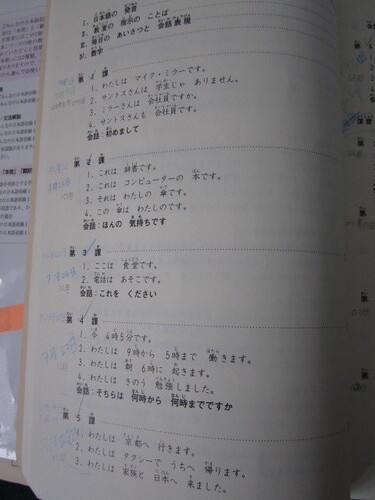
You can see that I've attempted to go through my Minna no Nihongo book several times since studying at the Calgary Japanese Language School:
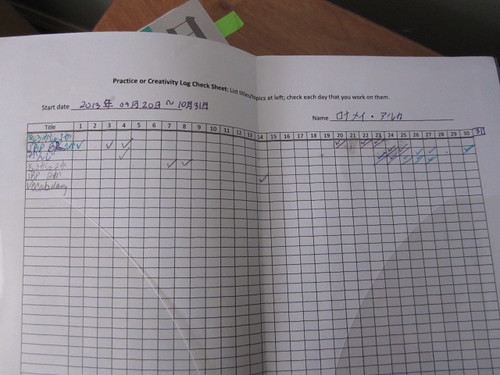
I was really good for the first six weeks. I set out the goal to dedicate 10 - 30 minutes a day, five days a week to studying Japanese. Here's my log sheet:
Our little study group was difficult to maintain as those who came to the first two were all at very different levels in their Japanese studies. The majority of my classmates from last year either continued with CJLS, decided to study on their own or commit to another activity.
Things began to unravel after Thanksgiving. Life happened. New projects on tap. Studying became more sporadic.
Here we are in November. I will try again to get back on track. I already notice that my Japanese comprehension when watching anime or listening to music is slipping to catching a few words here and there, instead of actual phrases. Yadda!
I am hoping that it will be easier to follow my schedule once I resume my Iaido training after Christmas. Fingers crossed.
Do you have any study tips and ideas to share for studying Japanese (or any language) independently?
My Misaka Mikoto Cosplay
My "easy" cosplay was hard enough. My Misaka Mikoto cosplay is done.
This year, I decided to do an "easy" cosplay: Misaka Mikoto from "To Aru Kagaku no Railgun". She's a Level 5 esper who can manipulate electricity, one of the strongest espers in Academy City. She is nicknamed, "Tokiwadai's Ace" or "Railgun" for her trademark move:
Here's my cosplay creation journey to give you an idea on how to cosplay:
Step 1: Get source material.

Step 2: Start with the hardest element.

Step 3: Know your skill level. A skilled seamstress I am not. Value Village is my friend.

Step 4: Make your modifications. Forty minutes later and I wind up with an unfinished vest.


Step 5: Make the character specific elements.


Step 6: Get your odds and ends. The loafers were hard to track down. I wound up getting these in the kids' section at Payless for 50% off. The knee high socks were from Adene's. I picked up the hairpins from Wal-mart.
The other two items hard to find were the temporary hair colour for my eyebrows and a large enough coin for launching Misaka's railgun. A lady at a hair salon recommended I get creamy eye shadow to colour my brows. Maybeline's Color Tatoo line works like a charm.
One of my friends found two big coins at the Farmer's Market for 50 cents apiece.
And now, for the big reveal:


To learn more about cosplay, check out my last entry, The Art of Cosplay.
The Art of Cosplay
Cosplay is so much more than going to the store to buy a costume. Check it out.

Cosplaying is one of the ways I express my inner geek. Short for "costume play", it involves much more than dressing up in costume. For many, it's a labour of love, involving countless hours to either make their character's outfit from scratch or to track down components that can be modified.
That's only part of the equation. Cosplay also involves becoming your character. That is, learning some of your characters trademark moves, poses and catch phrases so that when you're geeking out at an anime convention or comic con, you are that character.

People actually will chase you down like paparazzi to take your photo:


You can also enter cosplay contests.
Here's a video I found of some fantastic cosplaying at Anime Expo 2013:
Next up: photos of my latest cosplay project.
My First FallCon
It was short but sweet. My first FallCon was an adventure that was the highlight of my tabletop gaming extravaganza weekend.
I first heard about FallCon two years ago through one of my friends in Japanese class. At the time, I was intrigued, but for whatever reason, didn’t go. This year was different. Over the summer, I explored some new tabletop games with friends and at GeekMoot. I wanted to explore more games.
It would have been nice to attend the entire convention (September 27 - 29, 2013) but alas, time is so short. I only had time to attend the session on Saturday afternoon. Since it was my first time, I decided to register for Open Gaming.
This was a little different from GeekMoot. Upon registering for FallCon, you are basically reserving a seat, which becomes especially important when one of the featured games is running. You can see how many spaces are available at a table when you view your account. Or, if you're on the waiting list, you can see what position you are in.
It was just an adventure getting there. The venue is on the opposite end of town from where I live. Couple that with the fact that I was coming up from High River where I was visiting family - combo that with Deerfoot Trail being reduced to single lane traffic, starting at 22X - level that up with the fact that the detour ended in me overshooting my destination and backtracking through neighbourhoods I never knew existed - and you get one grumpy panda.
Now, don’t you tell me to turn on Google Navigation. My Android doesn't really get along with Google Maps or Google Navigation and I prefer using landmarks. Besides, I’m a hard copy map gal in the end. Guess what I forgot to print off that morning?
I was relieved to finally pull into the very full parking lot at the Commonwealth Centre and even more relieved to meet up with a friend’s hubby in the parking lot. He gave me the lay of the land upon entry: vendors here, food there, registered games right by the vendors and open gaming tables as far as the eye could see. In the very far corner, my friend and other volunteers were busy at the Games Library.
Speaking of the Games Library, what an impressive sight! There were over 690 tabletop games (some multiples). What was even more amazing was the fact that the majority of those games belong to one person.

My first stop was to the two vendors. The one game I didn’t purchase during my shopping spree was King of Tokyo. I’ve been itching to stomp around, kaiju style ever since GeekMoot but Imaginary Wars and Sentry Box were sold out when I went. I bought it from Boardgames.ca .
We caught up with my friend and then went in search of a table looking for players. These tables were denoted by an orange cone. Other tables sported a red cone, which meant that the players were in search of a teacher.
First up: Tzolk’in: The Mayan Calendar. The basic premise is similar to some games that I’ve played - build your kingdom/domain/land, gather resources, care for your people. However, the layout is quite different:

There’s a quite a bit more to the game. I was actually glad that our teacher (my friend’s hubby) had to explain the game three times, although I did feel badly for him. Since I was the first newbie at the table, I got the spiel, with added information, three times. Once he finished giving the rundown, another person showed up and then another.
There are six interconnected gears. On your turn, you can either place your workers on the lowest available spot in a wheel, or take them off so that you can reap the benefit granted for being in that spot. The wheels turn as the calendar advances, so your workers go around, stopping at different spots. It’s a waiting game to obtain a particular item, be it a building resource, corn to feed your workers, the right to build, an extra worker, etc.
Through all the action, you are trying to gain Victory Points. These are achieved in various ways, such as erecting buildings and temples, traversing the big blue wheel and moving up the temple levels as you gain favour with the Mayan gods.
Make sure you keep enough corn to feed your people otherwise, you will lose favour with the gods. I wound up with negative points for a while because of that.
If you need extra corn, one way you can get corn is to take control of the Headdress. You gain whatever corn has built up in the kitty AND you get control of the calendar. You can move time forward one day or two. You can also move the calendar backwards, in hopes of positioning your workers in a better spot on the gears.
It’s a neat game, but we three newbies readily agreed that it’s hard to get our brain around. It’s a game I’d like to try a few more times with a more experienced player as a guide before attempting to play it with me trying to be the coach.
It’s also one of the longer games too. The Boardgame Geek estimates gameplay at 90 minutes.
While we were playing, my nose was bombarded with delectable scents from the kitchen. People were ordering not just burgers and fries, but lasagna and Shepherd’s Pie. Oh so yummy. However, I made do with popcorn as I had dinner plans.
Next game: Bruges (pronounced “broozh” or “”brugguh”). It’s a city in Belgium. The game is set in Bruges during the Renaissance. Players are wealthy merchants competing to be Number 1. This is achieved by earning a high reputation on the scale, building as many buildings and canals as you can and having as many highly valued people out in your neighbourhood.
I was joined by a gentleman from BC and two ladies. The two ladies were familiar with the game.
Gameplay consists of four phases. In the first, we built our hand from the two decks of cards. The cards have colour-coded houses on one side and people on the other.
Phase 2 involves Player 1 rolling the coloured dice. The colours correspond with the works and the houses. If a player rolls a “5” or a “6”: watch out! Everyone gets struck with misfortune, such as pestilence or fire, earning a Threat Marker. Then, players can decide whether or not they want to pay the fee shown on the designated die to move up the Influence (or “Reputation”) Track.
In Phase 3, the players go around the table, playing their hand. Players can build canals or buildings, recruit workers, put workers in their buildings and activate an action listed on a card that’s in your neighbourhood.
In the final phase, players determine “majorities”. That is, you determine who’s the winner of that round in terms of canals, people and influence.
The decks are then passed to the next person. He or she becomes the Player 1 for the new round.
It’s straightforward enough. In some ways, I like it better than Dominion because of all the extra parts. You have your workers, gilder, cards and game piece. The combination of using cards and dice is neat as well.
Gameplay is listed at 60 minutes, but I’m sure we took longer than that. I think we were actually closer to 90 minutes. We missed out on the auction (which sounded quite lively). However, we were all committed to completing the game.
My first FallCon was short and sweet. The registration process was straight forward. The scheduling was varied. The cone system was brilliant. That Games Library simply blew me away. Everyone I played with or spoke to was extremely friendly and helpful.
And so ended my first FallCon experience, but not my gaming weekend. You see, my tabletop extravaganza began Friday night with a game of Pandemic. My brother and I wanted to see if we could save the world in a two-player scenario. Not only did we develop cures for all four dreaded diseases, we decided to keep playing until we eradicated all those nasty cubes from the world map.
The outbreaks started in Asia. We decided that it was fitting that we end up back in Asia. After we traversed the globe, treating and curing the world of Bugger Black, Bad Blue, that Darn Red and the Pesky Yellow diseases, we met up in Tokyo so our game pieces could party it up in Akihabara.
Sunday, we cracked open King of Tokyo. It was a fierce family fight amongst our kaiju, with each member employing a different gaming strategy. It was a bloody battle, coming back from 3 HP, but Mekka Dragon and I were victorious.

Now, it’s another year until FallCon 27. Thankfully, there are various tabletop gaming meetup groups, Gamer Sundays at Dickens’ Pub and of course, as many gameplay opportunities we can squeeze in with family and friends.
If you’d like to check out any of these games, head to a specialty gaming store. In Calgary, we have several, including Imaginary Wars, Revolution Games and Music and The Sentry Box. Otherwise, check out Amazon (click on the game links above) or GermanGames. If you have a favourite tabletop gaming store, feel free to share in the Comments section.
My TableTop Games Shopping Spree
It was the summer of tabletop games. Between GeekMoot and games nights with friends, I've tried, I've played and then I went on a huge shopping spree. Take a look at some of the games I've tried and see if any catch your fancy.
It all started with Wil Wheaton's Tweet about Qwirkle on May 13, 2013: "Turns out Qwirkle is a really fun #Tabletop game." I was intrigued. Time passed, work happened and a flood came, so I forgot about it. Later in the summer, when one of my friends posted a photo on Facebook of her new newly acquired Qwirkle, I remembered. She and her hubby hosted a little games night and I got my chance to try it.
How can I describe Qwirkle? It's like Scabble with colours and shapes. It's also like Sudoku in that a tile can only appear in a sequence once. The object of the game is that you're trying to earn the most points by building tile sequences. The tiles you play must share one aspect in common with the the tile you're connecting it to, either the same colour or shape.
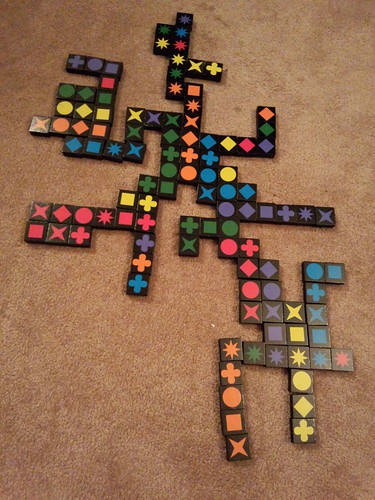
You seek to build as many Qwirkles as you can (worth 12 points each). A Qwirkle is a set of six tiles that share one thing in common (colour or shape). I loved it and set out to buy my own set.
That night, we also played Pandemic. I heard wonderful things about it at GeekMoot and really liked the idea that it's a co-operative game. Sadly, our team during games night wasn't able to save the world from the dreaded Black Disease, so I was itching to try it again and save the world.
Each player has a role, such as Dispatcher, Researcher and Quarantine Specialist. You work together to treat, cure and eradicate disease around the world, but you're constantly fighting epidemics.
We tried two other games that night too: Love Letter and Biblios. The former was all right but the latter is a game I'd like to try again.
A few weeks ago, I set out to buy Qwirkle and Pandemic. Unfortunately, Imaginary Wars didn't have either, but I picked up Labyrinth. It reminds me of the 2D adventure video games, in which you are trying to find hidden treasures. However, it's 3D and you must push a tile into the board to move the tiles around. Sometimes, you wind up in a dead end path and wish that the next player pushes you off the board so you can come in at hopefully a more favorable position.
Then, I went to the Sentry Box. Now, I knew they were big, but I never realized they were THAT big. It's the largest gaming store in all of North America, with over 13,000 square feet of tabletop gaming, models, comics, manga, books, plushies and play space.
I, er...um....bought enough to get the bulk discount:
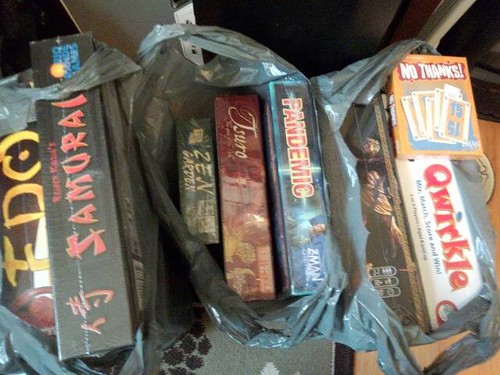
So far, my family has tried Tsuro, which was featured on Wil Wheaton's show, Tabletop. The rules for this tile-based game are simple: 1 - Last dragon flying, wins. 2 - Follow the path. 3 - Don't crash into other dragons. It's fun to watch that particular episode:
Another new game that we've tried out is Edo. North Americans will say "EE-doh" but the Japanese student in me will pronounce it as it should be ("Eh-doh").
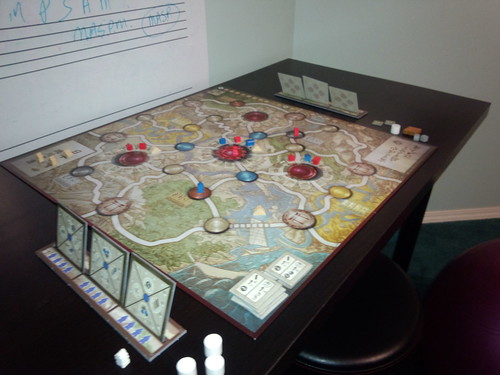
Although it took me a while to weed through the instructions (too much information to digest in one sitting), after a couple of rounds of gameplay, it's becoming one of my fave games. It's like Dominion in the sense that you are building a "kingdom" (er, "daimyo"). It's like Puerto Rico in the sense that you can build, harvest and earn money. Combine that with very well designed pieces - solid construction and aesthetically pleasing - and the Japanese theme and this chibi samuari is hooked.
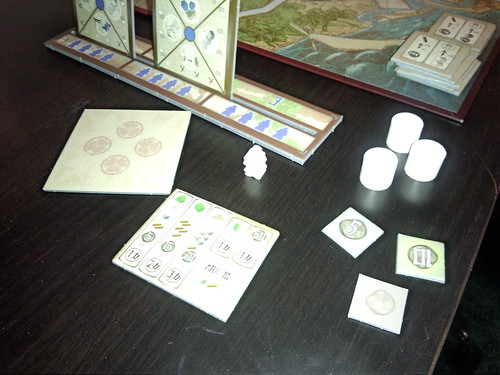
We will get to the other table games in those bags, but all in good time. I think we'll tackle the award-winning 7 Wonders next, as well as No Thanks.
If you're interested in checking out any of these games, drive past Toys'R'Us and head to a gaming store that specializes in European tabletop games, like Imaginary Wars and Sentry Box. Online, you can purchase Edo, Qwirkle, Tsuro and Pandemic on Amazon. One of my piano families recommend German Games.
Social Media Links
archives
- #YYCArts 32
- #YYCEvents 39
- Collaborative Music 25
- Community 11
- Composing & Arranging 6
- Entertainment 139
- Entrepreneurship 53
- Freebies 3
- Gardening 1
- Geeking Out 65
- Health & Wellness 120
- Improvisation 25
- Interviews 28
- Learning Music 188
- Martial Arts 13
- Memorization 7
- Music 230
- Music Careers 9
- Music Education 196
- Music Examinations 7
- Music Exploration 55
- Music Gigs 14
- Music Lessons 6
- Music Performance 32
- Music Theory 13
- Musical Instruments 12
- Musician Health 19
- Pets 57
- Piano Technique 12
- Practicing Music 120
- Productivity 20
- Professional Development 11
- Recommendations & Reviews 93
- Recreation 71
- Social Media 6
- Spirituality 10
- Studio Management 33
- Studio Technology 50
- Teaching Music 146
FOLLOW THE STUDIO on Instagram






Affiliate Links
As a Sheetmusicplus and CD Japan affiliate, I earn from qualifying purchases. The earnings help fund the Studio’s blog and YouTube channels. Your support is greatly appreciated.


FOLLOW Budo no Tabi on Instagram