THE MUSICAL MUSE
Blog dedicated to music education, practice tips, health
&
wellness, and geeking out.

Our Favourite Tabletop Games (2021 Edition)
A few months ago, my students and I were surprised to learn that some of my colleagues have been waiting for a game-related blog post with recommendations - both video games and tabletop games. Since our combined list is long, I’ll split this into two posts, sharing some of our favourites. First up: tabletop games.
A few months ago, my students and I were surprised to learn that some of my colleagues have been waiting for a game-related blog post with recommendations - both video games and tabletop games. You see, over the years, I have attracted music students who share some of my geeky interests: gaming, anime, manga, sci-fi and fantasy stories.
Our piano parties include gaming after everyone’s performances. Plans are in the works for joint-studio Minecraft parties with my brother’s studio. We all love our games.
Since our combined list is long, I’ll split this into two posts, sharing some of our favourites. First up: tabletop games.
Some of My Favourite Tabletop Games
I have played countless games through the years with family, friends, and students. The Calgary Comic & Entertainment Expo, G33kmoot, FallCon, and Wil Wheaton’s Tabletop series have introduced me to some really neat games.
It’s very difficult to narrow this list down. These are just some of my favourites. They are games that I like to come back to, time and time again:
Clank! Series (2 - 4 Players, Ages 12+): Both Clank! and Clank! in Space are deck-building games. In the original, players raid a dungeon’s lair to steal some of its loot. At some point, the dragon becomes enraged and it becomes a race back up to the surface. In the sequel, players are sneaking around the evil Lord Eradikus’ spaceship, Eradikus Prime. Players hack into the ship’s system to find the evil lord’s artifacts and try to make it out in an escape pod with some loot.

Clank! In Space. Credit: R-M. Arca.
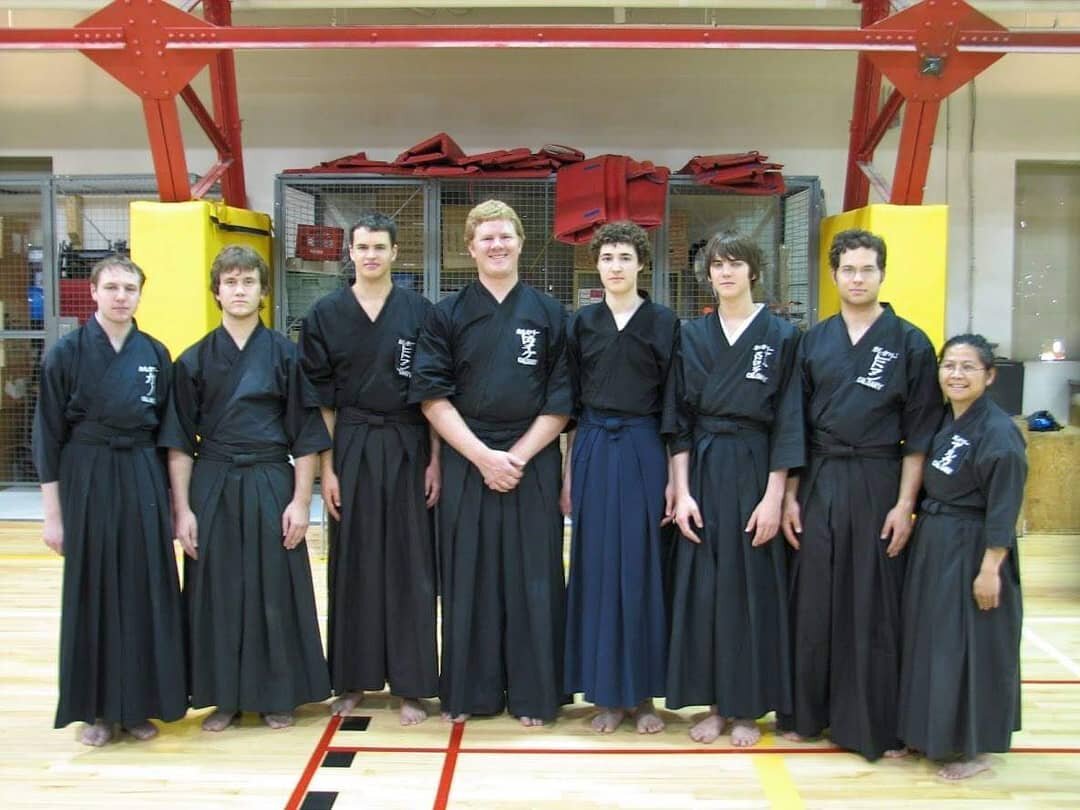
Seven Card Samurai (2 - 8 Players, Ages 9+): Seven Card Samurai is a favourite among members of Ka Muso Kai Calgary and the Edmonton Iaido Club. You know all samurai virtues that are represented by each of our hakama pleats? Those get thrown out the window as we steal rice and fight each other in this exciting card game.

Using Bandits and Ninjas to steal each other’s rice in Seven Card Samurai. Credit: R-M Arca.
Forbidden Series: In Forbidden Desert (2 - 5 Players, Ages 10+), players are members of an archaeological team, tasked with finding the parts to an ancient flying machine. It soon becomes a race against the clock as our sole mode of transportation crashes. Players must work together to find the parts and escape before the desert swallows them up.

Searching for an ancient flying machine before the desert buries us alive! Credit: R-M Arca
Forbidden Island (2 - 4 Players, Ages 10+) is also a co-operative game. Players work together to collect treasures before the island completely sinks, taking them with it!

Seeking treasure from the Forbidden Island. Credit: R-M Arca.
Castle Panic (1 - 6 Players, Ages 10+): Castle Panic is a cooperative tower defense game. Players work together to defend the castle from an onslaught of monsters that are trying to storm the castle. Expansions are available.

The monsters are coming! Credit: R-M Arca
Dominion Series (2 - 4 Players, Ages 13+). Since Dominion first came out in 2008, there have been multiple expansions. In this deck-building game, you are the monarch of a kingdom, seeking to build your realm up to a dominion. Standing in your way are the neighbouring kingdoms, seeking to build up dominions of their own.

One of my classmates from Japanese class had a turn that took around 20 cards to complete. Credit: R-M Arca
Defenders of the Realm (1 - 4 Players, Ages 13+): Defenders of the Realm is an adventure/fantasy game with lots of moving pieces. You and your fellow heroes defend the kingdom from dragons, demons, orcs and the undead who threaten to take over the land. Build your team of magicians, the tank, swords people, healers, archers...you know, the typical role-playing (RPG) team.

Defending Monarch City from Orcs, the Undead, Dragons, and Demons. Credit: R-M Arca
7 Wonders (2 - 7 Players, Ages 10+): This is a game I would not recommend to new gamers, just because the game mechanics are a little more complicated than the games I’ve mentioned so far. However, once you get into it, 7 Wonders is a very exciting game.
As the leader of one of the great cities of the Ancient World, you are building your city to last the ages - develop trade routes, build your army, build universities, invade your neighbours, etc. Choose your strategy and build your empire.
Honourable Mentions
The following games have been fun to play at games nights:
Machi Koro (2 - 4 players, Ages 10+): With the roll of a die and your growing deck of cards, build your city to become the biggest in the region. Multiple expansions are available.
Tales & Games: The Hare & the Tortoise (2 - 5 players, Ages 7+ ): Based on Aesop’s Fable of the tortoise and the hare, you bet on who will win the race in this cute card game.
Ticket to Ride (2 - 5 Players, Ages 8+): Collect cards and build your train routes. Winner earns the most points. Multiple expansions are available. Online versions are available.
Biblios (2 - 4 Players, Ages 10+): As the abbot of a medieval monastery, one of your responsibilities is to build the best library of sacred books. You are competing against abbots of other monasteries.
Just One (3 - 7 Players, Ages 8+): This is a short cooperative card game. Players try to uncover as many mystery words as possible. Strive to give your teammates unique one word clues to guess from.
Some of My Students’ Favourite Tabletop Games
These are some of the games that my students enjoy playing:
Tsuro (2 - 8 Players, Ages 8+): Play your tiles and follow the path. Try to stay on the board and not run into any of your opponents. Last one standing wins. First of a series.

Follow the path and try to be the last dragon standing. Credit: R-Marca
Dutch Blitz (2 - 4 Players, Ages 8+): A fast paced solitaire-type game. First one to play all their cards wins.
Labyrinth (2 - 4 Players, Ages 8+): Explore the labyrinth in search of treasures. Be careful, though! As the game tiles move, so does your path to the loot. First of a series.

The shifting labyrinth. Credit: R-M Arca
Cat Tower (2 - 6 Players, Ages 6+): Stack the cats as high as you can. The first player to get rid of all the cats in their hand wins.

How high can you go? Credit: R-M Arca
Pandemic (2 - 4 Players, Ages 8+): A cooperative board game in which you and your teammates are part of a team of experts, tasked with saving the world from a viral pandemic. First of a series.
King of Tokyo (2 - 6 Players, Ages 8+): It’s an epic dice-rolling slugfest among monsters to become the King of Tokyo. Win either by being the first monster to earn 20 Victory Points or by being the last monster standing.

Last monster standing. Credit: R-M Arca
Trouble (2 - 4 Players, Ages 4+): Players race to the finish line but a simple dice roll with the Pop-O-Matic can send anyone back to Home Base.
Sorry (2 - 4 Players, Ages 6+): Players race Home but a simple card draw can send you back to the starting line.
Where to Buy Tabletop Games
Support local business! We have several, wonderful game specialty stores in Calgary. Each offers an extensive collection and excellent customer service: Imaginary Wars, Metal Galaxy Social Games & Bistro, Sentry Box, and Games People Play. You can also check out Chapters, Mastermind Toys and The Discovery Hut.
Online, check out these Canadian board game suppliers: Boardgame Bliss, Boardgames N More, and Boardgames.ca.
What are some of your favourite tabletop games? Where do you like to buy your games? Share them in the comments.
Stay tuned for Part 2 - Our 2021 Video Game Playlist.
Building Community in the Studio
Growing up, I didn’t like how we kept to ourselves at recitals and how there was little interaction between students. I yearned for music buddies and community, which I didn’t have until I attended university.
When I started to teach privately, establishing a friendly studio community was one of my priorities. Since most of us publish studio newsletters to connect with families, my focus here is on the activities I have instigated to build connections and foster a sense of community through the years. Colleagues, feel free to adapt these into your studio.
(Originally published in the Fall 2020 APTA News & Views for the Alberta Piano Teachers’ Association. Updated & modified for the Studio Blog.)
Growing up, I didn’t like how we kept to ourselves at recitals and how there was little interaction between students. I yearned for music buddies and community, which I didn’t have until I attended university.
When I started to teach privately, establishing a friendly studio community was one of my priorities. Since most of us publish studio newsletters to connect with families, my focus here is on the activities I have instigated to build connections and foster a sense of community through the years. Colleagues, feel free to adapt these into your studio.
Group Classes & Special Projects
My students have collaborated on various projects, both in and out of group classes. They have done everything from composing, piano combos, pop bands, folk dancing, recording, editing, and field trips. Our three biggest projects were Eric Whitacre’s Virtual Choir 4: Fly to Paradise, David Wesley’s O Canada Choir, and a student band that earned an Honorable Mention in a Long & McQuade music contest.
It hasn’t been easy offering group classes. Some students are just too busy to come at a different time. Others really dislike the idea of group classes. For those who participate, the group projects and classes remain one of the most memorable parts of their music studies.
Sadly, with the pandemic, I fear the days of group classes are over. However, I will endeavour to find ways for my students to collaborate.
Casual Performance Opportunities
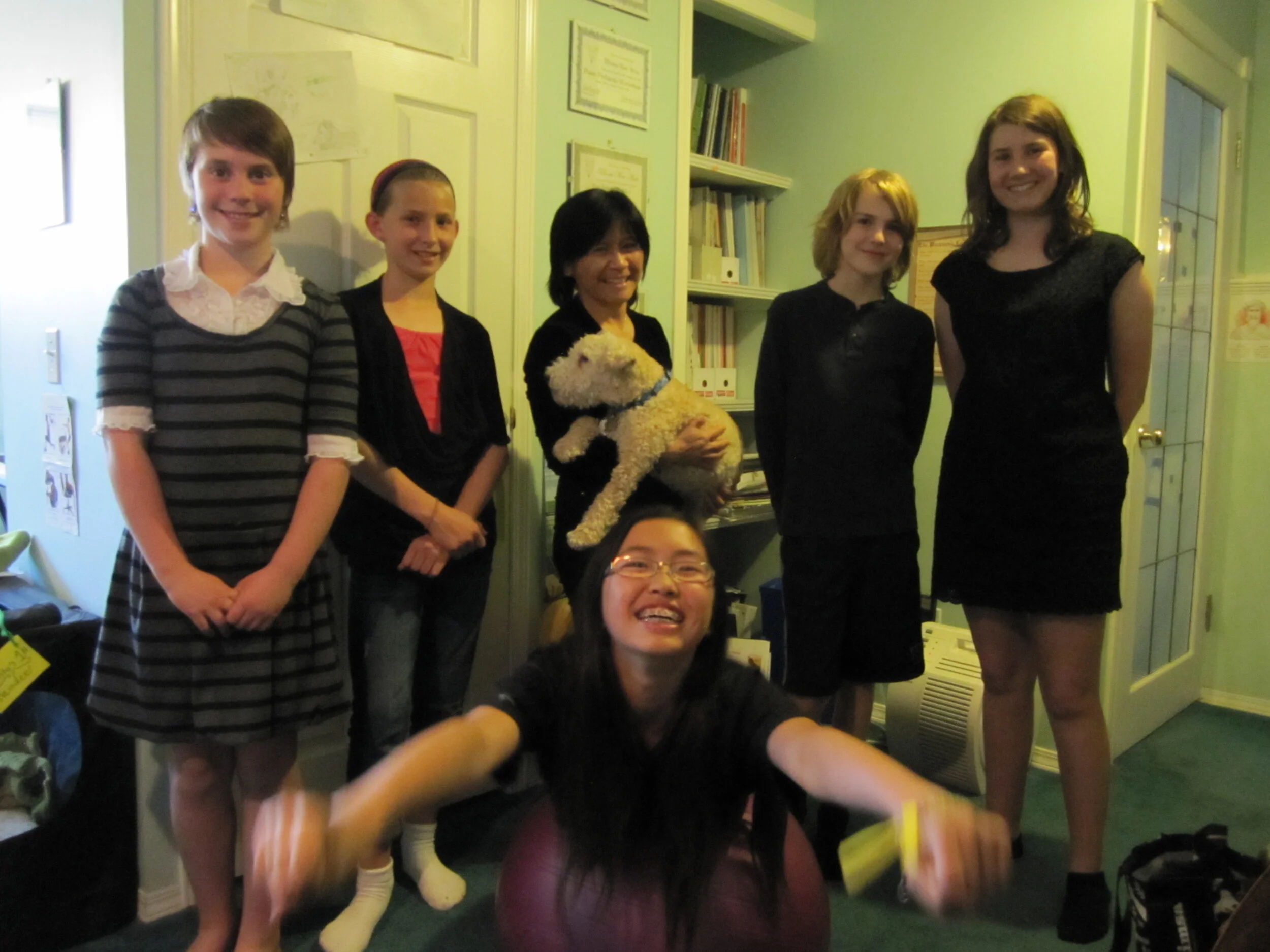
I established piano parties to give students performance experience in a social setting, seeing as most of their performances are for family and friends. I generally schedule two to three parties a year. Each student performs one or more pieces. I do as well, usually sharing something fairly new. If there’s a birthday, someone plays Happy Birthday. At one party, a student played O Canada, so we all stood up and sang the anthem.
Before and after performances, we play board games. Everyone brings snacks to share.

Cat Tower is a piano party favourite! Credit: R-M Arca.
One year, a student who suffers from severe performance anxiety had an attack. She went upstairs while another student went to comfort her and give her a pep talk. She came back down and performed, crying throughout her performance. Everyone listened to her calmly and supported her afterwards. I couldn’t have been more proud of my students for how they handled the situation.
With the pandemic, our last three piano parties were held online via Zoom or StreamYard. At the first online party, I ditched the performances in favour of giving my students a chance to socialize and discuss how they were coping. At our most recent one, we played a couple of online games after everyone performed.
To give students performance experience in a community setting, I book recitals at a local nursing home, two times a year. That was one tradition from my student days that I wanted to continue.

At our 2019 annual recital for our neighbourhood nursing home. Credit S. Yin.
The pandemic hasn’t stopped this. We have held two live stream recitals for the nursing home residents since the beginning of the pandemic. You can find out about our live streaming adventures here.
Crossover Periods & Mentoring
The studio is quite lively during the changeover period between lessons. Parents chat in the waiting area, while the students switching off exchange greetings, share news and listen to the Music Clip of the Day.
Alas, those days are over. Hopefully not permanently.
I recently set up a Piano Buddies program. Five students expressed an interest in being Piano Buddies. They’ll work together to do some ear training and rhythm practice and perform for each other. Earlier this week, I coached one of my students in how to set up a Christmas Break gaming day online. It is my hope this will evolve with minimal input from me.
Recitals as a Social Event
The Snack & Chat has been a popular feature at year-end recitals. Each family brings a plate of goodies to share. Students and parents chat with each other, students praise each other for a good performance and sometimes, someone breaks out a board game. Some years, it takes a while to clear out the area.
With our last two live stream recitals, my students did manage to keep that sense of community. They took full advantage of the backstage chat window during the recital, cheering each other on. Family and friends utilized the live chat on YouTube. Thanks to StreamYard’s user interface, I inserted some of the comments directly into the live stream and responded to comments and questions in real time.

It wasn’t the same as being in a church and having the Snack & Chat afterwards, but at least there was that real-time interaction with family and friends both near and far. After our December recital, some of us squeezed in a few rounds of Among Us.
Building Community via Social Media
Most students enjoy being the “Instagram Star of the Day,” where I feature a photo, video or screencap of fun or great moments during lessons. Most of my teenage students are on Instagram, so they have formed a network all on their own, following each other and keeping in touch via Direct Messaging. Past students keep in touch through Facebook or Instagram.
~
The fact that my students continue to keep in touch with each other as well as myself, years after lessons, makes me feel warm and fuzzy inside. My efforts to have a friendly studio community have borne fruit.
This may seem like a lot. Start with a few activities. Create opportunities for students and their families to connect and support each other in multiple ways. That is how community is fostered.
DISCLAIMER: This post contains a referral link to StreamYard.
Social Media Links
archives
- #YYCArts 32
- #YYCEvents 39
- Collaborative Music 25
- Community 11
- Composing & Arranging 6
- Entertainment 139
- Entrepreneurship 53
- Freebies 3
- Gardening 1
- Geeking Out 65
- Health & Wellness 120
- Improvisation 25
- Interviews 28
- Learning Music 188
- Martial Arts 13
- Memorization 7
- Music 230
- Music Careers 9
- Music Education 196
- Music Examinations 7
- Music Exploration 55
- Music Gigs 14
- Music Lessons 6
- Music Performance 32
- Music Theory 13
- Musical Instruments 12
- Musician Health 19
- Pets 57
- Piano Technique 12
- Practicing Music 120
- Productivity 20
- Professional Development 11
- Recommendations & Reviews 93
- Recreation 71
- Social Media 6
- Spirituality 10
- Studio Management 33
- Studio Technology 50
- Teaching Music 146
FOLLOW THE STUDIO on Instagram

Affiliate Links
As a Sheetmusicplus and CD Japan affiliate, I earn from qualifying purchases. The earnings help fund the Studio’s blog and YouTube channels. Your support is greatly appreciated.


FOLLOW Budo no Tabi on Instagram