THE MUSICAL MUSE
Blog dedicated to music education, practice tips, health
&
wellness, and geeking out.

Work and Budo Modifications with a Back Injury
As some of you know, I injured my back a couple of weeks ago. No, I wasn’t doing anything really cool like one of our awesome Iaido or Jodo kata, or going really wild on the cajón. I was simply sitting poorly at my desk and twisted funny when I got up to grab something from the printer. That’s when I felt a terrible twinge in my lower back. Next thing I knew, my body completely closed in and I could barely walk.
As some of you know, I injured my back a couple of weeks ago. No, I wasn’t doing anything really cool like one of our awesome Iaido or Jodo kata, or going really wild on the cajón. I was simply sitting poorly at my desk and twisted funny when I got up to grab something from the printer. That’s when I felt a terrible twinge in my lower back. Next thing I knew, my body completely closed in and I could barely walk.
Thankfully, I was able to see my chiropractor the following day for an emergency adjustment. He said that I completely jammed up my sacral region. I then compounded things by still using my active sitting discs while doubled up in pain for an additional day, thus aggravating my coccyx (tailbone) while sitting.
“This isn’t going to feel better right away,” he told me. “It will take a few adjustments.” He sent me hobbling off with the following advice, “Keep moving and try to avoid sitting as much as you can.” Well, considering that I need to sit at two of my instruments and work on a computer quite a bit, adjustments needed to be made.
Modifying the Studio for a Back Injury
The first thing that I rolled out of the studio was my exercise ball, which I used as my teaching chair. Next, I raised the stand for my digital piano so that I could play from standing. I spend half my time teaching from standing, so that wasn’t a big deal. However, I needed to come up with a different way to rest my muscles during lessons somehow.
I discovered during one of my shorter ushering shifts was that kneeling and going in and out of seiza was perfectly fine for my back. Seiza is the formal Japanese way of sitting, which we use in martial arts training. It’s more of a kneeling sit, although our buttocks float over our ankles. So teaching from kneeling or seiza made the afternoon and evening lessons go well. And stretching. Lots of stretching. I used these sacral release stretches quit a bit.

I’ve been getting into Child’s pose more regularly since my back injury. Credit: Iveto
My trusty Dr. Ho and Maestro’s old infrared pad have been a great help in the healing process. When I’m out running errands or working at one of my part-time jobs, I use Icy Hot patches.
Five days after my injury, I bought a Coccyx wedge to use in the car. I thought I could use it in the office and studio, but half the time, the wedge went flying off the seat because I move so much.
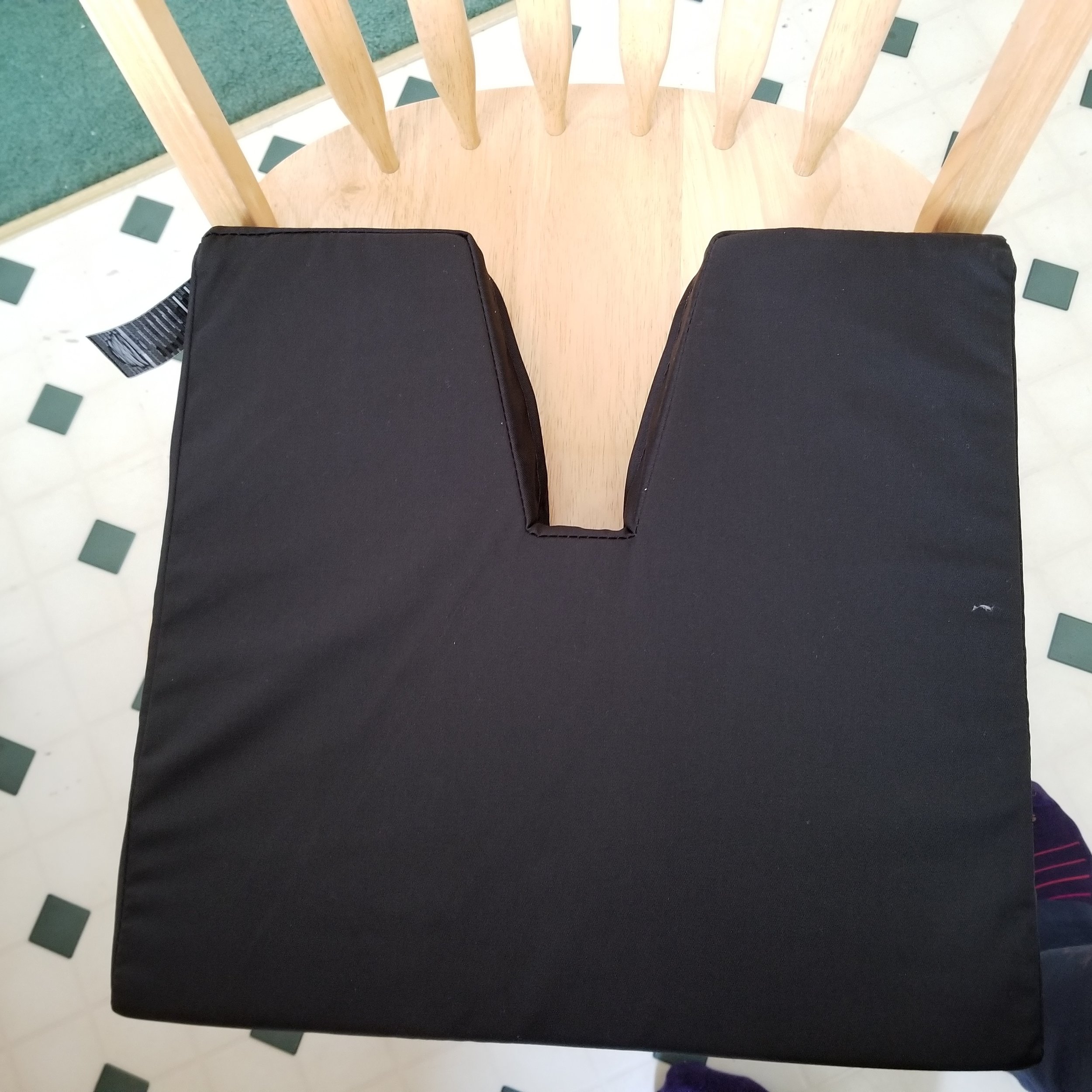
Coccyx cushion. Credit: R-M Arca.
One week after my back injury, I bought a kneeling chair from Staples to use in the office and studio. Too bad I got rid of my original chair a few years back. I am sitting in this one properly though, which is a huge improvement from last time.

Now that I’m using the kneeling chair properly (no slouching), things are going swimmingly. Credit: R-M Arca.
I’m in the process of building up my sitting endurance at the piano and cajón. I sit more or less properly at my instruments, so the only big change is that I still need to do short practice sessions with time to do sacral release stretches in between.

It was extremely easy to reconfigure my piano studio in such as way that I could take it easy on my back. Credit: R-M Arca.
Modifying Budo Training with a Back Injury
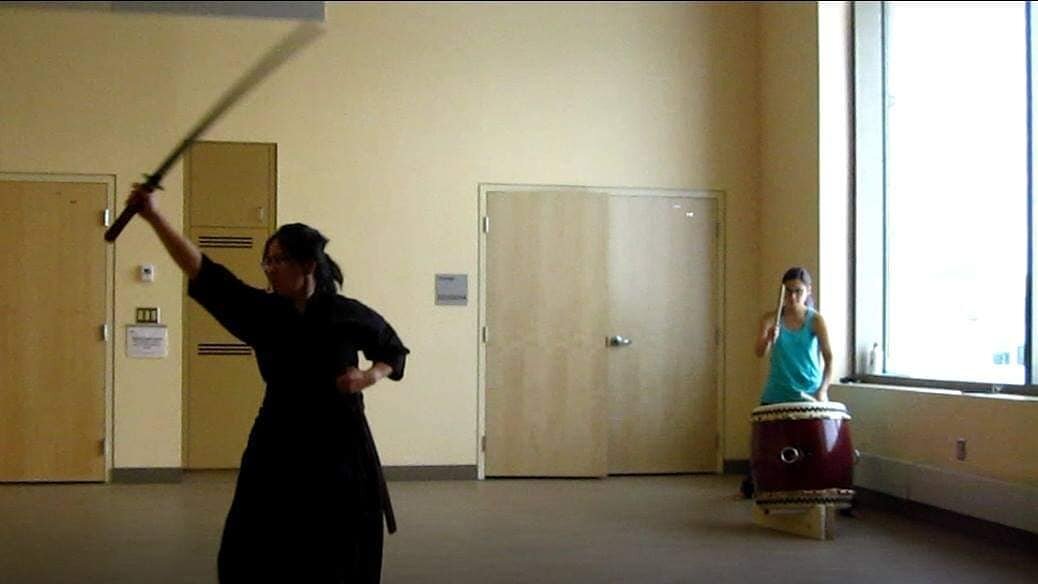
My chiropractor and massage therapist probably got tired of me asking, “When can I go back to training?” One visit, my chiropractor asked me describe the movements involved when we train. He was already grimacing when I started to show how we unsheathe our swords. I promptly stopped before my back said, “Don’t make me do sayabiki!”
Then, I tried to slowly demonstrate Uke nagashi, our third Iaido kata from the seitei set:
He stopped me very quickly and told me hold off until my back had healed some more. “No twisting.”
I have had to make myself content with practising my footwork and moving in and out of seiza. I have also been drilling small sections in my kata, such as o-chiburi, that don’t involve me to change directions. My visualization isn’t the greatest, but I’ve been mentally reviewing my troublespots and asking sensei questions every few days about something I’ve noticed or read.
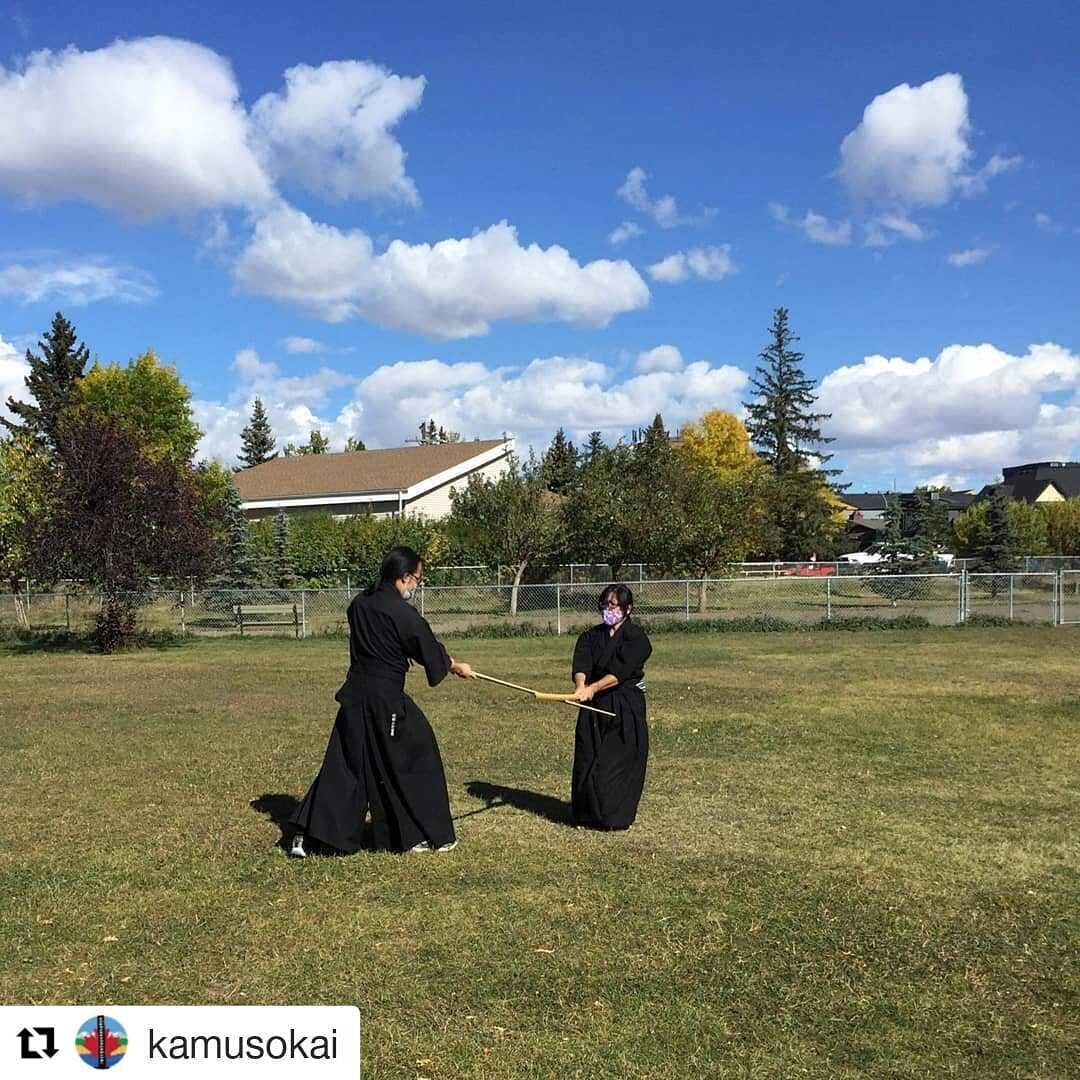
However, the main way that I’ve been keeping up with training is studying. I’ve got years’ worth of notes to review, as well as manuals for the four marital arts we practice (Iaido, Jodo, Hyoho Niten Ichi Ryu, and Choken Battojutsu Kageryu). Plus, there are always videos featuring some of of our sensei that I can watch.
Today, my chiropractor cleared me to ease myself back into regular training. I have a feeling that I’ll be doing a lot of solo practice at “Tai Chi slow” speed, taking time to dissect every movement for the first little while.
Lessons Learned from Injuring my Back
If anything, hurting my back has given me the opportunity to assess and adjust how I move and sit. During the first few days, I really had to break down how I did things like get on or off my bed into small segments. I am certainly sitting and getting on and off chairs more carefully these days.
I have definitely become more mindful of my body’s state as a result. Being more mindful can only be good, right?
Thermotex Personal Therapy System Product Review
The Thermotex Infrared Therapy System is a portable light therapy device to provide relief for chronic therapy, neck pain, spinal pain and more.
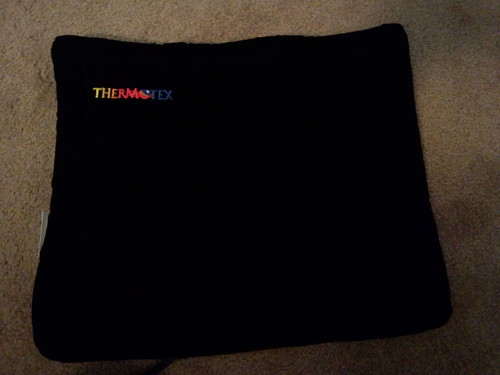
My dog, Maestro, was diagnosed with Inter-vertebral Disc Disease (IVDD) and osteoarthritis earlier this year. We have been going to the Canine Aquafitness Centre in Okotoks for his laser therapy treatments. Each session ends with a round on the Platinum Thermotex™ Personal Therapy System. Now that his laser therapy appointments have decreased from weekly to every other week, it was time to purchase our own Thermotex for at home pain relief from his vet; not only his muscle and joint pain, but my own!
How the Infrared Therapy Works
The Thermotex™ Personal Therapy System provides pain relief using infrared thermal energy (heat). This penetrates below the skin surface, all the way down into deep tissues and joints.
The body temperature in the injured area increases, increasing the blood flow into that area. The result is that the infrared jolts the affected area(s) into repairing the damage.
Infrared heat therapy is used on humans as well as pets for temporary relief of muscle and joint pain, sprains, strains, muscle tension, arthritis and even cancer patients. Maestro's vet assured me that it is very safe to use.
Features of the Thermotex™ Personal Therapy System
The Thermotex Personal Therapy System unit is 42 cm X 35 cm (17" X 15") The infrared heating plates are inside a soft, black case.
There are three settings on this product: High, Low and Off. The power cord is a decent length.
On the backside, there are removable Velcro straps. They can be used to wrap the device around the back, arm or leg.
In addition to the Thermotex™ Personal Therapy System, there are two systems specifically for animals. The equine system is designed as a coat for the horses to wear. The pet therapy system offers a line of pet beds.
Using theThermotex™ Personal Therapy System
When you first take the unit out of its packaging, check the cords inside the unit to make sure that they are securely connected. One end of the casing can be opened for this purpose.
His vet recommended that I put the pad in a pillowcase to keep the unit clean. So far, so good.
To use, place the unit on the injured area. You can use the Velcro straps to secure it in place. Put it on the high setting for the first 15 minutes and then switch to low. The instructions recommend that the device be used for at least 30 minutes.
The unit can be used up to four times a day. As with any therapy, the frequency can decrease as your condition improves.
There are several warnings that are worth noting. First, it is not recommended to use the unit while sleeping. Second, the Thermotex™ Therapy System should not be used on infants and thirdly, the product shouldn't be used in conjunction with liniments, salves or ointments. There rest are the regular warnings about using an electrical device.
There is a one year parts and labour warranty on the Thermotex™ Therapy System. There is also a 30-day satisfaction guarantee from the creator of the Thermotex™ Therapy Systems.
User Experience with the Thermotex™ Personal Therapy System
I purchased the device two weeks ago. Since then, Maestro has used the Thermotex™ Personal Therapy System daily. He uses it two to three times a day for approximately 30 minutes.
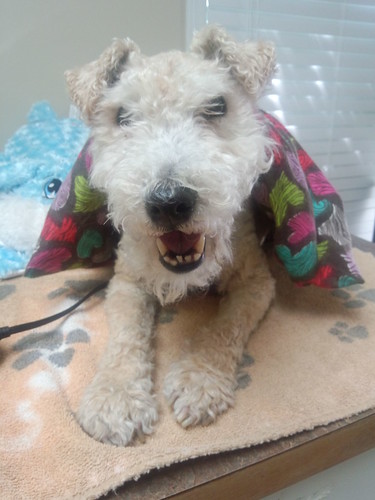
Maestro gets fidgety once we near the 30 minute mark. His vet says that "He's cooked and done," when he becomes restless.
After each use, he is more mobile. Maestro attempts to jump up on the couch and to tackle the stairs ("No jumping, running or stairs" was the first thing his primary vet said to me when he was diagnosed). If I'm not fast enough or if I'm too slow to put the doggie gate up, he actually does.
As for me, I've been using it daily as well. I use it on my tense shoulders and to ease my lower back pain. I've been a bit more active lately, so I am also using it to prevent tendinitis in my arm and on an achy leg/hip.
Although I feel better immediately afterwards, its effects aren't consistent. It works extremely well on my back and shoulders. However, I've had limited success with my hip region. To be fair, I'm only using it once a day. I should actually follow the directions and increase usage to three or four times a day. As well, it is a little tricky to keep the pad in place at my hip.
When finished, I roll the unit up and wrap the power cord around it. It stores easily, although, with both of us using it daily, I don't bother putting it away.
Alternatives toThermotex™ Personal Therapy Systems
The Thermotex™ Personal Therapy System is one of the pricier pain relief personal care products on the market. I purchased it from the Canine Aquafitness Centre for $249 CAD. I imagine other local dealers will sell it at a similar price. It sells on Amazon for $289.14 CAD. The Venture Heat KB-2436 Therapy Infrared Heating Pad retails for approximately $155 CAD. The Therasage HB-1600 Far-Infrared Heat Therapy Healing Belt With Battery is more expensive at $300 CAD. If you want the benefits of infrared heat therapy at an entry-level price, you could check out the Infrared Deep Heat Wand for less than $30 CAD.
There are also infrared light therapy systems. Prior to purchasing the Thermotex™ Platinum, we were using the Light Relief Infrared Pain Relief Device ($84.99). Gaiam sells a Deep Penetrating Light Therapy device for $169 USD. There is also the Sirius SS-77 Aurora Light Therapy System for $85 USD.
Thermotex™ and the other infrared heating systems have one advantage to the infrared light therapy units on the market - durability. Once those LED lights die, that's it. Game over, simply because I haven't found any replacement lights. Our power adapter also burned out - after the warranty expired. On the flipside, the advantage to infrared light therapy products is that they are cheaper.

Thermotex™ Personal Therapy System - The Final Verdict
Although the unit is the second most expensive that I've come across, I am satisfied with the Thermotex™ Personal Therapy System. The construction is solid, from the stitching of the casing to the thick Velcro straps. The heating plates are sturdy too.
It does work, if Maestro's increased mobility after each use is any indication. I too, have noticed less tension in my shoulders and back. The Thermotex™ Personal Therapy System is effective in providing temporary relief for chronic pain. One final bonus - no skin burns, which is always a factor when using "normal" heating pads.
Popular Back Massagers
A list of 10 of the most popular back massagers, developed from my ongoing quest for low back pain relief.


Last week, I reviewed the Travel Roller, which is a self-myofascial release (SMR) tool for back pain relief. We live in a sedentary society, after all. Between sitting at my instrument, sitting at my desk and sitting (sometimes) when I teach, I do get back aches. Even with all my attempts to have ergonomic seating, I still get backaches, especially lower back pain.
As much as I like my Travel Roller, I'm always on the lookout for other massagers that offer back pain relief. Since I'm self-employed (TL: not the health benefits plan), I try to solve as much as I can on my own before calling a medical professional.
I have done some digging and found these 10 popular back massagers. Sure, you can order them from Amazon. However, if you want to buy local, do check your local medical supply store or exercise equipment store. Here's the Top Ten Best Sellers in Back Massagers:

Trigger Point Performance The Grid Revolutionary Foam Roller, Black
Trigger Point Performance Grid 2.0 Revolutionary EVA Foam Roller (Black)
Trigger Point Performance The Grid Revolutionary Foam Roller with SMRT-CORE Level 1 DVD (Black)
Trigger Point Performance Self Myofascial Release and Deep Tissue Massage Starter Set
Alas, my Travel Roller is not in the Top 100 List. In fact, it's actually found under "Sports & Outdoors". Methinks it's in the wrong category.
Now, I do own back massager that IS on the Top 10 List: The Originial Backnobber. What I tend to do is use the Travel Roller to loosen up the knots a bit so that the Original Backnobber can get into a knot and finish the job.
Social Media Links
archives
- #YYCArts 32
- #YYCEvents 39
- Collaborative Music 25
- Community 11
- Composing & Arranging 6
- Entertainment 139
- Entrepreneurship 53
- Freebies 3
- Gardening 1
- Geeking Out 65
- Health & Wellness 120
- Improvisation 25
- Interviews 28
- Learning Music 188
- Martial Arts 13
- Memorization 7
- Music 230
- Music Careers 9
- Music Education 196
- Music Examinations 7
- Music Exploration 55
- Music Gigs 14
- Music Lessons 6
- Music Performance 32
- Music Theory 13
- Musical Instruments 12
- Musician Health 19
- Pets 57
- Piano Technique 12
- Practicing Music 120
- Productivity 20
- Professional Development 11
- Recommendations & Reviews 93
- Recreation 71
- Social Media 6
- Spirituality 10
- Studio Management 33
- Studio Technology 50
- Teaching Music 146
FOLLOW THE STUDIO on Instagram



Affiliate Links
As a Sheetmusicplus and CD Japan affiliate, I earn from qualifying purchases. The earnings help fund the Studio’s blog and YouTube channels. Your support is greatly appreciated.


FOLLOW Budo no Tabi on Instagram