THE MUSICAL MUSE
Blog dedicated to music education, practice tips, health
&
wellness, and geeking out.

On Becoming a Bulletproof Musician
The theme at last week’s group classes was becoming a bulletproof musician. The idea has been percolating in my mind ever since I discovered Dr. Noa Kageyama’s blog on performance anxiety and mindful practice, called The Bulletproof Musician.
The theme at last week’s group classes was becoming a bulletproof musician. The idea has been percolating in my mind ever since I discovered Dr. Noa Kageyama’s blog on performance anxiety and mindful practice, called The Bulletproof Musician.
Naming Our Fears
“Named must your fear be before banish it you can.” ~ Jedi Master Yoda
Each class had a different set of fears. I compiled everything that gives them performance anxiety below:
Everyone is watching
Making a mistake and everyone knowing it
Family teasing after making a mistake
Another student (known for giggling)
Messing up
Getting stuck
Stumbling and not being able to continue
Forgetting the music
Losing control
Not being ready (or able) to perform
People crowding too close to the piano
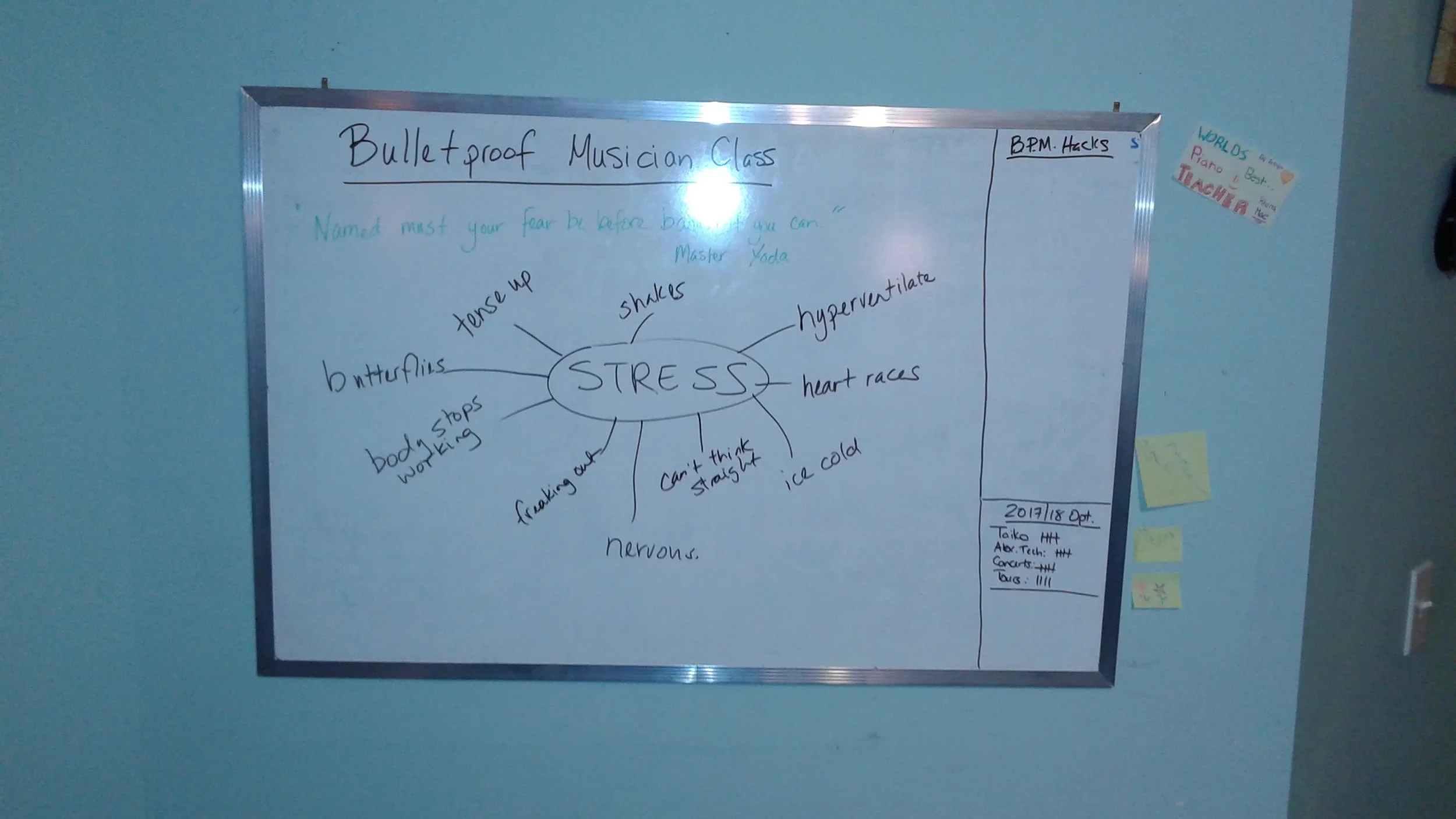
Most people share the same reactions when the body is under stress. Credit: Rhona-Mae Arca.
We discussed how our body reacts to performing under pressure or stress. To generate a paradigm shift, I showed my students this video by author and motivational speaker, Simon Sinek on performing under pressure:
It really comes down to convincing ourselves that yes, we really can do this. With a few practising and performing hacks, we can train ourselves to rush forwards to the stage with excitement rather than fear.
Creating the Ultimate Pre-Performance Routine
We all have our pre-performance routines. It could be lining up your pens, pencils, eraser, and ruler in a particular way before writing a test. Or wearing your lucky suit for a job interview. They’re little things, but they reduce our stage anxiety by helping us feel comfortable, grounded, and strong.
I read out professional tennis player Rafael Nadal’s 12-step pre-game routine. Most of my students giggled by the fifth (flicking the dirt of the hash mark with his left shoe). They were downright incredulous by the time I read out #10 (the order he wipes the sweat off his nose).
My students immediately poked holes in the routine: “What if both balls are fuzzy?...What if the ref tells him to hurry up?” I asked, “What if it’s raining?”
I then shared with them some of my pre-performance routines, starting with Mr. Buffalo. For most, it was the first time they heard about why there’s a photo of a buffalo sculpture above the piano.

Mr. Buffalo helped me ground myself before performing in master classes and recitals. Credit: Rhona-Mae Arca.
At my first piano lesson with Elinor Lawson at the University of Lethbridge, I was so nervous that I couldn’t focus. Elinor told me to take a deep breath, look out the window, and focus on a point. Standing stoically on the coulee, was the buffalo sculpture.
It got to the point where I either had to go outside before performing to commune with Mr. Buffalo, or just imagine him. Prior to my junior recital, one of my profs told me that I was too tightly strung up. He told me to go outside, scream, and shake it all out. That helped too.
Although I don’t need to do any of those stress busters these days, my photo of Mr. Buffalo just serves as that quick visual cue to ground myself. These days, my pre-performance routine includes: having a light practice the night before, eating one of my favourite meals for supper, doing something relaxing the night before, getting a good night’s sleep, picking out and testing a performing outfit that matches the mood of my piece(s) - and having a back-up, eating light prior to performing, stretching, and breathing exercises.
Then, it was their turn. Here are some of my student’s pre-performance ideas: jump, roll on grass, pack a lucky charm, sit in a sauna, swim, scorestudy, read a book, do something unrelated to the performance/test/presentation, keep your cool, sleep, watch TV, play video games, meditate, be at home and, be peaceful.
My students took a few minutes to come up with their own pre-performance routines and a mantra. Some notable mantras include:
Iz all gud.
I got this.
Nothing can stop me.
Calm down.
Play like you practiced!
I can do it.
What’s the worst that could happen?
Did I remember to turn off the stove?
Let’s go!
I am the captain of my own soul.
Let’s rock and roll!
Be aware of everything.
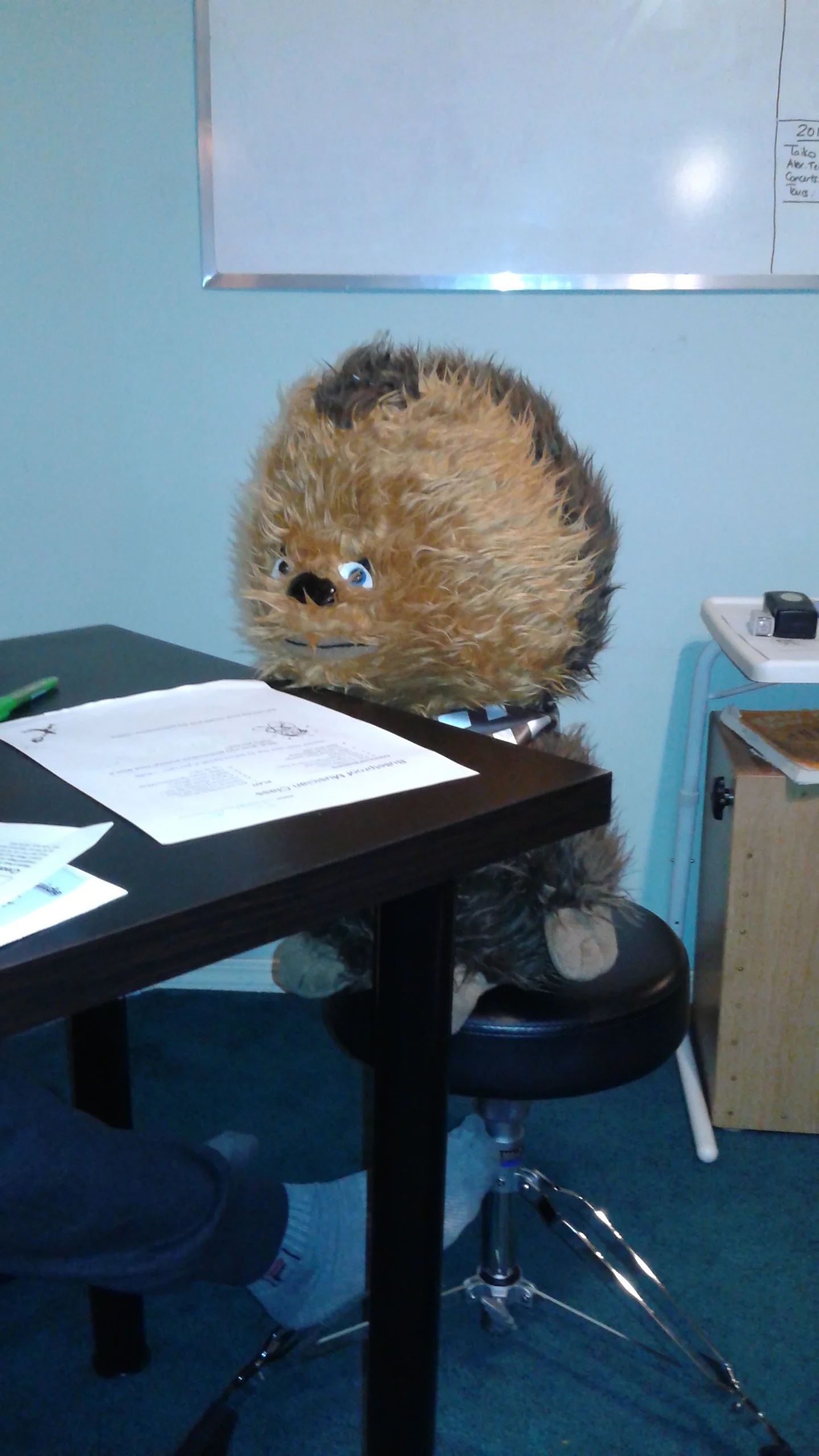
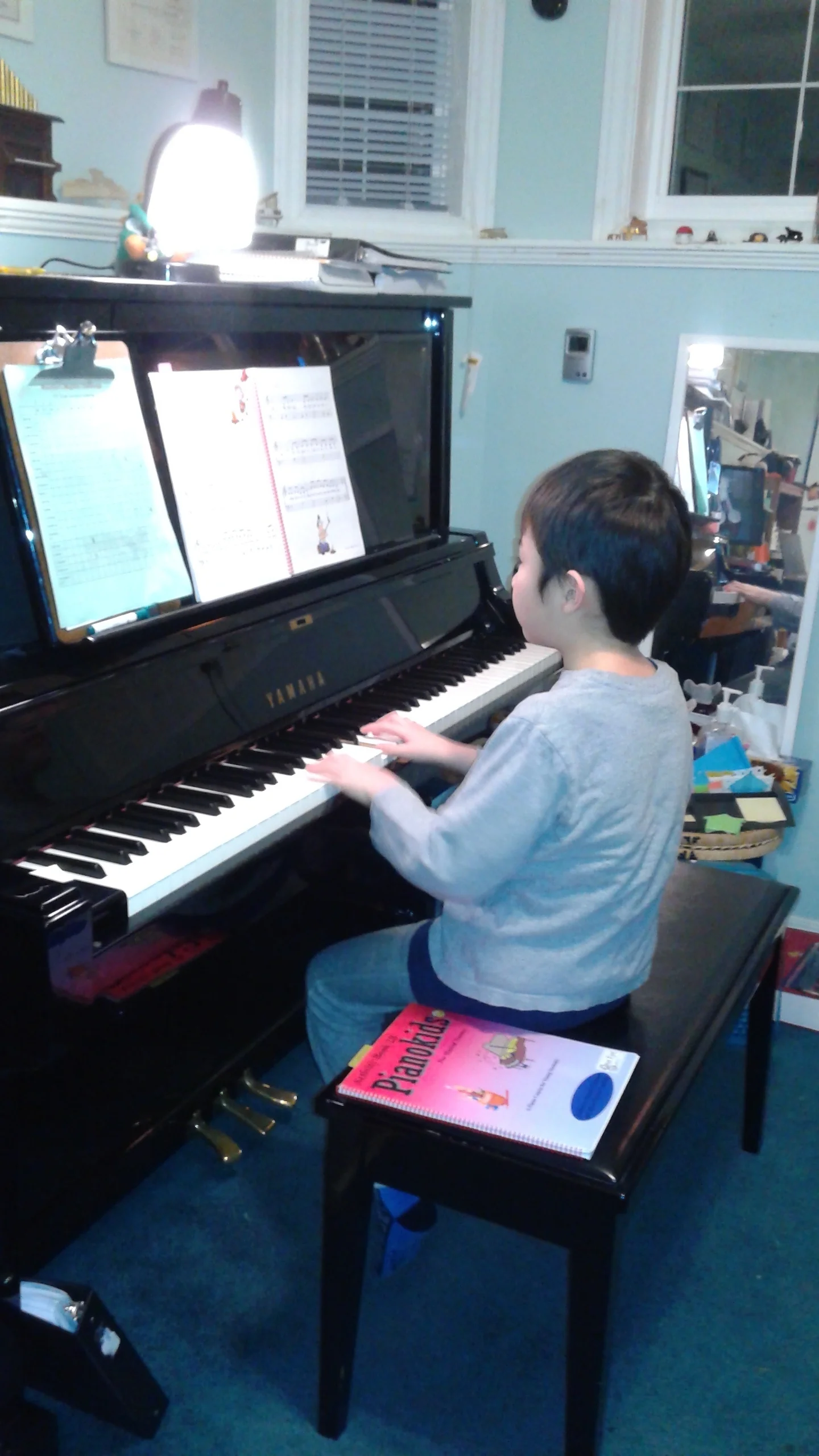
One of my younger students decided that Chewbacca had to participate in last week's group class. Credit: Rhona-Mae Arca.
Although some of my students are too young, I addressed the challenges of using drugs or alcohol to calm down nerves. Two teens looked at me, shocked. “But Miss Rhona! We’re not old enough.” I replied that I knew that, but that I also know that underage drinking does exist. There's always someone out there who just may try it.
Performance Savvyness
Next up, looking good on stage. We covered everything from showing up early enough to scope out the area and to find a place to relax. We discussed the pros and cons of being in the hall to hear the other students perform (depends upon the performance). Most importantly, we talked about owning the stage from the moment we get up from our seat until the moment we are off the stage, which covers: the walk, the bow, taking time to make adjustments (seat, music, bench), taking a few deep breaths, and approaching/leaving the keys in a way that matches the mood or character of your piece.
Telling a story through body language and sound. Credit: Rhona-Mae Arca.
Students came up, described their piece to the class and then played the opening. Their peers responded with how well their actions lined up with the piece. This turned out to be a fun exercise for all, trying to get the opening to look and sound epic or like little bunnies.
Exploring Practice & Performing Hacks
“The terror of performing never goes away. Instead, you get very, very comfortable being terrified.” ~ Eric Whitacre
We explored several performing hacks, which should alleviate some performance anxiety. One was an adrenaline drill. One student ran on the spot for approximately 40 seconds. Then, they had to quickly sit down and start playing. More often than not, the student had their hands in the wrong place. After taking a breath to clear their mind and recalling some of the performance savvyness aspects discussed earlier, they tried it again. Success.
Another performing hack we explored was a tempo drill. My students played a section of their piece at their desired tempo. Then, the others increased the metronome marking, bit by bit, while the one on the hot seat had to try playing at that tempo.
One student who has grappled with stage fright since day one, really connected with the visualization exercise. I asked her to engage all of her senses - imagine how the keys feel, how the room smells, what sound she wanted to create with her opening notes, etc. and then play.
In another class, a student shared this grounding exercise:
Think of:
Five things you can see,
Four things you can hear,
Three things you can feel or touch,
Two things you can smell, and
One thing you can taste.
One of the most popular exercises was the Roll the Dice Drill, which my students and I came up with when developing Maestro’s Music Tricks. As one student played, another would roll one of my polyhedral die and call out a bar number. The student on the hot seat had to quickly and smoothly transition to the new bar and carry on, not knowing when another student would call out another bar number.
Another popular exercise was the Play through Distractions Drill. Not only did that challenge the student performing to keep playing, but it challenged them to maintain his composure while the others flitted around, giggling and poking.
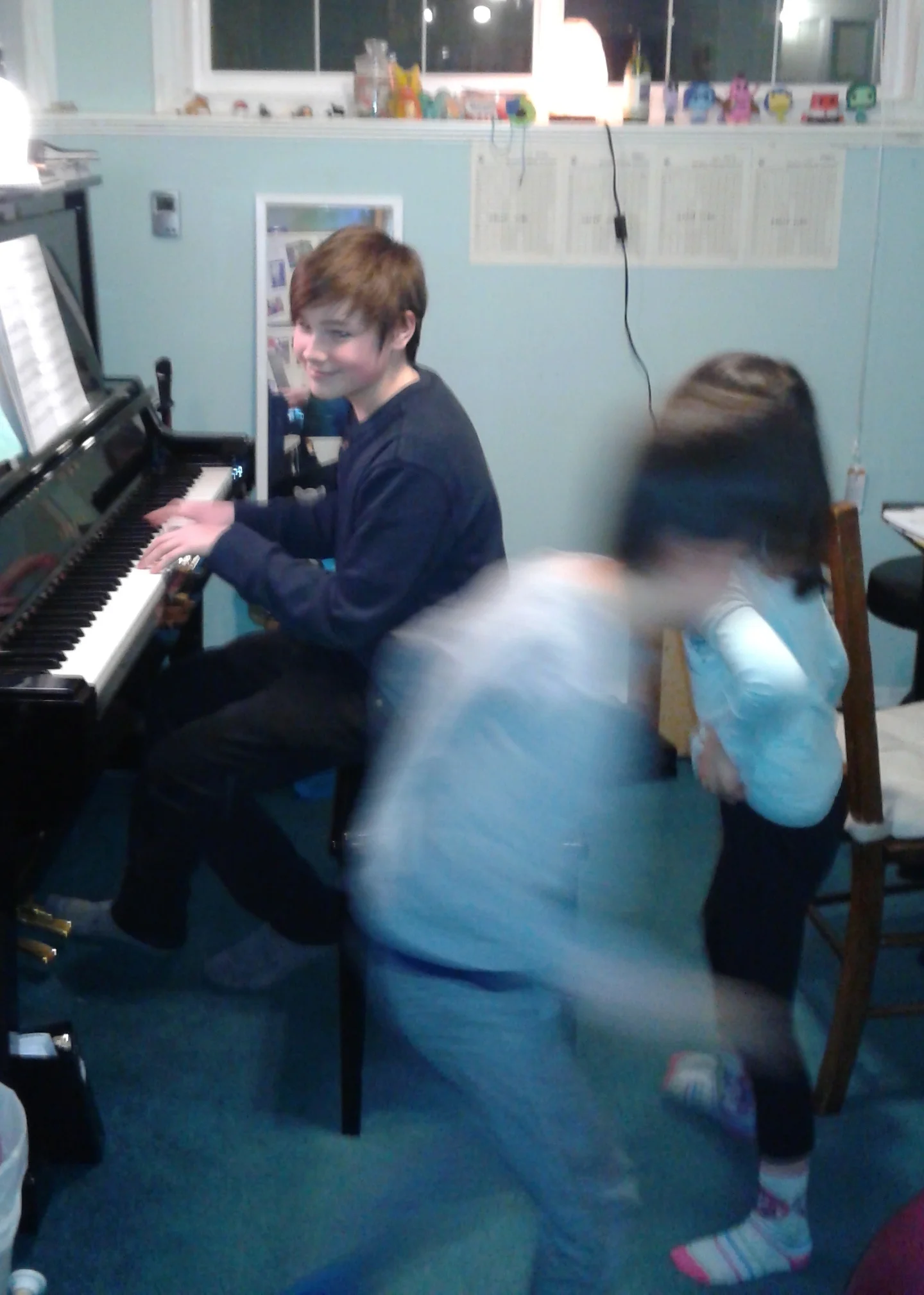
The Playing through Distractions Drill. Credit: Rhona-Mae Arca.
There were a couple of practice hacks that we quickly talked about, with the intent of working on it more in their piano lessons. One was studying the structure of their music, while the other was playing on a silent keyboard.
We wrapped up the class with my newest tabletop game, Cat Tower by IDW Games. It’s proving to be a popular game with my studio kids.
All in all, the kids found it a great class. It was comforting for my stage shy students to hear that they really aren’t alone with regards to performance anxiety. It was empowering to see them take charge and help each other level up their performance savvyness and bulletproof their music.
Now, if my students start performing a piece at the same speed as their on-stage heart rate, or someone’s phone rings in the middle of their piece, they should be able to “keep calm and carry on,” because they’ve prepared themselves for it through mindful practising, bulletproofing drills, and training their mind.
A Look at Virtual Choir 4 - Fly to Paradise
Virtual Choir is already at over 124,000 views! If you haven't checked it out, read on.
On July 11, 2013, our latest Eric Whitacre's Virtual Choir project went live. Our world premiere was for Her Majesty Queen Elizabeth at the Coronation Festival.
Here it is:
It's stunning. Sure, some people don't like the dubstep or the electronica and some are disappointed because they couldn't find themselves. Regardless, it's a beautiful piece of work. The beauty of hearing nearly 6,000 voices in sync - it's just magical. Peaceful. Awe-inspiring.
If you visit Eric Whitacre's website and scroll down to "Videos from the Choir", you'll find our very own Maestro with his Tenor "submission" to VC4. You can also check him out here:
Finally, one VC member suggested we come up with a blooper reel, while another painstakingly put them together. I'm towards the end:
You can check out my Virtual Choir 4 experience with my students here and my own reflection of VC4 here.
On Music and Technology, Teaching Awards and Future Collaborations
Musing about Virtual Choir and my swanky teaching award for Tech Teacher of the Year.
Last month, I was named the Tech Teacher of the Year. Last week, I got to pick up the hardware on the other side of the country:
The Tech Teacher of the Year Award is the brainchild of Roland Canada, Music for Young Children and Conservatory Canada. It is the first time that this award has been given out. The representatives involved decided to present the award at the Canadian Federation of Music Teachers' Associations (CFMTA) national convention in Halfiax, Nova Scotia, Canada.
The magnitude of the award didn't hit me until I stepped into the ballroom at the World Trade and Convention Centre. The mere thought of standing in front of music teachers from all over North America, many of whom have been teaching for far longer than I, was overwhelming. The realization that I had to come up with a decent acceptance speech was frightening.
Thanks to my previous "lives" - arts marketing and fund development, special events and communications - experience and Divine inspiration kicked in. Ergo, I am familiar with the "lead sheet" of an acceptance speech. All that was left was to decide upon a few salient points while my shaking hands tried to direct my meal into my mouth.
Now I can't remember everything I said. I do remember thanking the sponsors for coming up with the idea and for paying my transportation and accommodation to the convention. I vaguely remember mentioning how difficult it was to put the submission together (my first take was over 10 minutes long!). As well, I mentioned how my students are equally fascinated with old technology, tasking me with finding an old magnetic tape recorder.
My last point is one that I've made several times here: technology doesn't have to be scary. It took me years to get my studio to where it is today. Even then, it wasn't until my involvement with Eric Whitacre's Virtual Choir last year that I upped my game on the music and technology front.
Roland Canada hosted a dinner for the participants who were in attendance at the convention. It was inspirational to just meet and chat with this bright individuals and to express the desire to work together.
When I was able to tell the world that I had won the award, I shared my news on Eric Whitacre's Facebook Wall. I know I shouldn't be surprised that he replied. After all, Eric has nurtured a great relationship with his fans and members of Virtual Choir - to the point that he drops into the odd Virtual Choir Google Hangout and has dinner with 10 VC members who decide to go to Vancouver to catch him in concert:
However, knowing how busy he must be, it's still a bit shocking to get a reply from him.
What's next on the horizon? Who knows? I just know that now that I'm back from Halifax, I have to fight the urge to incorporate all the neat ideas I picked up - all at once.
Eric Whitacre's Virtual Choir, Live at TED 2013
After weeks of waiting, Eric's TED 2013 talk, featuring a performance by a live choir WITH a virtual choir is up.

I am very excited about this one. Although I wasn't able to participate, it is just a delight to be able to watch this and know that I've made connections with some of the people in the Virtual Choir who participated in this special project.
This time, Eric Whitacre had a live choir perform onstage with a virtual choir on screen. Just wild.
Virtual Choir for the world!
The full TED Talk:
Interview with Laura Slattery of Virtual Choir 3.0
When I was with Suite101, I interviewed Laura Slattery of Eric Whitacre's Virtual Choir 3.0 to discuss music, the links between music and medicine and Eric Whitacre.
When I was with Suite101, I interviewed Laura Slattery of Eric Whitacre's Virtual Choir 3.0 to discuss music, the links between music and medicine and Eric Whitacre.
Laura Slattery of Limerick, Ireland, recorded the Soprano 4 and 5 parts to Eric Whitacre's Virtual Choir 3 project: “Water Night” from the Grammy-winning album, Light & Gold. This huge multi-track project involved 3,746 videos submitted by amateur and professional singers from 73 countries.
Laura sat down with me on April 27, 2012 via Skype to discuss Eric Whitacre's music, the connections between music and medicine, musical obsessions and Virtual Choir.
Laura Slattery on Choral Singing
Laura has sung in choirs since the age of nine. “Actually, I tried to join my school choir when I was nine and I was told I wasn't good enough,” she recalled. “I said, 'Well I'll show you!' and went in and started getting voice lessons.”
Although Laura plays several instruments, including piano, guitar and tin whistle, choral music holds a special place in her heart. “There's nothing quite like choral singing. You can sing on your own, all you like; but there's just nothing like the experience you get with the people you meet.”
On Singing Eric Whitacre's Music for the First Time
“I think the first that I had heard of Eric Whitacre was actually my current choir,” Laura mused. She sings with the Tullamore Academy Chamber Choir, which recently was named National Choir of the Year.
She went on to recall the first time she sang an Eric Whitacre composition. “I kind of got drafted in at the last minute to sing tenor in “This Marriage” and it was kind of like, 'Wow, this is sick!'” Her conductor advised her to listen to more of Whitacre's music. “He said to go listen to “Cloudburst” . I was absolutely blown away,” she murmured.
Virtual Choir 3.0
“I had only heard “Water Night” once in my life,” she said. “When he announced it in December, I was like, 'Oops.' ” With a chuckle, she added, “I think it's fair to say I procrastinated – a lot. An awful, awful lot.”
She recorded countless times for VC3 and admitted that she was plagued with doubts. “There's just something about listening back to yourself. I hate it at the worst of times,” she admitted.
“We came up to the night before the submissions and I had been talking to my housemate about it. He was like, 'Look, just get and do it. Get up in the morning and get and do it. When are you going to get and do something like this again?' ”
Revitalized, Laura Slattery tried again. “I went into the college at 6:00 in the morning – the day of submissions. Had several failed attempts.” Then there were website and server issues. “I decided to go back home and record the S5 line in the car, just sitting outside of my apartment.”
Once she sent in her submission, Laura made a post to Eric Whitacre's Virtual Choir page on Facebook, saying, “Am I out of my mind? I recorded it in the car!” Responses came within seconds. “There were loads of people, 'You did great! We're delighted to have you.' ”
When Eric Whitacre announced that the Virtual Choir submission deadline would be extended, Laura decided to record the Soprano 4 line as well. “If he had gone for another day, I would have recorded another one. It was a labour of love.”
She fell in love with “Water Night”. “It's just such a fabulous piece. It's just so complicated. It's kind of counter-intuitive. How does he come up with these things? It just sounds so perfect but when you separate them out, you're like, 'These things shouldn't work together.' ”
Musical Obsessions
When asked about her favourite music, Laura quipped, “Does it sound cliché if I say any of Eric Whitacre's music? That's my study music now.”
“I've gone through kind of phases of being Handel-obsessed. I've gone through Evanescence. Take everything. Irish folk. I have great love obviously, for Irish music. I will absolutely listen to anything. There's very little that I don't like in music.”
“There's something intrinsically intense about music,” she mused. “It's people putting themselves out there, putting their heart out there on a plate.”
On Eric Whitacre and His Music
“Eric Whitacre is unique,” said Laura, matter-of-factly. “There's not a lot of people who utilize digital media.” She went on to explain. “I can put something up on Facebook and can hear back what he's thinking. You know, get an insight of his thought process.”
“He just captures words so well,” she said of Whitacre's music. “Every word you can see is thought out: 'Exactly how am I going to put those harmonies there? How am I going to get the message across?' “
“There's such feeling in it and a kind of purity and honesty,” she said. “Going back to the heart on a plate analogy, he's someone who literally, I imagine, gives all of himself. It's certainly how it comes across in his music.”
“He's exploded onto the choral scene,” she reported. “Every competition you go to – Ireland's not a big country – there's five or six choirs doing an Eric Whitacre piece.”
The Connections Between Music and Medicine
Ms. Slattery is a second-year medical student at the University of Limerick. She's in the graduate program, specializing in pediatrics oncology.
“Music is kind of like a vocation,” she said after pondering the question. “Medicine obviously has to be. The art of being a good musician, shall we say, is making it sound simple. It requires massive dedication, from the time you're a young child.
“And the ability to communicate emotions and the ability to understand emotion,” she added. “That is massive as a doctor, that too often is missing. You know, focus on the condition, focus on disease and fail to see the person, the emotion, the experience.”
Another link Laura recognized is the connection between creativity and adaptation. “There's obvious creativity in music. In medicine you have to think on your feet – adapt to situations.”
“Interestingly enough, an awful lot of people in my course are musical,” she admitted. “We've had talent nights.” She mentioned also that some medical students sing in choirs, while others teach music part-time.
“It's great to have something to escape to. Something to balance your life with. If you become too one-dimensional, then you lose the human aspect. If anything, I want to be a human doctor.”
Social Media Links
archives
- #YYCArts 32
- #YYCEvents 39
- Collaborative Music 25
- Community 11
- Composing & Arranging 6
- Entertainment 139
- Entrepreneurship 53
- Freebies 3
- Gardening 1
- Geeking Out 65
- Health & Wellness 120
- Improvisation 25
- Interviews 28
- Learning Music 188
- Martial Arts 13
- Memorization 7
- Music 230
- Music Careers 9
- Music Education 196
- Music Examinations 7
- Music Exploration 55
- Music Gigs 14
- Music Lessons 6
- Music Performance 32
- Music Theory 13
- Musical Instruments 12
- Musician Health 19
- Pets 57
- Piano Technique 12
- Practicing Music 120
- Productivity 20
- Professional Development 11
- Recommendations & Reviews 93
- Recreation 71
- Social Media 6
- Spirituality 10
- Studio Management 33
- Studio Technology 50
- Teaching Music 146
FOLLOW THE STUDIO on Instagram

Affiliate Links
As a Sheetmusicplus and CD Japan affiliate, I earn from qualifying purchases. The earnings help fund the Studio’s blog and YouTube channels. Your support is greatly appreciated.


FOLLOW Budo no Tabi on Instagram