THE MUSICAL MUSE
Blog dedicated to music education, practice tips, health
&
wellness, and geeking out.

Using Progressives for Music Experiment - Day 3
This will be done in two parts. This is from the first half of my day.I had trouble staying asleep last night, thanks to the nausea. Thankfully, I discovered that I still had Gravol in the house. While waiting for the feeling to subside, I did do some research.
This will be done in two parts. This is from the first half of my day.I had trouble staying asleep last night, thanks to the nausea. Thankfully, I discovered that I still had Gravol in the house. While waiting for the feeling to subside, I did do some research.
Most people who've had more than one pair of progressives say to wear them for as long as possible to speed up the adjustment process. This coincides with what my optometrist's office said.
The second thing I learned was that nausea is normal during this timeframe. However, patients with progressives say that if you're still having trouble after two weeks of "constant wear", you should talk to your optometrist to either get your a different prescription, a different type of progressive lens or to exercise your money back guarantee.To my chagrin, I didn't find out until after I ordered from my optometrist that there I do NOT have a money-back guarantee. I do, however, have a 90-day non-adapt (i.e. normal single-vision wear) clause.
I shall continue on my path to doubling my wearing time each day.
Time Length Goal: 2 hours minimumTime Length Progressives Worn: 3:38 PM - 8:20 PM (5 hrs. 42 min.)Tasks: Cleaning the studio, computer work and practicing pianoPart of the Lenses Used: 90 % Intermediate distance, 5% Long Distance, 5% Near "Fine-Print" Distance (only 2% intentional)
Feelings and; Symptoms Felt: Mild headache in occipital lobe area, gradually spreading across my entire head in a circle as it increased in intensity. Mild nausea today, which increased. Went from feeling disoriented, to "all right" to downright angry.
Video Clip 1: Cleaning the Studio
Part 2 will cover working on the computer and practicing piano with progressives.
Day 3 Conclusions - Part 1:
What's the point of that bottom part for reading? For me, someone who spends 90% of my reading time at the intermediate distance, that bottom "fine print" range at the bottom of the lenses is useless. I have to go out of my way to find things to try reading out of that area of the lens.

Using Progressives for Music Experiment - Day 2
I'll update this as the day progresses. However, I thought I'd share the play-by-play of my "progressives" experiment so far:
I'll update this as the day progresses. However, I thought I'd share the play-by-play of my "progressives" experiment so far: Time Length Goal: 1 hour minimum Time Length Progressives Worn: 1:30 PM - 2:57 PM (1 hour 27 min.) Tasks: Cooking and piano teaching Part of the Lenses Used: 90 % Intermediate distance, 10% Distance, 0% Near Symptoms Felt: Like I just got off a roller coaster at Universal Studios with flashing lights - nausea, mild headache in occipital lobe area, which later spread to the temples. Felt irritable by the end of the session.

Using Progressives for Music - Pre-Experiment Video
To give everyone a frame of reference as I start my "Using Progressives for Music" experiment, here are some videos taken of me practicing with my single vision lenses. Sight-reading example:
To give everyone a frame of reference as I start my "Using Progressives for Music" experiment, here are some videos taken of me practicing with my single vision lenses. Sight-reading example:
Drilling a student's piece:
Practicing ensemble music on piano:
Practicing conducting:
I'll repeat these experiments (and more) with the progressives.

Using Progressives for Music Experiment - Day 1
My eye doctor says I need progressives. Every musician I know who has them (or has had them) have basically told me that "progressives are useless for music".
My eye doctor says I need progressives. Every musician I know who has them (or has had them) have basically told me that "progressives are useless for music". They have either reverted back to single-vision lenses or use a dedicated pair for reading music. I even found some discussion threads dedicated to progressives and musicians. However, my optometrist is convinced that I should be able to handle it - for ALL situations - including music.
What's the big deal, you may ask? Well here, see for yourself:
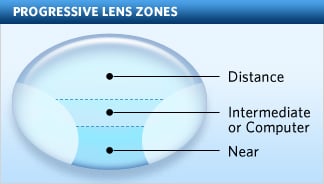
Photo from Master Eye Associates.
Now, look at the visual range for reading music. Note that this doesn't even include playing in an ensemble.
I am fighting a strong bias, so by documenting my journey, I hope to overcome that, as well as to give others an insight on the "progressives and music" experience.
The sides of on progressive lenses are essentially "dead" space, which does absolutely nothing for musicians who must rely on peripheral vision extensively and shift their focus very quickly.
Without further ado, here's my report on Day 1:
I should preface this by saying that I am extremely near-sighted with astigmatism. I have "dry eye" syndrome and plugged up tear glands, which may factor into this experiment. However, for the past month, I've been taking lubricating eye drops every 2 - 3 hours, being more diligent about removing my eye make-up, using eye lid wipes daily and either doing an eye wash or hot compress two or more times a day. Let's just say that my tear lubrication hasn't been this good in years.
In true science fair form, I will post some "Control" videos, showing how I see with my current (single-vision) glasses.
Practicing Music 101 - Warm Up Stretches
One area that music students (as well as working musicians!) tend to ignore is stretching. Musicians are, in fact, small muscle athletes. It is important to take care of those delicate muscles that we have, not only to prevent repetitive strain injuries, but to ensure that we can enjoy making music for many years.
One area that music students (as well as working musicians!) tend to ignore is stretching. Musicians are, in fact, small muscle athletes. It is important to take care of those delicate muscles that we have, not only to prevent repetitive strain injuries, but to ensure that we can enjoy making music for many years.
Here's a quick video from my Practicing Music 101 series
with seven warm-up stretches for the hands, arms and shoulders:
Check out my articles on Suite101 about
,
and
for more information. Happy practicing!
Social Media Links
archives
- #YYCArts 32
- #YYCEvents 39
- Collaborative Music 25
- Community 11
- Composing & Arranging 6
- Entertainment 139
- Entrepreneurship 53
- Freebies 3
- Gardening 1
- Geeking Out 65
- Health & Wellness 120
- Improvisation 25
- Interviews 28
- Learning Music 188
- Martial Arts 13
- Memorization 7
- Music 230
- Music Careers 9
- Music Education 196
- Music Examinations 7
- Music Exploration 55
- Music Gigs 14
- Music Lessons 6
- Music Performance 32
- Music Theory 13
- Musical Instruments 12
- Musician Health 19
- Pets 57
- Piano Technique 12
- Practicing Music 120
- Productivity 20
- Professional Development 11
- Recommendations & Reviews 93
- Recreation 71
- Social Media 6
- Spirituality 10
- Studio Management 33
- Studio Technology 50
- Teaching Music 146
FOLLOW THE STUDIO on Instagram


Affiliate Links
As a Sheetmusicplus and CD Japan affiliate, I earn from qualifying purchases. The earnings help fund the Studio’s blog and YouTube channels. Your support is greatly appreciated.


FOLLOW Budo no Tabi on Instagram