THE MUSICAL MUSE
Blog dedicated to music education, practice tips, health
&
wellness, and geeking out.
My Practice Tracks Recording Project
Making practice tracks recordings for a client is a relatively new gig for me. It was hard work, but I see the potential for future opportunities.
Before Christmas, my singing coach, Sherry Kennedy, sent one of her students to me with a new project. Her student sings with one of the Up2Something choirs in Calgary. Some of the pieces the choir is working on are challenging, so she hired me to make practice tracks recordings of the alto part.
A New Kind of Gig: Recording Practice Tracks
This was a little different from the practice tracks recordings I make for my piano students on occasion, so I had a bit of a learning curve. From the get-go, I knew that it would be most efficient to record the alto tracks digitally from my Yamaha CP-33 straight into my computer, using my favourite free audio recording and editing software: Audacity by SoundForge.
First, I had to research just how to get my digital piano to “talk” to Audacity, as initially, the program didn't recognize that the my piano was plugged into the computer. More specifically, my digital piano was plugged into my M-Audio Box, which wasn't on speaking terms with Audacity.
The turnaround time was approximately one week to do eight songs. I quickly saw why my client needed mp3 practice tracks: some of them were quite tricky, with multiple time signature changes and/or key signature changes. If it wasn't that, there were complex rhythms.
My client asked for just her part. However, there were bars and bars of alto tacet, with tempo changes in between. I decided to play one of the other vocal parts during those times.
Part 2: Recording Vocal and Piano Accompaniment mp3 Tracks
Last month, my client came back. She and her fellow altos wanted practice tracks of all their repertoire for the year: 15 songs. Actually, it was more than 15 as "A Celtic Fantasy" was a set of three songs, while "A Tribute to Queen" was a medley. Many of them were fast and lively.
This time, they asked for piano accompaniment during the alto tacet. Now, I could have done that, but that would have broken the flow. What if I messed up and played the soprano part after playing the piano interlude?
Besides, what if someone from one of the other choir sections came back and hired me to do practice tracks for them? The piano accompanist/sometime conductor in me demanded that piano accompaniment mp3 tracks were required for all of the works. That way, I could separate the tracks: piano accompaniment only, alto only, or vocals with piano accompaniment.
Talk about a make-work project. I tried to speed learn/semi-fake all the works in under a week. It didn't take long for me to realize that I would need to record a section at a time and then mix the tracks together. With a short window, made shorter with music teaching and writing, I could be “on” for short sections but not extended periods of time. This also made it possible to record each piece in multiple sittings. I could take a break, teach, sleep and start up, right where I left off (the beauty of digital recording).
Here's a screen shot of one of the tracks, “A Tribute to Queen”:
Did I have to do all of that? Probably not. However, I was looking at this from a long-term perspective. If I get more gigs like this – making piano accompaniment mp3 tracks – I need to hone my skills at each step. Not only that, I also need something that I can show off (Note to self: add a clip to your Soundcloud).
Besides, the pieces were just plain cool. I was itching to play them. As far as piano accompaniment projects go, this was pretty neat. Hard work, but I can see the potential practice tracks recording to be a neat sideline gig.
Music Teaching Idea: Using Visual Aids to Help Introduce New Works
When introducing a new work to a student, I try to give him or her an idea of the form, era and genre using visual aids. It's a little easier to get music teaching ideas when the composition has a descriptive title.
When introducing a new work to a student, I try to give him or her an idea of the form, era and genre. It's a little easier to get music teaching ideas when the composition has a descriptive title. Last month, one of my intermediate students started working on “Arabesque” by Génari Karganov (Royal Conservatory Grade 5). He's a delightful transfer student who excitedly says, “Sonatina!” when I ask him what he'd like to work on first. “I've been waiting to show you all week,” he'd say. This student has the same level of enthusiasm for all of his classical repertoire.
When we listened to the RCM CD recording of “Arabesque”, I asked my student to describe the music. Our discourse turned up: “graceful”, “lots of curve” and “flower”.
Then, I asked my student if he knew what an “arabesque” was. He answered, “No.” I shot up from my exercise ball, and did a quick online search for an arabesque. We found one that was licensed for reuse and printed one off:
I am pleased to say that one month later, my student still has the print-out of the arabesque clipped to his music. His shaping is coming along nicely. That was one music teaching idea that I'm glad I acted upon the moment it popped into my head.
One more example to share: My students and I have been exploring the music of Jennifer Ecklund of PIano Pronto. "No Limits" is extremely popular with my tween and teen boys in my studio.
When discussing choreography and the importance of our body language matching the music, my student came up with this to remind him how to end the piece:
As far as visual aids go, you can't miss that!
What about you? What kind of visual aids to use in your music teaching to help your students learn their pieces? Let the music teaching ideas come in!
Maestro's Continuing Adventures in Water Therapy for Dogs
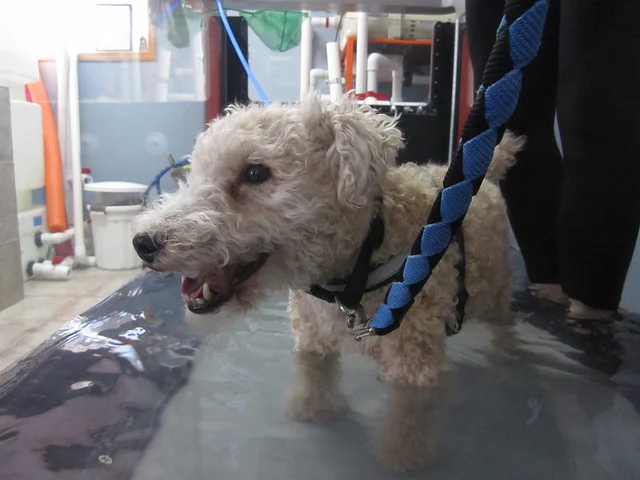
Last week, Maestro completed his fifth aqua therapy treatment for canine arthritis and Inter-vertebral Disc Disease. He has made steady progress.

Last week, Maestro completed his fifth water therapy treatment for canine arthritis and Inter-vertebral Disc Disease. He has made steady progress. Each week, he walks approximately .1 mile more than the previous week. He also spends more time walking at .75 mph.
Last visit, he walked for about 20 minutes. Thankfully, Maestro doesn't complain as much as he used to.
Here are clips from Maestro's third and fourth sessions of water therapy sessions:
Week 3 Front View
Profile View
[Week 4]
Unfortunately, I left my phone at home during Maestro's fifth water therapy session, so I wasn't recorded.
One interesting tale from our last visit: there have been several “poopy patients”. In case you are wondering what happens when a dog defecates during an aqua fitness treatment, the tank is shut down for the rest of the day and subsequent appointments are rescheduled. The water in the tank has to be purified, while the water treadmill is sanitized from top to bottom.
In order to avoid the embarrassment of having your dog defecate during a canine water therapy session (and the “poop charge”), there are three things three things pet owners can do. First, owners should not feed their dog less than three hours prior to a session. Second, owners should let their dog relieve themselves before they enter the clinic. Finally, if a dog has diarrhea on the day of an appointment, the owner should reschedule the water therapy for dogs until the it is feeling better.
(Not to worry, Maestro wasn't a poopy patient.)
Dr. Catherine at the Canine Aqua Fitness Centre did mention that Maestro is ready to try swimming as part of his treatment for canine arthritis. He will start that portion of his water therapy for dogs next month.
Dog Walks at Spruce Meadows
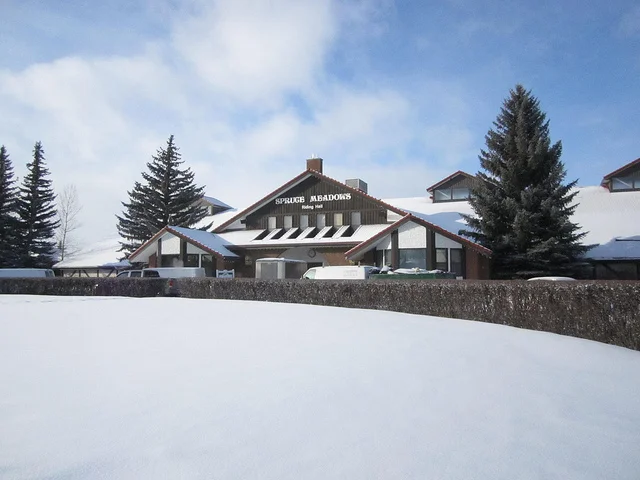
Upon the suggestion of another canine patient and his owner, Maestro and I have started going on dog walks at Spruce Meadows. Prior to that, I did not know that an extensive part of Spruce Meadows is dog-friendly.
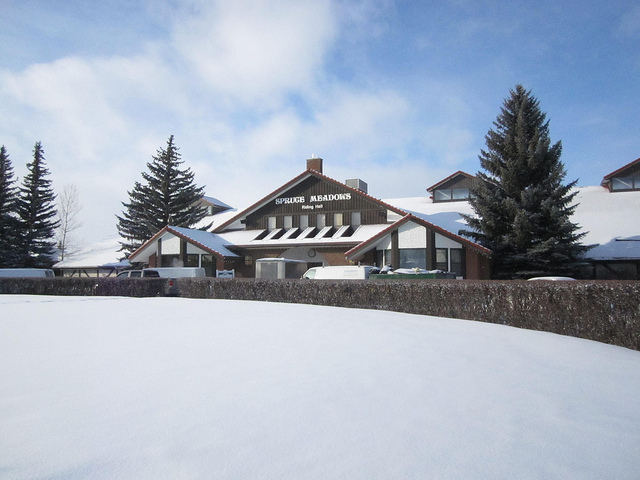
Another canine patient and his owner told us about walking inside the stables at Spruce Meadows when it's cold outside. I heard that Spruce Meadows was a pretty dog-friendly place, but I didn't realize that we could take our dogs inside the buildings as well!
Jigs' owner said that the stables are nice, warm and clean; a perfect place to walk an elderly dog on a cold winter's day. One day when it was below minus 20 degrees Celsius, I took Maestro to Spruce Meadows.
It was a bit of an adventure. Maestro was frightened by the horse's size. In turn, the horses didn't like it when Maestro hugged the stable doors. Kudos to the horses for staying calm while they kept a wary eye on Maestro's progress. As frightened as he was, Maestro did manage to walk further than he usually does outside.
So long as you don't interrupt the horses and staff from their training, you can travel all over the grounds. Spruce Meadows is open to the public every day from 9:00 a.m. to 6:00 p.m.
Here are some photos from our second visit to Spruce Meadows:
Many thanks to the owners of Spruce Meadows for opening up the grounds not just to Calgarians, but for making it a dog-friendly place in Calgary. Dog walks at Spruce Meadows is going to be a regular thing for us now!
Adventures in Water Therapy for Dogs
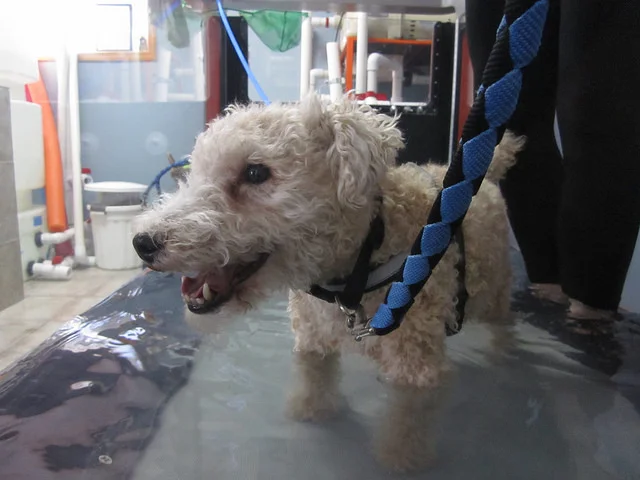
Maestro tries out water therapy for dogs to treat his canine arthritis and IVDD. Canine hydrotherapy is used to treat various conditions in dogs.
We've had several cold snaps this winter, which makes it tough for anyone to exercise, including our arthritic furry friend, Maestro. As a result, I've noticed an increase in the amount of stiffness in his movements. To combat this, we are exploring water therapy for the treatment of canine arthritis and IVDD in dogs. To give you an idea of Maestro's progress, this is a video that I took of Maestro's gait last month. He was in between his acupuncture and laser therapy sessions and it was a cold week. You can see how choppy is gait is and how he favours his left side:
Maestro's Water Therapy Treatment for Canine Arthritis
Maestro had his first water therapy session two weeks ago. The noises the water pump made as it filled the tank frightened him and I think he wanted to know what I wasn't going into the tank with him. He also wasn't keen on facing away from the door.
He quickly adjusted. I think he remembered the treadmill at home and started plodding along at 0.5 mph. Like the dry treadmill, he stopped to take breaks and would resume walking either when he reached the end of the treadmill or got a light bump from Louise (one of the fabulous staff members at Canine Aquafitness).
Here's a video from his first water therapy session:
He had his second session earlier this week. It went smashingly well. Maestro was happy that the treadmill was repaired and he could now walk while facing the exit.
Dr. Catherine, Emmanuelle and Louise have decided that Maestro doesn't need anyone with him next time. Here's some video from that treatment:
As you can see, his movements are much more fluid. He was bending his joints more and really getting into it. This time, he spent more time walking at 0.75 mph and travelled 0.16 miles (0.2 more than last week).
Maestro's monthly treatment plan at Canine Aquafitness now consists of weekly water therapy sessions on the underwater treadmill with one week of laser therapy. His acupuncture treatments are also going to go down to once every three weeks. Let's just say I'm glad there's pet insurance!
An Introduction to Water Therapy Treatment for Dogs
Water therapy is used as treatment for canine arthritis and Inter-vertebral Disc disease. The result will be increased mobility for our intrepid Canine Studio Assistant.
Water therapy can be used to treat other conditions in dogs. For example: hip and elbow dysplasia, patella luxation, obesity, spinal injuries and post-operation rehabilitation.
Water Therapy for Dogs in Calgary
Dog owners in Calgary and the surrounding area are quite lucky. There are three veterinary clinics that specialize in canine hydrotherapy:
Canine Aquafitness (Okotoks, AB): This is where Maestro goes. His vet there is Dr. Catherine Pampligione, who received the Okotoks Chamber of Commerce 2013 Award of Excellence in Animal Care. In addition to water therapy for dogs, the Centre offers therapeutic ultrasound, electrical muscle therapy, massage therapy, chiropractic treatments, infrared therapy and cold laser therapy.
Canine Fitness Centre (Calgary, AB): The Centre offers ultrasound, light therapy, magnetic field therapy, neuromuscular electrical stimulation, fitness conditioning, canine hydrotherapy and more.
Marda Loop Veterinary Centre (Calgary, AB): The Centre offers a wide range of canine rehabilitation services, including: chiropractic, acupuncture, water treadmill, extracorpeal shock wave therapy and more.
Pet owners in Calgary can find out more about water therapy for dogs at an information session hosted by the Shawnessy Pet Valu on Saturday, March 15, 2014. For those of you outside of the Calgary service area, you can visit the International Association of Animal Massage & Bodywork / Association of Canine Water Therapy's website to find a canine hydrotherapy centre near you.
Social Media Links
archives
- #YYCArts 32
- #YYCEvents 39
- Collaborative Music 25
- Community 11
- Composing & Arranging 6
- Entertainment 139
- Entrepreneurship 53
- Freebies 3
- Gardening 1
- Geeking Out 65
- Health & Wellness 120
- Improvisation 25
- Interviews 28
- Learning Music 188
- Martial Arts 13
- Memorization 7
- Music 230
- Music Careers 9
- Music Education 196
- Music Examinations 7
- Music Exploration 55
- Music Gigs 14
- Music Lessons 6
- Music Performance 32
- Music Theory 13
- Musical Instruments 12
- Musician Health 19
- Pets 57
- Piano Technique 12
- Practicing Music 120
- Productivity 20
- Professional Development 11
- Recommendations & Reviews 93
- Recreation 71
- Social Media 6
- Spirituality 10
- Studio Management 33
- Studio Technology 50
- Teaching Music 146
FOLLOW THE STUDIO on Instagram


Affiliate Links
As a Sheetmusicplus and CD Japan affiliate, I earn from qualifying purchases. The earnings help fund the Studio’s blog and YouTube channels. Your support is greatly appreciated.


FOLLOW Budo no Tabi on Instagram