THE MUSICAL MUSE
Blog dedicated to music education, practice tips, health
&
wellness, and geeking out.
What is an Audition-Interview?
Before signing up for music lessons, learn what's involved when a music teacher meets with a prospective student and parent(s) for the first time.

Before signing up for music lessons, learn what's involved when a music teacher meets with a prospective student and parent(s) for the first time.
The audition-interview can be a vital part of the selection process when finding a music teacher. It gives the prospective student, the parent (or guardian) and the music teacher the opportunity to gather information needed to make a final decision on where to study. The meeting occurs after first contact (phone/email) between a private music teacher and a prospective student’s family.
Purpose of an Audition-Interview
During the audition-interview, the prospective student and parent can learn more about a music educator’s teaching philosophies and policies. The music teacher uses this meeting to assess the student, the family and determine compatibility.
Determining compatibility is a critical part of the meeting. It’s a case of determining whether the student’s communication and learning style is well-matched to the teacher’s communication and teaching style, determining how well the parents’ vision meshes with the teacher’s and how well all parties “click” with each other.
How to Prepare for an Audition-Interview
Each person involved in the audition-interview has to prepare in advance. A music teacher should have printed copies of his or her studio policies, studio calendar, assessment tools and registration form ready.
A beginner student should think about why he or she is interested in music lessons and why he or she is interested in a specific instrument. A transfer student should practice a couple of pieces learned with his or her previous teacher and review some technical exercises.
Parents of transfer students can prepare for the audition-interview by bringing a copy of their child’s previous exam transcript(s), music books used previously and assignment book. All parents should bring a list of questions and their cheque book.
What Happens at an Audition-Interview?
The audition-interview can take between 30 – 60 minutes. The meeting can be broken down into three sections: Teacher Interview, Assessment and Policies, Philosophies and Final Questions.
During the Teacher Interview, the teacher can direct some questions to the prospective student and the rest to the parent/guardian. Some questions that a music teacher can ask a potential student are:
Why do you want to take music lessons?
What do you like about music?
What are some of your hobbies and interests?
Do you like taking music lessons? (for transfer students)
Are you willing to practice regularly? How much time are you willing to commit?
What would you like to learn?
The following are sample questions that can be directed to the student’s parent or guardian:
What is the setup, practice environment and support structure to help the student organize his or her practice?
What extra-curricular activities does the student have?
What amount of time do you feel is reasonable for daily practice?
Is the student or the family involved in other musical activities?
Why did you discontinue lessons with your previous teacher?
During the Assessment, the teacher may ask a potential student to perform one or two pieces and technical exercises, followed by aural, reading, theory and rhythm questions. This helps the teacher assess technique, musicality and posture.
The teacher may ask the parent to wait in another room during the assessment portion. This gives the music teacher and student an opportunity to see how well they “click” without outside influences or interruptions.
During Policies, Philosophies and Final Questions, the music teacher outlines his or her studio policies with regards to attendance, expectations, rescheduling lessons, termination of lessons and tuition fees. He or she may also present the Studio Calendar at this time.
The music teacher also shares his or her teaching philosophies and approaches with the prospective student and parent(s). He or she may do a walk-through of what happens during a regular lesson.
Finally, the parent and prospective student have an opportunity to ask questions that haven't been answered yet. They can also voice concerns that they would like the music teacher to know.
After the Audition-Interview
All parties should take some time to reflect and review the information they have been given. During this “cooling off” period, one may conclude that the student’s or the family’s goals do not mesh well with the teacher’s methods and teaching style.
Arrangements should be made to follow up after the audition-interview. The final stage is to either complete the registration process with the potential student or have the teacher recommend several other qualified teachers in the area that may better serve the needs of the student and the family.
Taking the time to meet for an audition-interview is a vital part of the process when finding a music teacher. Music lessons are a long-term commitment and investment. Registering with a music teacher is the beginning of what can be a long and fruitful relationship. The audition-interview sets the tone for the relationship.
References:
Color in my Piano: Printables updated: Student Info form, and Student Interview forms (accessed August 4, 2010).
Torney, Helen, “The Professional Studio: Interviewing Prospective Students”, Music Matters, January/February 2002, p. 2 – 4.
Originally published on Suite101.com on August 6, 2010. Updated March 22, 2013. All rights reserved by Rhona-Mae Arca.
Yes, He Really Plays the Bongos
At 11, Maestro still enjoys playing musical instruments. Whatever he can get his paws on.

Maestro Plays the Bongos
When I first contacted Maestro's breeder, Nancy Kiss of Calliente Lakelands, she asked me several questions. They are standard questions reputable breeders ask to determine whether or not you are a good fit for the breed.
When Nancy heard that I'm a musician, she said, "I have the perfect dog for you. He sings to the radio."
Now, I've only heard Maestro sing to the radio once or twice. He does sing along to scales, chords and arpeggios. He'll sing along with anyone who can carry a tune.
However, if you stumble one too many times, he leaves. Practicing, as he well knows, does not equal performing.
Maestro taken a huge shining to percussion instruments. Namely, the bongos, tambourines, shakers and rain stick:
Here another photo from Maestro's bongos practice during Group Class Week:

DSC_0089.jpg
Great Performances - Gustavo Dudamel at the Proms
A fantastic music clip featuring Gustavo Dudamel at the Proms. Happy Easter!
Happy Easter! Just a short post for you to enjoy. It's quite an honour to be be asked to perform at the BBC Proms. If you click on the link, you will be able to watch and listen to some spectacular performances.
Here's one of them. Venezuelan conductor Gustavo Dudamel is a treat to watch at work. He is so expressive and through every gesture and expression, he conveys so much to the orchestra. He is the Music Director of the Simón Bolívar Symphony Orchestra of Venezuela and the Los Angeles Philharmonic .I only wish he'd come up here and conduct our wonderful Calgary Philharmonic Orchestra.
Want to check out more of his performances? Click on the CD icon below:


Happy Easter 2013!
Happy Easter to everyone.

Happy Easter!
Here is one of my favourite songs, sung by Third Day and Stephen Curtis Chapman. It is I See Love:

It's from the album entitled Passion of the Christ: Songs (Original Songs Inspired by the Film).
Film Director Philip Spink on The Godchild
In this exclusive interview, writer/director/producer Philip Spink discusses the filming and production model his latest work, sci fi fantasy The Godchild.
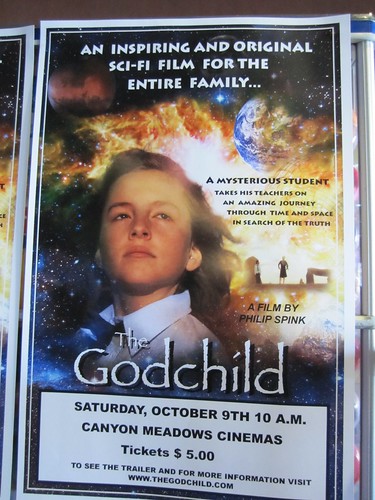
In this exclusive interview, writer/director/producer Philip Spink discusses the filming and production model his latest work, sci fi fantasy The Godchild.
In Part 1of this exclusive interview, screenwriter, independent film director and producer Philip Spink discussed sci fi TV and films, coming home and filming his indie film, The Godchild. In this final segment, Philip reflects upon his cast, the film music and the filmmaking model used to make The Godchild.
Philip Spink on The Godchild Cast
Casting was critical for the project to go ahead. The audition process was long but gave Philip an opportunity to pick the best actor for each role. “I was so lucky with some of our main actors. Once I had them, I knew that I could do this film.”
The role of Peter was portrayed by Grant Spink (Knights of Bloodsteel). “I needed someone who could spend incredible amounts of time doing special effects with, would always be there, explained Philip. “It worked out perfectly for that. He fit the part perfectly.”
Kari Townsend (The Call, Who Dressed You This Morning?) was cast as Sister Beth Myers. “She brought ferocity to the character,” remarked Philip. “She really empathized with the character who is a strong-willed woman who has had a tragic past.”
“I knew I wanted someone exotic,” said Philip regarding the role of Peter’s doctor, portrayed by Steve Dhillon (Money, ODC, 419: The Nigerian Scam). “I needed someone who could play a brilliant, dedicated doctor who has some guilt about leaving his homeland…When Steve showed up, he was perfect.”
Michael Heltay (Knights of Bloodsteel), who plays Sister Meyer’s friend Bernie, has worked with Philip Spink on several productions. “I wrote the part for him,” he said. Bernie does provide some comic relief in The Godchild. “I knew Mike could pull that off really well.”

Riah Fielding-Walters (The Wizard's Christmas) played Peter’s teacher. “It’s a character who is constantly battling her insecurities and her fears and trying to overcome them,” said Philip. “She brought such sensitivity to the role.”
Hazel Valdez is fairly new to the acting scene. As Sister Valdez, she is a balancing effect on the rest of the teaching staff. “You could really see her commitment on screen,” he said. “She has a very good technique and wonderful comic timing.”
When writing the screenplay, Philip, with help from co-producer and wife Zuzana Novak, kept each actor’s talents in mind. “I was able to hone the script and craft it to their strengths. They did a great job.”
Music Production for The Godchild
The film music for The Godchild was composed by Canadians Peter Jancewicz and James Guttridge. “With the combination of Peter and Jim, I was able to get the music I needed for the film without monopolizing their time.”
The Godchild marks Jancewicz’s debut into film composing. “It’s like having Chopin or Beethoven in the same city,” said Philip. “He brings such a sense of gravitas and sensitivity to his music.” Jancewicz is a Calgary-based composer, music teacher, clinician, writer and adjudicator, whose compositions are published by Alberta Keys and Alfred Music Publishing.
Guttridge has collaborated with Philip on several projects, including Voyage of the Unicornand Knights of Bloodsteel. In the realm of film music, “he’s a real heavy hitter,” he quipped.
Heavy hitter indeed. Guttrridge won a Leo Award for Best Musical Score (Once in a Blue Moon) and an International Television Award (Dinosaur). He also received Gemini, Leo, and Grammy nominations for his work on Voyage of the Unicorn and Kung Fu Killer. Most recently, Guttridge scored the music for Sy Fy Channel's TV drama Riverworld (2010), which stars Tahmoh Penikett (Cold Squad, Battlestar Galactica).
Modeling The Godchild on Quebec Film Productions
“Wouldn’t be nice if we could make our money back in Alberta like they do in Quebec?” posited Philip. “Quebec filmmakers are supported by Quebeckers.” He set out to achieve that with The Godchild. “We can prove that you can make a film in Alberta, make your money back and then start marketing it beyond the province.”
Another goal for keeping a low-budget independent film was to keep costs affordable to viewers. At $5 a ticket, “it’s a pretty good deal,” said Philip “Hopefully it will move you and in the end, you say, ‘I’ve got my money’s worth.’ ”
The Godchild premiered in Calgary, Alberta on Saturday, October 9, 2010, which I reviewed on my Stumbling Still blog. This sci fi fantasy film was written, directed and produced by Philip Spink and stars Kari Townsend, Steve Dhillon, Riah Fielding-Walters, Michael Heltay, Grant Spink and Hazel Valdez.
Originally published October 16, 2010 on Suite 101. Updated March 22, 2013. All rights reserved by Rhona-Mae Arca.
Social Media Links
archives
- #YYCArts 32
- #YYCEvents 39
- Collaborative Music 25
- Community 11
- Composing & Arranging 6
- Entertainment 139
- Entrepreneurship 53
- Freebies 3
- Gardening 1
- Geeking Out 65
- Health & Wellness 120
- Improvisation 25
- Interviews 28
- Learning Music 188
- Martial Arts 13
- Memorization 7
- Music 230
- Music Careers 9
- Music Education 196
- Music Examinations 7
- Music Exploration 55
- Music Gigs 14
- Music Lessons 6
- Music Performance 32
- Music Theory 13
- Musical Instruments 12
- Musician Health 19
- Pets 57
- Piano Technique 12
- Practicing Music 120
- Productivity 20
- Professional Development 11
- Recommendations & Reviews 93
- Recreation 71
- Social Media 6
- Spirituality 10
- Studio Management 33
- Studio Technology 50
- Teaching Music 146
FOLLOW THE STUDIO on Instagram

Affiliate Links
As a Sheetmusicplus and CD Japan affiliate, I earn from qualifying purchases. The earnings help fund the Studio’s blog and YouTube channels. Your support is greatly appreciated.


FOLLOW Budo no Tabi on Instagram