THE MUSICAL MUSE
Blog dedicated to music education, practice tips, health
&
wellness, and geeking out.
World Music Exploration - Andrea Bocelli
This week, we are listening to Italian tenor, Andrea Bocelli, sometimes referred to as "the fourth tenor." He has made a name for himself in opera as well as pop ballads
This week, we are listening to Italian tenor, Andrea Bocelli, sometimes referred to as "the fourth tenor." He has made a name for himself in opera as well as pop ballads, having recorded duets with Celine Dion, Sarah Brightman, Eros Ramazzotti and Al Jarreau, This is "Dare to Live" (Vivere), one of my favourite tracks from from The Best of Andrea Bocelli:
It was nominated for a Latin Grammy in 2008.
(c) 2012 by Musespeak(TM), Calgary, AB, Canada. All rights reserved.
Concert Review of CJO's An Evening of Romance

Concert Review of CJO's An Evening of Romance
The Calgary Jazz Orchestra performed a selection of popular love songs made famous by Billie Holiday and Chet Baker on Sunday, February 12, 2012 at River Park Church. Calgary vocalists Johanna Sillanpaa and Johnny Summers heated up the stage with their sultry vocals.
The Calgary Jazz Orchestra performed a selection of popular love songs made famous by Billie Holiday and Chet Baker on Sunday, February 12, 2012 at River Park Church. Calgary vocalists Johanna Sillanpaa and Johnny Summers heated up the stage with their sultry vocals.
The E.P. Scarlett Big Band kicked things off with “Happy Go Lucky Local” (Duke Ellington), an medium swing number. This was followed by a funky number called “There's the Rub” (Gordon Goodwin). The E.P. Scarlett Big Band of Calgary is directed by Jonathan Bell.
Johanna Sillanpaa and Torch Songs Featured in CJO's Opening Set
During his patter, director Johnny Summers, explained the inspiration for the change. Last month, the CJO had the opportunity to work with Grammy winning musician Maria Schneider. These arrangements are the first to bear the fruits of their time with Schneider. “We're just scratching the surface,” said Summers. “Stay tuned. It's gonna get crazy up here!”The CJO with two arrangements for small jazz combos. The group welcomed guest artist Johanna Sillanpaa of Calgary to the stage to bring some of Billie Holiday's memorable love songs to life. “My Man” (M. Yvain) featured Gerry Hebert on clarinet, Al Muirhead on trumpet, Sarah Matheson on bari sax and Willy Joosen on the piano. “Crazy He Calls Me” (C. Sigman), a sultry love ballad, featured Jeremy Brown on sax, Johnny Summers on trumpet, Willy Joosen on piano, Kodi Hutchinson on bass and Greg Baker on drums. The other members of the Calgary Jazz Orchestra came on-stage for the remainder of the first set. From the opening bar of F. Andre's “Dream a Little Dream of Me”, it was apparent that something was different. The group got in to the music a little more, while the solos by Al Muirhead and Jeremy Brown were melodious and featured new licks. This number gave Sillanpaa a chance to showcase her rich, warm low register. The Brahms' “Lullaby” quote at the end was a nice touch.
“He's Funny that Way” by R. Whitting and “What a Little Moonlight Can Do” by H. Wood rounded out the first half. Whether singing in a small combo or with the entire jazz band, Johanna Sillanpaa's strong and sultry voice projected clearly, seemingly without effort.
Billie Holiday and Chet Baker Love Songs and Surprise Guest Raffi in CJO's Second Set
The second half of “An Evening of Romance” also featured small combo arrangements before moving on to big band music. “You Go to My Head” by F. Coots, a soulful love ballad, featured Shane Statz on tenor sax, Kodi Hutchinson on bass and the vocals of Johnny Summers.
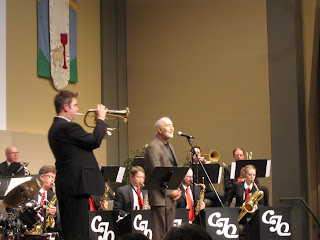
Raffi and CJO (Photo by R-M Arca)
Children's entertainer Raffi surprised the audience when he stepped up from the audience to sing “A Wonderful World”. Chuckles and cheers resounded when he sang “I see friends shaking hands, saying, 'Yo what's up?” Raffi did a quick plug for a cause close to his heart, the Centre for Child Honouring.
A nice trumpet solo opened “Let's Get Lost” (J. McHugh) before switching off to saxophone. This medium swing number featured soulful solos by Al Muirhead, Shane Statz and Willy Joosen, along with the vocal styling Johnny Summers.
The programme drew to a close with the sexiest version of “My Funny Valentine” that I have ever heard. The very sultry introduction featured Willy Joosen on piano and Al Muirhead on flugelhorn and Greg Baker using softer mallets on percussion. One could imagine smoke wafting through a jazz club on a hot summer's night during Al Muirhead's solo.
Three more numbers rounded out the second half: “You'd Be So Nice” (Cole Porter), “The More I See You” (H. Warren) and “Isn't It Romantic” (R. Rodgers).
About the Calgary Jazz Orchestra
The Calgary Jazz Orchestra is a 17 piece big band founded by Johnny Summers in 2004. Arrangements for “An Evening of Romance” were written by Johnny Summers and Greg Baker.
The fresh arrangements and easygoing demeanour of the Calgary Jazz Orchestra members at “An Evening of Romance” left me with two impressions: 1 – I must buy some music by Maria Schneider and 2 – I can't wait to hear what the CJO is going to do next.
In September, the CJO presented a concert featuring swing, Latin and Cuban music. In December, the big band performed Christmas hits made famous by Frank Sinatra.
Jazz lovers will have two more opportunities to hear the Calgary Jazz Orchestra in the 2011/12 season. On February 25, 2012, the CJO will perform at 18 Degrees of Jazz. Proceeds from this fundraiser go to benefit the Big Brothers Big Sisters of Calgary and Area. Blues tunes and numbers written by CJO members will be featured at the May 6, 2012 concert. You can buy concert tickets on the Calgary Jazz Orchestra website.
(c) Rhona-Mae Arca, Musespeak(TM), Calgary, AB. All rights reserved.
World Music Exploration - Vivaldi's Four Seasons
This week, we are listening to the music of Antonio Vivaldi (1675-1741). He was nicknamed the "red priest" because of his red hair, which was unusual at the time. He worked at Conservatorio dell'Ospedale della Pietà, which was a music school for orphaned girls.
Our musical journey moves northward to Venezia (Venice) for this week's clip. While setting up the clip, I surveyed my students."Pizza" and "pasta" are the first words that came to mind when asked about their knowledge of Italy. "It's shaped like a boot," came third. However, One of my 10 year-old students impressed me with his knowledge of Italian history, namely all about the city states and which country owned which area.
This week, we are listening to the music of Antonio Vivaldi (1675-1741). He was nicknamed the "red priest" because of his red hair, which was unusual at the time. He worked at Conservatorio dell'Ospedale della Pietà, which was a music school for orphaned girls.
Vivaldi composed cantatas, concerti, chamber music, church music, operas and an oratorio. He was one of the first Baroque composers to write for clarinet.
This is "Winter" from Vivaldi's Four Seasons. This work is comprised of four violin concerti:
The first thing my students have commented on are the dramatic masks, which Venice is famous for. Next, their eyes bug out when they hear the opening theme played on the solo violin.
Four Seasons is an example of programme music. Based on sonnets, this work is rich in imagery. My students and I have decided that this excerpt could be used for a snowstorm. One student imagined a couple of dogs chasing and playing in the snow.
(c) 2012 by Musespeak(TM), Calgary, AB, Canada. All rights reserved.

An Introduction to the Cajón
The cajón or drum box, is a small instrument with a big voice. Pronounced “ka-HONE”, this versatile instrument is Spanish for “box” or “crate”. This portable drum is used in a variety of performance settings and music genres.
The cajón or drum box, is a small instrument with a big voice. Pronounced “ka-HONE”, this versatile instrument is Spanish for “box” or “crate”. This portable drum is used in a variety of performance settings and music genres.
A Brief History on the Cajón
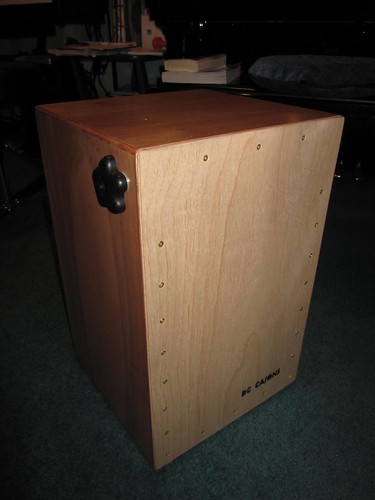
Cajon portable drum. Photo by R-M Arca
Most sources indicate that the cajón is Afro-Peruvian in origin. In the 16th century, African slaves took shipping crates and played them as they would play a drum from their motherland. Sometimes, drawers were used.
By the 19th century, the cajón had a distinct place in Afro-Peruvian and Afro-Cuban music. From Flamenco music to pop, rock and jazz, the cajón has steadily grown in popularity.
Cajón Construction
The cajón is generally made of pine, although there are several other types of woods used today. Another layer of thin plywood is nailed to the front. One notable feature is that the top corners of the face are left loose so as to produce a slapping sound. Another distinct feature is the sound hole in the back.
Some cajóns also have a snare (adjustable or non-adjustable). For a traditional Peruvian or African sound, the snare is turned off. There are also bongo cajóns, tubular and trapezoidal ones available too.
Buying a Cajón
If you live in a large city centre, chances are one of more music stores in your area is a licensed retailer of cajóns. If not, some music stores do ship worldwide.
There are several popular cajóns brands available around the world:
Asia: Pearl
North America: KOTZ™ in the US
Europe: Meinl Cajon in Germany, The Cajon Drum Shop in the UK, Requena cajon drums in Spain, Cajón de Gregorio in Spain and Schlagwerk drums in Germany
Cajóns vary in cost, depending on the make and the material used. Beginner cajóns are in the low $100's, while custom, hand-made cajóns can cost well over $600.
Learning to Play the Cajón
Getting started on the cajón is relatively easy. The instrumentalist sits on the cajón, with the drum face pointing forward. Striking the lower part of the drum face produces a warm bass tone. As you move higher, the sound is higher, similar to a bongo. You can slap the loose ends as well.

Vater Cajon Brushes. Photo by R-M Arca.
Drum accessories can enhance your cajón configuration. You can add other percussion instruments, such as cymbals, castanets, tambourines and blocks. As well, drum brushes or specific cajón brushes expand the range of tones you can produce on the instrument.
Several resources are available online to help you develop proper technique. There are free video tutorials, such as those available at Learn Cajon and Framed Drums. DVD courses available by notable cajón instrumentalists David Kuckhermann and Danny Moreno on their websites or via Amazon.
For those who one one-on-one instruction, contact your local flamenco club or Peruvian cultural society and enquire about cajón instructors in your area. Alternatively, some musicians do offer cajón lessons through Skype.
In addition to being a portable drum, the cajón is a relatively easy instrument to learn. From its humble Afro-Peruvian roots, it has expanded into other genres – from flamenco to jazz and from pop to church music.
Plus, it's just a lot of fun to play. Case in point: Japanese jazz-rock duo Pia no Jac:
© 2012 by Rhona-Mae Arca, MusespeakTM. All rights reserved.
Social Media Links
archives
- #YYCArts 32
- #YYCEvents 39
- Collaborative Music 25
- Community 11
- Composing & Arranging 6
- Entertainment 139
- Entrepreneurship 53
- Freebies 3
- Gardening 1
- Geeking Out 65
- Health & Wellness 120
- Improvisation 25
- Interviews 28
- Learning Music 188
- Martial Arts 13
- Memorization 7
- Music 230
- Music Careers 9
- Music Education 196
- Music Examinations 7
- Music Exploration 55
- Music Gigs 14
- Music Lessons 6
- Music Performance 32
- Music Theory 13
- Musical Instruments 12
- Musician Health 19
- Pets 57
- Piano Technique 12
- Practicing Music 120
- Productivity 20
- Professional Development 11
- Recommendations & Reviews 93
- Recreation 71
- Social Media 6
- Spirituality 10
- Studio Management 33
- Studio Technology 50
- Teaching Music 146
FOLLOW THE STUDIO on Instagram


Affiliate Links
As a Sheetmusicplus and CD Japan affiliate, I earn from qualifying purchases. The earnings help fund the Studio’s blog and YouTube channels. Your support is greatly appreciated.


FOLLOW Budo no Tabi on Instagram