THE MUSICAL MUSE
Blog dedicated to music education, practice tips, health
&
wellness, and geeking out.
Using Video Tutorials in Your Studio, Starring Your Students
A few of them actually ask, "Can we make a video clip of that?" so they can watch us working on one of their pieces at a later time.
In my entry, Piano Pedagogy & Technology Musings, I unveiled my grand plan to create an online audio/visual library for my students to use to assist with their at-home practicing. So far, my students have enjoyed laughing at my How to Sit at the Piano video, in which I use one of Maestro's giant stuffed dogs to demonstrate. Likewise with my Troubleshooting video, which showed that even teachers need to drill trouble spots repeatedly to iron them out. A few of them actually ask, "Can we make a video clip of that?" so they can watch us working on one of their pieces at a later time.
I initially set out to make 12 videos but it looks like there will be at least 15 in all as I or my students get ideas of what else to shoot. However, I am sure that my students don't want to watch just me for all 15, so I've gone recruiting.
If this is something that you're thinking of trying your studio, I highly recommend having your students star in some of your video tutorials. Six students have eagerly stepped up to the plate to date with several more waiting for their turn. One student demonstrated how he practices his memory stations, one shared how she started learning a song in lead sheet form, while four shared stories they made up to go with their pieces. They're finding the whole experience a blast, while I am getting my share of laughs of smiles.
All you need is your digital camera (if it takes video) or a video recorder. Make sure you have at least 4 GB on your SD card (I have 8 GB). As far as movie editing software goes, I've just been using Windows Movie Maker, which has lots of tutorials and help menus. A tripod is a bonus.
As an alternative to posting them on your website, you could burn your videos onto a DVD-R or DVD/RW or share them with your students via memory stick or ftp. Mind you, if you and your students are on Facebook, all you'd have to do is create a group for your studio and post your videos to the group. Of course, there are sites like Youtube and Vimeo.
Next on the horizon are the videos on Outstanding Openings and Fabulous Photo Finishes. I think I'll go recruiting again to get students to demonstrate each of these.
(c) 2009 by Musespeak(tm), Calgary, AB, Canada. All rights reserved.
More Exercises for Music through the Ages Exploration
This is becoming more and more enjoyable as the days go by. I stumbled upon a new approach towards the end of the week for the Music through the Ages Exploration: comparing and contrasting the evolution of a genre through the decades.
This is becoming more and more enjoyable as the days go by. I stumbled upon a new approach towards the end of the week for the Music through the Ages Exploration: comparing and contrasting the evolution of a genre through the decades.

Angie, a high school student, decided to explore pop at her lesson. She picked Kalafina, a Japanese band formed in 2007. She contrasted and compared that to ABBA, the 70s pop/disco group from Sweden. Finally, we came back to North America with Celine Dion, the pop sensation from the 80s - today. We had a great discussion about music texture, timbre and compared and contrasted pop not just from the 70s to today, but from one continent to the next.
Today, some of my students explored Bee Gees, ABBA, Madonna, Michael Jackson, Lady Gaga, Elise Estrada, UVERWorld, The Eagles, Billy Ray Cyrus, Miley Cyrus and Merle Haggard. Regardless whether it was young Mia or elementary student Emma, we were able to have intelligent conversations on:
instrumentation/timbre: My students dutifully reported that country music still uses primarily voice, guitar and percussion and that there are more crossover artists these days. Those crossover artists have more electronic music sounds and "sugar pop" drum grooves. They added that pop/rock has gone more electronic.
the development of the music videos: They express a great appreciation for Michael Jackson's and Madonna's pioneering contributions.
the evolution of dance in live performances: "They just stood there and sang in the 70s. There's more dancing and acting now."
the deterioration of melodic shape, dynamic contrast and rhythmic variance: Some were quick to notice that the melodies are getting flatter and that the rhythms are getting more basic. Ostinato seems to be the modus operandi. As for dynamics, "everything's louder", "it's just one level" and "they yell more" were popular comments.
As for me, I'm happy to report that I sill know the lyrics to Billie Jean, Material Girl, Dancing Queen and most of Desperado.
[October 29, 2009 update] My singing teacher recently said that today's country is yesterday's rock.
Improv by Eric Lewis Sparks Memories & Inspiration
This clip below of jazz pianist Eric Lewis brought all those memories back. Eric doesn't use rubber, nuts or bolts, but his hand technique on the piano strings is pretty impressive and creative. Around the 6'30" mark, he has a very funky groove.
I still remember the first time at university when classmate Lael Johnston performed a piece for prepared piano by John Cage at one Studio Master Class. All the piano students were shocked that bits of rubber, nuts and bolts, felt and more were wedged into the strings of a 9-foot Steinway concert grand.Lael assured us that no parts of the piano were permanently damaged. The fascinating thing was that the Steinway sounded exactly like an Indonesian gamelan.
This clip below of jazz pianist Eric Lewis brought all those memories back. Eric doesn't use rubber, nuts or bolts, but his hand technique on the piano strings is pretty impressive and creative. Around the 6'30" mark, he has a very funky groove.
It gives me ideas of things to do with any students who are easily bored or need something exciting to re-energize their playing. However, like Lael, I'll have to assure my students' parents that no piano parts should be permanently damaged in the process of unleashing their child's creativity.
Here's the clip:
(c) 2009 by Musespeak(tm), Calgary, AB, Canada. All rights reserved.
Music through the Ages Exploration Engages Students
This year, my students are exploring a different genre of music every month. Sometimes, it's a quick study. Sometimes it's just a case of listening to a CD or watching youtube and then discussing the music afterward.
This year, my students are exploring a different genre of music every month. Sometimes, it's a quick study. Sometimes it's just a case of listening to a CD or watching youtube and then discussing the music afterward. My student Namitha calls our exploration, "Music through the Ages". Last month, we explored the Classical period. Their comments on the music were colourful, ranging from "it sounds like someone's being chased" during Beethoven's 5th Symphony to "it sounds happy yet sad" for Mozart's Rondo alla Turk. The intermediate students have started to notice patterns that are similar to their pieces (sonata allegro form, anyone?).
This month, I've fast forwarded the timeline to the present for them to explore pop, rock and country. One student classified Carrie Underwood as "country", while the next day, one classified her as "pop". We listened to a couple of her songs and I asked them to tell me what madeJust a Dream more country than Cowboy Cassanova. A similar scenario happened with Taylor Swift.
(FYI: my students said it was the instrumentation and drum groove used that differentiated the styles).
After listening to The Beatles, I asked my student Tess what she thought of song and the style. "What am I supposed to say?" she asked me.
"The truth," I replied. "Did you like it? Love it? Hate it? Doesn't make you feel anything?"
She discovered that it doesn't make her feel anything and that it's a style she'll probably stay away from.
A few days later, I learned that young Gabe loves the 80s band Journey ("They're just cool!").
That's what it's all about for me, showing them what's out there. I hope by the end of the year, they will have a better idea of just how wide and diverse music is and along the way, find out what they would like to explore further (or avoid like the plague). If their active listening skills improve along the way as we discuss melody, timbre, rhythm, form and texture - all the better!
(c) 2009 by Musespeak(tm), Calgary, AB, Canada. All rights reserved.
Yawn, Puke, Sing - My First Singing Lesson
I had the pleasure of working with Sherry Kennedy at the Jazz Connection Workshop this summer. It was only a couple of sessions, but enough to make me realize that if I'm ever going to play and sing at a gig and give some intelligent pointers to my students who are trying the "playing and singing" thing, I need to have a solid foundation in my voice. Today, I had my first singing lesson today after many years.
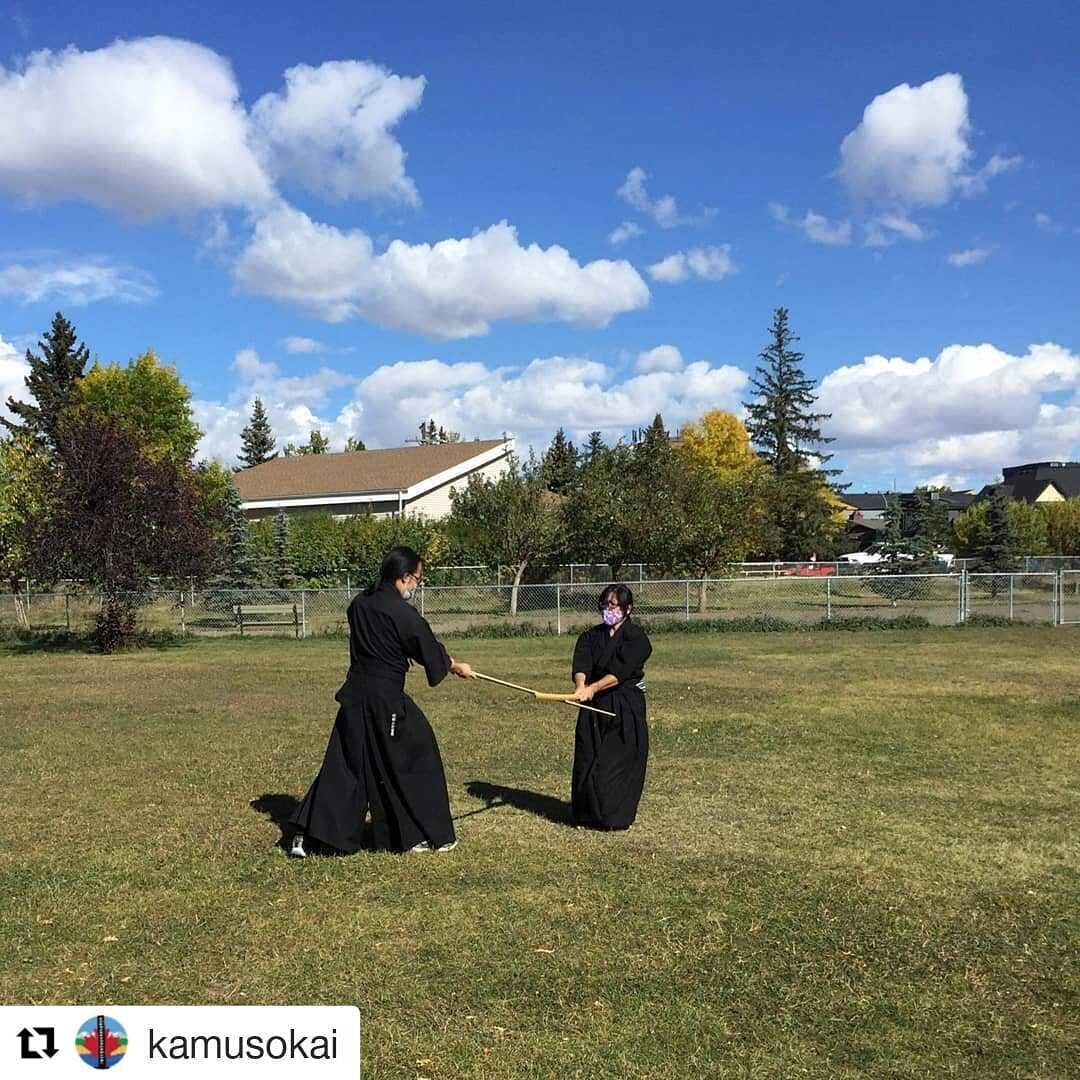
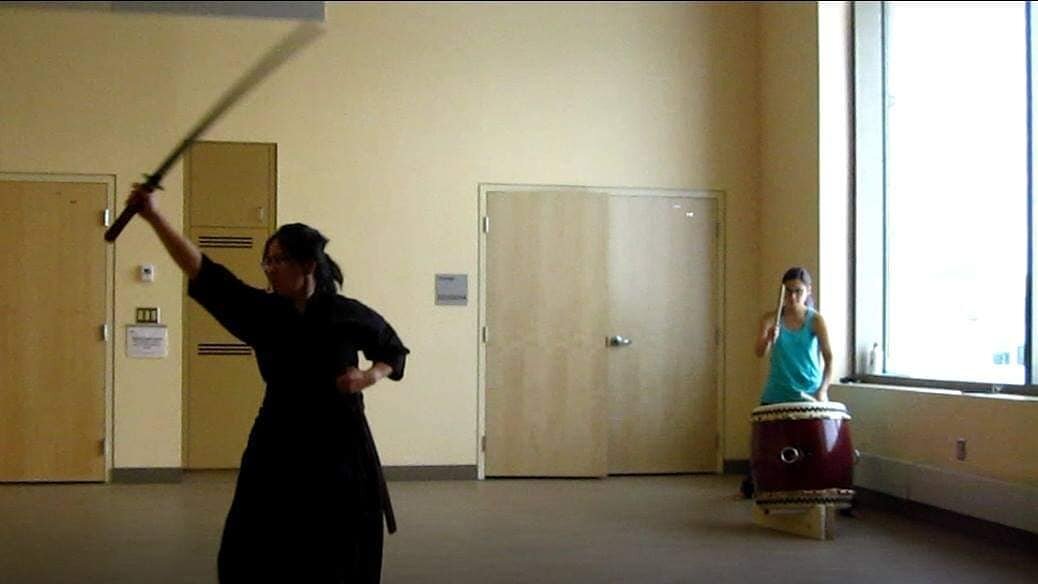
I had the pleasure of working with Sherry Kennedy at the Jazz Connection Workshop this summer. It was only a couple of sessions, but enough to make me realize that if I'm ever going to play and sing at a gig and give some intelligent pointers to my students who are trying the "playing and singing" thing, I need to have a solid foundation in my voice. Today, I had my first singing lesson today after many years. We spent a good chunk of it working on breathing and relaxation exercises. The singing stance reminded me of our "ready" stance in Iaido - feet shoulder width apart, no unnecessary tension. Try to relax and hit that state of zanshin.
Ha! I think I'll have to do practice more sword cuts.
I digress. Sherry had me visualize the air coming from the ground, through my feet and up to my boobs as I breathed in. The only way I could make it work was to imagine a white mist flowing upwards. At one point, I think it was blue but I don't think it really matters.
Then, she had me lay on the floor so I could feel my diaphragm expanding into the floor, WHILE concentrating on keeping my shoulders and chin level, WHILE focusing on the airflow going from my toes to my boobs, WHILE dropping my jaw and letting the lower jaw jut forwards (completely slack), WHILE keeping my tongue flat and soft palette open, WHILE imagining I had a straw in my mouth and that I was trying to make an imaginary leaf fly off the table and dance in the air.
Then, Sherry asked, "Are you relaxed yet?"
That's a joke, right?
I know with practice it will all become second nature. Just as I know that getting my muscles to relax will help my piano as much as my singing. It will help in overall posture and health too.
In the meantime, I know I'll be practicing puking and yawning motions in front of the mirror to get my tongue flat and lightly holding my jaw to check that it's slack and forward enough. So if you see someone doing this in the car at a red light, that's probably me.
Now I can't stop yawning.
(c) 2009 by Musespeak(tm), Calgary, AB, Canada. All rights reserved.
Social Media Links
archives
- #YYCArts 32
- #YYCEvents 39
- Collaborative Music 25
- Community 11
- Composing & Arranging 6
- Entertainment 139
- Entrepreneurship 53
- Freebies 3
- Gardening 1
- Geeking Out 65
- Health & Wellness 120
- Improvisation 25
- Interviews 28
- Learning Music 188
- Martial Arts 13
- Memorization 7
- Music 230
- Music Careers 9
- Music Education 196
- Music Examinations 7
- Music Exploration 55
- Music Gigs 14
- Music Lessons 6
- Music Performance 32
- Music Theory 13
- Musical Instruments 12
- Musician Health 19
- Pets 57
- Piano Technique 12
- Practicing Music 120
- Productivity 20
- Professional Development 11
- Recommendations & Reviews 93
- Recreation 71
- Social Media 6
- Spirituality 10
- Studio Management 33
- Studio Technology 50
- Teaching Music 146
FOLLOW THE STUDIO on Instagram

Affiliate Links
As a Sheetmusicplus and CD Japan affiliate, I earn from qualifying purchases. The earnings help fund the Studio’s blog and YouTube channels. Your support is greatly appreciated.


FOLLOW Budo no Tabi on Instagram