THE MUSICAL MUSE
Blog dedicated to music education, practice tips, health
&
wellness, and geeking out.
THWOMP Interview: On Songwriting
In Part Three of this exclusive interview, originally done for Suite101.com, Brad Stanton and Dave Marshall of the Nintendo® cover band THWOMP discuss their songwriting process.
Nintendo® cover band THWOMP has been rocking conventions, parties and bars since the early 2000’s. This is an exciting year for the Calgary-based group, with gigs at the Calgary Comic Convention, Otafest and Animethon 17. This fall, THWOMP will host a CD release party for their debut CD.
Band members Brad Stanton and Dave Marshall took time out from THWOMP’s rehearsal schedule to chat with Suite 101. In this segment, Brad and Dave explain the band’s songwriting process.
THWOMP and Music Transcription
THWOMP's band charts are faithful transcriptions made either by Brad Stanton (lead guitar) or Kirk McVean (keyboards). It's a painstaking process that challenges the musician's melodic and rhythmic dictation skills. The result is a product of their own creative talents.
"I always do it by hand," explained Brad. "One part for every player." Video game themes loop in two-minute segments, which helped in the transcription process. When transcribing the music to "F-Zero" (a racing game), Brad turned on his Nintendo® game console and paused the game just before the engines fired up. "I’ll get a bar, and then I’ll have to wait two minutes for it to come back around," Brad said. "It was an absolutely grueling process. Think of doing that for a drum track, a bass track, two guitar tracks and then eventually doing it for Dave too. It took forever, but it was it was an absolute labor of love."
There are software programs that pull the audio out of the game. "I did not know about that for the first two-and-a-half years," admitted Brad. "You can mute certain ones, you can slow it down. Oh my God, that saved my life a couple of times."
Two programs the group uses include a plug-in for WinAmp and Audio Overload. For some songs, the ability to slow down a track is essential. "Some of those arpeggiated keyboard lines are tough to figure out when they’re going 16th notes at 180 beats per minute," said Dave.
Having the Perfect Skill Set for Musical Transcription
All six members of the band work together at Sak's Music in Calgary, Alberta. Brad manages the McKenzie Towne location, while the other group members work as music teachers.
"We’re so perfectly situated to do this kind of thing," said Brad. "My job for 11 years was sitting in a room with a little kid and transcribing tunes for them so they could learn some tune that they like off the radio. I spent so much time doing that, that I got so fast at it, eventually."
The addition of Kirk McVean to the group gave Brad a chance to take a two year break from transcribing. "I was getting burnt out doing it. He’s taken over doing it and it’s such a blessing." This arrangement isn't without challenges, however. "I can’t believe how slow I’ve become at it," Brad admitted. "Stupid Kirk, being a keyboard player, he writes everything in standard. Now, the two guitar players, us idiots have to read actual notes. It makes us feel pretty stupid."
Why THWOMP Doesn't Play a Lot of Modern Game Music
"We don’t really do more modern stuff," said Dave. "It’s a different kind of music and it doesn’t suit our format quite as well."
Music from newer Nintendo® games are orchestral in nature. "They use a 64-piece orchestra when they record it, explained Dave. "They use straight digital audio. It’s almost MIDI the way it works (the old stuff)."
THWOMP is a Nintendo® band comprised of Calgarians Brad Stanton (lead guitar), Colin Mitchel (lead guitar), Scott Munro (bass), Scott Moffat (drums), David Marshall (keyboards/percussion) and Kirk McVean (keyboards). For more information about THWOMP, the band or to listen to audio clips, visit their website and Myspace page.
Originally published on Suite101.com on July 27, 2010. Updated on April 16, 2013. All rights reserved by Rhona-Mae Arca.
Full interview series: Part 1 – THWOMP’s Origins | Part 2 – Band Names & Niches | Part 3 – Songwriting | Part 4 - Hey! Listen! CD Release | Part 5 - On Gigs | Part 6 - Convention Gigs | Part 7 - Video Games | Part 8 - Fun & Food
Redefining My Practicing Style
Rebooting how I practice piano to revolve around music genres versus specific repertoire.

My brother and I have our first paid piano/cajón gig coming up. I don't know about him, but I've had to rewire my brain in my approach to this type of gig.
Typically, for solo background music gigs, I would put together a set list to cover the time that I was hired to play. I'd carefully select which songs to group with each other. However, in recent gigs, I've found that sometimes, I have to throw that list out the window and fake it because I what I prepared doesn't match the rhythm and flow of the crowd.
This time, we have picked a bunch of songs, hours more than required. We both have a tendency to gravitate to the ballads (easy to fake). This time, our set list is jam packed with faster tunes. This has presented me with Challenge #1: finding the time to get these faster songs into my fingers - in between teaching, writing and trying to keep up with my studio operations.
We've agreed to earmark a few starting songs and then we'll choose what's next based upon the energy in the room. No problemo.
We are taking turns on the piano and cajón. That's been fun. By far, it's a lot easier to prepare the percussion part: learn a pop groove: CHECK! Learn a rock groove: CHECK! Learn a polka/klezmer groove: CHECK! Learn a tango/Latin groove: CHECK! Listen carefully and have fun.
As a soloist, we subconsciously take more time or speed up in tricky spots. We cheat with our timing. Pianists are as guilty as everyone else. As much as we teachers would like to say that we don't, we do. We all do.
However, when playing in an ensemble, it's much more critical to play in time. Not only that, but to play in the style of the piece. Therein lies Challenge #2 & #3 for me. I get hesitant when I'm not confident in the chords and/or melody. It's human nature. Nor do I have all these styles firmly in my fingertips like my friends who gig regularly do (I'll get there, though!).
To beat that out of me, I've been playing along to Youtube recordings of some of the songs and just hammering out the chord changes. Once those are secure, I start to improvise. Once that's not too shabby, I look at the melody. That's different from the standard, "Learn Part A hands separately then hands together," line we tell our students.
The other approach I've taken is to work on specific musical styles. I heard from a fellow musician that another colleague achieved great success in mastering swing by just practicing swing - and only swing - every day for hours.
Now the gig is just around the corner, so I don't have the time to fully explore this approach. I'll keep the basic boogie, Latin, pop and rock grooves already under my fingers (more or less). I did add a tango groove and klezmer rhythms as the client has asked specifically for these styles.
Once the gig is behind me though, I will explore this in full force. My plan is to spend X weeks on one style - for all the instruments I play (piano, cajón, voice, melodica and conducting). Once that's coming along, I'll add another, and another.
It's a different practice approach for one who is classically trained. It is something that my friends who gig regularly have already mastered. It's going to be a fun project.

Where to Find Free Piano Music Online
A look at Free Art License, as well as various websites that legally offer free piano sheet music of anime, classical, video game, pop, and rock songs.
A look at Free Art License, as well as various websites that legally offer free piano sheet music of anime, classical, video game, pop, and rock songs.
Numerous websites offer free sheet music for piano. However, tracking down a suitable arrangement legally sometimes requires a bit of digging.
Free sheet music that is legal falls under the Free Art License, which "grants the right to freely copy, distribute, and transform creative works without infringing the author's rights." Works in the public domain, as well as arrangements and transcriptions posted by the arranger to be downloaded for free fall under this category.
Once the intellectual property rights on a work have expired, they become part of the public domain. These works are copyright-free and can be printed, copied, distributed, and modified.
An arrangement is a music score of a piece that a musician has done by hand or with music notation software. It includes his or her own editorial markings or it is set to a style or instrumentation that differs from the original version.
A transcription is not the same as a reproduction. To make a transcription, a musician picks out the melody and harmonies of a song by ear and then writes out the notation by hand or with the aid of music notation software.
The following are some websites that offer free printable piano sheet music:
Free Anime Sheet Music and Video Game Music Online
Josh's Anime Sheet Music Collection boasts an extensive collection of anime and video game music transcriptions and links to other websites with fan transcriptions. Theme songs from popular anime such as Bleach, Naruto, and K-On! are available. Difficulty level ranges from intermediate to advanced.
Ichigos has one of the largest collections online of free video game and anime sheet music. Theme songs from popular anime such as Neon Genesis Evangelion, The Melancholy of Harurhi Suzumiya, and Clannad, as well as music from popular video games such as The Legend of Zelda, Kingdom Hearts, and Final Fantasy are available.The difficulty level of the sheet music varies from low intermediate to upper intermediate.
Free Classical Sheet Music On the Internet
Music-Scores contains over 500 pieces of classical sheet music. There are arrangements for piano, violin, woodwinds, and more. The site features music by the greats like Bach, Beethoven, Chopin, Brahms, and Mozart. The level of difficulty is listed with each piece. Members have access to more music scores than non-members.
The Sheet Music Archive has over 5000 works that are in the public domain. Classical sheet music by famous composers such as Bach, Beethoven, Mozart, Brahms and Chopin are included in this library. Visitors can download up to two works a day for free. Subscribers have unlimited downloads.
The International Music Score Library Project (IMSP), otherwise known as the Petrucci Music Library, contains an extensive collection of public domain music. Sheet music, as well as recordings are available. It contains over 234, 000 scores and 23, 000 recordings.
Websites With Free Piano Sheet Music in a Variety of Styles
Easy Sheet Music houses around 500 songs for piano. Music is listed in five categories: Music from Around the World, Popular Classics, Boogie & Blues, Opera Classics, and Mission - Not That Difficult. Non-members are limited to three free downloads per day, while subscribers get unlimited downloads.
Free Piano Music! contains approximately 100 pieces of classical, popular, and Christmas songs. The pieces are ordered by level of difficulty, from beginner to intermediate. Midi files are also available for educational purposes.
Sibelius Music - Score Exchange has a wide range of printable sheet music, including classical, Christian, Christmas, historical, jazz, pop/rock, educational, and original works. The site contains music for piano, voice, guitar, strings, and ensembles. Although there are many free music titles, there are some available for purchase.
For further suggestions, read Finding Free Sheet Music and Christian Sheet Music Websites.
Things to Watch Out for When Downloading Free Printable Piano Sheet Music
There are three things to watch out for when searching for free sheet music online: illegal scans of copyrighted scores, poor transcriptions, or editions:
A fan making his or her own transcription or arrangement is legal. However, scanning a copyrighted work is illegal. Musicians should inspect the score carefully. Fuzzy quality is a sign of photocopying or scanning. A transcription is genuine when "Transcribed by" or "Arranged by" is part of the text.
Some music was originally written for an ensemble to be performed by a computer. An anime theme song that requires the right hand to play a chord that spans three octaves is just not "piano friendly." The musician must modify the transcription to avoid musician injury. Music students should consult with their music teacher if they require assistance.
With regards to classical music, it is wise to consult and compare several editions as edition quality varies. Students taking a piano exam should use an edition that is approved by the music conservatory conducting the piano examination.
Downloading an arrangement, transcription, or copyright-free work are three ways to legally obtain free printable piano sheet music. Good transcribers and arrangers are able to make their arrangement "piano friendly." Fans who wish to download free piano sheet music should be cognizant of the difficulty level of the arrangement and look for signs that a transcription is legitimate.
Originally published on Suite101.com on June 16, 2010. Updated April 16, 2013. All rights reserved by Rhona-Mae Arca.
Calgary Jazz Orchestra A Perfectly Frank Christmas 2010 Concert Review
The Calgary Jazz Orchestra entertained a full house, playing Christmas favorites and Frank Sinatra classics at River Park Church on December 19, 2010.
Calgary music aficionados love Christmas music, Frank Sinatra and the Calgary Jazz Orchestra. Concertgoers lined up outside and around River Park Church in Calgary, Alberta on Sunday, December 19, 2010 for a chance to get tickets to CJO’s sold out jazz concert, "A Perfectly Frank Christmas".
The concert start time was delayed by 15 minutes to ensure that the audience could find seats and get settled. The programme featured big band jazz arrangements of Sinatra classics along with fresh arrangements of popular Christmas songs.
Hazel Proctor and Greg Baker Sparkle in the Opening Set of “A Perfectly Frank Christmas”
The CJO set a relaxed yet festive tone to the evening with Hark! arranged by Paul Ashwell. This moderate swing number featured easygoing solos by Dr. Jeremy Brown (saxophone) and Bob Erlendson (piano).
Director Johnny Summers traded his trumpet in for the microphone for three numbers: Sleigh Bells, I’ve Got You Under My Skin from “Songs for Swingin' Lovers” (1956) and Just the Way You Look Tonight from “Sinatra Sings Days Of Wine And Roses, Moon River, And Other Academy Award Winners” (1964). Sinatra’s music wonderfully showcases Summers’ wide vocal range and warm timbre, especially on the upbeat numbers.
The Calgary Jazz Orchestra welcomed jazz vocalist Hazel Proctor as a guest performer for the evening. Proctor comes from a rich musical heritage that set roots in Alberta in 1910. She has performed at Dixieland jazz festivals throughout Canada and the US. Proctor currently sings with the Dixie Boppers of Calgary, Alberta.
Proctor joined the CJO on two numbers: Please Come Home for Christmas and The Christmas Song. Her down-to-earth nature drew the audience in. Proctor’s rich, earthy tone wowed the audience, often drawing cheers and applause throughout her performance. The Christmas Song marked the first duet that Proctor and Summers have performed live together.
Another performer that elicited the same response was drummer Greg Baker. Summers did a special arrangement of Little Drummer Boy to display Baker’s talents. His playful nature, tempered with technical virtuosity brought the house down. His solos ranged from youthful reminiscings (pounding) to the “drum roll please” groove and from toe-tapping rock to mind-blowing funk.
The Calgary Jazz Orchestra rounded out the first half with two additional numbers. What Child is This? was a fast swing number that ended in an extremely Baroque fashion. It featured solos by Shane Statz (sax), Al Muirhead (trumpet), Carsten Rubeling (trombone) and Bob Erlendson (piano). I’m Walkin’ was a bold, lively number that featured strong solos by Johnny Summers (vocals), Richard Harding (sax), Andrew Wickenheiser (trumpet), Gerry Hebert (sax), Carsten Rubeling and Kodi Hutchinson (bass).
Strong Jazz Solos, Swing Dancers and Comedic Moments Mark the Second Set
The jazz band launched the second set with Ol’ Santa Claus, a quick march-like call and response number. A 3-2 clave pattern wound its way into the drums, keeping it extremely rhythmic and lively.
Silent Night showcased Richard Harding on sax. His improvisation was quite varied and yet always maintained the soulfulness of the original melody. Harding’s final improv was done against an ostinato of the first two bars of the melody, played by the rest of the saxophone section.
Summers invited Matthew Isenor and Nicole Tomes of Toe Tapping Swing to show off their graceful choreography for his next vocal number, Come Fly with Me. Another memorable number was What a Wonderful World in which Baker and Summers exchanged places. Baker surprised the audience with his rousing tribute to Louis Armstrong, successfully imitating Satchmo’s rumbly timbre.
One of the fun things about playing jazz music is being able to put a completely new spin on old classics. Deck the Halls was good example of this. Baker’s arrangement moved this traditional carol into a minor key and threw in a sultry Latin groove (Besame Mucho, anyone?). This featured solos by Johnny Summers (trumpet) and Gerry Hebert (soprano sax).
One audience member learned what happens if you have the misfortune of arriving late to a CJO performance. She was on the receiving end of some good-natured ribbing throughout the evening. Molly will undoubtedly show up on time to next year’s performance and without her “winterscape” sweater that Summers admired. Others Sinatra hits performed in the second set included Love Me or Leave Me, Star Dust and All or Nothing at All.
The CJO closed the programme with Oh Holy Night. This arrangement was an interesting blend of styles – part gospel, part classical, and part country. The music soon gave way to an upbeat, double-time groove and featured solos by Sarah Matheson (baritone sax), Carsten Rubeling and Greg Baker.
The audience quickly rose to their feet to give the CJO a standing ovation and called out for an encore. The jazz band complied with one final Frank Sinatra hit, I’ve Got the World on a String. Isenor and Tomes returned to the stage, complementing the music with their toe-tapping swing.
About the Calgary Jazz Orchestra
The Calgary Jazz Orchestra is a sixteen-member jazz band that was founded in 2004 and is directed by Johnny Summers. "A Perfectly Frank Christmas" featured Johnny Summers, Hazel Proctor and Greg Baker on vocals, Gerry Hebert, Richard Harding, Jeremy Brown, Shane Statz and Sarah Matheson on saxophones, Johnny Summers, Kim Beachum, Gordon Wilhelm, Andrew Wickenheiser and Al Muirhead on trumpets and Tim Embree, Carsten Rubeling, Shawn Hamilton and Greg Robertson on trombones. Bob Erlendson (piano), Kodi Hutchinson (bass) and Greg Baker (drums) complete the jazz band. The band arrangements for this concert were by Paul Ashwell, Johnny Summers and Greg Baker.
The CJO delivered a lively programme with strong performances at "A Perfectly Frank Christmas", held Sunday, December 19, 2010. The band launched its 2010/11 season in September, featuring music by Charlie Mingus and Oscar Peterson. Upcoming jazz concerts include “ENTERTAINMENT!” on January 30, 2011, featuring music from pop culture (pop, movies and video games) and on April 10, 2011, the music Duke Ellington and Harry Connick Jr. For more information about the CJO, visit their website.
Originially published Suite101.com on December 20, 2010. Updated on April 13, 2013. All rights reserved by Rhona-Mae Arca.
Video Game Jazz Music at The Runaway Five's First All Ages Show
Driving, funky jazz versions of video game music were on tap when The Runaway Five performed in concert in Calgary, Alberta at the National Musical Centre Saturday, April 6, 2013. It was the jazz group's first "all ages" show.
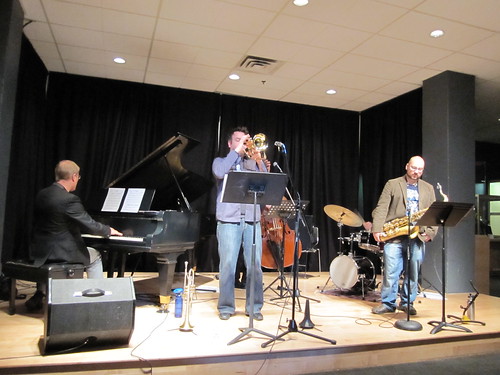
This concert featured Johnny Summers on trumpet and flugelhorn, Shane Statz on tenor sax, Sheldon Zandboer on piano, Brendan McElroy on bass and Karl Schwonik on drums. It was the group's first performance in a quintet configuration.
Jazz Arrangements of Classic Video Game Themes Played by the Runaway Five
The quintet opened the first half with two songs from the SNES game Earthbound (AKA "MOTHER 1+2"):"Sound Stone" and "Threed". This particular arrangement of the "Sound Stone" melody was quite lively, complete with stride piano. It featured solos by Shane, Johnny and and Sheldon.
In contrast, "Threed" was a laid back bossa nova. One of the neat moments in this arrangement was the transition between the flugelhorn and tenor sax solos. There was a lovely dialogue between the two instruments, which weaved and bobbed like someone floating aimlessly in the pool or ocean. I could have sworn I heard a "quote" from "Rainy Days and Mondays" by The Carpenters for a fraction of a second.
Next game on the set list was SimCity 3000, which is known for its jazz and new age soundtrack. "Updown Town" was a toe-tapping medium upswing. The trumpet solo began in the lower registered with shots that gradually led the listeners higher and higher. This was followed by an extremely chromatic piano solo, complete with rapid-fire blues riffs and shakes. After a very catchy vamp, the tenor sax solo gradually built up higher and higher, like a skyscraper.
"Into the Darkness" from Final Fantasy IVwas a lazy jazz waltz. The ensemble played upon the rhythmic ostinato from the introduction, working it into their solos. The flugelhorn solo was soft and mournful. In contrast, the tenor sax rose and fell like waves. The piano solo had punchy riffs and crunchy chords, while the bass solo played upon the theme, leading the audience deeper and deeper, lower and lower into blackness.
Another highlight from the first set was "Love Song" from BioWare's Dragon Age. This slow jazz waltz featured a beautiful duet between the flugelhorn and tenor sax. The sax solo began simply, who lush long tones, but the rhythm grew in complexity, building the tension. In contrast, the piano solo featured tender chords that rose and fell like a sigh. It too gradually grew in intensity with crunchier harmonies. The gradual deconstruction of the theme was a neat effect, just before leading the audience back to the head.
Three more video game themes were performed in the first set. "Buy Something Will Ya" (Earthbound) was a moderate swing number. "Zelda's Lullaby" (Zelda), which showcased the flugelhorn and piano. The Runaway Five closed the first set with the "Overworld Theme" from Super Mario Bros 2.
Soul Jazz, Ragtime and Swing Video Game Music in The Runaway Five's All Ages Concert
The Runaway Five did their best to make the audience forget the miserable weather outside with "Koopa Troopa Beach" from Super Mario Kart 64. Was I the only one pretending to drive my Mario Kart around the beach during the performance? I hope not.
The tenor sax solo was wavy, with splashes up into the higher register. The flugelhorn solo kept the mood high and bright, not just with playing in the higher register, but with the introduction of a different rhythm. The piano took that rhythm and changed it even more. When the head returned to lead us back to the finish line, it was a nostalgic moment.
Another highlight from the second half of the show was "Muscle Soul" from Battlefield Bad Company 2 Vietnam (Hill 137). This isn't a game I'd normally play, so hearing this theme was my introduction to the music of Anders Lewen.
This number opened with the bass and drums vamping on that opening riff until one by one, the rest of the company stepped in. The trumpet solo traversed a wide range, like a unit marching to their next mission. The sax solo was as soulful as the original recording. The piano solo had a little Motown, a little funk and a hint of disco.
The Runaway Five closed the show with "Air Platform - The Athletic Rag" from Super Mario World. The quintet had fun playing around with the two main themes from this classic video game. The trumpet solo used the A theme as a springboard to new riffs.
The tenor sax took the last rhythms played by the trumpet and then improvised on the B theme, then back to the A theme before tossing it to the piano, where we heard a chromatic treatment of the B theme, complete with zippy runs. The drum solo was playful, exploring different rhythmic and timbre combinations.
Three more VG themes were featured in the second set, including the "Figaro Castle Theme" from Final Fantasy III (VI), "Green Hill Zone" from Sonic the Hedgehog 2 opened with the drums and music from Street Fighter.
About The Runaway Five
Founded by Brendan McElroy, the Runaway Five performs jazz music arrangements of classic video games, including Super Mario Bros., Final Fantasy and Zelda. In 2008 and 2009, the group performed at Massey Hall in Toronto during the Video Games Live tour. The ensemble members change, increasing or decreasing depending upon the needs of the show.
The Runaway Five performed an intimate concert open to all ages on Saturday, April 6, 2013 at the National Music Centre. The interplay between the musicians was a delight to hear, while the themes left the audience feeling nostalgic about games past and present.
If you missed the show, you can check out some of group's earlier performances on their Youtube Channel. The Runaway Five will perform later this year. Details to follow.
Social Media Links
archives
- #YYCArts 32
- #YYCEvents 39
- Collaborative Music 25
- Community 11
- Composing & Arranging 6
- Entertainment 139
- Entrepreneurship 53
- Freebies 3
- Gardening 1
- Geeking Out 65
- Health & Wellness 120
- Improvisation 25
- Interviews 28
- Learning Music 188
- Martial Arts 13
- Memorization 7
- Music 230
- Music Careers 9
- Music Education 196
- Music Examinations 7
- Music Exploration 55
- Music Gigs 14
- Music Lessons 6
- Music Performance 32
- Music Theory 13
- Musical Instruments 12
- Musician Health 19
- Pets 57
- Piano Technique 12
- Practicing Music 120
- Productivity 20
- Professional Development 11
- Recommendations & Reviews 93
- Recreation 71
- Social Media 6
- Spirituality 10
- Studio Management 33
- Studio Technology 50
- Teaching Music 146
FOLLOW THE STUDIO on Instagram

Affiliate Links
As a Sheetmusicplus and CD Japan affiliate, I earn from qualifying purchases. The earnings help fund the Studio’s blog and YouTube channels. Your support is greatly appreciated.


FOLLOW Budo no Tabi on Instagram