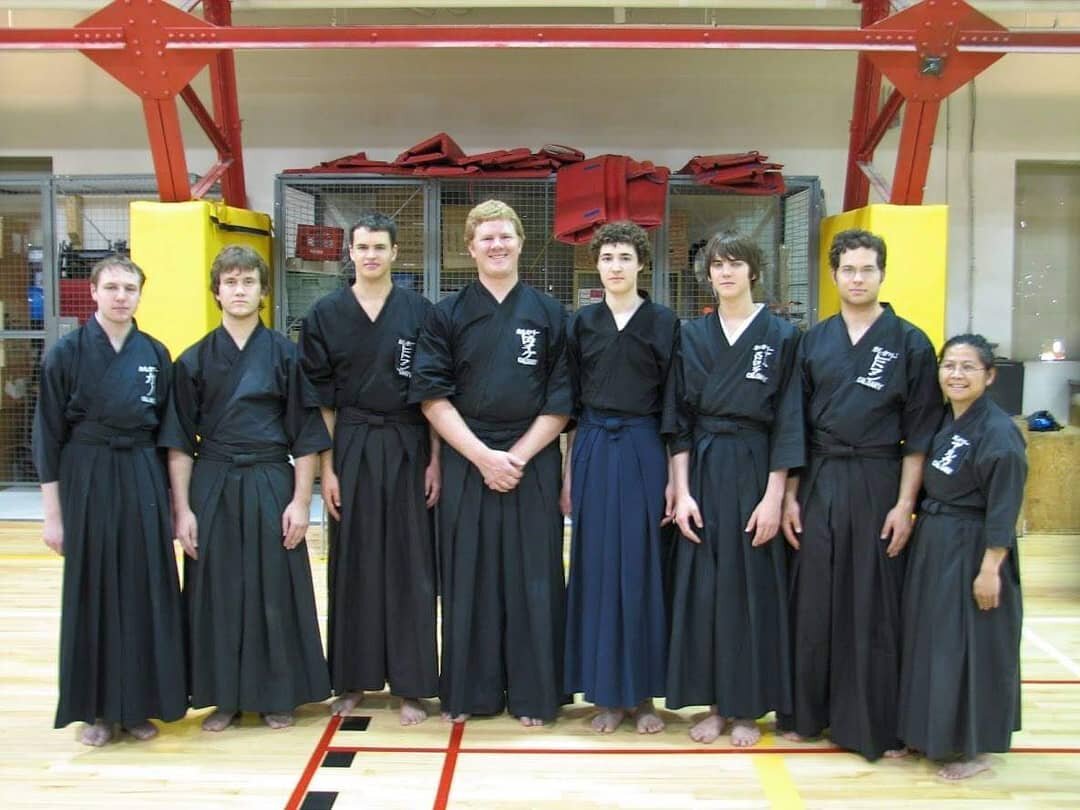
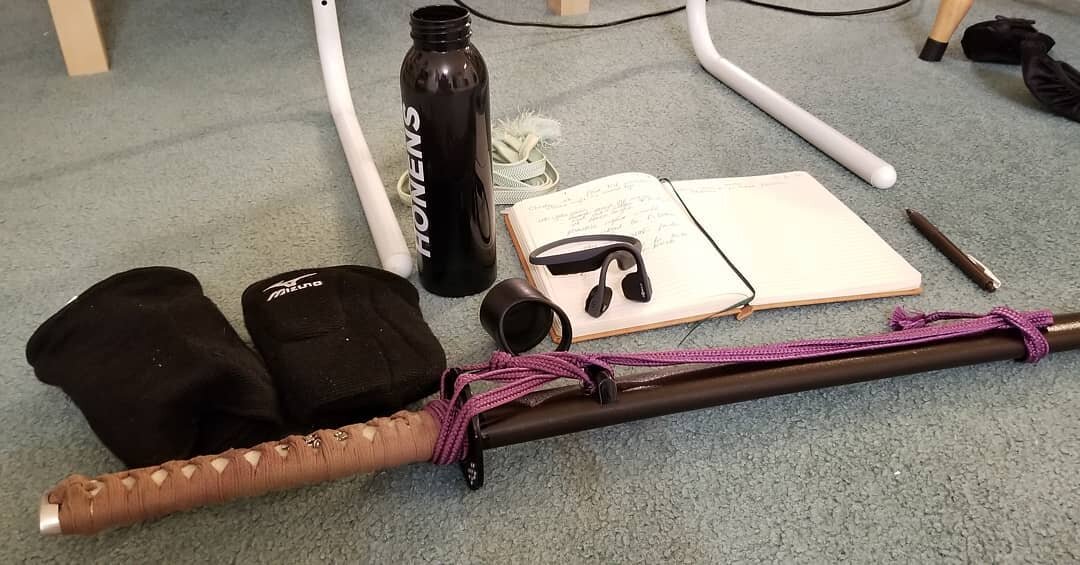
THE MUSICAL MUSE
Blog dedicated to music education, practice tips, health
&
wellness, and geeking out.
Calgary Omatsuri 2013 Interview with Dave Rathnow
My Calgary Omatsuri interview with Dave Rathnow sensei of Shin Ken Kai Nobara Iaido Club of Calgary. We talk about the martial art I started to learn - Iaido - and the differences between the two main styles practiced today.
At this year's Calgary Japanese Festival, I had the opportunity to interview Dave Rathnow, an Iaido practitioner and instructor at Shin Ken Kai Nobara Iaido Club. Iaido is referred to as "the art of Japanese swordmanship" or "the art of drawing of the sword". It is the sister art to Kendo. Unlike kendo, iaido is a non-contact martial art.
I must come clean, when I started to watch Bleach, I became interested in weapons-based martial arts. The Agent of the Shinigami arc remains, in my eyes, one of the strongest storylines I've come across in the shounen genre.
However, I digress. I wanted to learn kendo, but the cost of the equipment scared me off. I turned my attention to iaido. After watching videos online of how smooth and fluid the iaido kata are, I was hooked.
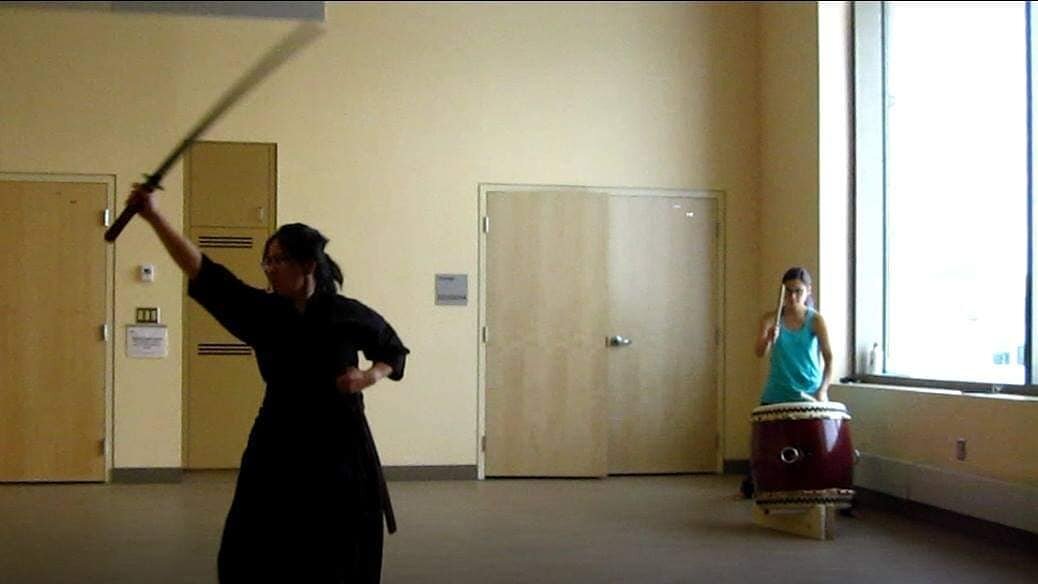
See for yourself the rhythm and flow of iai. Here are excerpts from the Iaido demonstration that Dave Rathnow-sensei, Allen Yee-sempai and Brent May-sempai did at the Calgary Omatsuri:
If you want a bit more of an introduction to Iaido, please read my article entitled "An Introduction to Iaido". I also have published a few more articles on Iaido for The Iaido Journal: "Rhythm and Flow", "Tempering Fire" and "A Special Box for a Special Club"
Now, for my interview with Dave-sensei:
Here are some of the websites I checked out when I first researched iaido:
Aoi Budo Gu: where I ordered my iaito
Ka Muso Kai Iaido Club: my dojo
Shin Ken Kai Nobara Iaido Club: Dave-sensei's dojo
SDK Supplies: where I ordered my beginner iaidoka set and my Hyoho Niten Ichi-Ryu (Musashi's two-sword style) bokuto
Sword Store: many of my sempai ordered their iaito from here
I currently have three katana and samurai-related books in my library. The are: The Book of Five Ringsby Miyamoto Musashi,The Life-giving Sword by Yagyu Munenori and the Hagakure by Yamamoto Tsunetomo.
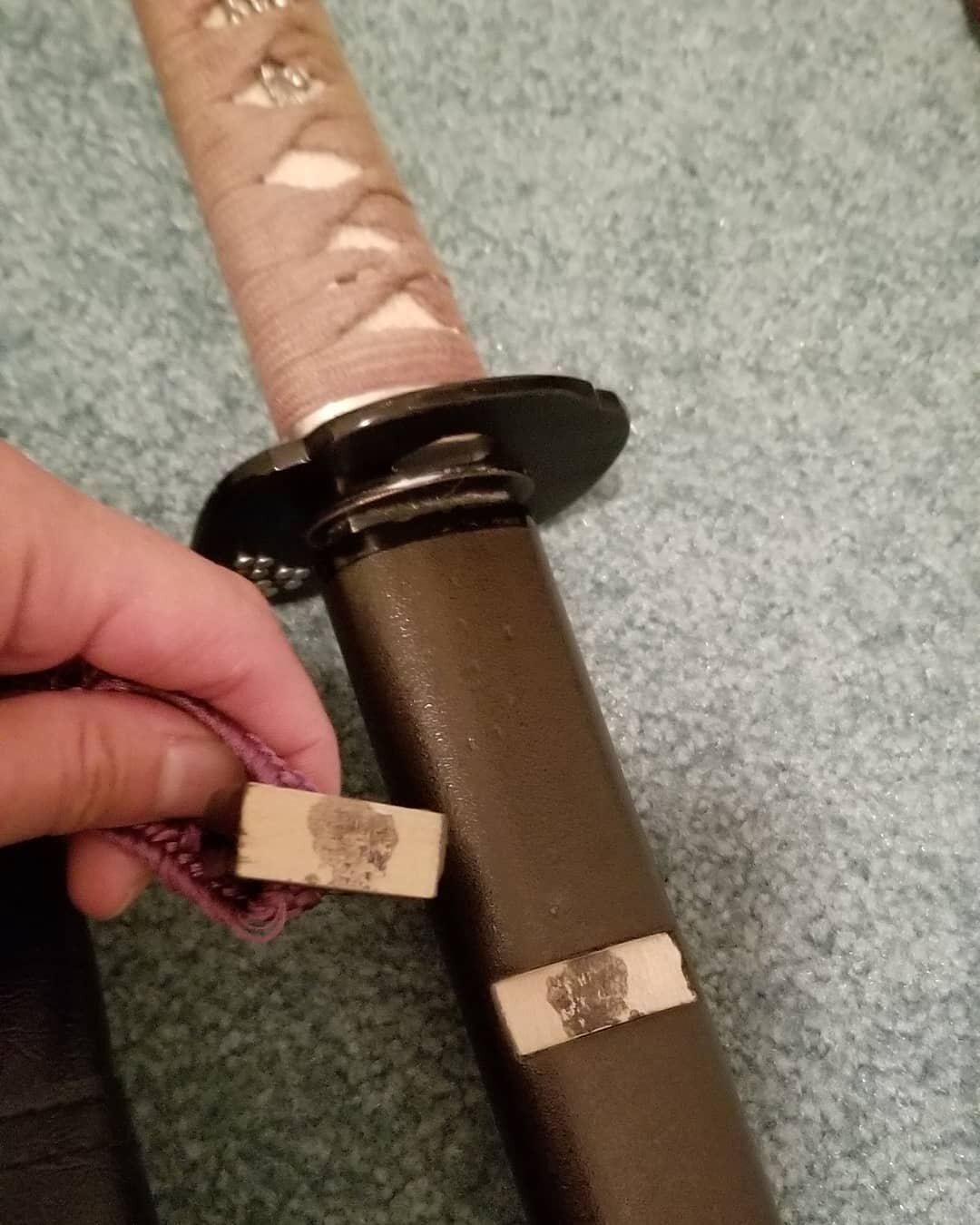
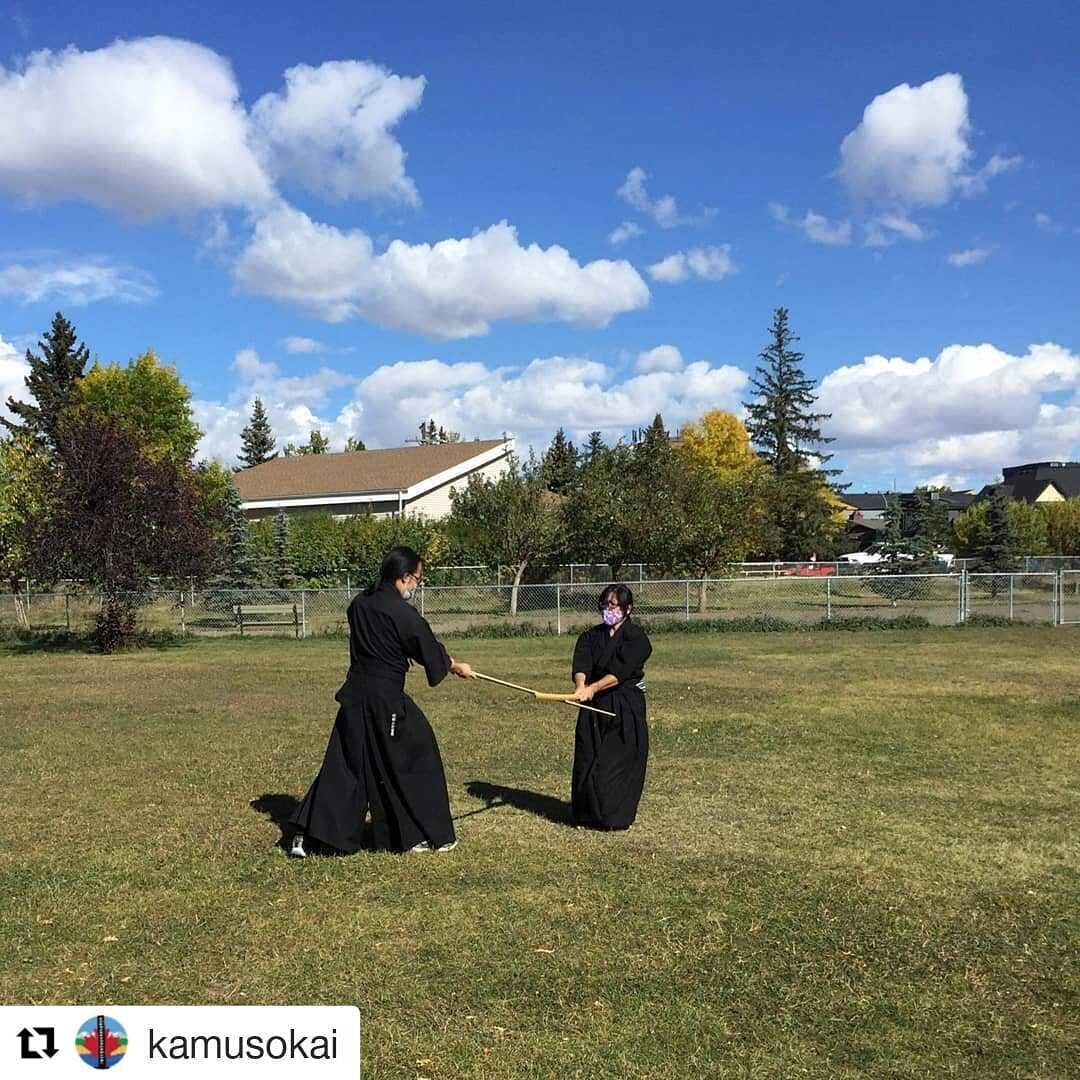
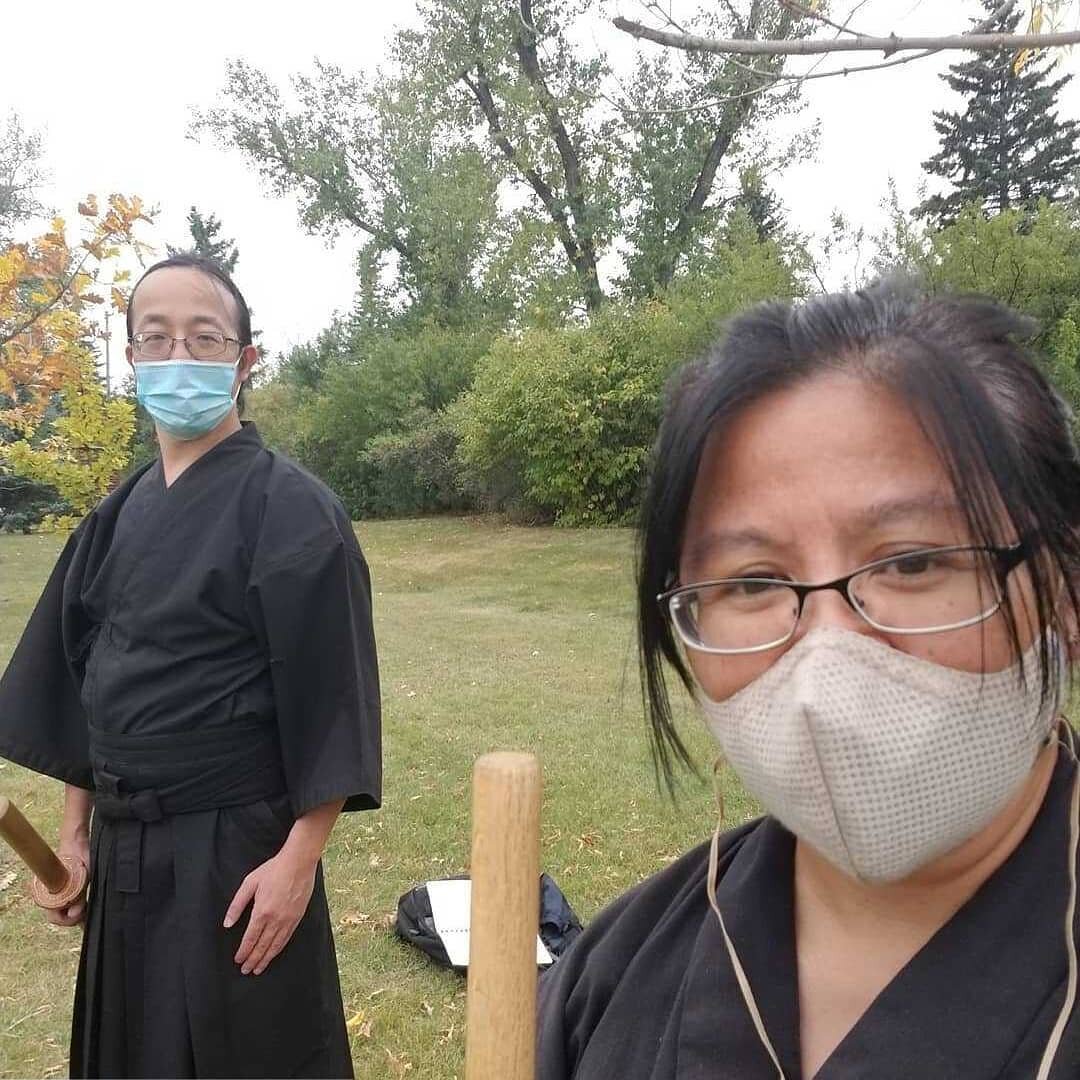
Here's a trip down memory lane for me. These are some photos of when I studied Iaido:
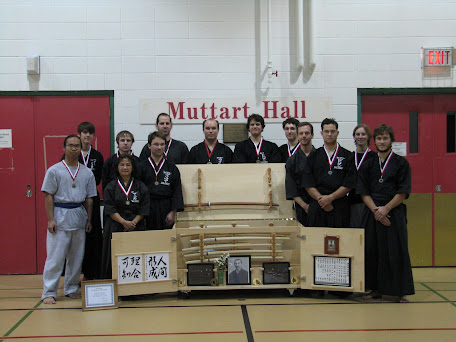
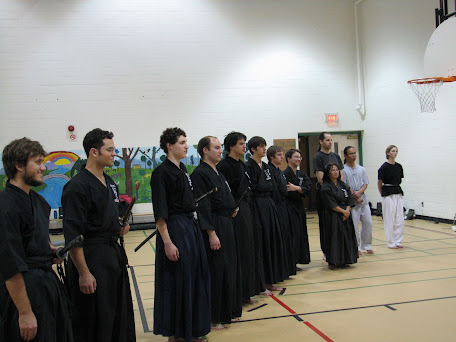
Sadly, training nights moved to prime teaching nights for me a while back, so I had to stop training. I do hope to get back into it someday. For now, I'll just try to keep regular with sword cuts. After all, it's a lot of fun to hear my iaito go "whoosh".
About the featured image: Allen-sempai demonstrates the first Iaido kata from the Seitei Gata Iaido at the Calgary Omatsuri. Photo credit: Christine Kohl. Publisher: Kathleen Boucher.

Iaido - The Art of Traditional Japanese Swordmanship
A brief introduction to the Japanese martial art of drawing the sword - Iaido.
Another one of my Suite101.com articles that got cut in The Big Purge. I'm not entirely sure why this one didn't make it but as you can see, not concerned enough to dispute it:
In times of war, samurai honed their swordsmanship skills on the battlefield. Iaido was developed as a means for samurai to maintain their skills during times of peace. Today, it is a martial art that attracts practitioners seeking moving meditation. Iaido is related to Kendo and Jodo.
Like its siblings, Iaido involves traditional Japanese weaponry. Unlike Kendo and Jodo, Iaido is a solitary, non-combative martial art. One common translation of the kanji for "Iaido" is the one used by Chris Gilham sensei of Ka Muso Kai: “the way of harmonizing one's self in action at all times and in all conditions.”

An iaito, or practice sword is custom-made to the users tastes and size. Photo by R-M Arca.
Iaido Clothing and Equipment
Iaido practitioners, called "iaidoka", begin training with a wooden practice sword (bokuto or bokken). As training progresses, they invest in an iaito, a dull-blade training sword. Advanced practitioners can use a shinken (live blade). Only iaito and shinken are allowed when grading. The Iaido uniform consists of a black gi, hakama and obi. The sheathed sword is inserted through the obi. The sheath (saya), is secured to the uniform by tying a silk or cotton cord (sageo), to the hakama.
Iaido Customs and Etiquette
The newest students in the dojo are responsible for set-up and clean-up of the training space. Upon entering the dojo, Iaido practitioners bow towards the shrine (shinzen or kamiza). While in the dojo, iaidoka traverse barefoot and in straight lines. They walk along the periphery of the dojo as a safety precaution.
The instructor is addressed as “sensei” (teacher) while the more senior students are called “senpai” (seniors). Junior members are called “kohai.” When responding to one another, practitioners respond affirmatively in Japanese. When greeting or thanking one another, iaidoka bow to each other as a sign of respect.
Iaido Training and Techniques
Iaido training is comprised of reiho (etiquette), warm-up exercises and kata (forms). Opening and closing reiho involve bowing to the shinzen, sensei and sword. Warm-up exercises include sword cuts in various positions. The sensei introduces a technique to a student and then leaves the student to practice. Periodically, the sensei and senpai check on a kohai's progress. Once a student masters a technique to the sensei's satisfaction, a new one is taught.
Iaido kata are patterns that represent everyday situations a samurai might have faced, such as drinking with someone who suddenly draws his sword. Iaidoka perform these kata while facing an imaginary opponent (teki). From a state of relaxed awareness and with the eyes focused on the horizon (metsuke), the Iaido practitioner reacts to an envisioned threat.
There are five parts to every kata:
Nukitsuke: drawing the sword and making the initial cut,
Furikaburi: raising the sword overhead,
Kiri-oroshi: killing cut,
Chiburi: shaking the blood from the blade and
Noto: re-sheathing the sword.
Each kata is completed by returning to one’s original position. Jo-ha-kyu is integral to the rhythm-timing in Iaido. Forms should be executed with fluidity, efficiency and precision, all while the practitioner's eyes are focused on the opponent.
There are 12 forms in the Seitei Iai Gata: mae, ushiro, uke nagashi, tsuka ate, kesa giri, morote zuki, sanpo giri, ganmen ate, soete zuki, shiho giri, sou giri and nuki uchi. After mastering these kata, Iaido practitioners learn older styles of Iaido, such as koryu and okuden.
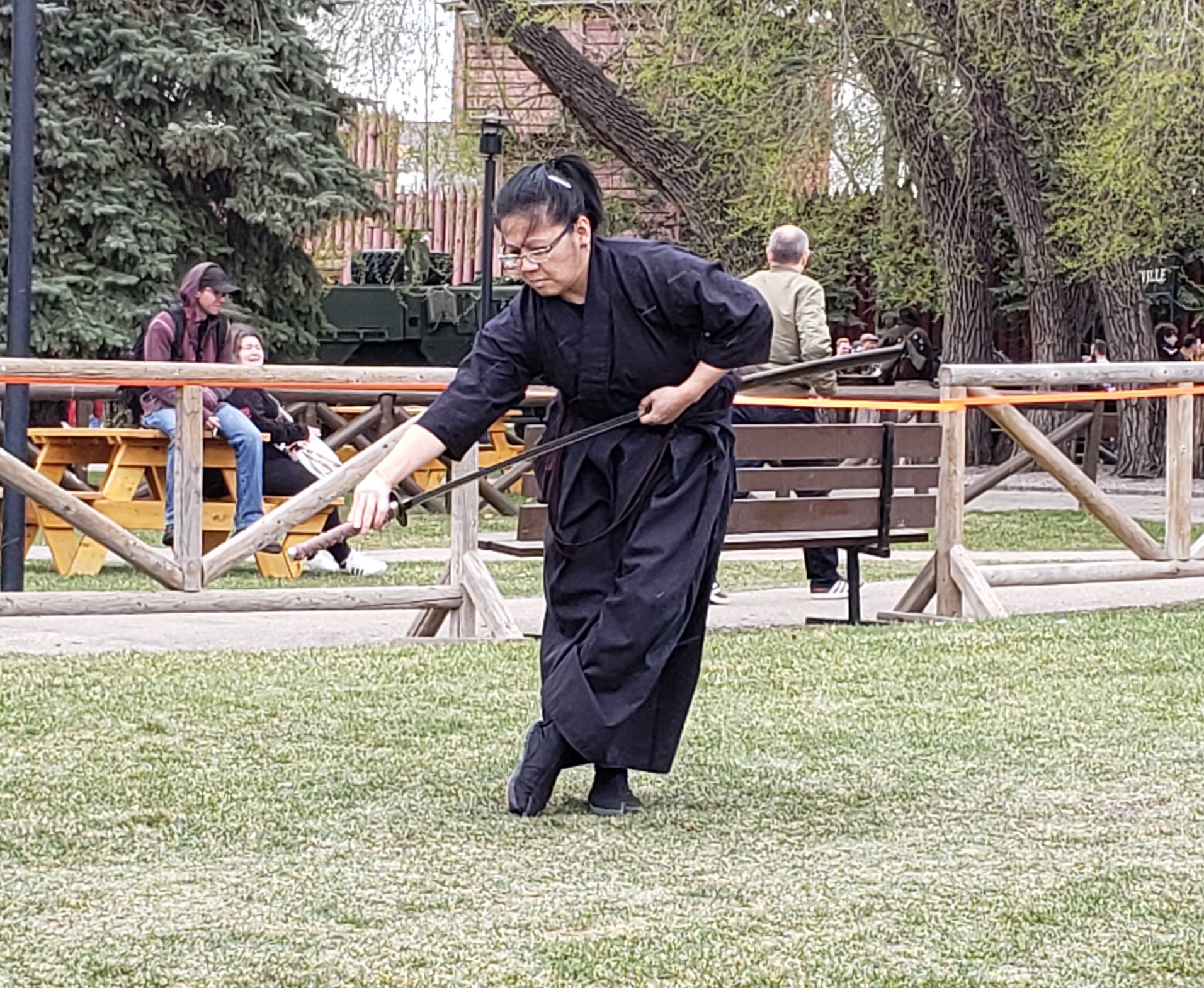
Iaido is the art of of Japanese swordmanship. Photo by Jonathon Wilkes.
Iaido practitioners can participate in tournaments and grading. The All-Japan Federation adopted a -kyu ranking for lower levels and a -dan ranking system for grading black belt levels in Iaido. Many federations, such as the Canadian Kendo Federation, the British Kendo Federation and the All United States Kendo Federation, follow this system.
History of Iaido
Iaido can trace its roots to a Japanese swordsman named Hayashizaki Jinsuke Minamoto no Shigenobu, who lived from 1546 - 1601. His sword techniques were called Batto-Jutsu, Shin Muso Hayashizaki Ryu, Junpaku Den, Shigenobu Ryu and Iai-jutsu.
Upon Hayashizaki's death, his style was carried on by the first Soke (headmaster), Tamiya Taira-no-Hyoe Narimasa, who instructed Tokugawa Ieyasu. By the eleventh Soke, two distinct sword styles emerged: Shimomura-ha and Tanimura-ha. These later evolved into Muso Shinden Ryu and Muso Jikiden Eishin Ryu, two popular styles of Iaido today. The term "Iaido" was first used by grand master Nakayama Hakudo in 1932. He was involved with codifying the techniques for both schools.
Once a means for samurai to maintain their swordsmanship skills during times of peace, Iaido is now a non-combative martial art. Although it is a sword-based art, Iaido is a form of meditation in motion, in which the practitioner strives to reach "mushin" (no-mindedness).
Sources:
Chris Gilham sensei (4th dan), Colin Pitman (4nd dan) and Alex Cook (4nd dan) of Ka Muso Kai.
Aukland Kendo Club: History of Iaido (accessed June 30, 2010).
Fighting Arts: Iaido (accessed June 30, 2010).
Fighting Arts: From the Beginning: The Importance of Reishiki in Iaido (accessed June 30, 2010).
The Iaido Journal: An Introduction to Iaido: Its Purpose and Benefits (accessed June 30, 2010). Copyright Rhona-Mae Arca, 2010. All rights reserved.
World Music Exploration - Chinese Opera and Crouching Tiger Hidden Dragon Soundtrack
This week, my students and I are eagerly anticipating the May long weekend. It's our last breather before the final round of non-stop recitals and examinations.
It was a toss up between Chinese opera and Crouching Tiger, Hidden Dragon.
This week, my students and I are eagerly anticipating the May long weekend. It's our last breather before the final round of non-stop recitals and examinations.
It was a toss up between Chinese opera and a movie soundtrack. Like European opera, Chinese opera is a spectacle of song, instrumental music, drama and dance. However, the melodies and the harmonies are unlike European music.
Here's a clip from Sacrifice of a Princess, complete with English subtitles:
I can picture some of my students cringing. They do that with any opera music though. On the other hand, my dog loves opera and enjoys this clip immensely.
I imagine this next clip will be a hit for my male and female students alike.
This is the second fight scene between actresses Ziyi Zhang and Michelle Yeoh in Crouching Tiger, Hidden Dragon:
I really enjoyed this movie. The fights are beautifully choreographed, while the music blends in seamlessly into the fabric of the story.
In this clip, the war drum aptly underscores the mounting tension between these two warriors.
Social Media Links
archives
- #YYCArts 32
- #YYCEvents 39
- Collaborative Music 25
- Community 11
- Composing & Arranging 6
- Entertainment 139
- Entrepreneurship 53
- Freebies 3
- Gardening 1
- Geeking Out 65
- Health & Wellness 120
- Improvisation 25
- Interviews 28
- Learning Music 188
- Martial Arts 13
- Memorization 7
- Music 230
- Music Careers 9
- Music Education 196
- Music Examinations 7
- Music Exploration 55
- Music Gigs 14
- Music Lessons 6
- Music Performance 32
- Music Theory 13
- Musical Instruments 12
- Musician Health 19
- Pets 57
- Piano Technique 12
- Practicing Music 120
- Productivity 20
- Professional Development 11
- Recommendations & Reviews 93
- Recreation 71
- Social Media 6
- Spirituality 10
- Studio Management 33
- Studio Technology 50
- Teaching Music 146
FOLLOW THE STUDIO on Instagram



Affiliate Links
As a Sheetmusicplus and CD Japan affiliate, I earn from qualifying purchases. The earnings help fund the Studio’s blog and YouTube channels. Your support is greatly appreciated.


FOLLOW Budo no Tabi on Instagram