THE MUSICAL MUSE
Blog dedicated to music education, practice tips, health
&
wellness, and geeking out.
Online Music Resources Spotlight: Making Music Fun
Making Music Fun is a friendly site with music games, music worksheets, free sheet music and music resources. These are geared toward beginner to early intermediate-level students.
There is a nice selection of note-naming worksheets as well as interval worksheets. They are visually appealing to young students. There are also composer word searches.
Making Music Fun is well laid out. Visit the Music Library and learn all about a composer. There are composer biographies, worksheets, lesson plans and sheet music. You can also access this information in the Print It section.
There is also an arcade, which contains two music theory games ("Music Distress" and "Eek Shark!"). All worksheets are available for free.
(c) 2012 by Musespeak(TM), Calgary, AB, Canada. All rights reserved.
World Music Exploation - Spanish Jazz-Fussion
I had to call for assistance for this week's selections. Special thanks to Luma Zuri, one of my friends from
Eric Whitacre's Virtual Choir 3.0, for introducing us to the music of Bebo Valdes and Diego El Cigala.
Bebo Valdes is a Grammy winning Afro-Cuban pianist, composer and arranger.
Diego El Cigala is a Grammy-nominated cantaor (flamenco singer). Their music is a fussion of jazz and flamenco. Listen carefully to the rhythm section (piano, drums and bass).
Their grooves combine flamenco and Afro-Cuban rhythms. The harmonies are typical of music both flamenco and jazz (love those "blues" intervals). The piano and drum licks? Pure jazz.
This is "Lagrimas Negros" ("Black Tears"), which is one of Luma's faves. I just love that piano intro.
I don't know about you, but thanks to Luma, I need to add Valdes and El Cigala's music to my music collection. You can explore more of Bebo Valdes music here:
(c) 2012 by Musespeak(TM), Calgary, AB, Canada. All rights reserved.
My Virtual Choir 3.0 Experience
Last year, a friend introduced me to the music of Grammy winning composer Eric Whitacre. Within hearing the first two notes of "Sleep", the hair on my arms stood up, as if to say, "This is really something!"
When the announcement was made about Virtual Choir 3.0, I eagerly signed up. Little did I know how eye-opening and how dramatic, the experience would be.
Last year, a friend introduced me to the music of Grammy winning composer Eric Whitacre. Within hearing the first two notes of "Sleep", the hair on my arms stood up, as if to say, "This is really something!"
When the announcement was made about Virtual Choir 3.0, I eagerly signed up. Little did I know how eye-opening and how dramatic, the experience would be.
"Water Night" is a haunting piece. Sometimes, I get poetry, but just sometimes. With "Water Night", certain phrases called out to me: "The secret kingdom of the water opens, flowing from the centre of the night," was by far my favourite line, followed by "And if you close your eyes, a river, a silent and beautiful current fills you from within."
I'll say this straight up, "Water Night" is by far the most technically challenging choral piece I've sung. Strong breath support is required to make it through those long phrases. I didn't have it when I began but I have it now.
However, "Silence and solitude, two little animals moon-led, drink in your eyes, drink in those waters," proved to be my nemesis. Bars 27- 28 soon became highlighted, circled and covered up in rainbow colours.
It was a hard fight, but my ear training improved to the point that I nailed that interval on the final take.
One month of drilling came down to four days/nights of recording. Four frustrating days and nights of tweaking and re-recording (usually done in the wee hours of the night, after teaching):
Night 1 (January 27 and 28): recorded in piano studio. Discovery: it was too wide of an area. Eight-plus takes coughed up one mediocre track. After experiencing uploading issues to the site, I gave up just before sunrise and sent a call for help to Tony Piper at Virtual Choir HQ.
Day #2 (January 28): I put a box around the mic to limit what it picked up. All was good until someone walked on the area above my studio within the mic's recording range (at least I knew the mic was good).
Then, there the countless lagging video issues with the conductor track and dropped frames in my recording. Discovery: Someone from Virtual Choir was online, ready to lend a helping hand (usually Jack Rowland in Florida, Kevin Callahan in Maine and Holly Christine Brown in Illinois). I wound up with three mediocre tracks (Bar 27 - 28 was still wobbly at this point). I did another 10 tracks that day, more if you include what I deleted right away.
Day #3 (January 29): While visiting relatives, I tried recording in a spare room. The sound quality sky rocketed. I came up with a work-around to the lagging video issue with some help. Three takes resulted in two good takes. I started ending each take with, "If this is the winning take, thank you to everyone involved with Virtual Choir...."
Night #4 (January 30 and 31): Entering the day of the final submission day. I decided to try "one more time" but in my studio bathroom. Takes had to take place whenever the furnace shut off for a spell (it was a cold week). Three takes garnered one that stood head an shoulders above the rest.
But that's just the music side of things. Virtual Choir 3.0 has introduced me to a multitude of choir geeks from around the world. When Eric spoke about the community that has built up, he wasn't exaggerating:
After posting the final take, I joined the throngs who kept checking the submission numbers and encouraged other members who were still working on their recordings. I also couldn't help checking (and re-checking) to make sure my submission was showing up in my VC profile.
Maestro and I celebrated the record number of submissions (3,746 from 73 countries) with people (and pets) from the UK, Australia, Puerto Rico, Canada and the US via Google Hangouts. As a group, we've helped each other with Virtual Choir submissions. We've supported each other through bad days, sad news, health and work problems. We've also celebrated each other's victories - great or small - a good performance, a great shopping spree and most recently, Maestro's birthday. And sometimes, we just hang out e.g. one person knitting, two working, one cooking. There is even talk of having Virtual Choir reunions around the world.
Some of us in Virtual Choir 3.0 are working on more projects together.
This was and continues to be an exciting experience. And speaking of projects, I should start practicing on our next one:
(c) 2012 by Musespeak(TM). All rights reserved.

An Introduction to the Cajón
The cajón or drum box, is a small instrument with a big voice. Pronounced “ka-HONE”, this versatile instrument is Spanish for “box” or “crate”. This portable drum is used in a variety of performance settings and music genres.
The cajón or drum box, is a small instrument with a big voice. Pronounced “ka-HONE”, this versatile instrument is Spanish for “box” or “crate”. This portable drum is used in a variety of performance settings and music genres.
A Brief History on the Cajón
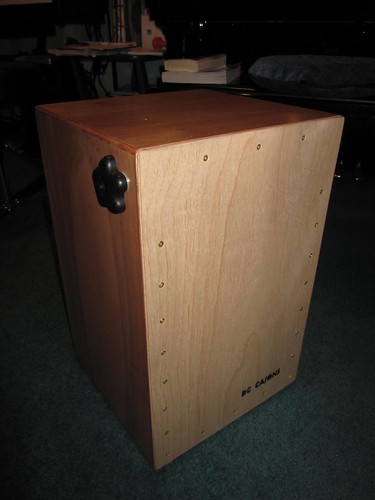
Cajon portable drum. Photo by R-M Arca
Most sources indicate that the cajón is Afro-Peruvian in origin. In the 16th century, African slaves took shipping crates and played them as they would play a drum from their motherland. Sometimes, drawers were used.
By the 19th century, the cajón had a distinct place in Afro-Peruvian and Afro-Cuban music. From Flamenco music to pop, rock and jazz, the cajón has steadily grown in popularity.
Cajón Construction
The cajón is generally made of pine, although there are several other types of woods used today. Another layer of thin plywood is nailed to the front. One notable feature is that the top corners of the face are left loose so as to produce a slapping sound. Another distinct feature is the sound hole in the back.
Some cajóns also have a snare (adjustable or non-adjustable). For a traditional Peruvian or African sound, the snare is turned off. There are also bongo cajóns, tubular and trapezoidal ones available too.
Buying a Cajón
If you live in a large city centre, chances are one of more music stores in your area is a licensed retailer of cajóns. If not, some music stores do ship worldwide.
There are several popular cajóns brands available around the world:
Asia: Pearl
North America: KOTZ™ in the US
Europe: Meinl Cajon in Germany, The Cajon Drum Shop in the UK, Requena cajon drums in Spain, Cajón de Gregorio in Spain and Schlagwerk drums in Germany
Cajóns vary in cost, depending on the make and the material used. Beginner cajóns are in the low $100's, while custom, hand-made cajóns can cost well over $600.
Learning to Play the Cajón
Getting started on the cajón is relatively easy. The instrumentalist sits on the cajón, with the drum face pointing forward. Striking the lower part of the drum face produces a warm bass tone. As you move higher, the sound is higher, similar to a bongo. You can slap the loose ends as well.

Vater Cajon Brushes. Photo by R-M Arca.
Drum accessories can enhance your cajón configuration. You can add other percussion instruments, such as cymbals, castanets, tambourines and blocks. As well, drum brushes or specific cajón brushes expand the range of tones you can produce on the instrument.
Several resources are available online to help you develop proper technique. There are free video tutorials, such as those available at Learn Cajon and Framed Drums. DVD courses available by notable cajón instrumentalists David Kuckhermann and Danny Moreno on their websites or via Amazon.
For those who one one-on-one instruction, contact your local flamenco club or Peruvian cultural society and enquire about cajón instructors in your area. Alternatively, some musicians do offer cajón lessons through Skype.
In addition to being a portable drum, the cajón is a relatively easy instrument to learn. From its humble Afro-Peruvian roots, it has expanded into other genres – from flamenco to jazz and from pop to church music.
Plus, it's just a lot of fun to play. Case in point: Japanese jazz-rock duo Pia no Jac:
© 2012 by Rhona-Mae Arca, MusespeakTM. All rights reserved.
Speedlinking December 19, 2011 Edition
Please check out these fantastic music posts by my colleagues:
One of these days I will get to musing on something regarding this teaching year. Today isn't one of them.
In the meantime, please check out these fantastic posts by my colleagues:
Contrapuntal Music for Young Students
Another Useful Accompanist Career Guide
More Thoughts on Slow Practicing
(c) 2011 by Musespeak(TM), Calgary, AB, Canada. All rights reserved.
Social Media Links
archives
- #YYCArts 32
- #YYCEvents 39
- Collaborative Music 25
- Community 11
- Composing & Arranging 6
- Entertainment 139
- Entrepreneurship 53
- Freebies 3
- Gardening 1
- Geeking Out 65
- Health & Wellness 120
- Improvisation 25
- Interviews 28
- Learning Music 188
- Martial Arts 13
- Memorization 7
- Music 230
- Music Careers 9
- Music Education 196
- Music Examinations 7
- Music Exploration 55
- Music Gigs 14
- Music Lessons 6
- Music Performance 32
- Music Theory 13
- Musical Instruments 12
- Musician Health 19
- Pets 57
- Piano Technique 12
- Practicing Music 120
- Productivity 20
- Professional Development 11
- Recommendations & Reviews 93
- Recreation 71
- Social Media 6
- Spirituality 10
- Studio Management 33
- Studio Technology 50
- Teaching Music 146
FOLLOW THE STUDIO on Instagram


Affiliate Links
As a Sheetmusicplus and CD Japan affiliate, I earn from qualifying purchases. The earnings help fund the Studio’s blog and YouTube channels. Your support is greatly appreciated.


FOLLOW Budo no Tabi on Instagram