THE MUSICAL MUSE
Blog dedicated to music education, practice tips, health
&
wellness, and geeking out.

Maestro's 2016/17 Studio Challenges - Part 1
This year, I made two big changes to Maestro's Challenges. The first is that I separated the Musician Survival Skills Challenges and the Music Moxie Challenges. The biggest change, however, is how my students and I are approaching technique. It's been a bit of a gamble, especially with the ones preparing for an exam, but it's paying off.
When Maestro crossed Rainbow Bridge, my students and I agreed that at least one challenge will forever be Maestro's, regardless of who the current Studio Assistant is (right now, it's R2-D2). Until a new canine studio assistant is brought in, all the challenges will remain in Maestro's name.
This year, I made two big changes to Maestro's Student Challenges. The first is that I separated the Musician Survival Skills Challenges and the Music Moxie Challenges. The biggest change, however, is how my students and I are approaching piano technique. It's been a bit of a gamble, especially with the ones preparing for an exam, but it's paying off.
2016/17 Challenge Theme: Focus
Last year, Maestro and I ran his Karate Belt Challenges to measure students' progress in piano technique, musician survival skills (e.g., ear training, sight-reading, rhythm work), and music moxie (performing, composing, etc.). My students had a fun time designing their avatars. Two had a little game of Hide & Seek going on where they'd hide each other's avatars.
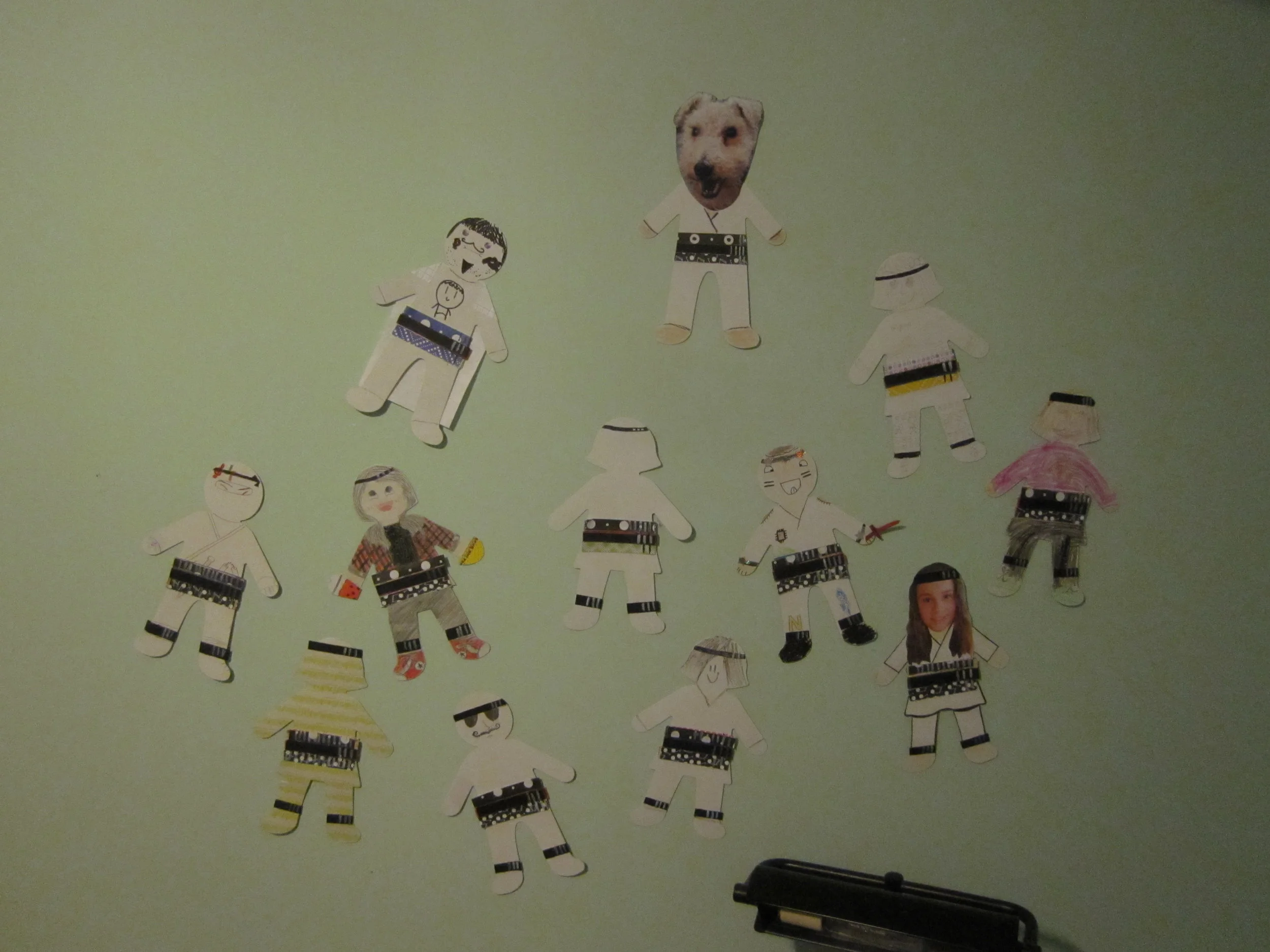
Some of the avatars that my students created last year for Maestro's Karate Belt Challenges. Photo: R-M Arca.
Looking back, there were a few drawbacks to this set-up. First, it was impossible to get through all of the weekly challenges, plus repertoire, and theory in a single lesson. Secondly, it took some students a really long time to get through their technique challenges.
This year, the students are only working on one or two challenges at any given time, most of the time. In September, is the Back Basics Challenge and the Technique Challenge.
The Back to Basics Challenge was pretty simple. The students had approximately five challenges a week, in which they demonstrated what they remembered about posture, articulation, tempo, and dynamics.
Piano Technique Challenge
One thing I wanted to do this year is make a clearer connection between those dreaded scales, chords, and arpeggios with keyboard theory (and then later, written theory). That way, could work on chording and faking with much earlier in the year.
For the first two months, we focussed on arpeggios and just arpeggios. We started with C Major and minor and travelled around the Circle of Fifths, playing the tonic major and minor arpeggios. We also worked on rhythm, sub-division, shaping, accents, and weight transfer ad nauseum.
My students began to string together several arpeggios. Most probably didn't realize that I was getting them to string the tonic, sub-dominant, and dominant chords together, but they did discover that if you pick keys close to each other on the Circle of Fifths, they string together rather nicely. Many powered through this fairly quickly.
Next came tonic major and minor triads. This is where most of my students are currently. Good enough for them to fake their way through Christmas songs if they are put on the spot this past Christmas Break.
Once they complete their trip around the Circle of Fifths, we'll go back to the top and work through the I-IV-V-I chord progression in earnest. That will be the first order of business after Christmas Break, followed by scales and modes. By that time, I hope that my students have started to make stronger connections between the technical elements in their music and between their technique and theory.
So far, one of my Grade 8 piano students has progressed to the scales portion of Maestro's Technique Challenge. She's enjoying it much more than in years past because she's also working on modes, the Hindu scale, blues, major pentatonic, and the Spanish/Jewish scale. That's standard fare for my Conservatory Canada Contemporary Idioms students, but she's in the Royal Conservatory. It's a whole new world of harmonies for her.
By the time all of my students complete the challenges for their level, they will know much more technique than what is listed in the conservatory syllabus for their playing level. That's fine. They will have enough tools in their "musician's toolbox" to be a versatile valued member in any ensemble.
For those who are interested in how I broke down the challenges, you may download the file here.
My students and I recently completed Maestro's Ear Training Challenge and are currently working through his Rhythm Challenge. More on those next time. Stay tuned!
Popular Hand Exercises Books for Piano
If you or your piano teacher have decided that you add finger strengthening exercises into your at-home practice sessions, check out these popular books of finger exercises. Please note, this list is just for piano. I'll eventually get around to posting popular exercise books for the other instruments.
Regardless of your playing level, or whether you are preparing for a piano exam, finger exercises are one of the keys to achieving technical fluency. These finger strengthening exercises give you the chops you need to tackle your pieces (AKA "repertoire").
This is a list of 15 of the most popular books of finger exercises for piano. If you click on the link, you'll go to a page to order it (or get more information on it):
Piano Essentials: Scales, Chords, Arpeggios, and Cadences for the Contemporary Pianist (Book & CD)
The First Book of Scales, Chords, Arpeggios & Cadences (Alfred's Basic Piano Library)
Master School of Virtuoso Piano Playing: Volume I Finger Exercises (Dover Music for Piano)
Oscar Peterson - Jazz Exercises, Minuets, Etudes & Pieces for PianoMaster School of Virtuoso Piano Playing: Volume I Finger Exercises (Dover Music for Piano)
Burgmuller, Czerny & Hanon: 32 Piano Studies for Technique and Musicality: 1
Twenty-Five Easy and Progressive Studies for the Piano, Op. 100: Piano Solo
Hanon: The Virtuoso Pianist (Complete) (Alfred Masterwork Edition)
Your eyes aren't deceiving you. There are several different editions of Hanon's exercises - all of them are pretty popular.
Time Saving Technique Practice Idea
Are you stuck between studying for tests and logging in much needed time on practicing technique? Try this idea that came up during one of my lessons last week.
Are you stuck between studying for tests and logging in much needed time on practicing technique? Try this idea that came up during one of my lessons last week:
This student is working on his Grade 8 piano technique. Four octave scales - woohoo?
He played d harmonic minor for the first octave and d melodic minor for the second by accident. Then, I had him play D major for the first octave, d natural minor for the second octave...you get the idea.
Basically in one pass, you practice all the scales you need to know for a traditional music exam. However, to actually hear any improvement, you'll have to play it this way more than once. More than twice.
You can change things up of course. Try this on all the minors (natural, harmonic, melodic, jazz). Or be bold and try these on some of the jazz scales.
The bottom of the white board refers to an idea I think has already been mentioned. Play the ascending scale one way (e.g., major), and the descending scale another way (e.g. harmonic minor).
You have to be awake to do this kind of practice. Well really, we should be all striving for mindful practice anyway...right?
Ideas for Practicing Piano Technique
Try as I might, some students just loathe practicing their technical exercises. You know the ones - scales, chords and arpeggios. I must admit that when I was their age, I wasn't too keen on practicing them either. However, if you want to "level up" and/or ace this portion of your music examination, you can't get away from it. You have to practice them. A lot.
If I have to ask my students to play a scale more than once in a lesson, I ask my them to play to play it differently. For instance, if a student played it legato the first time, they could play it staccato the second time.
But why stop there? Change the rhythm and make it sound like a real tune. Zig-zag back and forth so it doesn't sound like a scale. Change where you place the accents so that it's on every fifth note instead of every second or third.
The bottom line is that some degree of repetition is needed, so why not make it interesting for yourself?
15 Reasons Why Practicing Technique Can Improve Your Time at the Piano
Once again, Chris Foley posts another musical gem titled 15 Reasons Why Practicing Technique Can Improve Your Time at the Piano.
Once again, Chris Foley posts another musical gem titled 15 Reasons Why Practicing Technique Can Improve Your Time at the Piano.
So folks, keep up with your scales, chords and arpeggios - they're important!
(c) 2008 by Musespeak(tm), Calgary, AB, Canada. All rights reserved.
Social Media Links
archives
- #YYCArts 32
- #YYCEvents 39
- Collaborative Music 25
- Community 11
- Composing & Arranging 6
- Entertainment 139
- Entrepreneurship 53
- Freebies 3
- Gardening 1
- Geeking Out 65
- Health & Wellness 120
- Improvisation 25
- Interviews 28
- Learning Music 188
- Martial Arts 13
- Memorization 7
- Music 230
- Music Careers 9
- Music Education 196
- Music Examinations 7
- Music Exploration 55
- Music Gigs 14
- Music Lessons 6
- Music Performance 32
- Music Theory 13
- Musical Instruments 12
- Musician Health 19
- Pets 57
- Piano Technique 12
- Practicing Music 120
- Productivity 20
- Professional Development 11
- Recommendations & Reviews 93
- Recreation 71
- Social Media 6
- Spirituality 10
- Studio Management 33
- Studio Technology 50
- Teaching Music 146
FOLLOW THE STUDIO on Instagram


Affiliate Links
As a Sheetmusicplus and CD Japan affiliate, I earn from qualifying purchases. The earnings help fund the Studio’s blog and YouTube channels. Your support is greatly appreciated.


FOLLOW Budo no Tabi on Instagram