THE MUSICAL MUSE
Blog dedicated to music education, practice tips, health
&
wellness, and geeking out.
Video Game Jazz Music at The Runaway Five's First All Ages Show
Driving, funky jazz versions of video game music were on tap when The Runaway Five performed in concert in Calgary, Alberta at the National Musical Centre Saturday, April 6, 2013. It was the jazz group's first "all ages" show.
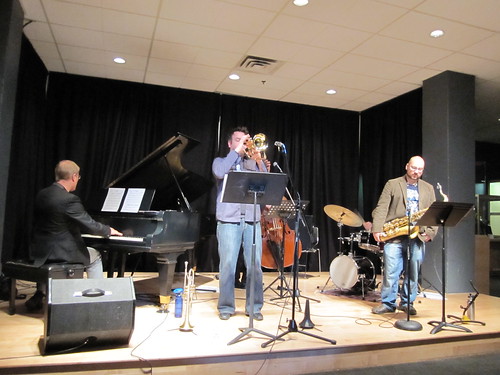
This concert featured Johnny Summers on trumpet and flugelhorn, Shane Statz on tenor sax, Sheldon Zandboer on piano, Brendan McElroy on bass and Karl Schwonik on drums. It was the group's first performance in a quintet configuration.
Jazz Arrangements of Classic Video Game Themes Played by the Runaway Five
The quintet opened the first half with two songs from the SNES game Earthbound (AKA "MOTHER 1+2"):"Sound Stone" and "Threed". This particular arrangement of the "Sound Stone" melody was quite lively, complete with stride piano. It featured solos by Shane, Johnny and and Sheldon.
In contrast, "Threed" was a laid back bossa nova. One of the neat moments in this arrangement was the transition between the flugelhorn and tenor sax solos. There was a lovely dialogue between the two instruments, which weaved and bobbed like someone floating aimlessly in the pool or ocean. I could have sworn I heard a "quote" from "Rainy Days and Mondays" by The Carpenters for a fraction of a second.
Next game on the set list was SimCity 3000, which is known for its jazz and new age soundtrack. "Updown Town" was a toe-tapping medium upswing. The trumpet solo began in the lower registered with shots that gradually led the listeners higher and higher. This was followed by an extremely chromatic piano solo, complete with rapid-fire blues riffs and shakes. After a very catchy vamp, the tenor sax solo gradually built up higher and higher, like a skyscraper.
"Into the Darkness" from Final Fantasy IVwas a lazy jazz waltz. The ensemble played upon the rhythmic ostinato from the introduction, working it into their solos. The flugelhorn solo was soft and mournful. In contrast, the tenor sax rose and fell like waves. The piano solo had punchy riffs and crunchy chords, while the bass solo played upon the theme, leading the audience deeper and deeper, lower and lower into blackness.
Another highlight from the first set was "Love Song" from BioWare's Dragon Age. This slow jazz waltz featured a beautiful duet between the flugelhorn and tenor sax. The sax solo began simply, who lush long tones, but the rhythm grew in complexity, building the tension. In contrast, the piano solo featured tender chords that rose and fell like a sigh. It too gradually grew in intensity with crunchier harmonies. The gradual deconstruction of the theme was a neat effect, just before leading the audience back to the head.
Three more video game themes were performed in the first set. "Buy Something Will Ya" (Earthbound) was a moderate swing number. "Zelda's Lullaby" (Zelda), which showcased the flugelhorn and piano. The Runaway Five closed the first set with the "Overworld Theme" from Super Mario Bros 2.
Soul Jazz, Ragtime and Swing Video Game Music in The Runaway Five's All Ages Concert
The Runaway Five did their best to make the audience forget the miserable weather outside with "Koopa Troopa Beach" from Super Mario Kart 64. Was I the only one pretending to drive my Mario Kart around the beach during the performance? I hope not.
The tenor sax solo was wavy, with splashes up into the higher register. The flugelhorn solo kept the mood high and bright, not just with playing in the higher register, but with the introduction of a different rhythm. The piano took that rhythm and changed it even more. When the head returned to lead us back to the finish line, it was a nostalgic moment.
Another highlight from the second half of the show was "Muscle Soul" from Battlefield Bad Company 2 Vietnam (Hill 137). This isn't a game I'd normally play, so hearing this theme was my introduction to the music of Anders Lewen.
This number opened with the bass and drums vamping on that opening riff until one by one, the rest of the company stepped in. The trumpet solo traversed a wide range, like a unit marching to their next mission. The sax solo was as soulful as the original recording. The piano solo had a little Motown, a little funk and a hint of disco.
The Runaway Five closed the show with "Air Platform - The Athletic Rag" from Super Mario World. The quintet had fun playing around with the two main themes from this classic video game. The trumpet solo used the A theme as a springboard to new riffs.
The tenor sax took the last rhythms played by the trumpet and then improvised on the B theme, then back to the A theme before tossing it to the piano, where we heard a chromatic treatment of the B theme, complete with zippy runs. The drum solo was playful, exploring different rhythmic and timbre combinations.
Three more VG themes were featured in the second set, including the "Figaro Castle Theme" from Final Fantasy III (VI), "Green Hill Zone" from Sonic the Hedgehog 2 opened with the drums and music from Street Fighter.
About The Runaway Five
Founded by Brendan McElroy, the Runaway Five performs jazz music arrangements of classic video games, including Super Mario Bros., Final Fantasy and Zelda. In 2008 and 2009, the group performed at Massey Hall in Toronto during the Video Games Live tour. The ensemble members change, increasing or decreasing depending upon the needs of the show.
The Runaway Five performed an intimate concert open to all ages on Saturday, April 6, 2013 at the National Music Centre. The interplay between the musicians was a delight to hear, while the themes left the audience feeling nostalgic about games past and present.
If you missed the show, you can check out some of group's earlier performances on their Youtube Channel. The Runaway Five will perform later this year. Details to follow.
THWOMP Interview: On Video Game Bands and Niches
In Part Two of this exclusive interview, Brad Stanton and Dave Marshall of the Nintendo® cover band THWOMP discuss band names and niches.
In Part Two of this exclusive interview, Brad Stanton and Dave Marshall of the Nintendo® cover band THWOMP discuss band names and niches.
Inspired by the music of video game composers Nobuo Uematsu (Final Fantasy), Koji Kondo (Super Mario Bros) and more, Nintendo® cover band THWOMP share their music with a growing fan base of gamers young and old.
Brad Stanton (lead guitar) and Dave Marshall (keyboards/percussion) from THWOMP take a break from their Animethon 17 preparations to chat with Suite 101. In the first part of their interview with Suite 101, Brad and Dave discussed THWOMP's origins. In this installment, they discuss Nintendo® bands, names and niches.
THWOMP on Naming the Band
It took the band a long time to settle on a name."I don’t even remember any of the iterations before we figured out THWOMP", said Brad. "We tried to have some “Legend of Zelda” reference for a while. We could never find one we liked."
By then, the band was starting to get gigs, making it necessary to name the band. "I don’t remember who came up with it," said Brad. "We should just attribute it to the drummer. It was probably him. I remember we were all standing there out in the parking lot of our jam space, drinking beer and smoking; and somebody said, “THWOMP”. We all just looked at him and we were all like, “Yeah!” It was definitely one of those "light shining from the clouds" moments. On the parking lot of our shitty jam space."
Nintendo® Bands and MAGFest
There are several Nintendo® cover bands out there, such as The Advantage, The Minibosses, Armcannon and NESkimos. Some have carved a niche for themselves in the realm of video game music. One of the top groups is Powerglove, a metal group. Another band, The OneUps, performs jazz interpretations of video game music.
Some of these bands perform at anime conventions and comic cons. The popular Nintendo® bands perform at MAGFest, a video game festival and conference in New Jersey. "Everybody but us, pretty much," said Brad. Their time will come.
On THWOMP’s Musical Niche
The members of the band are involved in other music groups and projects, ranging from jazz to rock and from bar gigs to workshops. THWOMP's focus, however, will forever be video game music. "It will never be anything other than that," said Brad. "It will never be watered down. It will never be compromised."
Their musical background and training, along with their love for the original music influences their philosophy. "We’re all purists about it, really," said Brad. "We really try to make everything absolutely note-for-note. Absolutely exact. We have really high standards for each other." They admit to holding some "good natured but fierce" cutting contests at rehearsals and putting each other in his place on occasion.
Giving others the same nostalgia factor they experience when playing classic Nintendo® music is not only important to them, it's their favorite part about playing this style of music. "We really want it to be fast, punchy, everything you remember," said Brad. "Every show we play, there’s some 30-year old guy in the audience who has no idea who we are and just stands there agape, staring at us, nearly crying. That happens at every show we play and it’s so gratifying.
The band enjoys watching the audience going through the actions from various Nintendo® video gameswhile they perform. "Tetris is always amusing because people try to become Tetris pieces," recalled Dave. "I don’t know if anyone’s come very close to being a Tetris piece yet but we’re interested to see people keep trying."
THWOMP is a Nintendo® band comprised of Calgarians Brad Stanton (lead guitar), Colin Mitchel (lead guitar), Scott Munro (bass), Scott Moffat (drums), David Marshall (keyboards/percussion) and Kirk McVean (keyboards). For more information about THWOMP, the band or to listen to audio clips, visit their website, BandCamp and Myspace page.
The full interview series:
Full interview series: Part 1 – THWOMP’s Origins | Part 2 – Band Names & Niches | Part 3 – Songwriting | Part 4 - Hey! Listen! CD Release | Part 5 - On Gigs | Part 6 - Convention Gigs | Part 7 - Video Games | Part 8 - Fun & Food
Originally published on Suite101.com on July 27, 2010. Updated on March 22, 2013. All rights reserved by Rhona-Mae Arca.
Popular Portable Keyboards
To follow up on my "Choosing a Digital Piano or Electric Keyboard" post I did some digging around to find out which portable keyboards are popular on the market right now.
Last week, I posted about Choosing a Digital Piano or Electric Keyboard. To follow up, I thought I'd check out what some of the popular portable keyboards are currently in the market. Plus, I'm a little curious to see where mine are on the list. Here goes:
Portable Keyboards with 61 Keys
Yamaha YPT-230 Premium Keyboard Pack with Headphones, Power Supply, and Stand
Casio LK165 Lighted Key Premium Keyboard Pack with Headphones, Power Supply, and Stand
Casio CTK-2300 61-Key Premium Portable Keyboard Package with Headphones, Stand and Power Supply
Digital Pianos with 76 Keys
Yamaha YPG-235 76-key Portable Grand Graded-Action USB Keyboard
Casio WK-225 76-Key Premium Portable Keyboard Package with Headphones, Stand and Power Supply
Digital Pianos with 88 Keys
I limited the list to digital keyboards with 61 full-sized keys or more. It isn't bad to start with 61 and it's perfectly fine when you're composing or jamming, although 76 keys would be better. However, if you're taking piano lessons, ideally, you want the full 88 keys.
These portable keyboards made Amazon's Best Sellers in Musical Instrument Keyboards. The list contains more items than keyboards, so I pulled the most popular keyboards on the list.
Now, how did mine do?

My Yamaha DGX-230 Keyboard ranked #57 on the list. Considering that the list contains everything from accessories as well as keyboards, that's not too shabby at all.


As for my Yamaha CP33 Stage Piano, it's not one that a beginner student would get. As the name implies ("stage piano"), it's geared for performance. It ranked #45 under Digital Pianos.
Five Free Music Websites to Improve Note Reading
A guide to some free music websites available on the Internet to help music students improve their note reading skills.
A guide to some free music websites available on the Internet to help music students improve their note reading skills.
Two common challenges faced by beginning music students are note learning and identifying a note's location on their instrument (geography). Until note reading fluency is achieved, this can lead to some frustrating practice sessions at home.
It is important to develop note fluency at an early stage. The process of learning new music will become easier. Sight-reading and sight-playing will be less stressful. Students will be able to read through music more quickly and play more expressively.
Online Note Reading Websites & Note Reading Games
The following list is a compilation of some of the sites available on the Internet to help with practicing and improve note reading.
musictheory.net
Musictheory.net has quite a few music drills. Under the "Trainer" section, click on "Note Trainer". Users can specify whether to be drilled on reading in the treble clef, bass clef, tenor clef and alto clef. Hints are available and Note Trainer keeps score. Users can also do ear training drills, watch flash presentations of various topics of music theory and print off blank manuscript paper. Note that the Note Trainer may be too advanced for young beginners as it tests students' reading of the entire Grand Staff plus ledger lines.
Funbrain.com – The Piano Player
Students drill their note reading and keyboard geography in this online game. Four levels of play are available: Beginner (one octave with labels), Intermediate (one octave, no labels), Expert (four octaves with labels) and Virtuoso (four octaves, no labels). The Piano Player is best suited for younger piano students (12 and under).
musicards.net
Eight sets of online flashcards are available on Musiccards.net: Note Names, Key Signatures, Intervals, Triads, Piano Note Names, Reading Piano Notes, Guitar Note Names and Reading Guitar Notes. Reading Piano Notes and Reading Guitar Notes are instrument location/geography drills. Students try to identify the note. To get the correct answer, scroll over the card. Several "decks" are available – no ledger lines, staff and ledger lines, naturals and accidentals.
Piano Pedagogy Plus
Online flash games are available on the Games page. Users can practice note reading on all four clefs. The games are timed and points are deducted for each incorrect answer. Students can also practice their interval reading.
emusictheory.com
Five note naming games are available on emusictheory.com: Note Names, Paced Note Names, C-Clef Note Names, Piano Keys and Guitar Frets. The first three are straight note identification exercises while the last two are instrument geography drills.
Online Note Reading Resources – Just the Tip of the Iceberg
Each of these websites listed contain a variety of drills and tools to help music students improve their note reading. There are other sites out there. Explore the many sites available and choose what sites work best for the student and his music practice needs.
For more information on practicing music, read Five Free Music Websites to Improve Ear Training, Free Websites to Help with Music Theory or Rudiments, and Reasons to Practice Daily.
Originally published on Suite101.com on November 22, 2009. Updated March 24, 2013. All rights reserved by Rhona-Mae Arca.
Popular Back Massagers
A list of 10 of the most popular back massagers, developed from my ongoing quest for low back pain relief.


Last week, I reviewed the Travel Roller, which is a self-myofascial release (SMR) tool for back pain relief. We live in a sedentary society, after all. Between sitting at my instrument, sitting at my desk and sitting (sometimes) when I teach, I do get back aches. Even with all my attempts to have ergonomic seating, I still get backaches, especially lower back pain.
As much as I like my Travel Roller, I'm always on the lookout for other massagers that offer back pain relief. Since I'm self-employed (TL: not the health benefits plan), I try to solve as much as I can on my own before calling a medical professional.
I have done some digging and found these 10 popular back massagers. Sure, you can order them from Amazon. However, if you want to buy local, do check your local medical supply store or exercise equipment store. Here's the Top Ten Best Sellers in Back Massagers:

Trigger Point Performance The Grid Revolutionary Foam Roller, Black
Trigger Point Performance Grid 2.0 Revolutionary EVA Foam Roller (Black)
Trigger Point Performance The Grid Revolutionary Foam Roller with SMRT-CORE Level 1 DVD (Black)
Trigger Point Performance Self Myofascial Release and Deep Tissue Massage Starter Set
Alas, my Travel Roller is not in the Top 100 List. In fact, it's actually found under "Sports & Outdoors". Methinks it's in the wrong category.
Now, I do own back massager that IS on the Top 10 List: The Originial Backnobber. What I tend to do is use the Travel Roller to loosen up the knots a bit so that the Original Backnobber can get into a knot and finish the job.
Social Media Links
archives
- #YYCArts 32
- #YYCEvents 39
- Collaborative Music 25
- Community 11
- Composing & Arranging 6
- Entertainment 139
- Entrepreneurship 53
- Freebies 3
- Gardening 1
- Geeking Out 65
- Health & Wellness 120
- Improvisation 25
- Interviews 28
- Learning Music 188
- Martial Arts 13
- Memorization 7
- Music 230
- Music Careers 9
- Music Education 196
- Music Examinations 7
- Music Exploration 55
- Music Gigs 14
- Music Lessons 6
- Music Performance 32
- Music Theory 13
- Musical Instruments 12
- Musician Health 19
- Pets 57
- Piano Technique 12
- Practicing Music 120
- Productivity 20
- Professional Development 11
- Recommendations & Reviews 93
- Recreation 71
- Social Media 6
- Spirituality 10
- Studio Management 33
- Studio Technology 50
- Teaching Music 146
FOLLOW THE STUDIO on Instagram

Affiliate Links
As a Sheetmusicplus and CD Japan affiliate, I earn from qualifying purchases. The earnings help fund the Studio’s blog and YouTube channels. Your support is greatly appreciated.


FOLLOW Budo no Tabi on Instagram