THE MUSICAL MUSE
Blog dedicated to music education, practice tips, health
&
wellness, and geeking out.
My First FallCon
It was short but sweet. My first FallCon was an adventure that was the highlight of my tabletop gaming extravaganza weekend.
I first heard about FallCon two years ago through one of my friends in Japanese class. At the time, I was intrigued, but for whatever reason, didn’t go. This year was different. Over the summer, I explored some new tabletop games with friends and at GeekMoot. I wanted to explore more games.
It would have been nice to attend the entire convention (September 27 - 29, 2013) but alas, time is so short. I only had time to attend the session on Saturday afternoon. Since it was my first time, I decided to register for Open Gaming.
This was a little different from GeekMoot. Upon registering for FallCon, you are basically reserving a seat, which becomes especially important when one of the featured games is running. You can see how many spaces are available at a table when you view your account. Or, if you're on the waiting list, you can see what position you are in.
It was just an adventure getting there. The venue is on the opposite end of town from where I live. Couple that with the fact that I was coming up from High River where I was visiting family - combo that with Deerfoot Trail being reduced to single lane traffic, starting at 22X - level that up with the fact that the detour ended in me overshooting my destination and backtracking through neighbourhoods I never knew existed - and you get one grumpy panda.
Now, don’t you tell me to turn on Google Navigation. My Android doesn't really get along with Google Maps or Google Navigation and I prefer using landmarks. Besides, I’m a hard copy map gal in the end. Guess what I forgot to print off that morning?
I was relieved to finally pull into the very full parking lot at the Commonwealth Centre and even more relieved to meet up with a friend’s hubby in the parking lot. He gave me the lay of the land upon entry: vendors here, food there, registered games right by the vendors and open gaming tables as far as the eye could see. In the very far corner, my friend and other volunteers were busy at the Games Library.
Speaking of the Games Library, what an impressive sight! There were over 690 tabletop games (some multiples). What was even more amazing was the fact that the majority of those games belong to one person.

My first stop was to the two vendors. The one game I didn’t purchase during my shopping spree was King of Tokyo. I’ve been itching to stomp around, kaiju style ever since GeekMoot but Imaginary Wars and Sentry Box were sold out when I went. I bought it from Boardgames.ca .
We caught up with my friend and then went in search of a table looking for players. These tables were denoted by an orange cone. Other tables sported a red cone, which meant that the players were in search of a teacher.
First up: Tzolk’in: The Mayan Calendar. The basic premise is similar to some games that I’ve played - build your kingdom/domain/land, gather resources, care for your people. However, the layout is quite different:

There’s a quite a bit more to the game. I was actually glad that our teacher (my friend’s hubby) had to explain the game three times, although I did feel badly for him. Since I was the first newbie at the table, I got the spiel, with added information, three times. Once he finished giving the rundown, another person showed up and then another.
There are six interconnected gears. On your turn, you can either place your workers on the lowest available spot in a wheel, or take them off so that you can reap the benefit granted for being in that spot. The wheels turn as the calendar advances, so your workers go around, stopping at different spots. It’s a waiting game to obtain a particular item, be it a building resource, corn to feed your workers, the right to build, an extra worker, etc.
Through all the action, you are trying to gain Victory Points. These are achieved in various ways, such as erecting buildings and temples, traversing the big blue wheel and moving up the temple levels as you gain favour with the Mayan gods.
Make sure you keep enough corn to feed your people otherwise, you will lose favour with the gods. I wound up with negative points for a while because of that.
If you need extra corn, one way you can get corn is to take control of the Headdress. You gain whatever corn has built up in the kitty AND you get control of the calendar. You can move time forward one day or two. You can also move the calendar backwards, in hopes of positioning your workers in a better spot on the gears.
It’s a neat game, but we three newbies readily agreed that it’s hard to get our brain around. It’s a game I’d like to try a few more times with a more experienced player as a guide before attempting to play it with me trying to be the coach.
It’s also one of the longer games too. The Boardgame Geek estimates gameplay at 90 minutes.
While we were playing, my nose was bombarded with delectable scents from the kitchen. People were ordering not just burgers and fries, but lasagna and Shepherd’s Pie. Oh so yummy. However, I made do with popcorn as I had dinner plans.
Next game: Bruges (pronounced “broozh” or “”brugguh”). It’s a city in Belgium. The game is set in Bruges during the Renaissance. Players are wealthy merchants competing to be Number 1. This is achieved by earning a high reputation on the scale, building as many buildings and canals as you can and having as many highly valued people out in your neighbourhood.
I was joined by a gentleman from BC and two ladies. The two ladies were familiar with the game.
Gameplay consists of four phases. In the first, we built our hand from the two decks of cards. The cards have colour-coded houses on one side and people on the other.
Phase 2 involves Player 1 rolling the coloured dice. The colours correspond with the works and the houses. If a player rolls a “5” or a “6”: watch out! Everyone gets struck with misfortune, such as pestilence or fire, earning a Threat Marker. Then, players can decide whether or not they want to pay the fee shown on the designated die to move up the Influence (or “Reputation”) Track.
In Phase 3, the players go around the table, playing their hand. Players can build canals or buildings, recruit workers, put workers in their buildings and activate an action listed on a card that’s in your neighbourhood.
In the final phase, players determine “majorities”. That is, you determine who’s the winner of that round in terms of canals, people and influence.
The decks are then passed to the next person. He or she becomes the Player 1 for the new round.
It’s straightforward enough. In some ways, I like it better than Dominion because of all the extra parts. You have your workers, gilder, cards and game piece. The combination of using cards and dice is neat as well.
Gameplay is listed at 60 minutes, but I’m sure we took longer than that. I think we were actually closer to 90 minutes. We missed out on the auction (which sounded quite lively). However, we were all committed to completing the game.
My first FallCon was short and sweet. The registration process was straight forward. The scheduling was varied. The cone system was brilliant. That Games Library simply blew me away. Everyone I played with or spoke to was extremely friendly and helpful.
And so ended my first FallCon experience, but not my gaming weekend. You see, my tabletop extravaganza began Friday night with a game of Pandemic. My brother and I wanted to see if we could save the world in a two-player scenario. Not only did we develop cures for all four dreaded diseases, we decided to keep playing until we eradicated all those nasty cubes from the world map.
The outbreaks started in Asia. We decided that it was fitting that we end up back in Asia. After we traversed the globe, treating and curing the world of Bugger Black, Bad Blue, that Darn Red and the Pesky Yellow diseases, we met up in Tokyo so our game pieces could party it up in Akihabara.
Sunday, we cracked open King of Tokyo. It was a fierce family fight amongst our kaiju, with each member employing a different gaming strategy. It was a bloody battle, coming back from 3 HP, but Mekka Dragon and I were victorious.

Now, it’s another year until FallCon 27. Thankfully, there are various tabletop gaming meetup groups, Gamer Sundays at Dickens’ Pub and of course, as many gameplay opportunities we can squeeze in with family and friends.
If you’d like to check out any of these games, head to a specialty gaming store. In Calgary, we have several, including Imaginary Wars, Revolution Games and Music and The Sentry Box. Otherwise, check out Amazon (click on the game links above) or GermanGames. If you have a favourite tabletop gaming store, feel free to share in the Comments section.
Myristol Joint Health Supplement for Dogs Product Review
Dr. Catherine recommended that Maestro take Myristol, a joint health supplement for dogs. Read on, as the creators also make products for humans too.

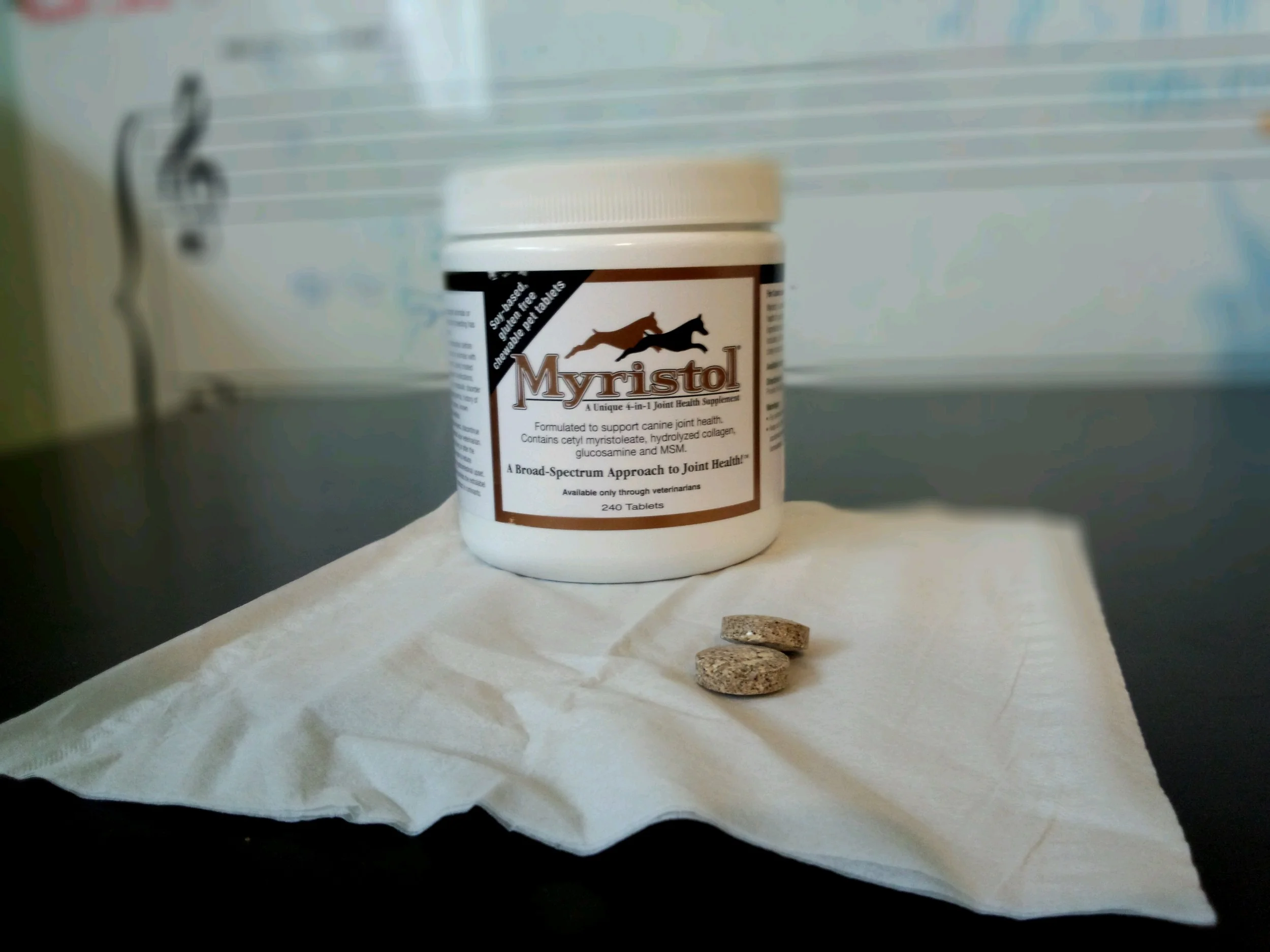
A couple of weeks ago, Maestro's vet from the Canine Aquafitness and Veterinary Rehab Centre recommended that he try Myristol. It's a joint care supplement for dogs. We picked up the "small" tub for $78 CAD. Thankfully, it contains 240 soy-based gluten free, chewable tablets, so it will last Maestro over half a year.
About Myristol Joint Health Supplement for Dogs
Myristol contains the following ingredients: Cetyl Myristoleate Fatty Acid Complex, Glucosamine HCl, MethylSulfonylMethane (MSM), Hydrolyzed Collagen, Ascorbic Acid (Vitamin C), Zinc (Zn), Manganese (Mn) and Copper (Cu).
The tablets are approximately .75 inches in diameter. Not too stinky.
Dr. Catherine recommended that Maestro start with 1/2 tablet a day on an empty stomach. Let me tell you, she meant it. Feeding Maestro 1 tablet with supper meant that he lost his supper and I had to feed him again. #lessonlearned
The History of Myristol Products for Dogs, Cats, Horses and Humans
Myristol was developed by Dr. Trotter who graduated from the University of Saskatchewan. In addition to Myristol for canines, Dr. Trotter has developed similar products for cats, horses and humans.
Myristol is available through your local veterinarian. Online, you may purchase it through Myristol's store .
Other joint supplements worth checking out include: Nutri-Pet Research Nupro Joint Supplement for Dogs, Joint MAX TRIPLE Strength SOFT CHEWS and Cosequin Maximum Strength Hip & Joint Supplements. Please note that these are a bit more potent than the $8.99 versions you see at your local pet store.
Myristol: Final Verdict
Maestro has only been on Myristol for a few weeks now. I have noticed some improvement in his mobility. Normally, I would noticed increased stiffness 10 days after a laser therapy session. With Myristol, he's a bit more agile beyond that point.
We'll give an update after he has been on Myristol joint supplement for a longer period of time. For now, our experience has been fairly positive.
How to Publish Your App A Must for New App Creators
How To Publish Your App by Grant Spink takes the hunting and digging out of trying to publish your first iOS app. This easy-to-read guide walks you through the process step-by-step in a concise manner.

If you have a mobile device, chances are, you have said, "I wish there was an app for that." Perhaps you're thinking, "How hard can it be?" and have started to create said app. Making an app is one thing, but how to you get it on the App Store? Author Grant Spink walks you through the whole process of publishing your iOS app in his first book, entitled How to Publish Your App. The subtitle says it all: "No code! Just a step-by-step guide, helping you through the tricky parts of publishing an app."
A quick search on Amazon reveals that this is the only book of its kind currently in the marketplace. So young author, Grant Spink (he's 14) saw an opportunity to share the lessons he learned in publishing his own app.
The first thing to take note of is that Spink says outright that this guide is to help you publish your app, not create it. You will have to look elsewhere for help in that area.
When Grant gave me a copy of How to Publish Your App, I was attracted to the layout. Flipping through the book, I could see that the design is very clean, with just the right amount of text and plenty of screen shots. Both copy and images are spaced out to give an uncluttered feel.
The guide is laid out into 13 chapters which outlines the publishing process in clear and concise steps. The first five chapters show you how to get set up as an Apple Developer: the obligatory introduction, Becoming a Developer, iOS Provisional Portal Outline, Requesting Your Certificates and Uploading Your Certificates.
Spink explains what is happening at each step and why it is important that you complete it. He provides links to the URLs to all the forms you need to complete. No hunting, no digging required.
The next two chapters prepare you to test and subsequently distribute your app: App IDs and Provisioning Profiles. He explains why these steps are important and walks the reader through the steps of creating profile.
Chapters 9 and 10 are critical for any new App Developer to go through. These chapters alone make the book worth its weight in gold: Getting Access to Contracts and Filling out Your Information. They walk you through all the legal, payment and tax forms that Apple makes all developers and sellers complete.
The final three chapters take you through the last stages of publishing your app: Adding a New App, Preparing an App for Archiving and Submit to the App Store. True to form, these final steps are described step by step with the requisite screen caps.
In an interview, Spink told me that he wanted to make the step-by-step guide simple enough that people without coding experience and complete newbies to developing apps can understand. I say that he succeeded in doing so. I have absolutely no experience in this area and after reading his book, I feel that I can publish my own app.
This young author has my brain going, trying to think of a couple of apps that I could create. However, I should probably just get to know my new iPod Touch first.
How to Publish Your App is available on Amazon in softcover ($21.08 CAD) and eBook format in the iBooks Store. At 122 pages, it's a very easy read.
Grant Spink is an actor, writer and student in Calgary, Alberta. He is the owner of Grantworks Media. I look forward to seeing what he does next.
Beginning major scales Book Review
A look at Paul D. Sayre's Beginning major scales Technique & Theory Workbook. Smart design and text, I can see it meeting the needs of certain groups of students and look forward to the release of the next book in the series.
When I attended the CFMTA Music Inspires Convention last month, I had the pleasure of speaking with Paul Sayre, author of Beginning major scales. It's a combination technique and theory workbook for piano and voice students. This is quite different from the traditional theory books we use to teach music rudiments to our Royal Conservatory and Conservatory Canada students. I find it refreshing.
A Look at Beginning major scales
The workbook opens with a section called "Cold Feet". It's cute enough that young students will enjoy colouring but there is an important riddle on it for young and, as Mr. Sayre says, "grown up" kids to figure out. It's a new take on memorizing the Order of Sharps. This is followed by a cheat sheet of all the major key signatures that all students will hopefully refer to often.
Then the book introduces each key in turn, going through the Circle of Fifths. For each key, the one-octave scale, I-IV-I-V7-I cadence and arpeggio are shown. On the opposite page, there are some questions for students to answer - written and aural (yay! ear training). At the end of the section, two octave scales and arpeggii are shown.
The second half of the book is dedicated to music theory. There are extra theory questions on scales, followed by an introduction to major and minor thirds (followed by questions to answer).
Students not only learn about major and minor triads, but also augmented and diminished as well. The final section of the book has a Note Catcher!™ ear and theory training game.
First Impressions of Begnning major scales
Like the Piano Adventures series, The Sayre Series Beginning major scales introduces music students to intervals, chords and arpeggii early. I do like the fact that Mr. Sayre introduces the various technical elements with the single octave but gives the two-octave version later on.
Another thing that I do like about the book is that the text is worded to speak to a wide age range of music students. It's simple enough for a seven year-old student but worded with care so that an adult student wouldn't be turned off. That's not an easy feat to accomplish.
Using Beginning music scales
My beginning piano students use the theory books from Piano Adventures, while my conservatory students use either Conservatory Canada's theory workbooks or Glory St. Germain's Ultimate Music Theory series. I don't have plans of dropping those.
However, I can see three groups of students in my studio who can benefit from using Beginning major scales. The first are my adult students who are playing recreationally. They tend to find the conservatory-affiliated theory books to be "too much". They want the basics and they don't have the time to work through chapters of questions.
The second group of students I can see benefitting from this series are what I'd call "students in transition". I have a few students who are beginning that transition from the beginner method books to one of the conservatories, but they aren't quite ready age-wise or level-wise for formal rudiments. "Students in transition" also covers transfer students who are a little weak on theory but also, aren't quite ready to look at conservatory-affiliated theory books.
The third group of students are the ones who just aren't getting it. They've been in music for a few years and the materials we've been using just confuse them. Sure, there are other issues at play, but if I can help them by using a friendly-looking book, worded in "plain-speak" with them, I think they can finally get over the hump.
I do have one beef and that is the fact there is no Beginning minor scales book. I did contact Paul Sayre regarding this and he has assured me that one is in the works. However, its release is contingent upon the success of Beginning major scales (my fingers are crossed).
Beginning major scales is a fresh approach to teaching music theory and technique. This combination workbook contains practical, written and aural exercises for students to complete. It is perfect for beginners who are beginning to transition to elementary playing.
About Beginning major scales
Title: Beginning major scales for All Piano and Voice Methods: Technique and Theory Workbook for All Piano and Voice Methods
Author: Paul Sayre
Publisher: Brownstyle, 2011
ISBN: 0615426832, 9780615426839
Length: 41 pages, text and illustrations
Price: $9.98 US and up
In Canada, Beginning major scales is available at Long & McQuade. In the United States, music teachers and students may purchase the book through Performers Music Chicago. The book is also available for sale online on The Sayre Series website .
I Love My Merrells
My feet were so sore after volunteering at the Calgary Expo. For the Calgary Japanese Festival, I made one important switch: different footwear. My Merrell barefoot shoes gave me the sense of being on terra firma all day long. Happy feet and back.
Earlier this summer, I blogged about my foray into the barefoot shoe movement. Unfortunately for me, the toe shoes I bought were one size too small and had already removed the tags. What I didn't mention was that I also purchased barefoot casual flats. Initially, I had my heart set on the Vivobarefoot Women's Kali Shoe. Unfortunately, they weren't available in my size locally.
I lucked out with the two Merrells that I bought. They were on sale. Here's one of them:
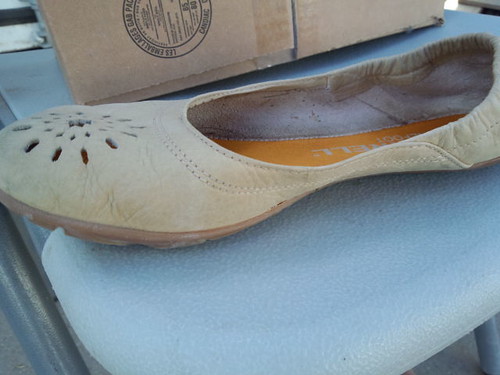
This is the Merrell Women's Barefoot Life Zest Glove Flat (purchased at Soft Moc). I also have the Merrell Women's Barefoot Wonder Glove (purchased at Checkmate Shoes).
Both pairs are extremely comfortable. The rubber Vibram soles provide a little bit of cushioning without compromising on flexibility.
Even after running around in them all day at the Calgary Japanese Festival, my feet were still happy at the end of the day. My legs were another story.
There's no arch support, so one unfamiliar with the barefoot movement would think that my arches would have been screaming by lunchtime. However, I think what helped is the fact that they ARE so flexible and have zero drop.
With my heightened foot to ground connection, I've changed how I walk (no heel striking). My toes wiggled freely because of the roomy toe box. The result? My entire foot adjusted easily and quickly to the uneven ground. Terra firma. In fact, I used the little bumps to massage my feet throughout the day by rolling back and forth.
The only downside? I'm short and wearing barefoot shoes really accentuates the height difference between myself and my interviewees. >_<
However, in the whole scheme of things, I think I'm healthier with barefoot shoes: no backaches, heightened nimbleness and balance and finally, improved posture. Sounds good to me.
Social Media Links
archives
- #YYCArts 32
- #YYCEvents 39
- Collaborative Music 25
- Community 11
- Composing & Arranging 6
- Entertainment 139
- Entrepreneurship 53
- Freebies 3
- Gardening 1
- Geeking Out 65
- Health & Wellness 120
- Improvisation 25
- Interviews 28
- Learning Music 188
- Martial Arts 13
- Memorization 7
- Music 230
- Music Careers 9
- Music Education 196
- Music Examinations 7
- Music Exploration 55
- Music Gigs 14
- Music Lessons 6
- Music Performance 32
- Music Theory 13
- Musical Instruments 12
- Musician Health 19
- Pets 57
- Piano Technique 12
- Practicing Music 120
- Productivity 20
- Professional Development 11
- Recommendations & Reviews 93
- Recreation 71
- Social Media 6
- Spirituality 10
- Studio Management 33
- Studio Technology 50
- Teaching Music 146
FOLLOW THE STUDIO on Instagram



Affiliate Links
As a Sheetmusicplus and CD Japan affiliate, I earn from qualifying purchases. The earnings help fund the Studio’s blog and YouTube channels. Your support is greatly appreciated.


FOLLOW Budo no Tabi on Instagram