THE MUSICAL MUSE
Blog dedicated to music education, practice tips, health
&
wellness, and geeking out.
More Summertime Practice Ideas
Let's talk about summertime music practicing, shall we?

You may be thinking, "Summertime practicing? But summer vacation has just started." True enough, and we music teachers hope to enjoy the summer break just as much as our students.
All we ask is that you don't forget about your musical instrument. After all, you've spend the entire school year studying and practicing - most of you on your parents' dime. You don't want to forget everything you've learned.
I've noticed that if you don't practice music for two months, it takes at least two months to get back to where you left off. One year, I was away on a work-term and didn't have ready access to a piano for six months. That was my first year working towards my ARCT Diploma. It took between six to eight months to get back into shape!
The following articles have some good ideas on how to set up summer practicing goals and a music practice plan for the summer:
Summer practice plan, with the goal of 50 times
There is a Cure for Summertime Blues...Play Music!
Bigfoot, Ogopogo and Summer Piano Practicing has good ideas for music students and teachers. Finally, A Guide to Great Home Music Practice has some good general tips.
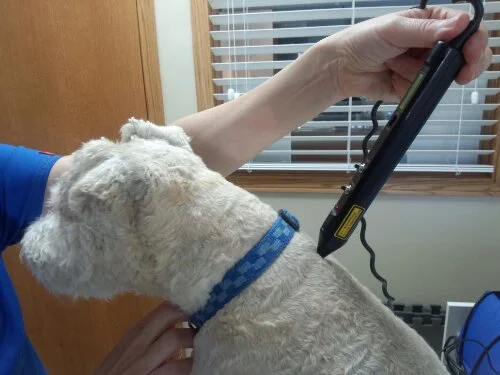
Adventures in Canine Laser Therapy
Laser therapy may seem like a new treatment for dogs and cats to treat arthritis and various types of degenerative diseases, but it's actually been around since the 1980's.

Laser therapy pen.jpg
Last week, prior to getting his chiropractic adjustment done, the vet added laser therapy to Maestro's list.
It is a non-invasive treatment for his arthritis and Inter-vertebral Disc Disease (IVDD). In a nutshell, laser therapy stimulates sick cells to heal, to regenerate. The vet told us about a dog that was paralyzed. After laser therapy treatments, the dog was able to walk again, although it failed conventional nerve tests. That's because the damaged nerves were too far gone, so the laser therapy jump-started the cells to create a new bridge of neurons.
Maestro had cold laser therapy. At first, the vet used a wand that emitted light.

Cold Laser Therapy for Canine Arthritis.jpg

DSC_0101.jpg
Maestro visibly relaxed on the table throughout the treatment. Then, the vet used a pen that delivered a laser/Acupressure combo treatment. He didn't like that part so much, but it did make a huge difference afterwards.
Today, Dr. Catherine said that Maestro didn't need a chiropractic adjustment. Just the laser therapy and infrared treatment.
Here are a couple of articles that describe laser therapy for cats, dogs and humans in more detail:
AKC's Laser Therapy for Dogs Article
In case you're wondering, yes, laser therapy is available for humans too.
The Light Relief machine I've been using on Maestro is a type of laser therapy. However, it's just at a much lower level..
Check out this newscast on pet arthritis and laser therapy:
Fun Ways for Music Students to Stay in Shape in the Summer
Many music students take a break from music lessons in the summer. These are some fun ways musicians can retain their skills and knowledge over the summer.
As the school year draws to a close, music students, their parents and music teachers relish the opportunity to slow down in the summer. At first glance, taking a hiatus sounds like a good idea. However, music students are treading dangerous ground if they think that it's perfectly fine to leave their instrument untouched for the entire summer.
Music students face a significant decrease in skills and memory if they stop playing for two months. In his article "Encouraging Summer Lessons," John M. Zeigler, Ph.D says that "if parents' money is not to be wasted, students must continue, at the least, to practice during summers off from lessons."
10 Fun Ways Music Students can Stay in Shape
The following are 10 fun ways music students can stay in shape and protect their musical investment during the summer break:
Sign up for summer music lessons: Summer lessons allow students to maintain their skills, address special issues or explore new genres at a more relaxed pace. These lessons are usually structured more loosely and allow for some schedule flexibility.
Enroll in a summer music program or workshop: Summer music schools offer various summer music programs for musicians of all levels. These summer music programs offer musicians ample opportunities for social interaction and performing.
Play music with family and friends: "Duets are an effective way to have a student improve sight reading, timing, listening, and especially keeping the beat," says piano teacher "sylviabee" in her blog entry, "Piano Duets".
Pick out songs by ear: Music students can develop their musical ear by picking out the notes to their favorite songs. Intermediate and advanced students can try to pick out harmonies and accompaniment patterns to complement the melody.
Sight-read a wide variety of music: Sight reading and sight playing are skills that take time to develop. Music students can borrow music books from their neighborhood library or, purchase or download some of their favorite books and sheet music. Music students who want to practice chording can do an internet search on "[insert title] + chords]."
Play "fun" music: All musicians can use the summer to learn and play the music they really enjoy. They can explore ethnic music, popular music, jazz, video game music or whatever music they deem to be "fun".
Listen to music live: Music students can also get musical inspiration by attending live performances during the summer. Larger cities and towns offer a wide variety of cultural and summer music festivals, such as a folk festival.
Improvise: Music students can start using a familiar song or rhythm as a guideline, such as the "golden chord progressions" (.e.g, I-vi-IV-V or I-V-vi-IV).They can incorporate technical exercises, such as scales, chords, arpeggios, and transform them into songs. Musicians can also explore some of the publications on improvising, such as the Pattern Play books.
Compose: Music students can explore their own creativity through music composition. Music can be written down by hand onto manuscript paper or by using music notation software.
Play at social gatherings: After a year of hard work, music students can show off what they learned at social events, such as family reunions, a block party, their grandparents' nursing home or a community celebration.
Other Considerations When Planning Summer Music Practices
The summer months are an ideal time to start working on repertoire for the next school term, without the pressure of homework and extracurricular activities. During the summer, music students have more time to learn new pieces or technical elements.
In 10 Ways To Get A Fresh Start With Summer Practice Assignments, Chris Foley, a music teacher and collaborative pianist says "Without the pressure of upcoming concerts, summer is a fine time to go that extra mile and get a proper handle (Handel?) on your technical facility." Music students should practice their scales, chords and arpeggios and other technical exercises fairly regularly to keep their muscles in shape.
Summer is a time to spend time with family and friends. It would be wise to have at least a couple of pieces that are performance-ready. Musicians can be asked to perform at any gathering, such as a birthday party, family reunion or cousin's wedding. Happy Birthday is also a good song to know for these occasions.
To assist music students with at-home practice, music students and their parents can read articles on practice strategies and techniques, music theory websites, online note reading aids, free ear training websites and how parents can help their child practice.
For music students who take the summer off from music lessons, practicing during the summer helps them maintain the skills and knowledge learned throughout the school year. These tips will help make summer practicing more enjoyable for musicians young and old and ensure that students get off to a solid start when regular music lessons resume in the fall.
Originally published on Suite101.com in 2010. All rights reserved by Rhona-Mae Arca.
An Interview With 2011 Honens ProAm Champion David Dixon
While I wrote for Suite101, I interviewed with David Dixon, winner of the 2011 Honens Piano Competition for Amateurs. Dixon discussed playing the piano, life lessons gained from music, jazz music, creative outlets and the Honens ProAm.
When I was a Contributing Writer for Suite101, I had this opportunity to speak with David Dixon, the winner of the 2011 Honens Piano Competition for Amateurs. A reservoir engineer for Nexen Inc., David immerses himself in music after hours. This talented pianist discussed his musical studies, the Honens ProAm, jazz music, composing and life lessons gained from music.
I also interviewed Linda Kundert-Stoll, David's piano teacher, via email. Linda shared her thoughts about David's musical development and talent.
Photos were taken by Boon Ong Photography. Photo permission was granted by Honens.
David Dixon on Music Lessons and Musical Influences
“I was diddling around on the piano before I had any official lessons,” David said. Formal piano lessons began at the age of eight, under the tutelage of his mother.
When he was approximately 10 years old, David's mother began teaching him intermediate-level repertoire. “She said, 'Well, he's in Grade 5 in school, so I'll try and teach him a Grade 5 piano piece',” David reflected. “She bought the Grade 5 RCM (Royal Conservatory of Music) books and taught me a few pieces.”
David quickly progressed to more challenging repertoire. “She taught me Für Elise. I learned that in a weekend,” he said. “I learned that pretty quickly, so I just kept on going with it.”
Perhaps another contributing factor to David's rapid development were the ingenious challenges his parents gave him when began studying piano. “My dad said that if I could learn the middle movement of the Pathetique Sonata, he'd pay me a hundred dollars.” With a chuckle, he added, “Now that's some encouragement there!”
After a brief hiatus from lessons, David resumed his piano studies as a teenager. He studied with Calgary-based instructors Dr. Peter Jancewicz, Dr. Lana Henchell and Mila Brandman. For the past three years, David has been studying piano with Linda Kundert-Stoll.
David Dixon on the Honens ProAm Competition
David first became involved with the Honens ProAm in 2008, when he was declared the alternate competitor in the event of a competition withdrawal. “I got to play in a bunch of the events and enjoyed it,” he recalled. When event organizers asked David whether he would like to participate in the 2011 Honens ProAm, he eagerly agreed.
David drew from pieces he prepared for his associateship through the Royal Conservatory of Music. “I did my ARCT back in August, so I already had the repertoire learned,” David said. “I already had them at a high level so I thought I might as well keep on playing them.” For his Honens recital programme, David performed Claude Debussy's La Danse de puck and Frédéric Chopin's Scherzo in E major, op. 54, no. 4.
The Honens ProAm is a fundraiser for the Honens International Piano Competition. It is named after philanthropist Esther Honens.
David Dixon on Life Lessons Learned from Music
There are numerous life lessons that David Dixon has learned through his musical studies. “Obviously discipline,” he said. After a few moment's thought, he added, “Appreciating subtleties and nuances of music...attention to detail.”
David is quick to admit that learning music has helped him enjoy music all the more. Music lessons help him “understand it enough to better appreciate it.”
David Dixon on Jazz Music and Creative Music
“I've always improvised at the piano,” David said. “That's what drew me to it [jazz] – being able to be more creative.”
David has also composed music for piano and small chamber music ensembles. “It's just a different way to express yourself,” he remarked.
David Dixon on Musical Outlets
David is involved with several musical projects. He plays in a jazz big band called Southern Stardust and accompanies the One Accord Choir. “That's a good outlet,” he said.
David also performs in several smaller music ensembles in Calgary. “I like the smaller groups,” David admitted. “You get a bit more freedom, a little bit more soloing space and communicating a little bit more dynamically.”
As the 2011 Honens ProAm Champion, David gained another musical outlet. His performance earned him a weekend residency at the Banff Centre.
Piano Instructor Linda Kundert-Stoll on David Dixon
In August 2011, David Dixon successfully completed his ARCT in Piano Performance from the Royal Conservatory of Music. David earned First Class Honours with Distinction.
“He played several ARCT programs while he was working to complete his theory,” commented Linda Kundert-Stoll. “From a playing level, he could have taken his ARCT earlier, but we thought it best that he finish the theory first.”
As a teacher, Linda couldn't be any happier. “I have enjoyed having him in my class immensely,” she said. “He is a huge talent: great ears, excellent facility, he learns fast and he has a great memory.”
Just how good is David? “He has what it takes to be a professional musician, should he choose to go that route,” added Linda.
David Dixon's employer can rest easy. For now, David is quite content to stick with his day job. He is even contemplating working on his MBA.
Musically, he's open to new challenges. “I'm just trying to figure out what to do next.”
Originally published on Suite101.com on November 9, 2011.
Looking Back on My Music Student Incentive Program
This school year, I revamped my incentive program for my piano students. We wrapped up the year with a fun party.
This past school year, I made some changes to my student incentive program. Then, to wrap up the year, I decided to throw a Top Dog Party which was open to all students. It's a busy time of year, so there was a small turnout. However, everyone who came had a great time.
Over snacks, four of my students and I chatted about the recent flooding in Southern Alberta. The three who had never been to the Calgary Stampede were concerned that the event would be cancelled due to the flooding.
My other student and I took turns telling them about what they can see at the Stampede. I also showed them some photos and video clips.
Then, it was time to get to business. Maestro and I proceeded to award the Top Dog prizes for the following:
Most Gigs: Winning student performed 43 times (at least, that's the number of recorded performances)
Technique Savvy: Two sisters tied at knowing and mastering 43 technical elements (e.g. scales, chords, arpeggios, progressions)
Music Mastery & Music Maestro: One student mastered 40 songs and completed 18 extra projects and tasks (e.g. recital helper, worked ahead, improvised and/or composed)
Each student received a jumbo cute cat or dog mug.
We wrapped up by playing several rounds of Scattergories. Now, you may ask why we didn't play Music Bingo, charades or another music game. My students were curious about the game, plain and simple.
In the end, it wound up being the perfect choice. By showing them to think outside the box with vocabulary, perhaps that showed them that they can do that in other areas too, like music.
How successful was the 2013 incentive program? Overall, I'd say fairly successful - for those that used it. Not everyone participated and several forgot or misplaced their Gig Card and/or Progress Card.
In fact, I nearly had a five way tie for Music Maestro! Yes, I had that many students who showed initiative by doing something a little extra with their music.
Several of my students performed between 20 - 40 times. I don't recall performing that often when I was their age, so kudos to them!
Ditto with my Technique Savvy Sisters. Not surprisingly, these two were also the most prepared for their piano examination earlier this month.
My last Top Dog is a beginner student. With him snagging two titles, I'd say that he's got a pretty solid foundation of practicing. His progress has been steady, which I attribute to to the discipline he gets through homeschooling and martial arts.
If anything, I'll make some minor tweaks to the program. I'll ask for some feedback when the students come for their summer flex and/or group class.
Social Media Links
archives
- #YYCArts 32
- #YYCEvents 39
- Collaborative Music 25
- Community 11
- Composing & Arranging 6
- Entertainment 139
- Entrepreneurship 53
- Freebies 3
- Gardening 1
- Geeking Out 65
- Health & Wellness 120
- Improvisation 25
- Interviews 28
- Learning Music 188
- Martial Arts 13
- Memorization 7
- Music 230
- Music Careers 9
- Music Education 196
- Music Examinations 7
- Music Exploration 55
- Music Gigs 14
- Music Lessons 6
- Music Performance 32
- Music Theory 13
- Musical Instruments 12
- Musician Health 19
- Pets 57
- Piano Technique 12
- Practicing Music 120
- Productivity 20
- Professional Development 11
- Recommendations & Reviews 93
- Recreation 71
- Social Media 6
- Spirituality 10
- Studio Management 33
- Studio Technology 50
- Teaching Music 146
FOLLOW THE STUDIO on Instagram

Affiliate Links
As a Sheetmusicplus and CD Japan affiliate, I earn from qualifying purchases. The earnings help fund the Studio’s blog and YouTube channels. Your support is greatly appreciated.


FOLLOW Budo no Tabi on Instagram