THE MUSICAL MUSE
Blog dedicated to music education, practice tips, health
&
wellness, and geeking out.
Random Sight-Reading Exercises to Boost Music Literacy
My classmate and colleague recently told me about having to sight-read for 15 minutes at the start of her piano lessons. I decided to try it on my "weaker" note readers.
Growing up, I was extremely jealous of my classmate Trish Evans. She probably has no idea.
Trish could improvise at the drop of a hat and make up songs that had our classmates gushing over her skills. On the other hand, I felt compelled to play everything as written and suffered stage fright up until university.
Then, I heard that Trish formed a rock band. A really cool one, called Zoey's Closet. Meanwhile, I talked myself out of joining jazz band because lead sheets and improvising scared the bejeebers out of me.
I have since taken a bit of jazz piano and rely on lead sheet reading to get me through choir more often than not. Progress.
Trish and I caught up over tea and talked shop last month. She told me about her piano teacher's efforts to improve Trish's music literacy (great ear, weaker reading skills at the time).
For the first 15 minutes of each lesson, Trish's teacher made her sight-read random music. Sometimes, the pieces were several levels above her playing level. Other times, just below.
While she was sight-reading, Trish's teacher would give comments to guide her. The teacher would play each excerpt before assigning a new one. It gave Trish a way to measure what she sight-read well (and what she didn't).
Last month, I tried this out with my "weaker" readers. My strategy has been to make the first piece several levels above their current one. The second one is closer to their current level, while the third (if there is time) is below their reading level. I drag my finger across my bookcase and stop at a random spot.
This is not the first time that I've heard about starting each lesson with sight-reading. One of my university classmates, Gregory Knight, had lessons like this too. Now, he works as an accompanist at the University of Lethbridge. His sight-reading skills are top notch, which is a useful skill as an accompanist.
I have already noticed an improvement in their musical literacy. A fringe benefit has been that these students are starting to work on music independently. Two of them walked in last week with a new piece to show off to me.
This week, we will begin the second stage of my sight-reading challenge. It will be interesting to see how my so-called "weak" readers will perform this time round.
Who Levelled Up in My First Sight-reading Challenge?
Stage One of my studio's Sight-Reading Challenge is complete. How many advanced? How much chocolate did I buy?

October has come and gone and Stage One of my Sight-reading Challenge is behind us. It was an interesting experience for my students and I. Here are our Stage One Results:
72% did 4/4 weekly challenges
12% did extra songs
40% advanced one level
16% advanced two levels
8% advanced three levels
36 % stayed at the same same level
As for me, I didn't do nearly as well as I had hoped. It took me two weeks to clear my first challenge because of a nasty cold. In the end, I got through three pieces but not well enough to move my pin up a notch on the game board.
My adult students and Grade 12 students were in the same boat as me. There just wasn't enough time or energy to get through all of the challenges. I will have to plan how to make this work more effectively in Stage Two.
I was able to take advantage of the post-Halloween candy sales and give away some of my excess Halloween candy. Not only that, I did get regular and jumbo sized chocolate bars on sale too. It still wound up costing about $30, but I have lots of leftovers.
The funny part about this sight-reading experience is that my students have been asking why they didn't have a sight-reading challenge during Week 1 of our rest period. I suppose they got used to it.
The nice side benefit that I am seeing is that more of my students are taking the initiative to learn some songs on their own. Not just one song, but two or three. Others have taken to signing out some music books from my studio library and sight-reading music from cover to cover on their own.
Another student is using this time off to relearn all of her favourite songs from last year. She thought it was fun. I thought it was a fantastic way for her to relearn and reinforce information and techniques that she had forgotten about.
I have two weeks to prepare for the next sight-reading challenge for my students. It has been a great project for all of my students (and for me too!).
Now that I know how much time is involved with picking out pieces, I will get everything all selected in advance. Wish me luck.
Related Reading:
Efficient Sight Reading by Li-San
Improving Your Sight-reading by Melanie Spanswick
Why Sight-Reading is Important by Robert Estrin
Piano Parties: Giving music students a comfortable place to perform, learn and socialize
Piano parties are one of the popular events at my studio. This year's piano parties got off to a grand start with the Halloween Piano Party.
Last year, inspired by music educators who host social events and informal performances for their students, I jumped on this creative music teaching idea. I offered three piano parties to my students, which fast became one of the most popular events of the year. Last weekend, I hosted the first one of the 2013/14 year. It was a Halloween Piano Party. All of my students came in costume and brought treats to share. I supplied a meat and cheese tray, juice and games.
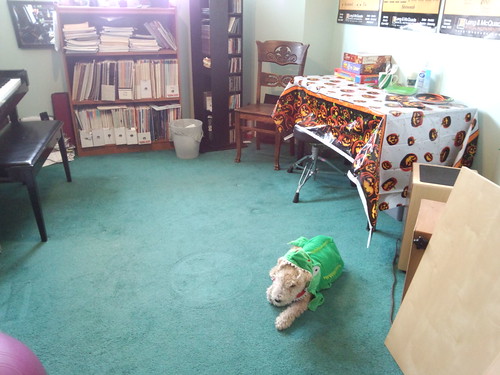
The students who arrived first created their own ice breaker. One of the questions was "If you could have a superpower, any super power in the world, what would it be?"
My students and I played one spooky song each. For most of us, we performed one of the pieces I assigned as a Sight-Reading Challenge. They did well.
Me, on the other hand, performed something I hadn't run through for a few days and had to compete with kids and canine assistant who were all excited about the arrival of two more students. It became a case study on playing with distractions.
Then, I introduced my music students to some tabletop games that most had never seen before. On one hand, I was thinking of giving them a break from music games. Later, after reading that my colleague, Diane Hidy often does puzzles with potential students, I realized that I had a golden opportunity to see how my students think.
We started with Labryinth. It's a 3D maze game, in which the players race to find the treasures. Of the four newbies, one caught on very quickly. Another couldn't care less, while the other two had an extremely tough time planning their moves because they couldn't seem to visualize what their next move should be. At least, not without someone (either myself or my other two students who have played the game before) pushing a tile in to show them possible cause and effects. It was a game where my visual, creative thinkers dominated.
The second game was the undisputed favourite: Tsuro. It's a tile-based game in which you try to be the last dragon flying on the board. Each tile contains four lines; four possible paths to follow. All of my students latched onto the concept fairly quickly. The two who struggled with Labyrinth had an easier time because they could fiddle with the tiles and pretend to lay it down to see where the path would lead.
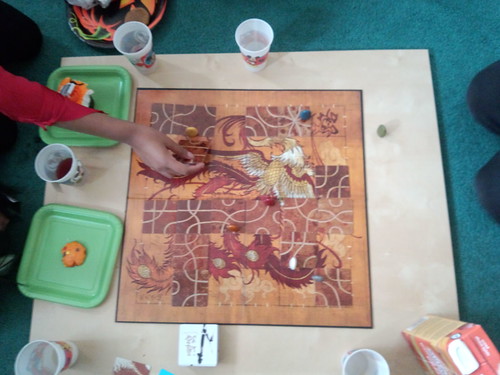
And yes, they started to think ahead, asking themselves: "If I put the tile down like this, what is my dragon's path?" Not all of them. One of them left things to chance.
The third game I introduced them to was King of Tokyo. It's a dice and card game in which monsters take pot shots of each other. The victor is either the first monster to reach 20 victory points, or the last monster standing.
One thing I learned with the games is not to spend too much time with the rules. I gave the kids the objective of the game, general actions and then had them jump in. With King of Tokyo, I explained what their dice rolls gave them, answered the questions about the cards and then let them decide what to do.
One student left King of Tokyo to return to Tsuro, leaving two boys and one girl. My female student was starting to think strategically but her monster was killed off early in the game. She too, returned to Tsuro.
That left the two boys who were looking forward to being monsters to enjoy an epic slugfest to their hearts' content. Neither were thinking of victory points, opting to just continually take pot shots at each other.
In short, I learned three things. First, the visual and creative thinkers were most successful at the games. Second, the ones who thought strategically were also my students who are more detail oriented and third, the one who didn't really care about strategy is also the one who has the most problems with timing. He was also the most enthusiastic about being a monster.
All in all, my music students had a fun time. They all cheered each other on when they performed. They ate a balance of sugar and healthier food and they thoroughly enjoyed themselves with the tabletop games.
I relished in the opportunity to give them a relaxed performance opportunity, another way to see how they think and to share with them some fun games that they could enjoy with their family and friends. The piano party continue to be one creative teaching idea that is worth repeating again and again.
When a student leaves: making the most of the time you have left
One of my students terminated lessons before the end of the year. We ended our time together by recording a CD.
One of my students terminated lessons. Really, it came as no surprise that his parents were pulling him out. Music lessons are not for everyone. Private lessons aren't for everyone. His parents have enrolled him in other activities, that I feel are a better fit for him. For his final month of lessons, I gave him a set of Halloween songs to work on. They didn't really stick. That's when I thought of making a CD. I asked my student to choose his three favourite songs and relearn them. If they weren't good enough to record, then they wouldn't make the cut. "No one wants to own a CD that sounds bad, do they?" I asked him.
He nailed his three songs on the first take. That gave us enough time to add some special effects to each of his tracks and burn the CD.
That was probably his strongest performance of that old folk melody.
We didn't have time to design a CD jacket or create any CD art. I'm sure that if he wants to, he can handle that on his own.
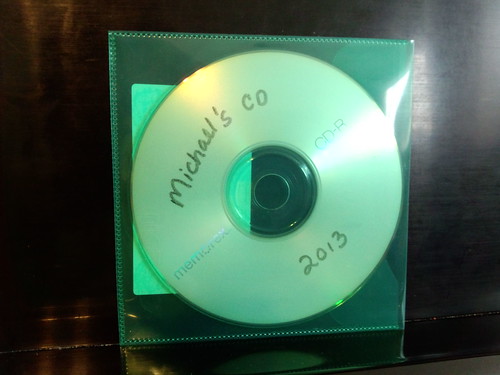
Our little CD project is a nice way to end lessons. It gives all of us a little souvenir of our time together. It was also a joy to hear my student rise to the challenge to get his pieces ready for recording.
On another note, this has inspired me to try this with a few other students. Perhaps with the challenge of a deadline, they too may rise to the challenge. If they wind up with something neat to present their parents for Christmas, Hanukkah or Kwanzaa, that would be a wonderful gift.
Music Practicing 101: The Looping Drill
The Looping Drill is one of my favourite drills since it can be used at any stage of music mastery.
The Looping Drill has become my favourite practice drill as of late. It is great to use at any stage of music mastery, the learning stage, troubleshooting, polishing, memorizing or reviewing. It is an effective way to practice only what needs more work.
Start by playing through your piece or technical exercise. When you hit a snag, play that bar five to seven times before moving onto the next one.
I find that usually by the third repetition, my fingers start to "get" it. However, it isn't until the fifth to seventh repetition that I start to consistently get it.
You can combine the looping practice drill with the Smarties Drill or any other drill to improve your accuracy and consistency. Here is a video demonstration of me using the looping drill:
I am in the process of revamping my Music Bag of Tricks, which are cards that show many of the practice drills my students and I use to achieve efficient and organized music practice. My gaming hobby is heavily influencing the design and set-up.
My Music Bag of Tricks will be tested by a handful of teachers and students before making them available to the general public. They will be available for music students, music teachers and any musician seeking for new ideas on how to practice music efficiently. Stay tuned!
Social Media Links
archives
- #YYCArts 32
- #YYCEvents 39
- Collaborative Music 25
- Community 11
- Composing & Arranging 6
- Entertainment 139
- Entrepreneurship 53
- Freebies 3
- Gardening 1
- Geeking Out 65
- Health & Wellness 120
- Improvisation 25
- Interviews 28
- Learning Music 188
- Martial Arts 13
- Memorization 7
- Music 230
- Music Careers 9
- Music Education 196
- Music Examinations 7
- Music Exploration 55
- Music Gigs 14
- Music Lessons 6
- Music Performance 32
- Music Theory 13
- Musical Instruments 12
- Musician Health 19
- Pets 57
- Piano Technique 12
- Practicing Music 120
- Productivity 20
- Professional Development 11
- Recommendations & Reviews 93
- Recreation 71
- Social Media 6
- Spirituality 10
- Studio Management 33
- Studio Technology 50
- Teaching Music 146
FOLLOW THE STUDIO on Instagram


Affiliate Links
As a Sheetmusicplus and CD Japan affiliate, I earn from qualifying purchases. The earnings help fund the Studio’s blog and YouTube channels. Your support is greatly appreciated.


FOLLOW Budo no Tabi on Instagram