THE MUSICAL MUSE
Blog dedicated to music education, practice tips, health
&
wellness, and geeking out.
The Sight-Reading Challenge
Drawing inspiration from Alessandra DiCienzo from the Ontario Registered Music Teachers' Association, I have launched a sight-reading challenge in my music studio.

One of the presenters at the CFMTA "Music Inspires" Teachers' Convention, Alessandra DeCienzo, gave an inspiring presentation called, "Love at First Sight". She shared several ideas and activities that she has used in her studio to improve sight-reading.
One of the ideas was a year-round sight-reading challenge. Each week, students would have a sight-reading assignment. Exam students participated in a less strenuous variation of this, completing their sight-reading assignments at their leisure.
I decided to do a variation of her weekly challenge this year. Instead of running it year-round, I have set four stages, which take place in October, December, February and April. That gives all of us a one-month reprieve to explore other areas.
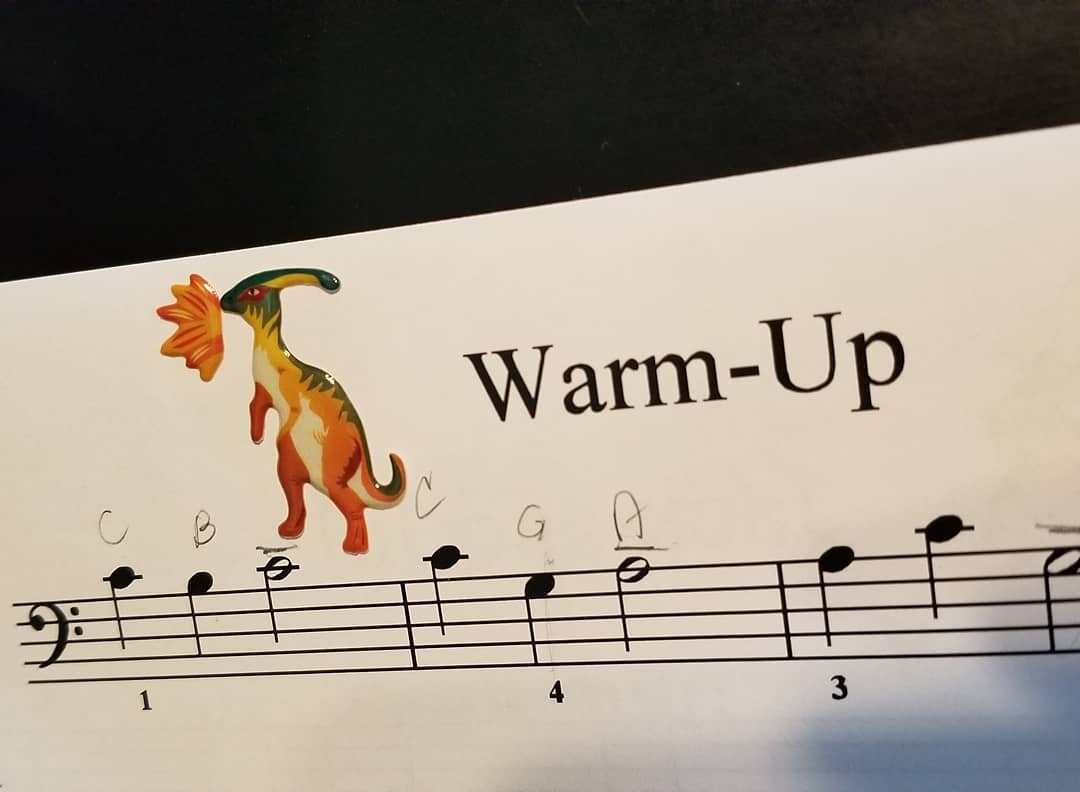
All of us (yes, me too!) have a pin on my game board:

How the Sight-Reading Challenge Works
We all are starting approximately four levels below our current playing level. It is my hope that my students will be able to comfortably sight-read music at their current playing level by April, or get to one level below it. In the process, I also hope that my slower readers will be able to "level up".
This month, I have been assigning spooky music for sight-reading. My students have the option to officially learn the music once they've "cleared" the sight-reading challenge for a piece. Like Alessandra DiCienzo's students, my students are to play the piece once per practice, without any pauses or corrections.
If they can do that at their next lesson, then they've cleared the challenge of the week and move onto the next one. Some of my students are still on the first challenge, while others are already working on a bonus challenge.
As for incentives, they are working for treats. If they clear only one assignment in the month, they get a small candy. If they complete their four and choose up to three extra songs to do for the bonus challenge, they will the equivalent of a giant chocolate bar.
Repertoire Selection for the Sight-Reading Challenge
Selecting the pieces for the sight-reading challenge has been an adventure and a chore. Thankfully, Alessandra shared some excellent links. Plus I have a growing list of online music teaching resources to draw from. Here are some of them: IMSLP Petrucci Music Library, Wikifonia, Susan Paradis Piano Teaching Resources, G Major Music Theory and Debbie Dee. I keep track of my selections on a spreadsheet saved on Google Drive, complete with the URL's.
In December, we will explore seasonal music: Christmas, Hanukkah and Kwanzaa. We'll either do romantic or wintry music in February and spring-themed music in April.
I have found that this is a great way to introduce students to different styles of music, cultures and different notation (i.e., standard versus a lead sheet or a sheet of chords). In this way, I hope that my students learn that sight-reading doesn't have to be a chore. It can be an exciting adventure.
On Note-Tab Reminders in Music Lessons
I almost walked right past these in the store. These Post-it Note Tabs are a neat way to put important lesson reminders where my music students will look at them!
I'm sure that I'm not the only music teacher out there to bemoan the fact that many of their students do not read their assignment books. Or, that they do but only just before their lesson. Post-it flags work as bookmarks for songs, but I've had limited success with regular post-it notes. Until now.
Last week, I found Post-it Note Tabs at Staples. I decided to try them with students who do not check their homework book (the ones who don't check off their goal list to show what they worked on).
When I showed them to my Monday and Tuesday students, they got a bit excited. "That's really neat!" one said. "Yeah, that should work," said another.
I've started writing short phrases to jog their memory. If the student writes quickly enough, I ask them to write the reminders. We post it on one of their pieces that they are sure to practice. The little tab sticking out says, "Reminders", so it's hard to miss.

Seeing as they don't read their assignment books often, I simply jot down the song or exercise titles. Fingers crossed that this works!
Using Practicing Personalities in Music Lessons
This summer, I bought Practice Personalities: What's Your Type? by Thornton Cline in the hopes of gaining new information to help my music students practice more efficiently.


When I was at the CFMTA Convention this summer, I spied Practice Personalities: What's Your Type? by Thornton Cline in Long & McQuade's trade show booth. The idea of determining students' practice type and working with that sounded intriguing.
About Practice Personalities: What's Your Type?
Mr. Cline identifies nine practice personalities:
The Perfectionistic Type Student
The Not-So-Detailed Type Student
The Unmotivated Type Student
The Fragile, Easily Discouraged Type of Student
The Overscheduled Way-Too-Busy Type of Student
The Dramatic Type of Student
The Exucse Making, Blaming Type Student
The Over-Exhuberant, Highly Confident Type of Student
Build Your Own Personatily Type of Student
Cline introduces each type before going into more detail for each practice type. Next, he gives a brief (too brief!) chapter with some teaching suggestions for each type. Interspersed throughout the book are interviews with a variety of music educators.
He also dedicates a chapter to motivational rewards and prizes. There is even a chapter on motivational games. Finally, there is a CD in the back, which outlines some of the practice strategies Cline recommends. The back of the book has a handy assessment chart for music teachers to use.
Music Teaching with Practice Personalities
I actually didn't need a full month to complete my assessment. All of my students are a combination of two or more types. To help keep me organized my teaching approaches, I've kept track of how many students are in each group:
The Perfectionist Type Student: 36%
The Not-So-Detailed Type Student: 52%
The Unmotivated Type Student: 24%
The Fragile, Easily Discouraged Type of Student: 24%
The Overscheduled Way-Too-Busy Type of Student: 40%
The Dramatic Type of Student: 20%
The Exucse Making, Blaming Type Student: 16%
The Over-Exhuberant, Highly Confident Type of Student: 20%
I decided to tackle one strategy at a time.
First off: showing students various practice drills to help them fix trouble spots more quickly. To do that, I simply asked my students to pull out their Bag of Tricks and have them choose a couple of appropriate drills to use from their deck, based on what needed to be fixed.
Many of my students have commented that it's fun to pull out their Bag of Tricks that I made for them. I spent the first two to three weeks doing that just to help reinforce how to practice, but also to appeal to everyone's state of busy-ness. "You want to fix this as quickly as you can so you can move onto other stuff, right?" I'd ask.
With the majority of my students being some combination of the Not-So-Detailed, I decided to increase the frequency of doing Record & Review. You can read about that experience in my post on Active Listening.
This week, I'm employing another technique that's good for several practice types, but especially for the Dramatic and the Not-So-Detailed: roleplaying with a bit of dramatic exaggeration thrown in. This tests my aural memory, let me tell you!
I try to play back what they played incorrectly and ask them to tell me what I did wrong. A few students get it right away, "You didn't hold that note long enough," or "You sped up in that line." My reply is, "Well, that's what I heard you do. Now you show me that you can play it better than me."
The other thing I've launched this week is a Sight-Reading Challenge (more on that later). In addition to increasing my students' music literacy, it's also an exercise to challenge my Perfectionist students.
I'll give my students some time to get get used to these approaches. Then, I'll tackle the Excuse-Making and Blaming Students Fragile, Easily Discouraged ones.
It's a neat book. Mr. Cline is a strong writer and the CD is useful.
However, I was disappointed with how few strategies he offered. Let me re-phrase that: I was disappointed in how little new information I gleaned from it. The majority of the strategies are ones that I've already employed.
In short, I'd say that Practice Personalities: What's Your Type? is ideal for a music teacher just starting out. It would also be good for a teacher just looking for some fresh ideas, especially if they don't already use technology in the studio.
Mr. Cline's suggestions simply reinforced for me some of the strategies that I'm already using in my teaching. The main difference is that now that I know which practice type my students are, I can switch strategies more quickly. When combined with knowing my students' VARK learning preferences, it's a powerful combination.
Practice Personalities Publication Details
Author: Thornton Cline
Title: Practice Personalities: What's Your Type
Paperback: 88 pages
Publisher: Centerstream
Publication Date: July 1, 2012
ISBN-10: 1574242814
ISBN-13: 978-1574242812
Price Range: $16.62 - $27.95 CAD
I purchased my copy from Long & McQuade. You may need to special order this book through your local bookstore. Practice Personalies: What's Your Type? is also available online on Amazon, Alibris and Sheetmusicplus.
Training Students to Become Active Listeners
Teaching my students how to become active listeners is tedious but a necessary step in teaching them how to practice more efficiently.

When I was growing up, I studied piano with Miss Mahaffy. She took me from Grade 3 to Grade 9 piano. After running though a piece, she would usually comment on how I did. More often than not, my dynamics were flat or my playing was choppy. Then she'd ask me, "Did you listen to what you just did?" Usually, I'd say, "No," or "Not really." She would dutifully write, "Listen to yourself!" in my assignment book.
Fast forward to 2013. After hearing a student, usually I ask them, "What did you think? How did you sound?" Their response is eerily similar, "I don't know. I wasn't listening." To which I reply, "Well how do you know if you're getting any better if you don't listen to what you're saying?"
My strategy to teach my students to become active listeners is two-fold. I rely heavily on the technology on hand: my YouTube Music Exploration Play List and Record & Review.
Every week, I highlight a "Clip of the Week". I've been doing this for several years now. My students have an Active Listening Handout, although I really should just keep one at the piano to save time. While watching and listening to the clip, I ask them questions such as, "What instruments do you hear?", "What's the tempo like?", "Is the song major, minor or something else?" and "What's the articulation?"
The one thing that I've been employing more regularly is recording my students and having them listen to themselves.I record them onto my computer using Audacity. Any recording device will do: mp3 player, camera or phone.
I ask them to draw a star on any spot in the score in which they heard a bobble. Some students are really good at it, so I just have to talk about various practice drills and the end goal.
I have a group of students who don't really listen to themselves when they play. However, they realize what needs work only when we do the Record and Review.
Unfortunately, many of my students are weak in this area, and I want to fix that. Sometimes, I have to record them playing through a spot, record myself playing the same spot and have them compare the sound and the waveforms.
With guided questions (and a few replays), I can usually get my students to pick out one trouble spot that I'd like them to work on for the week. Once we select the most critical issue, I have them pull out their Bag of Tricks so that we can work on that spot.
This evening, I recorded a nine-year old student as she drilled a trouble spot. I played each recording for her and asked her to assess herself. We probably spent 10 minutes recording and reviewing until I felt confident that she knew what to listen for at home and that her practices will be better organized.
Basically, I'm walking my students through how to practice music efficiently. It's very tedious, especially when you take into account that I've been doing this with most of my students for the past couple of weeks. I do feel that this will pay off in the end. If I can successfully teach my students active listening skills, then they have a better chance of succeeding at self-regulated practicing.
It is my hope that well before the end of the school year, when I ask them, "What did you think? How did you sound?", they all will be able to assess their playing accurately and objectively. Then, I can focus on helping them progress with their musicianship and expression.
My Music Ed App List for iOS Devices - 2013 edition
I've had my iPod Touch for two weeks now. Check out some of the music ed apps that I've loaded onto it, as well as some recommendations of iOS Apps from my colleagues Alessandra diCenzo and David Story.
Many of my students have mobile devices. It's what drove me to buying a Android smartphone and most recently, an iPod Touch. Now that I've had a bit of time to play with some of these apps that either my esteemed colleagues Alessandra diCenzo and David Story told me about or that I've stumbled upon, I can put a decent list together of music education apps for iPad, iPhone and iPod Touch.

Recording and Backing Track Apps for iOS
Garage Band for iPhone ($4.99) turns your iPad, iPhone and/or iPod touch into a collection of "touch instruments" and a full-featured recording studio. Want piano? Guitar? Drums? You can do it. You can even plug an electric guitar into you iThing to play through amps. Someone will have to let me know how well it works as I don't have an iPhone.
iReal b Music Book & Play Along ($7.99) is currently on my Android smartphone. However, I believe it was available for iOS devices first. What can I say about it? You get a mobile band with iReal b. Download the chord charts for over 1,200 songs available in the forums. Or, enter in the chord progression for any song, choose your instruments, tempo and style and play away. Instead of using a metronome, why not try practicing with a virtual band?
Note Reading, Theory and Ear Training Drills
Master in a Minute (FREE) is a fun music app for kids. It helps students develop their note reading skills. I like how it teaches intervallic reading. It has certainly been helping some of my students who are struggling with note reading. There used to be a full version, but it is no longer available in the App Store.
Music Reading Essentials ($2.99) has four sets of flash cards to choose from: notes, rhythms, intervals and symbols. Students can focus on one area or combine decks. The timer sure adds a bit of pressure. My students have been playing a round of this while waiting for their lesson.
Music Theory Pro ($4.99) has note naming games, key signatures and interval ear training. So far, I've noticed that it's better suited to my older beginners, intermediate and advanced students. Very slick design. I'll have to try the pro levels. I like how this app includes jazz chords and scales, altered dominants and extended chords. MTP is also available for Apple computers in the App store.
My Note Games! (FREE) was featured on BBC Click! and was nominated for a "Learning without Frontiers Innovation Award" in 2012. It has six games: Hear it, Play It; Play that Note, Play-a-Day!, Play-a-Carol!, Toonr the Tuner and Hear it, Note It. My beginner students enjoy it, although they don't get very far with the free version. I just bought the $6.99 upgrade to unlock all 18 levels..
Note Works Free (FREE) is for iPad. I was quite sad to see that I couldn't get it on my iPod Touch. It looked like pure fun when Alessandra showed it to a bunch of us at the 2013 CFMTA Convention. This game is designed to teach note recognition and improve sight reading skills. Your mission is to help Hungry Munchy catch each note as quickly as possible before it skitters off-screen. The full version has more bells and whistles (Note Works Full) for $4.99.
Rhythm Lab ($2.99) allows users to copy, save, or share any rhythm pattern as an image. You can send tapping results in an e-mail, create and print worksheets. My students and I haven't tried this app out yet
I have long recommended Musictheory.net to students and am glad that the creators have made a mobile version. Tenuto ($3.99) offers fifteen customizable exercises to help you with chord recogniation, intervals and ear training. There are also musical calculators and twelve-tone matrices. They also have a Theory Lesson app for $2.99.
Metronome and Tempo Related Apps
Metronome Ϟ (FREE) is what I have installed on my iPod Touch. It's simple and gets the job done. The "tap tempo" feature is greatly appreciated. Also, the practice timer is a neat. You can actually set it to hammer out the beats while you drill a trouble spot for one, two, three, four or five minutes.
I've just installed Tempo - Metronome with Setlists ($1.99). It has made the Top 100 List in the Music category. There are five modes: Basic, Preset, Setlist, Practice and Gig. Each mode presents a different combination of functionalities optimized for the task at hand. I look forward to exploring this app.
Tempo SloMo (FREE) allows you to practice at your own pace. This is great not just for music students, but language and dancing students as well. Take a whatever you are working on and slow it down or speed up the audio track without affecting the pitch. I think this will become a popular app with my students, especially with their pop songs.
There are countless apps for music education. I'll update the list as I discover new apps. Feel free to suggest some of your favourite iOS apps for learning and playing music.
Next, I'll take a look at some Android apps for music education.
Social Media Links
archives
- #YYCArts 32
- #YYCEvents 39
- Collaborative Music 25
- Community 11
- Composing & Arranging 6
- Entertainment 139
- Entrepreneurship 53
- Freebies 3
- Gardening 1
- Geeking Out 65
- Health & Wellness 120
- Improvisation 25
- Interviews 28
- Learning Music 188
- Martial Arts 13
- Memorization 7
- Music 230
- Music Careers 9
- Music Education 196
- Music Examinations 7
- Music Exploration 55
- Music Gigs 14
- Music Lessons 6
- Music Performance 32
- Music Theory 13
- Musical Instruments 12
- Musician Health 19
- Pets 57
- Piano Technique 12
- Practicing Music 120
- Productivity 20
- Professional Development 11
- Recommendations & Reviews 93
- Recreation 71
- Social Media 6
- Spirituality 10
- Studio Management 33
- Studio Technology 50
- Teaching Music 146
FOLLOW THE STUDIO on Instagram


Affiliate Links
As a Sheetmusicplus and CD Japan affiliate, I earn from qualifying purchases. The earnings help fund the Studio’s blog and YouTube channels. Your support is greatly appreciated.


FOLLOW Budo no Tabi on Instagram