THE MUSICAL MUSE
Blog dedicated to music education, practice tips, health
&
wellness, and geeking out.
The Tickle Trunk of Textures
Inspired by Dr. Jennifer Snow, Frances Mae Balodis, Karen King and Mr. Dressup, I've put together a Tickle Trunk of Textures to teach touch. (A 6-word Alliteration Combo - AWESOME).
At the CFMTA Music Teachers' Convention, Dr. Jennifer Snow shared some fantastic teaching ideas. One of them was her fabric board of textures. Her students are "imagination gardeners". Frances Mae Balodis expanded upon this in her talk about imagination. It was one of those ideas that I filed away and didn't think of again until Karen King posted about the Imagination Gardener on her blog. Last week, I finally made it to the fabric store:

I just couldn't picture a board of fabric swatches in my studio. That's when Mr. Dressup popped into my head. Aha! A Tickle Trunk of Textures (yes, I like alliteration).
Now, I spent way too much on fabric (that .2m minimum and 1.0 m minimum for fabrics on sale). For approximately $50, I bought enough fabric and trinkets to make not one, not two, not three, but FOUR Tickle Trunks. Thankfully, my brother is also a music teacher, so we split the bill and each have a spare set of fabric.
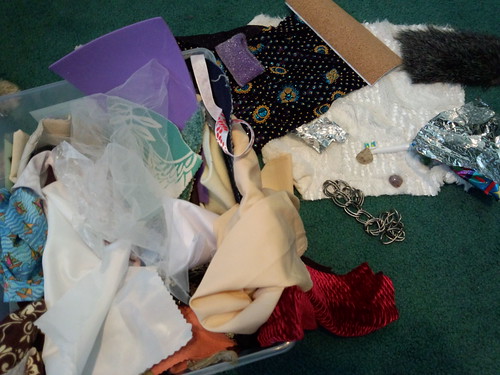
I am amazed at how well it works! Especially for the students who have trouble playing softly.
When I first show off the Tickle Trunk, I ask my students to pick something and we talk about what kind of song it could describe. That usually gets their imagination going.
Now if only I could get Maestro to let go of the fabric swatch with hearts on it.
A Rainbow of Handouts and Studio Incentives
A few tweaks and new bells and whistles make this year's student incentive program and practice aids a rainbow of colours and very much, game inspired.
Now that my website issues have been resolved (knock on wood), I can get back to the business of writing and teaching. You can read all about it here. I've wanted to share some of the tweaks I've made to my studio incentive program:

What's New:
First off, I changed the name from "Maestro's Musical Quest" to "Maestro's Top Dogs". It makes sense, since the Top Dogs in each category will party it up with Maestro at the Top Dog Party.
I also reformatted the Piano Progress Card. The booklet format was nice, but students misplaced it. Now, all the elements that were in the Progress Card are printed on 8-1/2 X 11" coloured sheets (lilac, pink, green and blue) and placed in their binders.
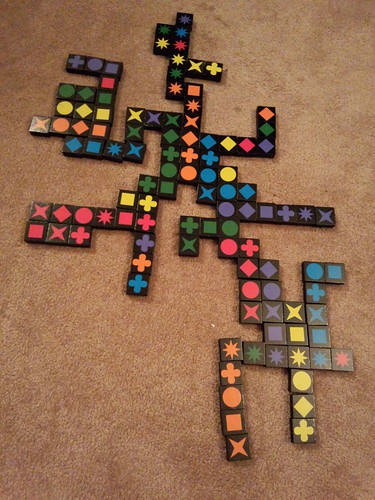
In the top LH corner in the photo above, you'll see two cards with shapes in a grid. That's the new technique challenge. Inspired by Qwirkle, a game created by MindWare, my students will work their way through the card, building Qwirkle-like rows ("Twirkles", perhaps?). Whenever they master six technical elements in a row, they collect $15 Maestro Bucks to spend at Maestro's Market. Students who complete the card (major minor keys) will be inducted into Maestro's Technique All-stars.
Upgraded Studio Incentives - Sticking to a Theme
One thing I noticed with last year's "Gig Card" is that some students either performed a lot or hardly at all. I suspect that some lost their steam for performing 20 times before seeing $100 Maestro Bucks. This year, they will earn $25 Maestro Bucks for each five performances.
That transferred over to the Music Moxie (formerly the "Music Maestro") and the Music Mastery cards. I decided to keep it simple and have $25 Maestro Bucks for five on all of them. The goals setting incentive remains the same as last year.
Handouts and a Bag of Tricks
This year, my students and I are going to explore practice strategies based upon their "practice personality". This is inspired by a book I bought at the CFMTA Convention, entitled Practice Personalities: What's Your Type?: Identifying and Understanding the Practice Personality Type in the Music Studentby Thornton Cline.
Instead of the Practicing 101 handouts of years past, I decide to repackage the info for my predominantly Visual and Visual-Kinesthetic learners. Once again, I drew inspiration from some of the tabletop games and video games I've played.
All students, young and young-at-heart, received a Bag of Tricks:

The original set contains 24 practice drills. One side of the card shows you how to do the drill. The reverse side tells you when to use the practice strategy and what it can be used to fix.

Some of my students were very excited when they read what the cards contained. Others looked skeptical, to which I'd say, "They're good for when you're stuck and you need to change up how you're working on something."
One of my fellow gamers enthusiastically read the cards out loud to his mother. When he got to the part where it said, "Repeat until you can play this spot cleanly five to seven times in a row," his mother said something like, "Well, duh!"
Then, one of my Grade 12 students looked at them and said, "Dude, that's a lot of work." Well, if more of my students improve because of them, then I'd say that it's worth it. At any rate, I hope that they have as much fun with their materials, practice aids and practice incentives as I had making them.
June 13, 2014 update:The musical bag of tricks has undergone significant testing and revisions, as well as a new name. I am pleased to announce that the Canadian product release of Maestro's Music Tricks (MMT) is June 30. There are 34 practice drills. MMT is currently available on pre-order. Stay tuned for details on the international product release.
MMT website: http://mmt.musespeak.com
MMT FB page: https://www.facebook.com/maestrosmusictricks
Beginning major scales Book Review
A look at Paul D. Sayre's Beginning major scales Technique & Theory Workbook. Smart design and text, I can see it meeting the needs of certain groups of students and look forward to the release of the next book in the series.
When I attended the CFMTA Music Inspires Convention last month, I had the pleasure of speaking with Paul Sayre, author of Beginning major scales. It's a combination technique and theory workbook for piano and voice students. This is quite different from the traditional theory books we use to teach music rudiments to our Royal Conservatory and Conservatory Canada students. I find it refreshing.
A Look at Beginning major scales
The workbook opens with a section called "Cold Feet". It's cute enough that young students will enjoy colouring but there is an important riddle on it for young and, as Mr. Sayre says, "grown up" kids to figure out. It's a new take on memorizing the Order of Sharps. This is followed by a cheat sheet of all the major key signatures that all students will hopefully refer to often.
Then the book introduces each key in turn, going through the Circle of Fifths. For each key, the one-octave scale, I-IV-I-V7-I cadence and arpeggio are shown. On the opposite page, there are some questions for students to answer - written and aural (yay! ear training). At the end of the section, two octave scales and arpeggii are shown.
The second half of the book is dedicated to music theory. There are extra theory questions on scales, followed by an introduction to major and minor thirds (followed by questions to answer).
Students not only learn about major and minor triads, but also augmented and diminished as well. The final section of the book has a Note Catcher!™ ear and theory training game.
First Impressions of Begnning major scales
Like the Piano Adventures series, The Sayre Series Beginning major scales introduces music students to intervals, chords and arpeggii early. I do like the fact that Mr. Sayre introduces the various technical elements with the single octave but gives the two-octave version later on.
Another thing that I do like about the book is that the text is worded to speak to a wide age range of music students. It's simple enough for a seven year-old student but worded with care so that an adult student wouldn't be turned off. That's not an easy feat to accomplish.
Using Beginning music scales
My beginning piano students use the theory books from Piano Adventures, while my conservatory students use either Conservatory Canada's theory workbooks or Glory St. Germain's Ultimate Music Theory series. I don't have plans of dropping those.
However, I can see three groups of students in my studio who can benefit from using Beginning major scales. The first are my adult students who are playing recreationally. They tend to find the conservatory-affiliated theory books to be "too much". They want the basics and they don't have the time to work through chapters of questions.
The second group of students I can see benefitting from this series are what I'd call "students in transition". I have a few students who are beginning that transition from the beginner method books to one of the conservatories, but they aren't quite ready age-wise or level-wise for formal rudiments. "Students in transition" also covers transfer students who are a little weak on theory but also, aren't quite ready to look at conservatory-affiliated theory books.
The third group of students are the ones who just aren't getting it. They've been in music for a few years and the materials we've been using just confuse them. Sure, there are other issues at play, but if I can help them by using a friendly-looking book, worded in "plain-speak" with them, I think they can finally get over the hump.
I do have one beef and that is the fact there is no Beginning minor scales book. I did contact Paul Sayre regarding this and he has assured me that one is in the works. However, its release is contingent upon the success of Beginning major scales (my fingers are crossed).
Beginning major scales is a fresh approach to teaching music theory and technique. This combination workbook contains practical, written and aural exercises for students to complete. It is perfect for beginners who are beginning to transition to elementary playing.
About Beginning major scales
Title: Beginning major scales for All Piano and Voice Methods: Technique and Theory Workbook for All Piano and Voice Methods
Author: Paul Sayre
Publisher: Brownstyle, 2011
ISBN: 0615426832, 9780615426839
Length: 41 pages, text and illustrations
Price: $9.98 US and up
In Canada, Beginning major scales is available at Long & McQuade. In the United States, music teachers and students may purchase the book through Performers Music Chicago. The book is also available for sale online on The Sayre Series website .
Lesson Planning - A Work in Progress
Part of me is worried that I haven't buckled down to do some major planning for the upcoming teaching year, but as I declutter, I am making some progress in the planning department.

The big decluttering project continues. It's taken years to amass all this paper and stuff so I guess I shouldn't be surprised that it will take a while to clean up my mess. It seems though, that no sooner do I get my office tidied up that it becomes a bigger mess as soon as I tackle a new section in my office. Case in point:
Amidst the chaos however, plans are beginning to emerge. As I file handouts and documents from the previous teaching year, ideas for new handouts and teaching strategies are percolating in my mind.
However, I don't want to break the flow of my clean up (I refuse to start another teaching year with a messy office); so, I have three medium-sized coloured sheets, labelled: "Lesson Strategies/Planning", "Handouts to Make" and "To Do" on top of one of the binders in the lower LH corner.My tin of Crayola® markers are also close by.
So far, I've jotted down things like, "How to make technique more fun," "Strategies for helping the Keyboard Geography/Hand-Eye Coordination Challenged Students" and a long list of optional activities.
For the time being, I just grab the appropriate sheet and jot down a phrase. Once I get that tower beside my desk emptied out, then I can hunker down and transform the ideas into something tangible. I imagine that by the time I reach that point, I'll have more than three sheets of ideas. At least, it will be easier to focus as by then, I'll have a less cluttered workspace.
Getting Those Fingers Back into Shape
Back to school is just around the corner, so music lessons aren't far behind. Get your chops (your finger strength and dexterity) up to snuff by trying out these finger exercises.
I think it's safe to say that most music students take it easy during the summer. Most music teachers like to as well. However, with fall just around the corner, it's time to strengthen those fingers!
I recommended a few popular books with hand exercises a while back. Last year, I finally worked through the first book of Hanon exercises:

The New Hanon (link to my affiliate link)
This summer, I'm working my way through the Schmitt Five-Finger Exercises, op. 16 (affiliate link).
What I really like about the Schmitt exercises is that they are five-finger exercises. Sure, you're supposed to play them 15 times each, but it's really not that bad. I use the following pattern:
Five times legato
Five times staccato
Five times something else
That "something else" could be portato, or jazz triplets or two-note slurs. I do notice that it takes at least five repetitions of the pattern before my tone evens out.
If you're looking for a way to get your fingers back into shape before the fall, you can't go wrong with Hanon or Schmitt. It beats playing your Conservatory scales, chords and arpeggios every day.
Social Media Links
archives
- #YYCArts 32
- #YYCEvents 39
- Collaborative Music 25
- Community 11
- Composing & Arranging 6
- Entertainment 139
- Entrepreneurship 53
- Freebies 3
- Gardening 1
- Geeking Out 65
- Health & Wellness 120
- Improvisation 25
- Interviews 28
- Learning Music 188
- Martial Arts 13
- Memorization 7
- Music 230
- Music Careers 9
- Music Education 196
- Music Examinations 7
- Music Exploration 55
- Music Gigs 14
- Music Lessons 6
- Music Performance 32
- Music Theory 13
- Musical Instruments 12
- Musician Health 19
- Pets 57
- Piano Technique 12
- Practicing Music 120
- Productivity 20
- Professional Development 11
- Recommendations & Reviews 93
- Recreation 71
- Social Media 6
- Spirituality 10
- Studio Management 33
- Studio Technology 50
- Teaching Music 146
FOLLOW THE STUDIO on Instagram



Affiliate Links
As a Sheetmusicplus and CD Japan affiliate, I earn from qualifying purchases. The earnings help fund the Studio’s blog and YouTube channels. Your support is greatly appreciated.


FOLLOW Budo no Tabi on Instagram