THE MUSICAL MUSE
Blog dedicated to music education, practice tips, health
&
wellness, and geeking out.
My 20 Piece Polishing Challenge
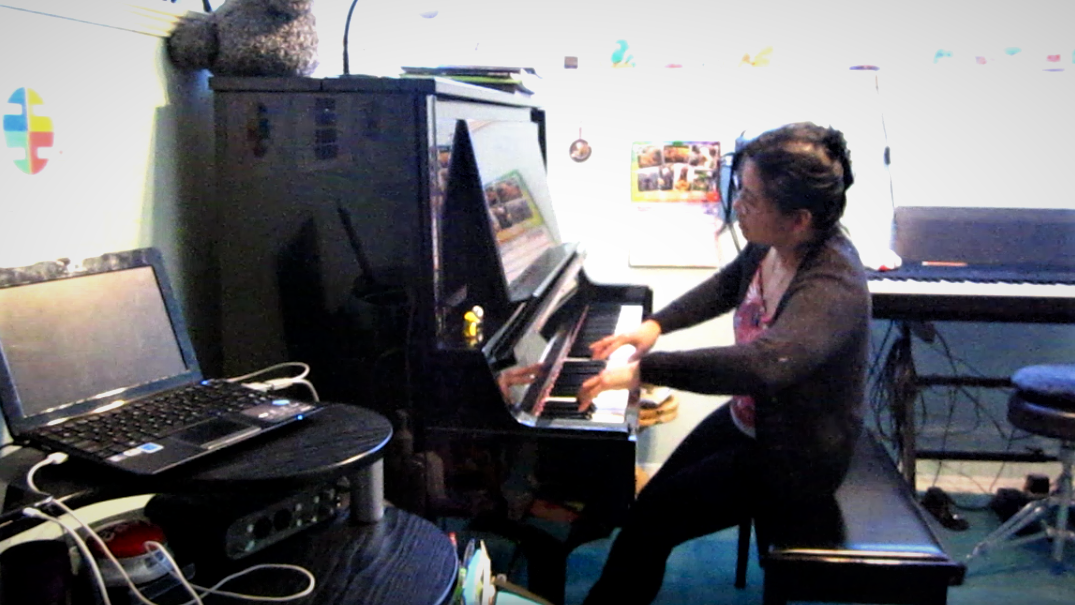
With more of my students moving up to the upper intermediate and advanced grades, I myself need to get back into shape. Sure, I know their pieces well enough to teach them, but they are by no means polished. Nor do they need to be, but what better way to get my solo piano polishing skills back up than by starting with my students' pieces?
While updating my student repertoire playlist on YouTube, I noticed that one of the videos that I selected was tied to a 40 Piece Challenge. Curious, I did a little digging.
It turns out that piano teacher Elena Fortin has been participating in these 40 piece challenges with other colleagues in the Art of Piano Pedagogy Facebook group for several years. They learn one piece a week and upload a performance of it at the end of the week.
What a great idea for us music teachers to keep our chops up. Learning pieces in a short amount of time really forces a musician to practice efficiently.
Lately, I've been working more on collaborative music. My brother and I have had fun working on music by Pia no Jac. I played and sung at a friend's wedding recently and have been doing more of that in church choir. Then, there are the various VGM and J-Pop projects that I have been doing with my buddy, the Animal Alchemist. In most of these cases, I utilize my technical, improvisational and sight-reading skills more than anything else. As much as I hate to admit it, I'm getting a little rusty at taking a solo piece - especially a classical one - and polishing it up to performance standard.
With more of my students moving up to the upper intermediate and advanced grades, I myself need to get back into shape. Sure, I know their pieces well enough to teach them, but they are by no means polished. Nor do they need to be, but what better way to get my solo piano polishing skills back up than by starting with my students' pieces?
Setting up my 20 Piece Polishing Challenge
I set up the parameters for my 20 piece challenge as follows:
Polish 20 student pieces between now and August 31, 2018.
Record polished performances of the challenge pieces and upload them onto the Studio's YouTube Channel.
Pieces must not be ones I have previously learned and polished up to performance standard (that will be another self-imposed challenge).
Pieces must be between Grade 7 - 10 level in the Royal Conservatory or Conservatory Canada (Traditional or Contemporary Idioms) syllabi.
Repertoire must be for solo piano.
Memorization is optional.
As I have to juggle this project with the rest of the repertoire I'm working on, I'm not going to pin myself down to spitting out a piece a week. I have had plenty of practice speed learning pieces and getting them to "good enough." I need more practice getting things to a much higher level. Some pieces will take me just a few days to polish while others will take several weeks.
Perhaps I'll participate in the 40 Piece Challenge next fall but for now, this seems like a good way to get back into shape while being able to help my students with their repertoire even more.
20 Piece Challenge Video #1: Disco Visit
About Disco Visit
Composer: Mike Schoenmehl (b. 1957), Germany
Source: RCM Level 8 Etudes
Notable Score Markings: Einleitung, MM ♩ = 84 - 92, straight eighths at the start. "With a heavy groove!" at bar 5.
Prior Experience with the Piece: Minimal. I sight-read it when I first bought the Etudes book at the beginning of the school year and immediately thought it would be a perfect fit for one of my students. I was right and she's going to start working on it later this year.
Learning Challenges: syncopated rhythm, leaping bass, repeated large chords and octaves, hand coordination, speed
My Disco Visit Journey (AKA, "Practice Log")
Day 1: Ran through the entire piece. Reviewed patterns and structure. Identified rhythm and coordination trouble spots (bars 9 - 12 and bars 17 - 19). Drilled them by tapping and counting out the rhythms, playing hands separately and then hands together several times. Got the first spot clean and consistent. The second? Still working on it. #awkwardchords #syncopationproblems
Day 2: Checked to see if I could get the easier bits up to 84 beats per minute before drilling the fingering fingering on bars 17 - 19 and 21 - 24 until I had better consistency than the previous practice. Drilled the trouble spots at the piano with and without the metronome. Did full run-throughs with and without metronome at 60 - 69 beats per minute. Holding steady.
Realized how easy the patterns were to memorize and began to memorize the music in four-bar chunks. Tempo shot up to 72 - 80 beats per minute as the memory improved. Did periodic memory and speed drills in between bookkeeping and errands, getting obsessed with the idea of reaching 84 beats per minute by the end of the day. Stopped after realizing that trying to get two pieces with large chords up to speed was beginning to take its toll on my right hand and arm. Will need to rest my arm and break things down slowly to memorize "release all tension" spots. So much for practising the big chordal section in Typhoon today.
Day 3: Rested the piece. Worked on Typhoon instead as I performed it later in the day at the studio piano party.
Day 4: It was a light practice day as I wound up suffering from a bad case of eye strain from using the wrong glasses at work the night before. I simply ran through the trouble spot between bar 17 - 19 by memory slowly, and in a darkened studio (which really forces your aural and tactile memory to kick in). I made a point of really relaxing my forearm during those eighth rests. I even tried with my eyes closed.
Day 5: It's my lesson prep/housecleaning day, so I alternated between drilling my memory stations and cleaning my house. I recorded my final round of memory and tempo drills to show how I worked on the hardest part of the piece (click here for the practice video).
Then, it was time to record. Here's my video performance of Disco Visit:
I've got Easter Triduum music to focus on and Typhoon to finish learning this week, so it may be a couple of weeks before I get another challenge piece up to snuff. You can follow my progress on by checking out these two playlists:
My 20 Piece Polishing Challenge Playlist - contains the video performances
My Practice Videos - show how I work through some of the common trouble spots
Check back here for my thoughts and musings as I work through the pieces.

Mid-Year Checkpoint on My Student Incentive Program
This year, I've made minor changes to Maestro's Top Dogs, my student incentive program. These changes have led to progress in two key areas: technique and performance. Here's a quick rundown on what I changed and how things are working out so far.
This year, I've made minor changes to Maestro's Top Dogs, my student incentive program. These changes have led to progress in two key areas: technique and performance. Here's a quick rundown on what I changed and how things are working out so far.
To bring new readers up to speed, the gist of my student incentive program is that students earn Maestro Bucks in various ways throughout the year. They get to spend their money at Maestro's Market. The Top Dogs in the four areas (Technique, Practice, Bulletproof Musician Playlist, and Music Moxie) will earn a special prize at the end of the year.

Practice hard, earn Maestro Bucks.
Maestro's Technique Challenge
Everyone who knew Maestro knew just how picky he was about technique. He was famous for stomping out of the studio if he deemed any scales, chords, and arpeggios sub-par (including mine).
The big change is that I adjusted the reward for each cleared technical exercise according to playing level: beginner to Pre-Grade students earn $10 Maestro Bucks (MB) per exercise, Grade 1 - 5 students earn $20 MB each, Grade 6 - 8 students earn $40 MB each, while Grade 9 and 10 students earn $50 MB each.
In the past, students earned the same amount of MB for an exercise, regardless of level. This resulted in the younger students learning all of their pentascales quickly, while the more advanced students took much longer. With this year's change, my students are progressing more steadily - on the whole.
Of course, there are some students who still balk at practising their scales, chords, and arpeggios. I struck a compromise with them. As this small group is not on the exam track, I have modified their technical exercises to focus on learning the I-V-vi-IV-I chord progression in each key. We "review" their scales and modes at their lessons. Believe it or not, they actually do practise the chord progression at home (probably because this is the progression used in nearly every pop song).
As for my exam track students, they have learned all their technical requirements much earlier compared to years past. This gives them plenty of time to secure tempo and memory. Since they already know their technical exercises for their level, their weekly incentives are tied to tempo and memory.

Maestro was extremely proud of his market. He'd be happy to know that it's still in operation in his name.
Maestro's Practice Challenge
In the past, I awarded $2 MB per completed goal. This year, I wanted to encourage practice frequency as well as give a bigger payoff for mastering a piece. As a result, students earn $5 MB for each day practiced (theory homework can also be logged).
Here's the practice sheet that we have been using this year. My students have been tweaking it throughout the year.
My students have a Bulletproof Musician Playlist, which contains songs they have mastered, plus songs that all musicians should know, like Happy Birthday and O Canada. As they master a song (as in, they can play it fluently versus perfectly), it gets added to their Playlist. This list becomes their go-to set list whenever someone puts them on the spot to play a song (thus, making them bulletproof).
For ease, the breakdown is identical to Maestro's Technical Challenge. This change has evened the playing field immensely. The beginner students wind up with longer Playlists than their seniors, but the advanced students will earn more each time they add to their list, because let's face it, their pieces are more difficult.
One interesting observation: my students are generally learning their repertoire at a faster rate than they did last year.
Maestro's Music Moxie Challenge
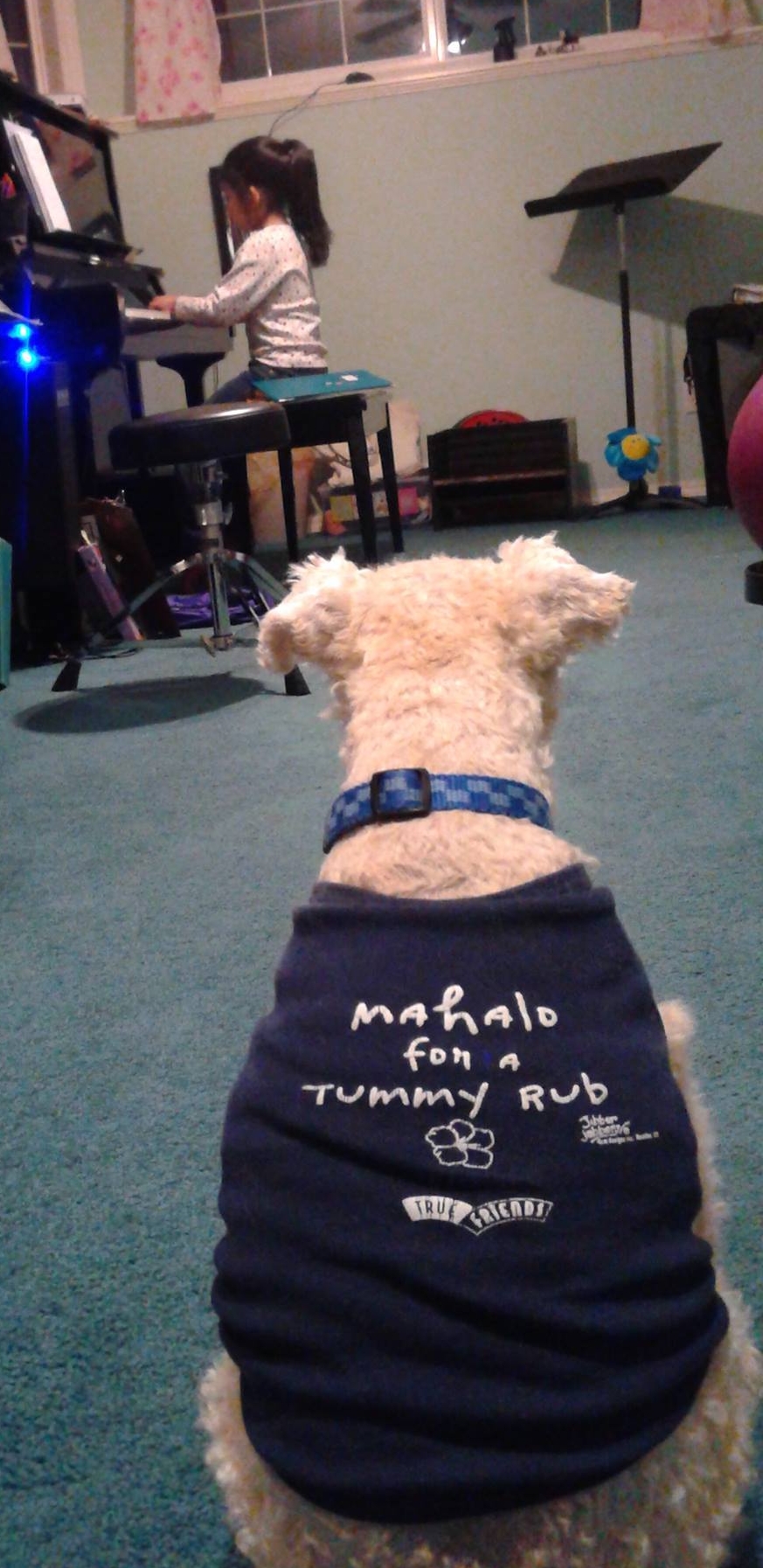
Maestro loved a good performance just as much as the next canine studio assistant.
This area underwent a few changes as well. The main change is that I wanted to better recognize the extra effort required to do something above and beyond their regular work:
$20 MB for each solo or collaborative piano performance
Memorization bonus ($10 MB/beginner piece, $20 MB/Grade 1 - 5 piece, $40 MB/Grade 6 - 8 piece, $50 MB/Grade 9+ piece)
$10+ MB each time you help out in the studio
$25+ MB per composition
$25+ MB for each concert you attend or studio workshop you participate in
The biggest change I've seen is that students are performing more this year.
Next up: Find out about my 20 Piece Polishing Challenge. Post will be out later this week.

The First Brain Game Exercise I Learned
This was a brain exercises that I committed to memory and has become a favourite amongst my students.
During the 2015 CFMTA Music Teachers' Convention, educator Terry Small came and talked to us. It was a fantastic talk about engaging the whole brain as musicians. This was a warm-up that I committed to memory and has become a favourite amongst my students:
Terry has some wonderful advice and tips for brain health on his blog, the Brain Bulletin.
Taiko Drumming: Working the Brain and Body
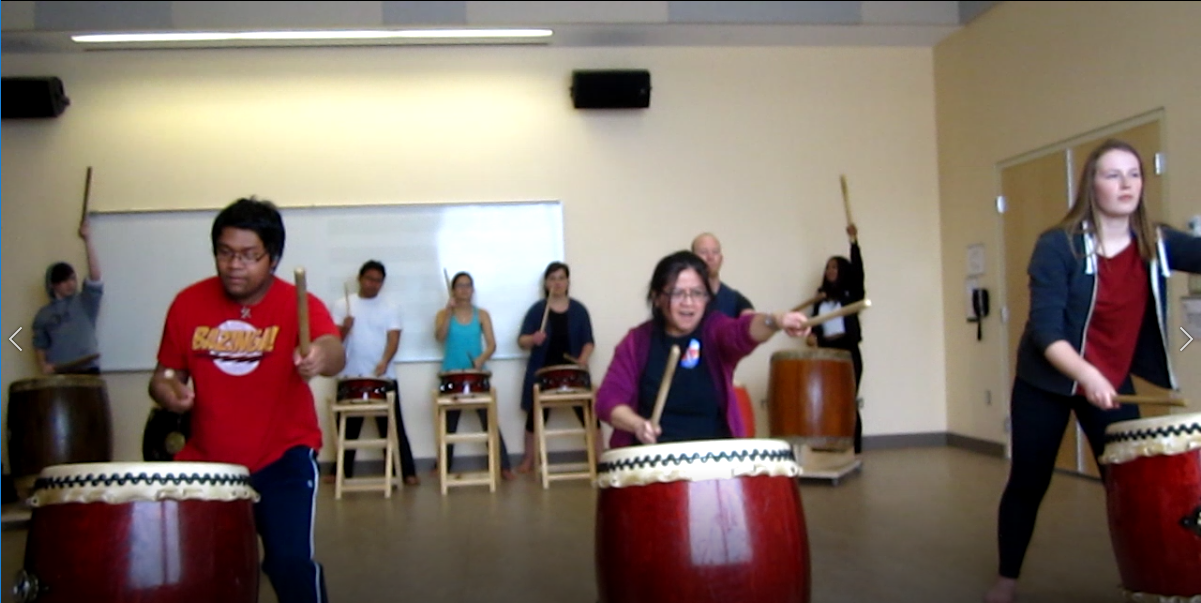
Last weekend, some of my studio families, friends and I took a beginner taiko drumming workshop. It might sound like an unusual activity for a piano studio, but music is music, regardless of instrument. Besides, nothing challenges your sense of rhythm and coordination like playing percussion in a group.
Last weekend, some of my studio families, friends and I took a beginner taiko drumming workshop. It might sound like an unusual activity for a piano studio, but music is music, regardless of instrument. Besides, nothing challenges your sense of rhythm and coordination like playing percussion in a group.
The first time I heard taiko drumming live was at the Calgary Omatsuri, featuring the Midnight Taiko Kai. I was immediately drawn to the driving rhythms, the synchronicity amongst the ensemble members, and the martial arts like discipline.
That was several years ago. I have since gotten to know two members of Midnight Taiko though other musical endeavours, thus making it rather easy to set up a custom taiko workshop through the Mount Royal Conservatory.
Taiko and Brain Games
We had a three-hour workshop let by Paula Midori Niekar sensei, Artistic Director of Midnight Taiko. She started us off with various brain exercises based on the Rock, Paper, Scissors game to wake up our foggy brains:
After a few minutes, we added the rest of our body to the mix, scooting up and down the floor. It was challenging.
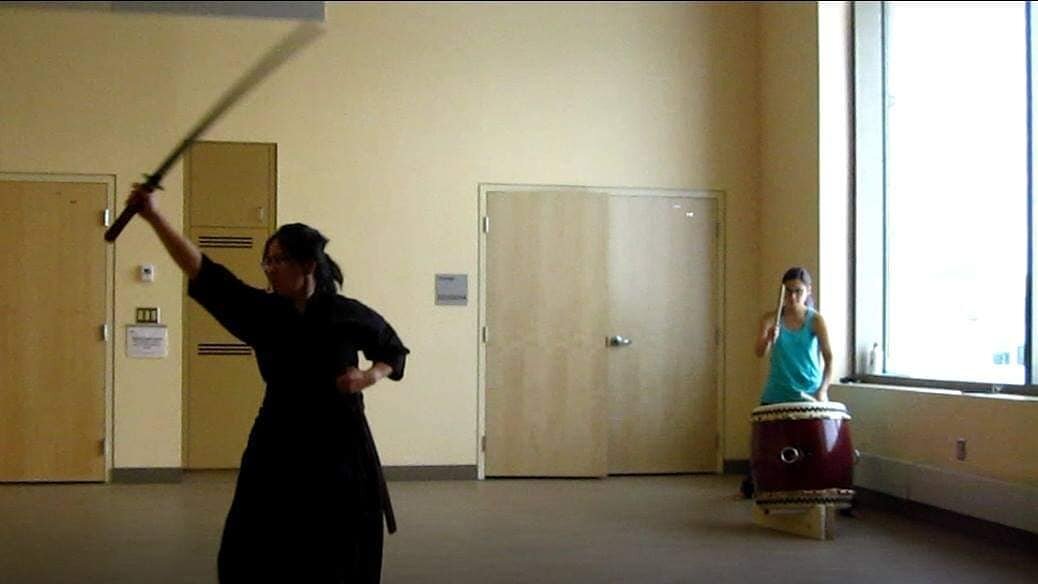
Next, we learned basic techniques for holding the drumsticks (bachi) and our stance (kamae). The latter reminded me our our long stance for one of the martial arts I practice.
Testing our Endurance with Taiko
We learned a couple of basic patterns by ear and by rote, which is traditionally how taiko is taught. Then, we moved on to the Oroshi, which is the "Come check out what we're doing!" pattern.
Finally, we learned Isami Goma, which is a song I have heard Midnight Taiko perform. It translates to "Courageous War Horse." It's quite a long piece, so we had to learn it in sections and went through countless repetitions.
It really tested our memory, coordination and physical endurance. Finally, we had it decent enough to record:
Unfortunately, the sound quality isn't the greatest. My poor camera mic just couldn't handle all that percussion. Next time, I'll bring my Handy Zoom and adjust the mic levels and set-up appropriately.
My students and their parents enjoyed themselves immensely. Afterwards, they expressed the desire to do another taiko workshop next year.
Opening the workshop up to my piano parents and friends made for a wonderful studio community activity. As some of you know, social interaction with other "piano geeks" was one thing that was missing from my musical education growing up. It became an integral part to my musical studies at university. Group activities are an important part of my studio for these reasons, along with giving my students varied ways to enjoy music.
どうも ありがとう ございました to Paula Midori Niekar, Lisa Macleod and the Mount Royal Conservatory. If you'd like to try your hand at taiko, check out the taiko programs at MRU. If you'd like to hear taiko live, check out Midnight Taiko in concert on March 17, 2018.

Beats and Budo
Several months ago, one of my fellow iaidoka (AKA, “The Tiny Samurai”) posed a question to Kim Taylor sensei of Sei Do Kai with regards to beats and budo. Taylor sensei shared some of his thoughts here, then made a reference to me (AKA, “The Tinier Samurai”) to try tackling the question.
When I first began my Iai journey in the mid 2000s, I recognized immediately the many shared themes between music and martial arts. Beats and budo, now this is something that I have been grappling with since Day One.
Several months ago, one of my fellow iaidoka (AKA, “The Tiny Samurai”) posed a question to Kim Taylor sensei of Sei Do Kai with regards to beats and budo. Taylor sensei shared some of his thoughts here, then made a reference to me (AKA, “The Tinier Samurai”) to try tackling the question.
When I first began my Iai journey in the mid 2000s, I recognized immediately the many shared themes between music and martial arts. Beats and budo, now this is something that I have been grappling with since Day One. More on that later. First, I’ll touch upon some of Taylor sensei’s other points that resonated with me.
Music as a Metaphor for the Story
Taylor sensei said that music can be used to tell the riai, the story of a kata. That makes a lot of sense to me as a musician and an iaidoka. Whereas books tell stories through words, music tells stories through sound and silence. Of all the performing arts, kata is most like dance, as both tell a story through movement.
I recently stumbled upon a draft of some scores I wrote back in 2007 where I began to translate the kata into music. This is as far as I got.
In Mokuso, I used a major pentatonic scale and quartal harmonies to give an Oriental sound. I gradually slowed the rhythm down to show the progression from having jumbled thoughts to achieving mushin (“no mind”), where I am calm and alert.
In Mae, I used a Locrian mode. I find it the creepiest of all the old church modes. I used two voices. The high voice depicts the iaidoka, while the piano is the teki. Register depicts movement up and down, dissonance and dynamics indicate the sword’s movement, while rhythm represents jo ha kyu. You’ll notice in the score that I even scribbled down what was happening in the kata.
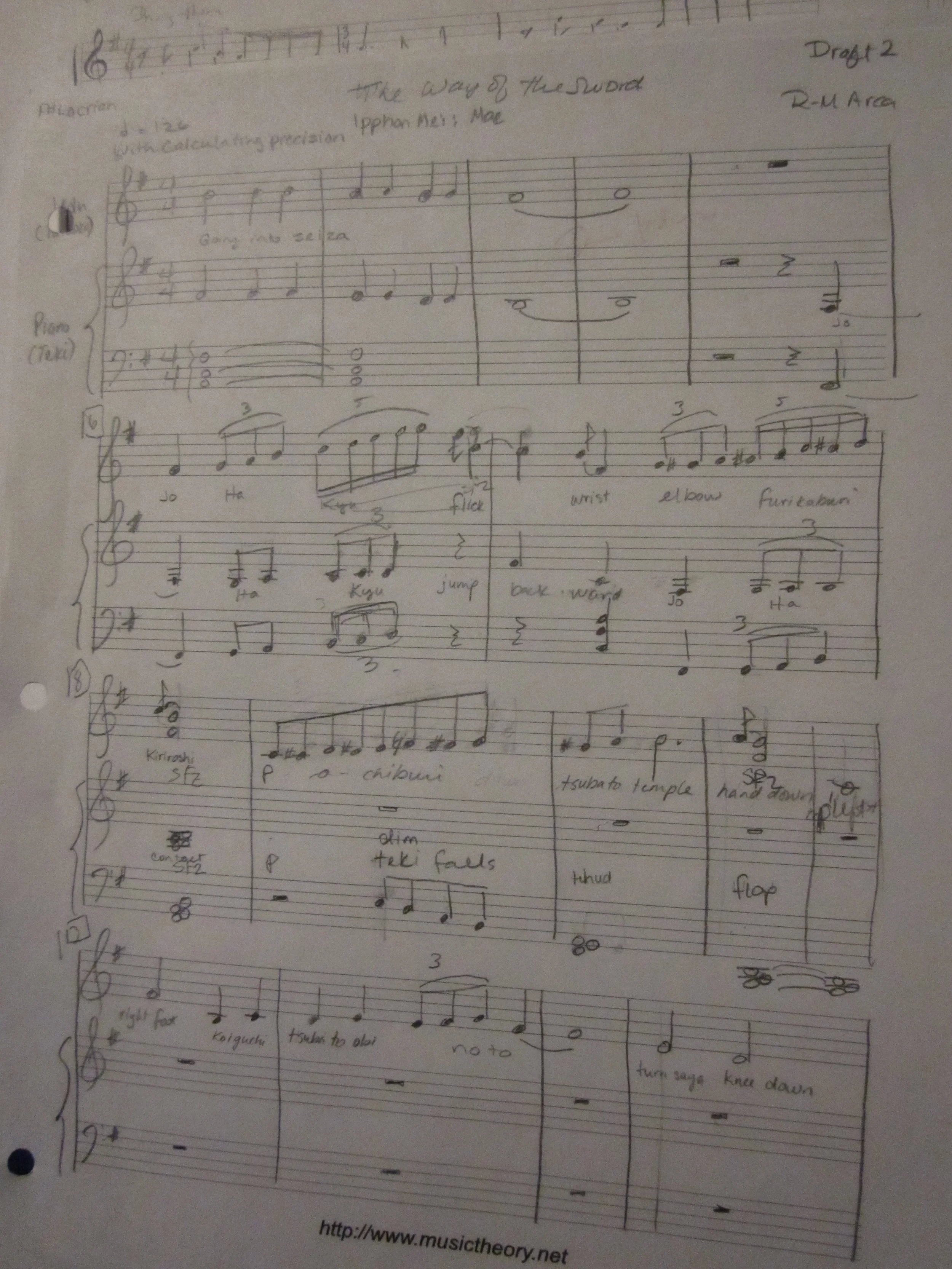
My early scribbles for setting Ippon Me Mae to music. The top staff is the iaidoka, while the bottom two represent teki. Credit: R-M Arca.
Add a training hiatus in the middle of my journey, age, increased knowledge and experience, and I have a slightly different perspective on my budo. These days, I’m really trying to refine my jo ha kyu timing. If I were to translate the kata now, I would take a different approach. Rhythm would play a much bigger role. It would most likely be non-metrical or polymeter. Plus, I’d use one of the Japanese scales I learned earlier this year.
Copying Another’s Performance to Achieve Mastery
In his post, Taylor sensei said that “A perfect copy of James Ehnes is going to be an actor playing the part.” Agreed. Does parroting a famous artist show that you truly understand what’s going on? No. Does it show that you understand the instrument? Nope. Does it show who you are? Not at all.
On a related note: Can a robot perform a piece better than a person? Can a machine completely capture the essence of a person’s performance? Technology can now recreate the performances of famous pianists. Check out the Steinway Spirio:
When I saw the Spirio in action at Steinway Pianos for the first time, my initial reaction was, “Creepy.” Sure, it was cool to see that we can do this, but it just felt like it was a shadow of Gershwin’s actual performance. I was drawn more to Gershwin’s recorded performance on the TV screen versus the piano’s recreation of it. It had more soul to me.
I could see George’s expression, the speed of his attack, his arm gestures, and his breathing. Those little things told me much more about the story and his playing than watching keys being pressed by mechanical means.
Music students who work through either the Royal Conservatory of Music or Conservatory Canada have a set list of repertoire to choose from. Some pieces are more popular than others, so sometimes, teachers, adjudicators, and examiners hear the same pieces countless times from multiple students. The notes are the same, but each student’s interpretation is unique. Not only that, each time they work with their own teacher or obtain feedback from an adjudicator or coach, it undergoes another metamorphosis.
One student make take a piece at the low end of the recommended tempo range, whereas the next may perform it at the opposite end. One may use a heavier touch. Another may use dramatic dynamic contrasts. One may choose to take extra time in Bar 8, while another may push the tempo in that same spot.
It doesn’t necessarily mean that one student has achieved a higher level of mastery than another. For that, one must ask if technical fluency was in evidence and whether the performer convincingly told us the story in a way that is in style with the form and the idiom.
To a practiced listener, it is possible to recognize a musician by their sound, or to recognize a musician’s lineage by how they play. Budo has that too. Although we strive to get our timing in line with “dojo timing,” each of us has a slightly different internal timing. Whenever we run through our Seitei Iaido kata as a club, the group timing differs ever so slightly, depending upon who is leading, who is there, and how focussed everyone is. Regardless, it should still be relatively close to sensei’s timing.
That’s the beauty of it. We don’t want to be carbon copies of someone else. The subtle differences provide some variety to the same story - and that’s what keeps things interesting.
The Same Art but Different Eras or Regions
Perhaps one day, I’ll get around to completing my musical set of Iaido kata. Unfortunately, that day isn’t anytime soon. Real life commitments have a tendency to cut into composing time.
Since The Tiny Samurai posed her question, I have also pondered Iaido kata on a structural and stylistic level. The seitei set reminds me of a Baroque suite of dances. Each dance represents a different country, e.g. a sarabande is Spanish, whereas a minuet is French.
Baroque dances have a set structure, binary or rounded binary. They also have a set order of steps. Some have telltale rhythms. The time signature changes depending upon the dance, but the tonic key remains the same. Very little markings are given in terms of dynamics and expression, leaving room for various interpretations of the same story.
I see the koyru iaido sets as being akin to character or mood music from the Romantic era. These are generally composed in ternary form, although other structures, like through-composed, crop up from time to time. Like certain pieces, e.g. polonaise or lieder, each koryu can represent a different region.
My mind wanders to Modest Mussorgsky’s Pictures at an Exhibition. Each piece depicts a different painting that two characters are viewing and sometimes, debating over:
Another way to describe this musically is to have two pieces with the same title and same overall structure. However, each are completely different:
Leitmotif in Budo
Merriam-Webster Dictionary defines leitmotif as “an associated melodic phrase or figure that accompanies the reappearance of an idea, person, or situation especially in a Wagnerian music drama.” John Williams made good use of it in the Star Wars movies with “Luke’s Theme,” the “Imperial March,” and so on. Taylor sensei also mentioned it in his beats and budo post.
I could see one leitmotif for Muso Shinden Ryu noto and a different one for Muso Jikiden Eishin Ryu. O-chiburi could be notated a little differently from yoko chiburi. Musically, that would provide unity and consistency.
Beats and Budo - Reprise
Beats and budo - Miyamoto Musashi called this rhythm-timing in the Go rin no sho. Ever since reading that, I’ve been playing around with beats. I came up with timing for the opening etiquette, which I waxed poetic on in The Iaido Journal. Here’s the link to the article, entitled Rhythm and Flow.
I’ve been experimenting with the following rhythms for jo ha kyu:
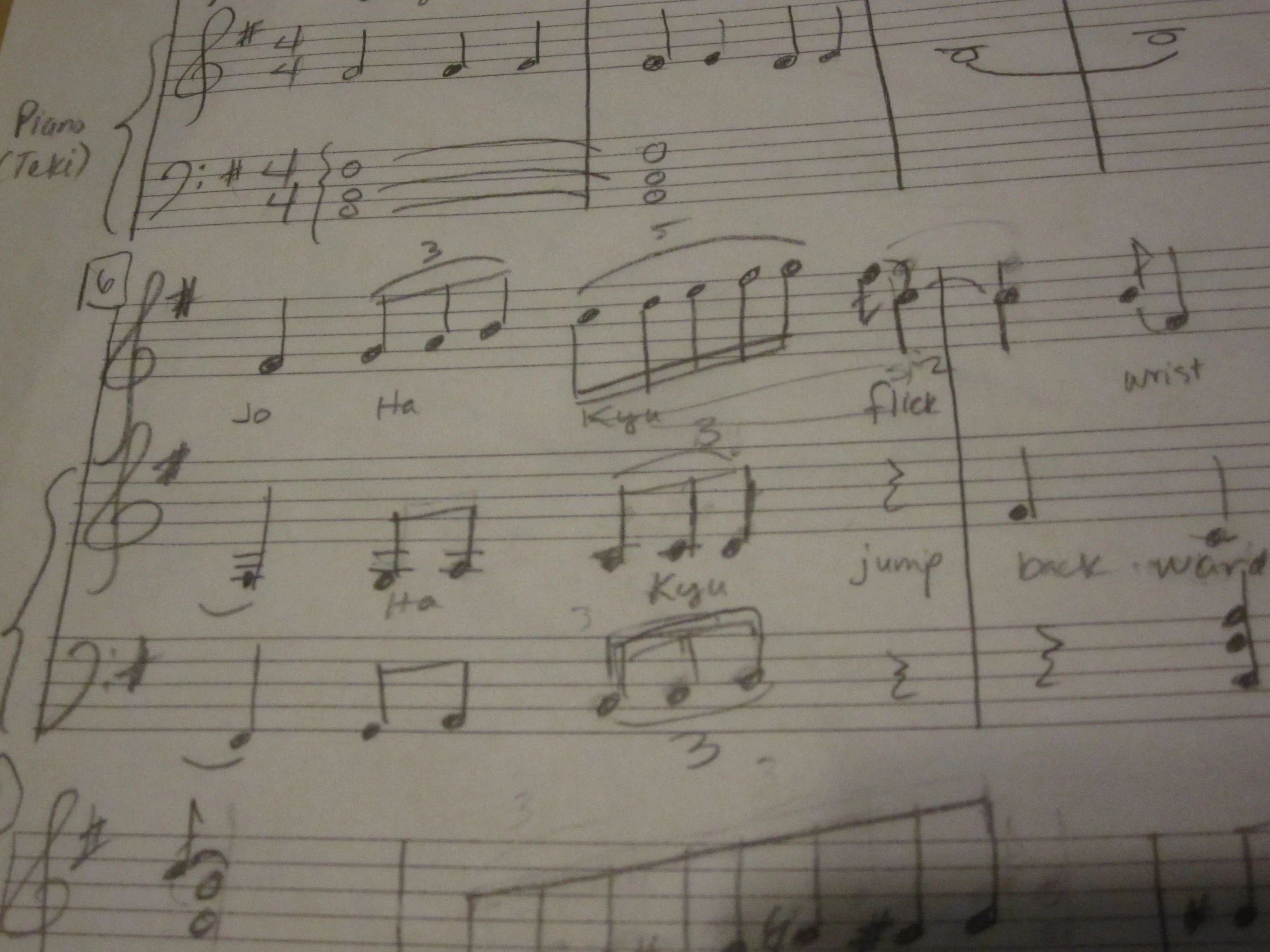
My rhythmic representation of jo ha kyu in 2007. Credit: R-M Arca.
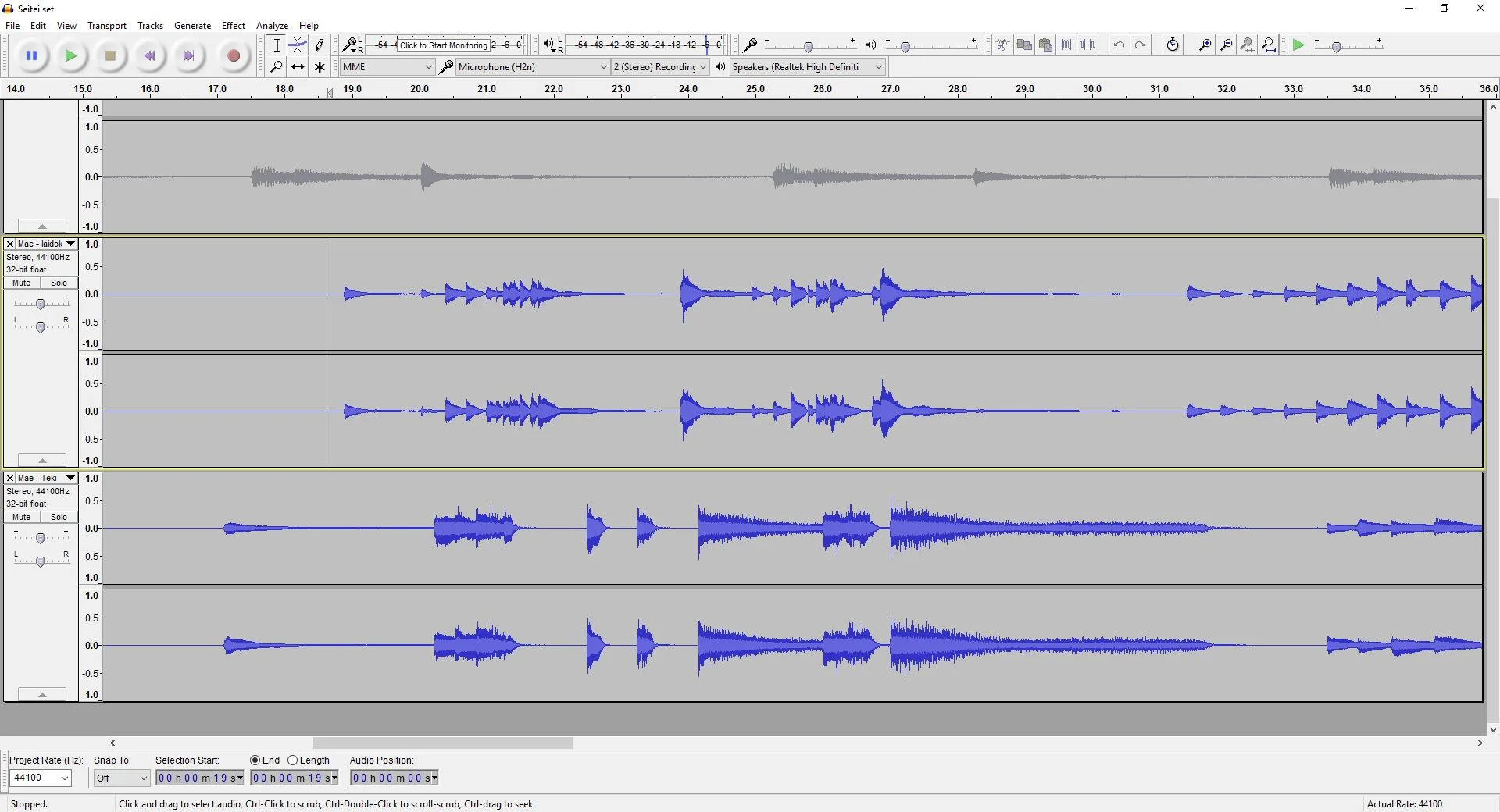
A screenshot revealing the waveforms for that same section of music. The iaidoka's jo starts just after the cursor. Credit: R-M Arca.
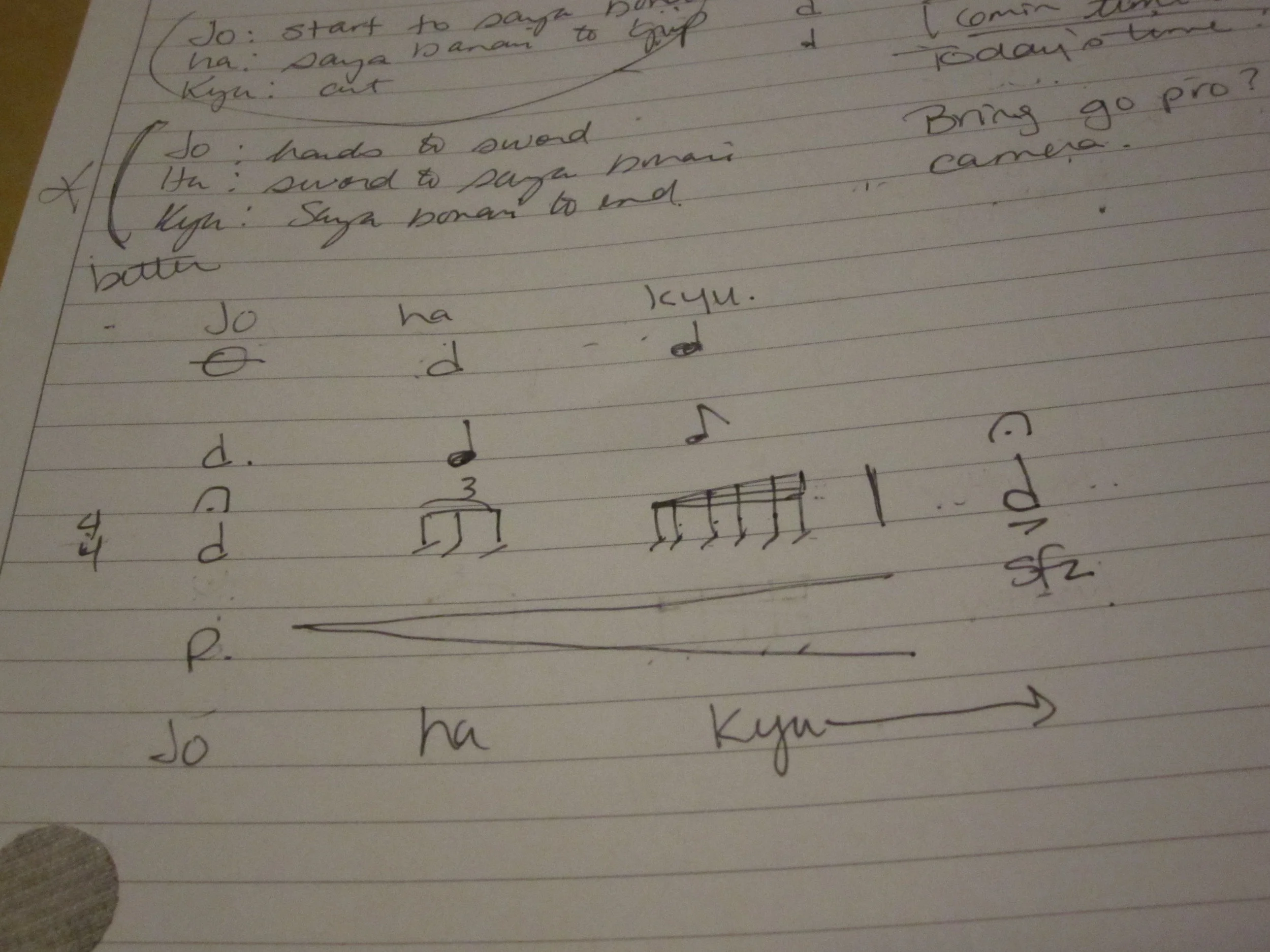
Jo Ha Kyu circa 2016. Credit: R-M Arca.
The last one is the one I’ve been playing around with. I don’t hear pitches. When I’m by myself, I’ll use a bit of singspiel, saying “Jo ha kyu”, in rhythm, from the moment my hands to go my tsuka to nukitsuke in Mae. I use dynamics for intensity.
Last night, I was studying a video of Alex Cook sensei practising Mae and improvising at the piano to it. I used the Hirajoshi scale and a lot of tone clusters. The result isn’t pretty sounding, but then, when you think about the riai for Mae, it’s not supposed to be:
Studying the waveforms made it easier to see how I need to have more ha not only in my iai but in my musical interpretation of the riai.
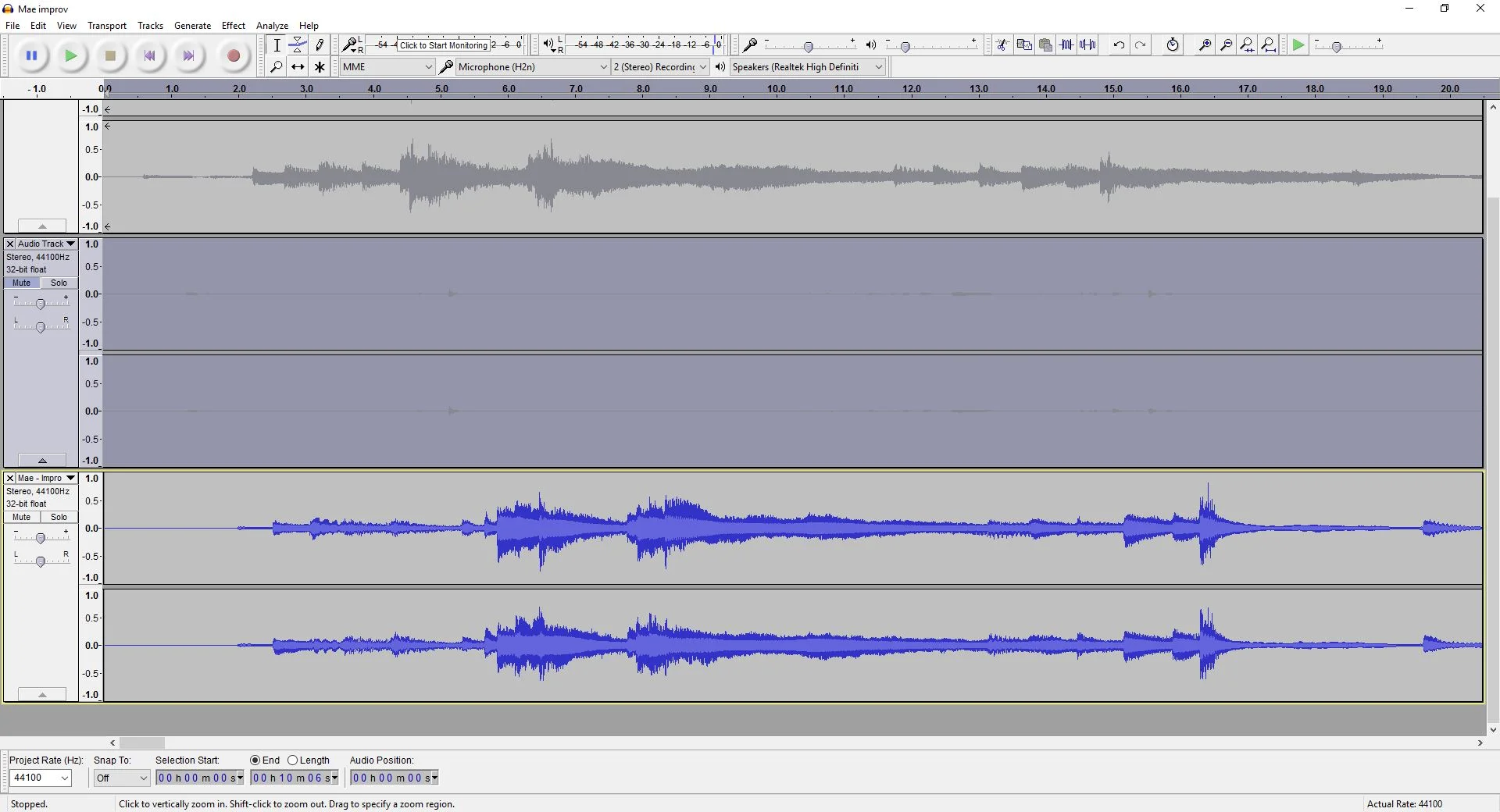
The waveforms reveal the quickening of sound during ha, yet still distinctly shows that there is a ha. This is what I must work on. Credit: R-M Arca.
I will do a bit of rhythmic dictation and attempt to notate sensei’s rhythm. I have a feeling that until I have the rhythm notated in a way that I can count the beats, I will be playing with jo ha kyu for a while longer yet.
Social Media Links
archives
- #YYCArts 32
- #YYCEvents 39
- Collaborative Music 25
- Community 11
- Composing & Arranging 6
- Entertainment 139
- Entrepreneurship 53
- Freebies 3
- Gardening 1
- Geeking Out 65
- Health & Wellness 120
- Improvisation 25
- Interviews 28
- Learning Music 188
- Martial Arts 13
- Memorization 7
- Music 230
- Music Careers 9
- Music Education 196
- Music Examinations 7
- Music Exploration 55
- Music Gigs 14
- Music Lessons 6
- Music Performance 32
- Music Theory 13
- Musical Instruments 12
- Musician Health 19
- Pets 57
- Piano Technique 12
- Practicing Music 120
- Productivity 20
- Professional Development 11
- Recommendations & Reviews 93
- Recreation 71
- Social Media 6
- Spirituality 10
- Studio Management 33
- Studio Technology 50
- Teaching Music 146
FOLLOW THE STUDIO on Instagram

Affiliate Links
As a Sheetmusicplus and CD Japan affiliate, I earn from qualifying purchases. The earnings help fund the Studio’s blog and YouTube channels. Your support is greatly appreciated.


FOLLOW Budo no Tabi on Instagram