THE MUSICAL MUSE
Blog dedicated to music education, practice tips, health
&
wellness, and geeking out.
What does pizza have to do with studying music theory?
My students and I had our first music theory study and pizza party this weekend. It was an enjoyable experience for students and teacher alike.
"Pizza" probably isn't the first word that comes to mind when you think about studying music theory. Now, it's probably the first thing my students will think of whenever they study music theory. The idea of hosting a pizza music theory party came from my colleague, Dorcas Ng. Whenever she shared pictures from her music theory and harmony study sessions, it looked like the students were having a great time studying and eating pizza.
This is my first year teaching music theory as a group class. It didn't take long for me to realize that my Basic Rudiments / Theory 1 class would need coaching on certain areas, in addition to extra help on how to study music theory. It didn't take much convincing to tell them we should have a music theory study party with pizza.

Three out of four of my students in the class attended the music theory party this past Saturday. The party lasted for 2.5 hours. We got to a slow start because everyone slept in. Then, of course, the weather.
Each student bought study snacks to share. I purchased two 12-inch pizzas from Sobeys from the deli section.
The class was also part of an experiment. In October, the students drafted up rules of conduct for the studio. Each time a student exhibited good manners as per "the rules", I added a marble into the Good Manners Jar. If they filled it up to the line (which they did), then I would get them a special dessert for the music theory study party.
The first hour of the music theory study session was dedicated to review. I zoomed in on the typical troublespots: the Circle of Fifths, intervals, rhythm and chords.
My students came up with a unique mnemonic to remember the Circle of Fifths:

We then took a 10-minute break, which gave me enough time to prepare lunch. One student played a game, another jammed on a keyboard, while the third student sketched.
The next part to our "How to study music theory" session was dedicated to working through a practice test. It was open book and I allowed my students to ask each other questions. This way, they could start developing their self-study music theory strategies.
During lunch, we chatted about non-music topics, such as everyone's plans for the weekend. We also discussed history, travelling and inventions.
The final part of the music theory study session was dedicated to vocabulary. My students took turns being the Quiz Master. It was a delight to listen to them give each other hints:
Students A & B: FORTE! FORTE!
Student C: I can't think! You're both too loud.
***
Student A: Rall - en - ta - - - n - - - d - - - - o - - - - - -
Student B: To get slower?
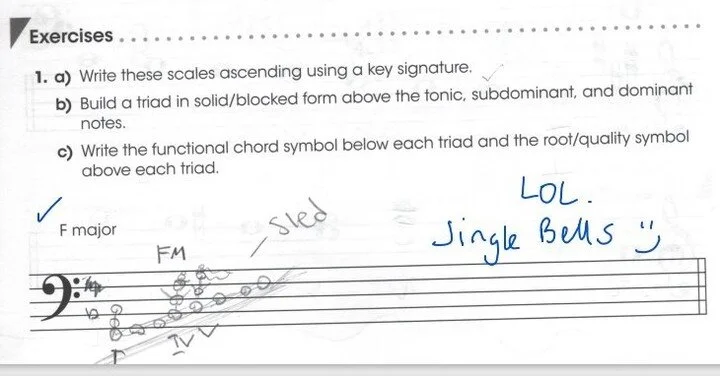
I took a snapshot of a couple of other cute definitions, mispronounciations and study helps that they came up with:

For homework, they are to complete the practice test. On Tuesday, they will write an in-class final examination.
Two of my students will write a music theory examination through either Royal Conservatory of Music or Conservatory Canada. The other two will continue to the next level before writing the official examination.
Afterwards, I asked each of my students if they gained a better understanding of music theory during the study session. The answer was a resounding "YES!" They also had a good deal of fun, whether it was when they were developing the Circle of Fifths mnemonic, drilling vocabulary or telling me, "Are you writing that down? You should post that on your Facebook."
Music theory has been one area that my students have called "boring". Teaching music theory in a class setting was my first step to changing things up. Hosting the music theory study / pizza party was another. It is my hope that the two changes make studying music theory a bit more interesting and enjoyable.
Random Sight-Reading Exercises to Boost Music Literacy
My classmate and colleague recently told me about having to sight-read for 15 minutes at the start of her piano lessons. I decided to try it on my "weaker" note readers.
Growing up, I was extremely jealous of my classmate Trish Evans. She probably has no idea.
Trish could improvise at the drop of a hat and make up songs that had our classmates gushing over her skills. On the other hand, I felt compelled to play everything as written and suffered stage fright up until university.
Then, I heard that Trish formed a rock band. A really cool one, called Zoey's Closet. Meanwhile, I talked myself out of joining jazz band because lead sheets and improvising scared the bejeebers out of me.
I have since taken a bit of jazz piano and rely on lead sheet reading to get me through choir more often than not. Progress.
Trish and I caught up over tea and talked shop last month. She told me about her piano teacher's efforts to improve Trish's music literacy (great ear, weaker reading skills at the time).
For the first 15 minutes of each lesson, Trish's teacher made her sight-read random music. Sometimes, the pieces were several levels above her playing level. Other times, just below.
While she was sight-reading, Trish's teacher would give comments to guide her. The teacher would play each excerpt before assigning a new one. It gave Trish a way to measure what she sight-read well (and what she didn't).
Last month, I tried this out with my "weaker" readers. My strategy has been to make the first piece several levels above their current one. The second one is closer to their current level, while the third (if there is time) is below their reading level. I drag my finger across my bookcase and stop at a random spot.
This is not the first time that I've heard about starting each lesson with sight-reading. One of my university classmates, Gregory Knight, had lessons like this too. Now, he works as an accompanist at the University of Lethbridge. His sight-reading skills are top notch, which is a useful skill as an accompanist.
I have already noticed an improvement in their musical literacy. A fringe benefit has been that these students are starting to work on music independently. Two of them walked in last week with a new piece to show off to me.
This week, we will begin the second stage of my sight-reading challenge. It will be interesting to see how my so-called "weak" readers will perform this time round.
How to Play Music Faster
Trying to figure out how to play your technique at the required tempo for your level? Check out these tips on how to play faster.

After Christmas, my students will be doing a Technique Challenge. I still have to finalize the details and incentives, but I can tell you that speed and accuracy will be key criteria to succeeding in this challenge.
To prepare, I thought I would share some tips on how to play the piano really fast. I must say, kudos to Shawn Cheek, Dr. William Leeland, Kenneth T. Rose and Robert Estrin for sharing these videos and article with musicians everywhere.
Piano teacher Shawn Cheek has created a great video on how to play arpeggios (or in proper Italian, "arpeggii") faster:
Now, Mr. Cheek says that you don't need to exercise the left hand like this unless you're doing classical. I disagree. Firstly, it's important for the hands to be balanced and secondly, I actually have used arpeggios in contemporary styles. It all depends on the style, I guess.
[UPDATE] I originally had another video here, demonstrating the "thumb up" and note clumping technique. However, a few of my colleagues caught how immobile the demonstrator's wrist and arm were. I admit, I was focussed on the thumb up and note clumping, so I'm grateful to Arlene Steffen and Rami Bar-Niv for drawing my attention to it.
There is this neat article by Dr. William Leeland about the "thumb under" and "quick hand shift" technique for scales. It is called The Ins and Outs, Twists and Turns of Scale Playing. It contains some videos.
I actually learned about this "quick hand shift" technique from my brother. It has certainly helped me play my scales, chords and arpeggii faster. Some keys are better than others.
Kenneth T. Rose from England wrote a great article, called “How to play faster”. He has other useful tips on his website, World of Piano.
Finally, Robert Estrin of Living Piano has done a fantastic tutorial on how to play piano faster:
I love how Mr. Estrin explains everything step-by-step.
Here's his video on practicing scales and arpeggii:
I am looking forward to trying some of the new tips on how to play the piano faster in my own piano practice.
Who Levelled Up in My First Sight-reading Challenge?
Stage One of my studio's Sight-Reading Challenge is complete. How many advanced? How much chocolate did I buy?

October has come and gone and Stage One of my Sight-reading Challenge is behind us. It was an interesting experience for my students and I. Here are our Stage One Results:
72% did 4/4 weekly challenges
12% did extra songs
40% advanced one level
16% advanced two levels
8% advanced three levels
36 % stayed at the same same level
As for me, I didn't do nearly as well as I had hoped. It took me two weeks to clear my first challenge because of a nasty cold. In the end, I got through three pieces but not well enough to move my pin up a notch on the game board.
My adult students and Grade 12 students were in the same boat as me. There just wasn't enough time or energy to get through all of the challenges. I will have to plan how to make this work more effectively in Stage Two.
I was able to take advantage of the post-Halloween candy sales and give away some of my excess Halloween candy. Not only that, I did get regular and jumbo sized chocolate bars on sale too. It still wound up costing about $30, but I have lots of leftovers.
The funny part about this sight-reading experience is that my students have been asking why they didn't have a sight-reading challenge during Week 1 of our rest period. I suppose they got used to it.
The nice side benefit that I am seeing is that more of my students are taking the initiative to learn some songs on their own. Not just one song, but two or three. Others have taken to signing out some music books from my studio library and sight-reading music from cover to cover on their own.
Another student is using this time off to relearn all of her favourite songs from last year. She thought it was fun. I thought it was a fantastic way for her to relearn and reinforce information and techniques that she had forgotten about.
I have two weeks to prepare for the next sight-reading challenge for my students. It has been a great project for all of my students (and for me too!).
Now that I know how much time is involved with picking out pieces, I will get everything all selected in advance. Wish me luck.
Related Reading:
Efficient Sight Reading by Li-San
Improving Your Sight-reading by Melanie Spanswick
Why Sight-Reading is Important by Robert Estrin
How to Warm Up at the Piano
Not sure exactly how to warm up before practicing piano? Check out Robert Estrin's video and my series of musician stretches.
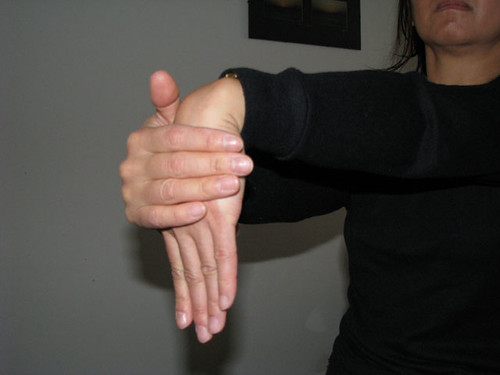
My colleague Robert Estrin of Living Pianos recently posted a great video tutorial on how to warm up at the piano. There are some great tips for all musicians!
He talks about staying healthy and taking breaks. He also mentions the importance of stretching.
Here is is clip on how to warm up at the piano:
Here are some keyboard warm-ups, courtesy of my colleague Irina Gorin. These are geared towards beginner piano students:
Finally, check out my series on musician stretches:
Social Media Links
archives
- #YYCArts 32
- #YYCEvents 39
- Collaborative Music 25
- Community 11
- Composing & Arranging 6
- Entertainment 139
- Entrepreneurship 53
- Freebies 3
- Gardening 1
- Geeking Out 65
- Health & Wellness 120
- Improvisation 25
- Interviews 28
- Learning Music 188
- Martial Arts 13
- Memorization 7
- Music 230
- Music Careers 9
- Music Education 196
- Music Examinations 7
- Music Exploration 55
- Music Gigs 14
- Music Lessons 6
- Music Performance 32
- Music Theory 13
- Musical Instruments 12
- Musician Health 19
- Pets 57
- Piano Technique 12
- Practicing Music 120
- Productivity 20
- Professional Development 11
- Recommendations & Reviews 93
- Recreation 71
- Social Media 6
- Spirituality 10
- Studio Management 33
- Studio Technology 50
- Teaching Music 146
FOLLOW THE STUDIO on Instagram


Affiliate Links
As a Sheetmusicplus and CD Japan affiliate, I earn from qualifying purchases. The earnings help fund the Studio’s blog and YouTube channels. Your support is greatly appreciated.


FOLLOW Budo no Tabi on Instagram