THE MUSICAL MUSE
Blog dedicated to music education, practice tips, health
&
wellness, and geeking out.
Beginning major scales Book Review
A look at Paul D. Sayre's Beginning major scales Technique & Theory Workbook. Smart design and text, I can see it meeting the needs of certain groups of students and look forward to the release of the next book in the series.
When I attended the CFMTA Music Inspires Convention last month, I had the pleasure of speaking with Paul Sayre, author of Beginning major scales. It's a combination technique and theory workbook for piano and voice students. This is quite different from the traditional theory books we use to teach music rudiments to our Royal Conservatory and Conservatory Canada students. I find it refreshing.
A Look at Beginning major scales
The workbook opens with a section called "Cold Feet". It's cute enough that young students will enjoy colouring but there is an important riddle on it for young and, as Mr. Sayre says, "grown up" kids to figure out. It's a new take on memorizing the Order of Sharps. This is followed by a cheat sheet of all the major key signatures that all students will hopefully refer to often.
Then the book introduces each key in turn, going through the Circle of Fifths. For each key, the one-octave scale, I-IV-I-V7-I cadence and arpeggio are shown. On the opposite page, there are some questions for students to answer - written and aural (yay! ear training). At the end of the section, two octave scales and arpeggii are shown.
The second half of the book is dedicated to music theory. There are extra theory questions on scales, followed by an introduction to major and minor thirds (followed by questions to answer).
Students not only learn about major and minor triads, but also augmented and diminished as well. The final section of the book has a Note Catcher!™ ear and theory training game.
First Impressions of Begnning major scales
Like the Piano Adventures series, The Sayre Series Beginning major scales introduces music students to intervals, chords and arpeggii early. I do like the fact that Mr. Sayre introduces the various technical elements with the single octave but gives the two-octave version later on.
Another thing that I do like about the book is that the text is worded to speak to a wide age range of music students. It's simple enough for a seven year-old student but worded with care so that an adult student wouldn't be turned off. That's not an easy feat to accomplish.
Using Beginning music scales
My beginning piano students use the theory books from Piano Adventures, while my conservatory students use either Conservatory Canada's theory workbooks or Glory St. Germain's Ultimate Music Theory series. I don't have plans of dropping those.
However, I can see three groups of students in my studio who can benefit from using Beginning major scales. The first are my adult students who are playing recreationally. They tend to find the conservatory-affiliated theory books to be "too much". They want the basics and they don't have the time to work through chapters of questions.
The second group of students I can see benefitting from this series are what I'd call "students in transition". I have a few students who are beginning that transition from the beginner method books to one of the conservatories, but they aren't quite ready age-wise or level-wise for formal rudiments. "Students in transition" also covers transfer students who are a little weak on theory but also, aren't quite ready to look at conservatory-affiliated theory books.
The third group of students are the ones who just aren't getting it. They've been in music for a few years and the materials we've been using just confuse them. Sure, there are other issues at play, but if I can help them by using a friendly-looking book, worded in "plain-speak" with them, I think they can finally get over the hump.
I do have one beef and that is the fact there is no Beginning minor scales book. I did contact Paul Sayre regarding this and he has assured me that one is in the works. However, its release is contingent upon the success of Beginning major scales (my fingers are crossed).
Beginning major scales is a fresh approach to teaching music theory and technique. This combination workbook contains practical, written and aural exercises for students to complete. It is perfect for beginners who are beginning to transition to elementary playing.
About Beginning major scales
Title: Beginning major scales for All Piano and Voice Methods: Technique and Theory Workbook for All Piano and Voice Methods
Author: Paul Sayre
Publisher: Brownstyle, 2011
ISBN: 0615426832, 9780615426839
Length: 41 pages, text and illustrations
Price: $9.98 US and up
In Canada, Beginning major scales is available at Long & McQuade. In the United States, music teachers and students may purchase the book through Performers Music Chicago. The book is also available for sale online on The Sayre Series website .
Getting Those Fingers Back into Shape
Back to school is just around the corner, so music lessons aren't far behind. Get your chops (your finger strength and dexterity) up to snuff by trying out these finger exercises.
I think it's safe to say that most music students take it easy during the summer. Most music teachers like to as well. However, with fall just around the corner, it's time to strengthen those fingers!
I recommended a few popular books with hand exercises a while back. Last year, I finally worked through the first book of Hanon exercises:

The New Hanon (link to my affiliate link)
This summer, I'm working my way through the Schmitt Five-Finger Exercises, op. 16 (affiliate link).
What I really like about the Schmitt exercises is that they are five-finger exercises. Sure, you're supposed to play them 15 times each, but it's really not that bad. I use the following pattern:
Five times legato
Five times staccato
Five times something else
That "something else" could be portato, or jazz triplets or two-note slurs. I do notice that it takes at least five repetitions of the pattern before my tone evens out.
If you're looking for a way to get your fingers back into shape before the fall, you can't go wrong with Hanon or Schmitt. It beats playing your Conservatory scales, chords and arpeggios every day.
Sight-reading Music for Fun
Sight-reading doesn't have to be just an exam requirement. It can be a fun way to embark on an adventure.
Summer music practicing should be fun, don't you think so? One way that I've been keeping it light but still maintaining my skills is to sight-read. I recently bought a bunch of music while at the music teachers' convention. I plan on doing book reviews on most of them, so I've decided to sight-read my way through them. Sure, some of it is easy peasy for me, but there are enough books in my "To Read" pile that do remind me to utilize the sight-reading tips that my colleagues and I give to our students.
It's been an adventure. I'm not familiar with all the composers or the pieces in these new books so I have no idea where the composers are going to take me.
Give it a try. If you are in need of sheet music to sight-read, head to your local library to borrow some song books. You can also visit your local music store. If you want to buy some music online, there's always Sheetmusic Plus and Musicnotes. Happy exploring!
6 Steps to Self-Regulated Practicing
According to super-cool professor Dr. John Picone, there are six steps to self-regulated practicing. Master these and you will learn your music quickly and efficiently.
Last month, I attended a national music teachers' convention. It was my first time as an attendee (versus when I was a organizing committee member). One session that really resonated with me was Dr. John Picone's Steps to Parnassus: Guiding Young Musicians to Self-Regulated Practicing.
He was such a dynamic presenter and had wonderful ideas. I hope that one day, the Alberta Registered Music Teachers' Association or the Alberta Piano Teachers' Association could bring him out here to do a session for music teachers AND music students.
He shared a lot of information and examples with us. I will just highlight six main points for you try to incorporate into your at-home practicing. They are, what Dr. Picone referred to as "Six Dimensions of Self-Regulated Learning":
Take charge of your environment: Is your pet pestering you when you practice? Does your little sister come and bash on the keys while you are at your instrument? Or is your practice area in the same room as the television? You need to, perhaps with some help from your parents, create a practice space in which you can actually get some quality practice time in. Get rid of those distractions!
Manage your Time and Setting Goals: This past year, I introduced my students to the concept of "speed learning". To force them to think about time management, I used the countdown timer. If you only have 10 minutes, then you need to have a solid plan of attack. Pick a chunk of music that's do-able in 10 minutes. How much can you learn in 10 minutes? Or fix? The clearer you are with your plan, the more productive your practice will be.
Record and Review: Record and Review is something I encourage my students to do regularly. I think some do but not all. There's a lot going on when we play a piece or technical exercise. How else are you going to know if you're making any progress at home unless you listen to what you just did? If your iPod records, then use it. Or a tablet, computer, phone or other recording device.
Seek out resources on your own: Can't remember what "subito" means? You know technology more than your parents and teachers do. Google it! Or get a music dictionary app.
You have a repertoire of strategies and you know how to use them: One drill I grew up on was "Drill this 10 times". I'd get tired by five. My students have some more creative practice drills in their arsenal (e.g. Smarties Drill, the Every Other Bar Drill and the Fill in the Blanks Drill for starters). Regardless of what practice drills you have been taught, you have to know when to use them and how to use them. Now that would require you to read your music notebook, wouldn't it?
Motivation: There's external motivation (e.g. you have a music exam next week and you don't want to fail) and internal motivation (you simply want to do well). It doesn't matter how often your teacher asks you to practice more or how often your parents yell at you to practice - if you don't want to do it, it's not going to happen as well as it should. However, you need to really think hard about whether you don't want to practice because you've hit a snag or because you really hate music, but that's a separate topic.
The video that Dr. Picone showed us was of a seven-year old boy. He didn't really play much in the practice clip, but he didn't need to. He spent about a minute asking his mother to take the family dog into another room. Then, he spent a couple of minutes planning out what he was going to practice.
Once he selected a piece, he took another minute to skim through it. His finger traced over the notes. He stopped and looked at a tricky rhythm. After a moment's thought, he pulled out his music notebook to read his teacher's practice suggestions for that rhythm. Then, he remembered that he had a recording of that part of his lesson, so he listened to it. He checked his clock. Then, the clapped out the rhythm a few times. Checked his time again and then did a run-through at the piano - slowly. He tried it a few times before running through the whole piece.
If a seven-year old can master self-regulated, or organized practicing, you can too.
Piano Shopping with my Adult Student
Piano shopping with one of my adult students was educational for me as well. It also proved to me that the piano chooses the musician.
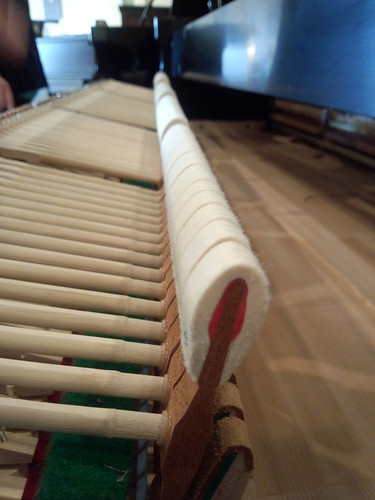
Last month, one of my adult students asked me to accompany her as she went piano shopping. It was a delightful experience for both of us.
Our search began at Steinway Pianos of Calgary. I had booked a Look Inside the Piano workshop and Owner/President Brent Hay gave a fantastic presentation. His passion for our instrument was infectious we learned lot about how pianos are made. My student zoomed in on the Boston and Essex lines, which are Steinway's student models.
We learned about the manufacturing differences between the three product lines as well. For instance, Boston pianos are manufactured in Japan, whereas Essex pianos are manufactured in China. Steinway designs.
We learned to look at the posts in the back to determine if their functional posts or mere decoration (think joists in a home). And, we learned about little adjustments manufacturers make when the frame is just a teensy bit too big for the guts.
Our next trip was to St. John's Music to test out Yamaha pianos. I got to try the "silent" model of the piano I grew up on, the U1. It truly is a hybrid piano. It has the similarities to the piano I honed my skills on but the benefits that technology has to offer. Turn on the unit underneath and this acoustic piano becomes a digital piano. However, unlike digital pianos, this is first and foremost and acoustic piano.
We also tried Yamaha's new "B" line, manufactured in China (Yamaha has design control). The piano I tried had a nice, rich tone and for families just starting out, a nice price tag. The Cable-Nelson piano just felt heavy compared to the Yamaha's.
My student fell in love with the GB1. Those Georgian legs, the rich dark finish. More importantly, the piano sang for her. There was an instant connection, akin to when Harry Potter's wand chose him in Harry Potter and the Philosopher's Stone. For a 5'0" grand, it sounds more like a 6' or even a 7' grand piano.
Our last stop was Michael Lipnicki's Fine Pianos. She tried the student line (the Palatino) but found it a little "clunky". Then we both tried the Bechstein (I think it was the B120 but I'm not 100% sure). What beautiful tone. So rich. And those pedals! We're still talking about how smooth the pedal action is. It was on sale too! We even liked it better than the Grotrian pianos.
Just to give her a frame of reference, I urged my student to try the top of the line pianos in each store. Steinway & Sons, C. Bechstein, Fazioli and Yamaha's best melted for her - as they should! Half-jokingly, I compared it to test driving a Ferrari.
There is undoubtedly a difference between handcrafted and mostly machine manufactured pianos. Personally, I think both have their pros and cons.

In the end, the Yamaha GB1 was the winner. It was love at first sound and first touch. She went back a second time to just confirm.
Accompanying my student was a learning experience for me too. When I purchased my Yamaha WX-7F, I was a music student. My music teacher didn't accompany me. However, my brother and I were at a high enough level and on enough pianos to know what to look for in terms of sound and touch. Piano shopping as a teacher is a little different. I learned a bit more about piano construction and what to look for in terms of the soundboard and the the posts in the back. I paid more attention to the key action and the voice of each piano I played.
However, next time I go shopping for an acoustic piano for my studio, once I have a short-list, it will still come down to sound and touch. And which piano chooses me. For I think, like Harry Potter, the piano chooses the musician.
Social Media Links
archives
- #YYCArts 32
- #YYCEvents 39
- Collaborative Music 25
- Community 11
- Composing & Arranging 6
- Entertainment 139
- Entrepreneurship 53
- Freebies 3
- Gardening 1
- Geeking Out 65
- Health & Wellness 120
- Improvisation 25
- Interviews 28
- Learning Music 188
- Martial Arts 13
- Memorization 7
- Music 230
- Music Careers 9
- Music Education 196
- Music Examinations 7
- Music Exploration 55
- Music Gigs 14
- Music Lessons 6
- Music Performance 32
- Music Theory 13
- Musical Instruments 12
- Musician Health 19
- Pets 57
- Piano Technique 12
- Practicing Music 120
- Productivity 20
- Professional Development 11
- Recommendations & Reviews 93
- Recreation 71
- Social Media 6
- Spirituality 10
- Studio Management 33
- Studio Technology 50
- Teaching Music 146
FOLLOW THE STUDIO on Instagram


Affiliate Links
As a Sheetmusicplus and CD Japan affiliate, I earn from qualifying purchases. The earnings help fund the Studio’s blog and YouTube channels. Your support is greatly appreciated.


FOLLOW Budo no Tabi on Instagram