THE MUSICAL MUSE
Blog dedicated to music education, practice tips, health
&
wellness, and geeking out.
Music Practice Advice from Barney the Dinosaur
Barney the Dinosaur invited pianist Greg Murphy to talk about practicing music. He and his friends also try to help another student who's struggling on a piece for an upcoming recital.

I was never a huge fan of Barney the Dinosaur (he just wasn't as cool as Snuffy and Big Bird to me). However, I recently came across this two-part episode where Barney and his friends talk about how practice makes music.
Pianist Greg Murray shows the kids a few neat things that you can do with music once you've worked hard to learn a song. In this clip, Greg plays some different variations of Twinkle Twinkle Little Star:
Barney & Friends: Practice Makes Music (Part 1):
And Part 2 of Practice Makes Music:
The main point to take away is that Barney the Dinosaur's friend Greg practiced a lot to get to the point where he could have fun with any song, whether it was Mary Had a Little Lamb or Twinkle Twinkle Little Star.
Trying to Tame the Paper Monster
I've tried file folders. I've tried binders. This year, I'm trying baskets to deal with paper management.
Summer is speeding to a close. I am quite happy to say that my summer decluttering project is nearly finished as well. I've decided to try using baskets to manage my papers for the week:

I've tried Bring Forward Files however, "out of sight, out of mind" happens all too easily. I've also tried weekly hanging folders. I broke a set of hanging folders because I stuffed it too much.
That brings us to the baskets. They're not that big, so I need to be vigilant to prevent spillage. They do hold more than a file folder, so that's good.
Let me translate and explain the labeling (they're in Japanese):
きょう ("Kyou"): Today
あした ("Ashita"): Tomorrow
こんしゅう ("Konshuu"): This Week
しはらって ("Shiharatte"): Pay
よんで ("Yonde"): Read
I've tried enough systems to know that my active trays need to be as lean as possible. Keeping it simple is really the only thing I remember out of my copy of Donna Smallin's book, The One Minute Organizer.
Three is a good number The remaining two trays contain items that need to be dealt with within the month.
Fingers crossed that this paper management system works!
Beginning major scales Book Review
A look at Paul D. Sayre's Beginning major scales Technique & Theory Workbook. Smart design and text, I can see it meeting the needs of certain groups of students and look forward to the release of the next book in the series.
When I attended the CFMTA Music Inspires Convention last month, I had the pleasure of speaking with Paul Sayre, author of Beginning major scales. It's a combination technique and theory workbook for piano and voice students. This is quite different from the traditional theory books we use to teach music rudiments to our Royal Conservatory and Conservatory Canada students. I find it refreshing.
A Look at Beginning major scales
The workbook opens with a section called "Cold Feet". It's cute enough that young students will enjoy colouring but there is an important riddle on it for young and, as Mr. Sayre says, "grown up" kids to figure out. It's a new take on memorizing the Order of Sharps. This is followed by a cheat sheet of all the major key signatures that all students will hopefully refer to often.
Then the book introduces each key in turn, going through the Circle of Fifths. For each key, the one-octave scale, I-IV-I-V7-I cadence and arpeggio are shown. On the opposite page, there are some questions for students to answer - written and aural (yay! ear training). At the end of the section, two octave scales and arpeggii are shown.
The second half of the book is dedicated to music theory. There are extra theory questions on scales, followed by an introduction to major and minor thirds (followed by questions to answer).
Students not only learn about major and minor triads, but also augmented and diminished as well. The final section of the book has a Note Catcher!™ ear and theory training game.
First Impressions of Begnning major scales
Like the Piano Adventures series, The Sayre Series Beginning major scales introduces music students to intervals, chords and arpeggii early. I do like the fact that Mr. Sayre introduces the various technical elements with the single octave but gives the two-octave version later on.
Another thing that I do like about the book is that the text is worded to speak to a wide age range of music students. It's simple enough for a seven year-old student but worded with care so that an adult student wouldn't be turned off. That's not an easy feat to accomplish.
Using Beginning music scales
My beginning piano students use the theory books from Piano Adventures, while my conservatory students use either Conservatory Canada's theory workbooks or Glory St. Germain's Ultimate Music Theory series. I don't have plans of dropping those.
However, I can see three groups of students in my studio who can benefit from using Beginning major scales. The first are my adult students who are playing recreationally. They tend to find the conservatory-affiliated theory books to be "too much". They want the basics and they don't have the time to work through chapters of questions.
The second group of students I can see benefitting from this series are what I'd call "students in transition". I have a few students who are beginning that transition from the beginner method books to one of the conservatories, but they aren't quite ready age-wise or level-wise for formal rudiments. "Students in transition" also covers transfer students who are a little weak on theory but also, aren't quite ready to look at conservatory-affiliated theory books.
The third group of students are the ones who just aren't getting it. They've been in music for a few years and the materials we've been using just confuse them. Sure, there are other issues at play, but if I can help them by using a friendly-looking book, worded in "plain-speak" with them, I think they can finally get over the hump.
I do have one beef and that is the fact there is no Beginning minor scales book. I did contact Paul Sayre regarding this and he has assured me that one is in the works. However, its release is contingent upon the success of Beginning major scales (my fingers are crossed).
Beginning major scales is a fresh approach to teaching music theory and technique. This combination workbook contains practical, written and aural exercises for students to complete. It is perfect for beginners who are beginning to transition to elementary playing.
About Beginning major scales
Title: Beginning major scales for All Piano and Voice Methods: Technique and Theory Workbook for All Piano and Voice Methods
Author: Paul Sayre
Publisher: Brownstyle, 2011
ISBN: 0615426832, 9780615426839
Length: 41 pages, text and illustrations
Price: $9.98 US and up
In Canada, Beginning major scales is available at Long & McQuade. In the United States, music teachers and students may purchase the book through Performers Music Chicago. The book is also available for sale online on The Sayre Series website .
Calgary Omatsuri 2013 Interview with Dave Rathnow
My Calgary Omatsuri interview with Dave Rathnow sensei of Shin Ken Kai Nobara Iaido Club of Calgary. We talk about the martial art I started to learn - Iaido - and the differences between the two main styles practiced today.
At this year's Calgary Japanese Festival, I had the opportunity to interview Dave Rathnow, an Iaido practitioner and instructor at Shin Ken Kai Nobara Iaido Club. Iaido is referred to as "the art of Japanese swordmanship" or "the art of drawing of the sword". It is the sister art to Kendo. Unlike kendo, iaido is a non-contact martial art.
I must come clean, when I started to watch Bleach, I became interested in weapons-based martial arts. The Agent of the Shinigami arc remains, in my eyes, one of the strongest storylines I've come across in the shounen genre.
However, I digress. I wanted to learn kendo, but the cost of the equipment scared me off. I turned my attention to iaido. After watching videos online of how smooth and fluid the iaido kata are, I was hooked.
See for yourself the rhythm and flow of iai. Here are excerpts from the Iaido demonstration that Dave Rathnow-sensei, Allen Yee-sempai and Brent May-sempai did at the Calgary Omatsuri:
If you want a bit more of an introduction to Iaido, please read my article entitled "An Introduction to Iaido". I also have published a few more articles on Iaido for The Iaido Journal: "Rhythm and Flow", "Tempering Fire" and "A Special Box for a Special Club"
Now, for my interview with Dave-sensei:
Here are some of the websites I checked out when I first researched iaido:
Aoi Budo Gu: where I ordered my iaito
Ka Muso Kai Iaido Club: my dojo
Shin Ken Kai Nobara Iaido Club: Dave-sensei's dojo
SDK Supplies: where I ordered my beginner iaidoka set and my Hyoho Niten Ichi-Ryu (Musashi's two-sword style) bokuto
Sword Store: many of my sempai ordered their iaito from here
I currently have three katana and samurai-related books in my library. The are: The Book of Five Ringsby Miyamoto Musashi,The Life-giving Sword by Yagyu Munenori and the Hagakure by Yamamoto Tsunetomo.
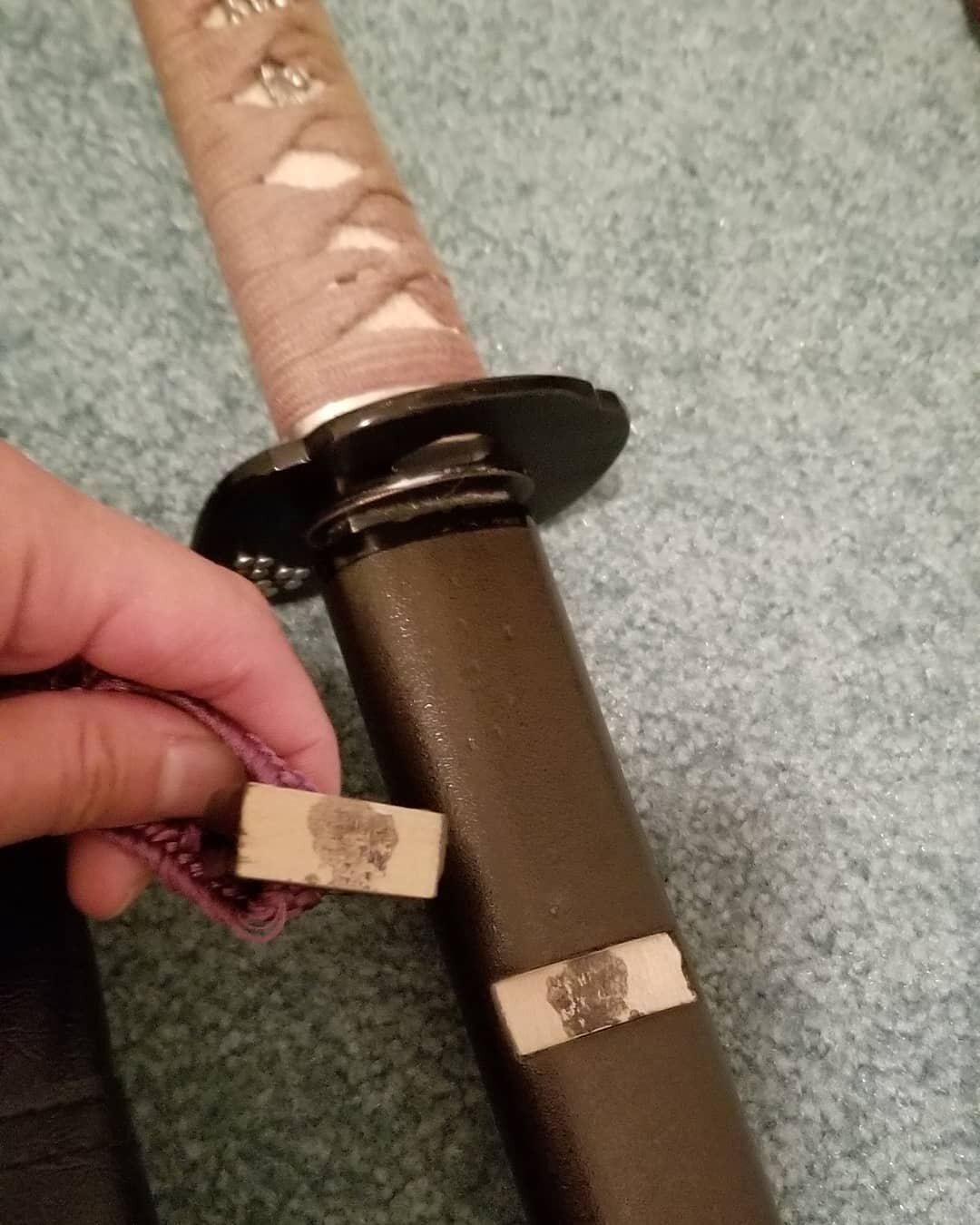
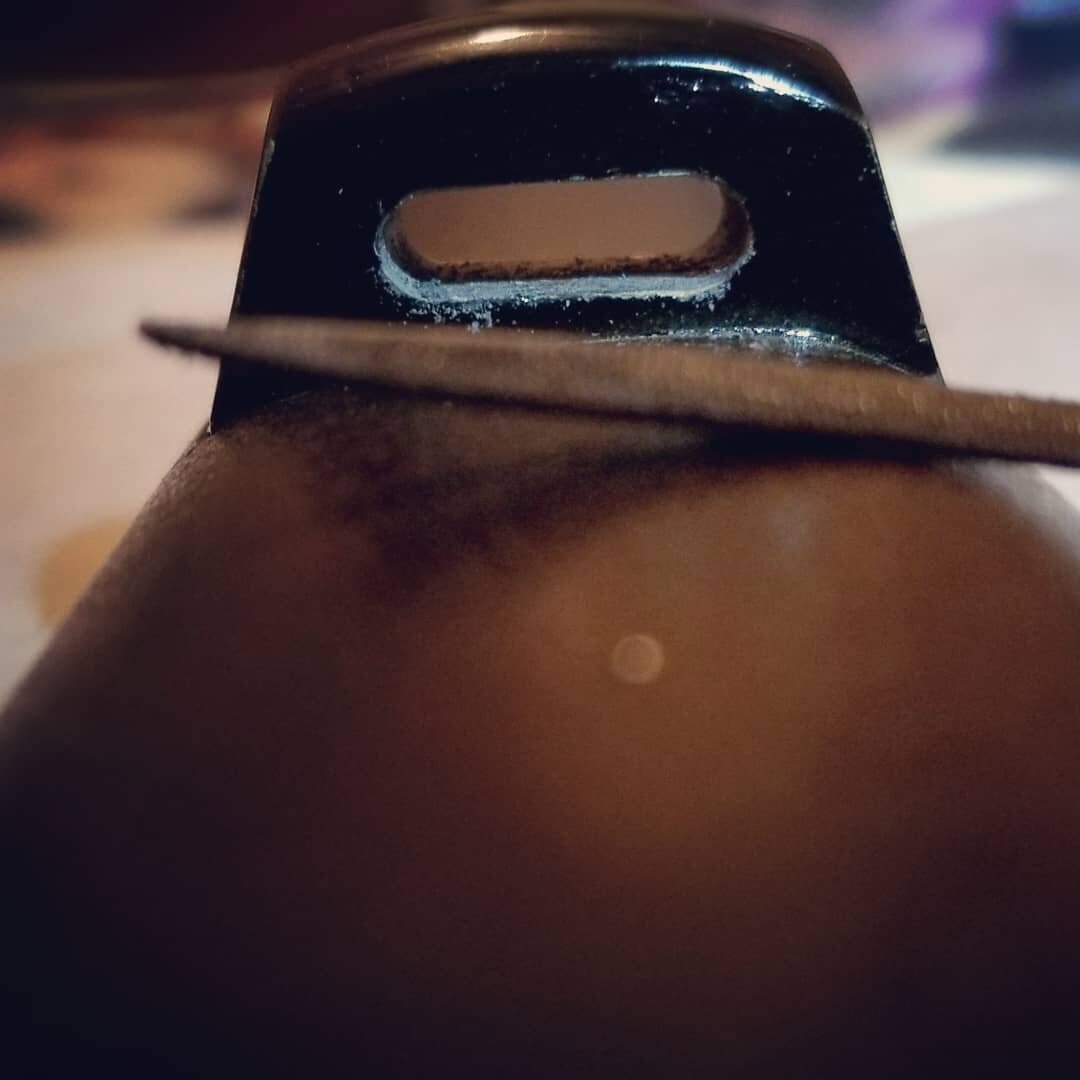
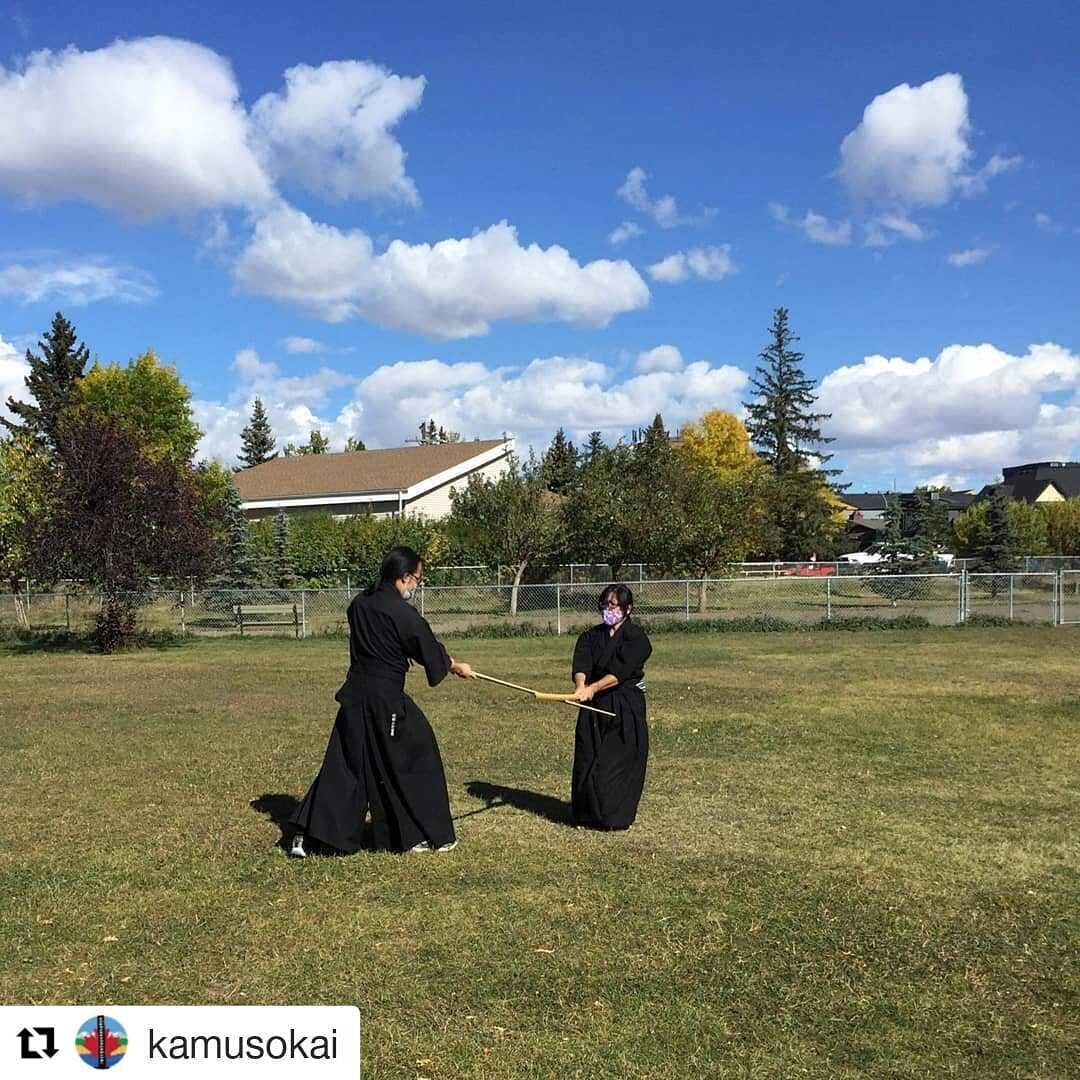
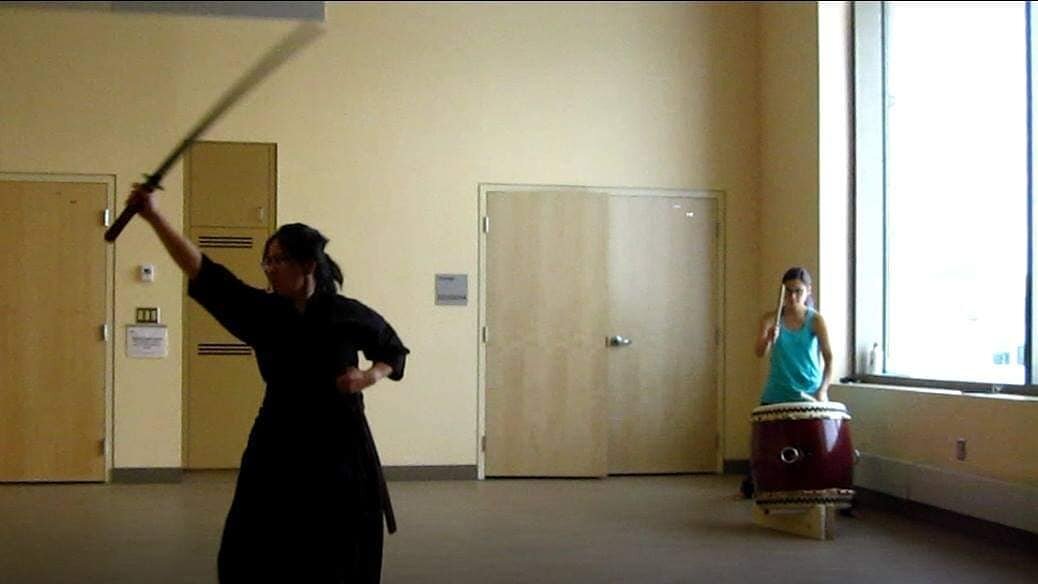
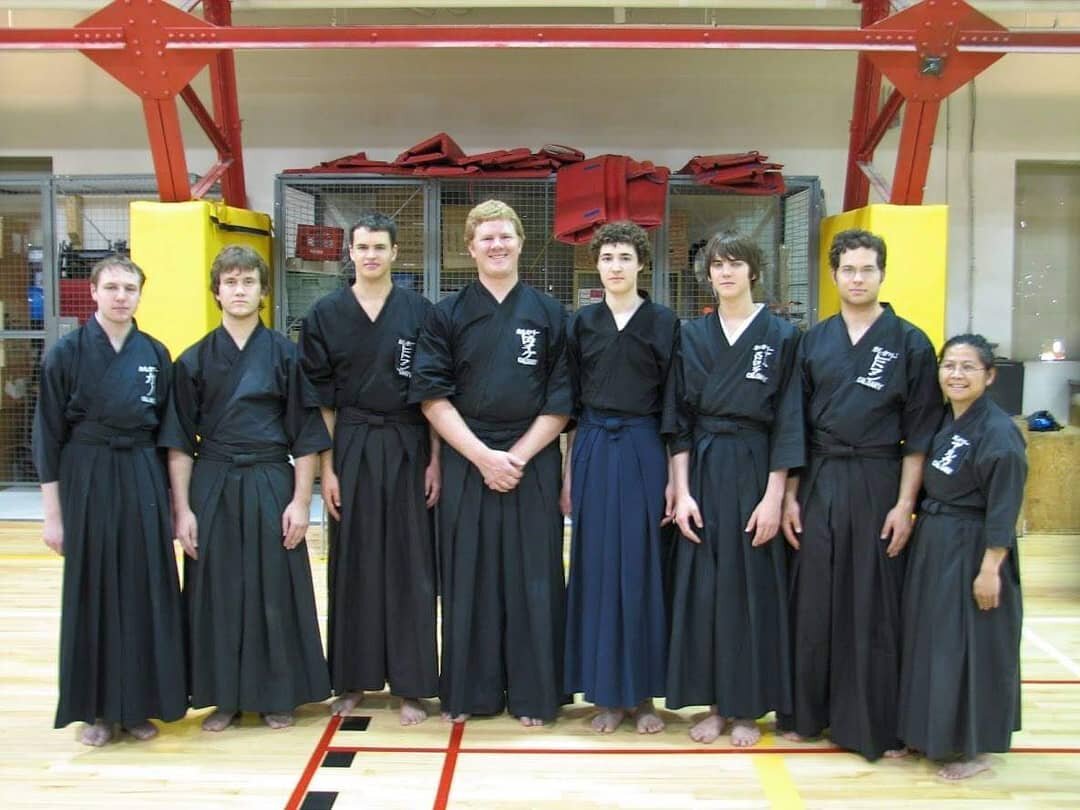
Here's a trip down memory lane for me. These are some photos of when I studied Iaido:
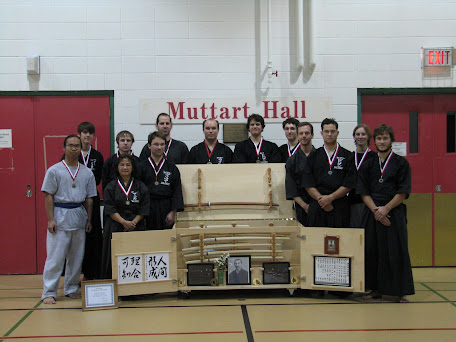
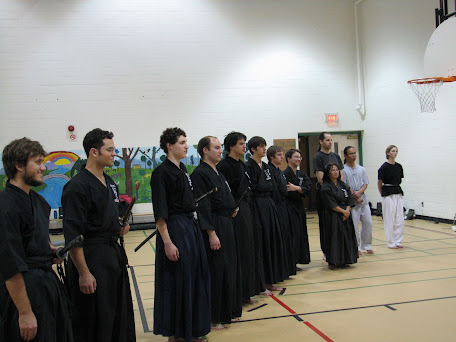
Sadly, training nights moved to prime teaching nights for me a while back, so I had to stop training. I do hope to get back into it someday. For now, I'll just try to keep regular with sword cuts. After all, it's a lot of fun to hear my iaito go "whoosh".
About the featured image: Allen-sempai demonstrates the first Iaido kata from the Seitei Gata Iaido at the Calgary Omatsuri. Photo credit: Christine Kohl. Publisher: Kathleen Boucher.
Calgary Omatsuri 2013 Interview with Kay Toyota
My second interview from the 2013 Calgary Japanese Festival features my chat with Kay Toyota-san of the Kotobuki Seniors group. She explains the dances and shares her experiences of connecting with her Japanese heritage through Odori.
こんにちは みな! Konnichiwa minna-san! At the 2013 Calgary Japanese Festival, I had the honour of speaking with Kay Toyota-san of the Kotobuki Seniors Group. The ladies of the Kotobuki performed two numbers at this year's Omatsuri. Here's a snippet of the first one, called Sumidagawa:
The dance and the Noh play are based on the same story about a woman whose son was stolen by a slave trader. A year passes and she's gone mad, searching the country for her son. A boatman agrees to take her across the Sumida River, where she discovers a crowd holding a memorial service for a young boy was abandoned by a slave trader and died along the shore. She learns that the boy was indeed her son. You can find the lyrics here.
Here is my interview with Kay-san:
Kay-san gives a bit more detail about the Sumidagawa and the second dance they performed, the Tanko Bushi. I took some footage of dancing the Tanko Bushi with my GoPro Hero in my Highlights from the 2013 Calgary Omatsuri video.
She also shares how her mother encouraged her to connect with her Japanese roots through traditional Japanese dance. Finally, she speaks about what the Calgary Omatsuri means to her.

Kay-san is part of the Kotobuki Seniors Group. The Kotobuki Seniors Group is a highly active arm in the Calgary Japanese Language Association. They meet regularly for karaoke, choir, dancing, community work and other activities.
The kanji for "kotobuki" is a combination of two kanji characters. The first means 'praying for a good harvest', while the second means 'old'. One translation reads "blessing to one's longevity." I think this is a pretty apt way to describe this particular group.
About the featured photo: The ladies of the Kotobuki Seniors Group perform the Sumidagawa at the 2013 Calgary Japanese Festival. Photo credit: Christine Kohl. Publisher: Kathleen "Irulanne" Boucher.
Related Reading:


Social Media Links
archives
- #YYCArts 32
- #YYCEvents 39
- Collaborative Music 25
- Community 11
- Composing & Arranging 6
- Entertainment 139
- Entrepreneurship 53
- Freebies 3
- Gardening 1
- Geeking Out 65
- Health & Wellness 120
- Improvisation 25
- Interviews 28
- Learning Music 188
- Martial Arts 13
- Memorization 7
- Music 230
- Music Careers 9
- Music Education 196
- Music Examinations 7
- Music Exploration 55
- Music Gigs 14
- Music Lessons 6
- Music Performance 32
- Music Theory 13
- Musical Instruments 12
- Musician Health 19
- Pets 57
- Piano Technique 12
- Practicing Music 120
- Productivity 20
- Professional Development 11
- Recommendations & Reviews 93
- Recreation 71
- Social Media 6
- Spirituality 10
- Studio Management 33
- Studio Technology 50
- Teaching Music 146
FOLLOW THE STUDIO on Instagram



Affiliate Links
As a Sheetmusicplus and CD Japan affiliate, I earn from qualifying purchases. The earnings help fund the Studio’s blog and YouTube channels. Your support is greatly appreciated.


FOLLOW Budo no Tabi on Instagram