THE MUSICAL MUSE
Blog dedicated to music education, practice tips, health
&
wellness, and geeking out.
DVD Review - The Music Instinct: Science & Song
Driven by curiosity to find out where goose bumps come from, neuroscientist Daniel Levitin, musician Bobby McFerrin and a team of scientists explore why music moves us.

"One of the last frontiers is the human brain," said Robert J. Zatorre, neuroscientist at McGill University. "Music serves as a gateway to understanding human cognition." Zatorre and Daniel Levitin teamed up with colleagues from around the world to unravel the secrets of the brain in The Music Instinct: Science & Song.
Also featured in this PBS Network DVD documentary are physicist Brian Greene, neuroscientists Lawrence Parsons and Jamshed Bharucha, archeologists Steven Mithen and Nicholas Conard, ethnomusicologist Kay K. Shelemay, researchers Sheila C. Woodward, Kathleen Wermke and Tom Fritz, psychologist John Sloboda, neurologists Gottfried Schlaug, Oliver Sacks and Tom Cicoria, neurobiologist Aniruddh Patel and author Steven Pinker.
Musicians interviewed include singer Bobby McFerrin, deaf percussionist Evelyn Glennie, violinist Daniel Bernard Roumain, conductor/pianist Daniel Barenboim, British rockers Jarvis Cocker and Richard Hawley, cellist Yo-Yo Ma, blind pianist Hwaen Ch'uqi and Lebanese singer Christiane Karam.
Cutting Edge Technology Reveals How Music Affects the Brain
With Functional Magnetic Resonance Imaging (FMRI) and PET technology, scientists can track blood flow and brain activity when subjects are listening to music, improvising, composing and collaborating. This helps them map various areas of the brain that are used.
In The Music Instinct, scientists discovered that the body is a barometer of our musical response to music. When listening to frightening music, our body responds by exhibiting the "flight or fight" response. When we listen to music we like, dopamine, the neurotransmitter for pleasure, is released. A recent discovery is that multiple areas of the brain are involved in processing music.
Music Teaches Us about the Brain, the Brain Teaches Us Music
"If you look at music performance, there's no activity that we do that allows the brain to do so many things at once, with such a complicated coordination and at such depth," said Parsons. His team discovered brain activity is higher when performing in collaboration versus performing solo. Playing an instrument engages the brain more than just listening to music.
"Music - probably one of the most distinctive characteristics of humans," said Mithen, who set out to discover how this compulsion for musicality evolved. He traveled to Germany, where Conard showed him an ivory flute from the Ice Age. The ancient artifacts found seem to indicate that music was as much a part of their life as it is now and that they used a similar scale in their music.
Woodward and Wermke found that babies can hear sound within their mother's womb and that they prefer consonance. Wermke learned that babies cry using melodic intervals, commonly using a perfect fifth, major and minor third and perfect fourth.
Both found that children of deaf parents performed similarly. This is significant as children of deaf parents were subject to less sound stimulation in the womb.
Is Music Universal?
Researchers learned that there are three intervals that are most common worldwide: the perfect fifth, perfect fourth and the perfect octave (the third is next). Ethnomusicologists also found that art music and lullabies from around the world possess common traits.
One interesting study showed the Mafa tribe in Africa. This civilization is far removed from modern technology and Western music. Researchers asked the Mafa to listen to musical excerpts from around the world and identify each as being "happy", "sad" or "scary". Their response was identical to people from Western cultures.
However, Shelemay warns viewers against claims of anything being "universal" in music. "Conceptions vary," she said.
Neurologists and other scientists found that playing music with a strong pulse helps patients with Parkinson's Disease learn to walk again. They also discovered that music helps stroke patients improve their speech and motor skills. Music that mimics the sound of a mother's heartbeat soothes premature babies, while it helps slow down the progress of dementia.
A Well Done Piece that Leaves Viewers with More Questions
Will this take away the mystery of music for you or whet your appetite for more information? Watch it and decide for yourself.
This PBS documentary features an impressive team of scientists and musicians. However, as the team admits, they face challenges and controversies moving forward. Are music and language two sides of the same coin or can they be separated? How much of what we know is learned and how much is "music instinct"? Does music move us or do the memories we attach to a song move us?
To find out more about Daniel Levitin's studies on science and music, visit Why Music Moves Us, Why Do People Sing?, DanielLevitin's website and The Music Instinct on PBS.
If you haven't figured it out yet: goose bumps come from the brain.
Release Date: 2009
Running Time: 120 minutes
MPAA Rating: Not Rated
Director: Elena Mannes
Executive Producers: Elena Mannes & Margaret Smilow
Special Features: 12 additional interviews and performances
Where to buy The Music Instinct:
Originally published on Suite101.com on December 19, 2009. Updated April 2, 2013. All rights reserved by Rhona-Mae Arca.

Where to Find Free Piano Music Online
A look at Free Art License, as well as various websites that legally offer free piano sheet music of anime, classical, video game, pop, and rock songs.
A look at Free Art License, as well as various websites that legally offer free piano sheet music of anime, classical, video game, pop, and rock songs.
Numerous websites offer free sheet music for piano. However, tracking down a suitable arrangement legally sometimes requires a bit of digging.
Free sheet music that is legal falls under the Free Art License, which "grants the right to freely copy, distribute, and transform creative works without infringing the author's rights." Works in the public domain, as well as arrangements and transcriptions posted by the arranger to be downloaded for free fall under this category.
Once the intellectual property rights on a work have expired, they become part of the public domain. These works are copyright-free and can be printed, copied, distributed, and modified.
An arrangement is a music score of a piece that a musician has done by hand or with music notation software. It includes his or her own editorial markings or it is set to a style or instrumentation that differs from the original version.
A transcription is not the same as a reproduction. To make a transcription, a musician picks out the melody and harmonies of a song by ear and then writes out the notation by hand or with the aid of music notation software.
The following are some websites that offer free printable piano sheet music:
Free Anime Sheet Music and Video Game Music Online
Josh's Anime Sheet Music Collection boasts an extensive collection of anime and video game music transcriptions and links to other websites with fan transcriptions. Theme songs from popular anime such as Bleach, Naruto, and K-On! are available. Difficulty level ranges from intermediate to advanced.
Ichigos has one of the largest collections online of free video game and anime sheet music. Theme songs from popular anime such as Neon Genesis Evangelion, The Melancholy of Harurhi Suzumiya, and Clannad, as well as music from popular video games such as The Legend of Zelda, Kingdom Hearts, and Final Fantasy are available.The difficulty level of the sheet music varies from low intermediate to upper intermediate.
Free Classical Sheet Music On the Internet
Music-Scores contains over 500 pieces of classical sheet music. There are arrangements for piano, violin, woodwinds, and more. The site features music by the greats like Bach, Beethoven, Chopin, Brahms, and Mozart. The level of difficulty is listed with each piece. Members have access to more music scores than non-members.
The Sheet Music Archive has over 5000 works that are in the public domain. Classical sheet music by famous composers such as Bach, Beethoven, Mozart, Brahms and Chopin are included in this library. Visitors can download up to two works a day for free. Subscribers have unlimited downloads.
The International Music Score Library Project (IMSP), otherwise known as the Petrucci Music Library, contains an extensive collection of public domain music. Sheet music, as well as recordings are available. It contains over 234, 000 scores and 23, 000 recordings.
Websites With Free Piano Sheet Music in a Variety of Styles
Easy Sheet Music houses around 500 songs for piano. Music is listed in five categories: Music from Around the World, Popular Classics, Boogie & Blues, Opera Classics, and Mission - Not That Difficult. Non-members are limited to three free downloads per day, while subscribers get unlimited downloads.
Free Piano Music! contains approximately 100 pieces of classical, popular, and Christmas songs. The pieces are ordered by level of difficulty, from beginner to intermediate. Midi files are also available for educational purposes.
Sibelius Music - Score Exchange has a wide range of printable sheet music, including classical, Christian, Christmas, historical, jazz, pop/rock, educational, and original works. The site contains music for piano, voice, guitar, strings, and ensembles. Although there are many free music titles, there are some available for purchase.
For further suggestions, read Finding Free Sheet Music and Christian Sheet Music Websites.
Things to Watch Out for When Downloading Free Printable Piano Sheet Music
There are three things to watch out for when searching for free sheet music online: illegal scans of copyrighted scores, poor transcriptions, or editions:
A fan making his or her own transcription or arrangement is legal. However, scanning a copyrighted work is illegal. Musicians should inspect the score carefully. Fuzzy quality is a sign of photocopying or scanning. A transcription is genuine when "Transcribed by" or "Arranged by" is part of the text.
Some music was originally written for an ensemble to be performed by a computer. An anime theme song that requires the right hand to play a chord that spans three octaves is just not "piano friendly." The musician must modify the transcription to avoid musician injury. Music students should consult with their music teacher if they require assistance.
With regards to classical music, it is wise to consult and compare several editions as edition quality varies. Students taking a piano exam should use an edition that is approved by the music conservatory conducting the piano examination.
Downloading an arrangement, transcription, or copyright-free work are three ways to legally obtain free printable piano sheet music. Good transcribers and arrangers are able to make their arrangement "piano friendly." Fans who wish to download free piano sheet music should be cognizant of the difficulty level of the arrangement and look for signs that a transcription is legitimate.
Originally published on Suite101.com on June 16, 2010. Updated April 16, 2013. All rights reserved by Rhona-Mae Arca.
Calgary Jazz Orchestra A Perfectly Frank Christmas 2010 Concert Review
The Calgary Jazz Orchestra entertained a full house, playing Christmas favorites and Frank Sinatra classics at River Park Church on December 19, 2010.
Calgary music aficionados love Christmas music, Frank Sinatra and the Calgary Jazz Orchestra. Concertgoers lined up outside and around River Park Church in Calgary, Alberta on Sunday, December 19, 2010 for a chance to get tickets to CJO’s sold out jazz concert, "A Perfectly Frank Christmas".
The concert start time was delayed by 15 minutes to ensure that the audience could find seats and get settled. The programme featured big band jazz arrangements of Sinatra classics along with fresh arrangements of popular Christmas songs.
Hazel Proctor and Greg Baker Sparkle in the Opening Set of “A Perfectly Frank Christmas”
The CJO set a relaxed yet festive tone to the evening with Hark! arranged by Paul Ashwell. This moderate swing number featured easygoing solos by Dr. Jeremy Brown (saxophone) and Bob Erlendson (piano).
Director Johnny Summers traded his trumpet in for the microphone for three numbers: Sleigh Bells, I’ve Got You Under My Skin from “Songs for Swingin' Lovers” (1956) and Just the Way You Look Tonight from “Sinatra Sings Days Of Wine And Roses, Moon River, And Other Academy Award Winners” (1964). Sinatra’s music wonderfully showcases Summers’ wide vocal range and warm timbre, especially on the upbeat numbers.
The Calgary Jazz Orchestra welcomed jazz vocalist Hazel Proctor as a guest performer for the evening. Proctor comes from a rich musical heritage that set roots in Alberta in 1910. She has performed at Dixieland jazz festivals throughout Canada and the US. Proctor currently sings with the Dixie Boppers of Calgary, Alberta.
Proctor joined the CJO on two numbers: Please Come Home for Christmas and The Christmas Song. Her down-to-earth nature drew the audience in. Proctor’s rich, earthy tone wowed the audience, often drawing cheers and applause throughout her performance. The Christmas Song marked the first duet that Proctor and Summers have performed live together.
Another performer that elicited the same response was drummer Greg Baker. Summers did a special arrangement of Little Drummer Boy to display Baker’s talents. His playful nature, tempered with technical virtuosity brought the house down. His solos ranged from youthful reminiscings (pounding) to the “drum roll please” groove and from toe-tapping rock to mind-blowing funk.
The Calgary Jazz Orchestra rounded out the first half with two additional numbers. What Child is This? was a fast swing number that ended in an extremely Baroque fashion. It featured solos by Shane Statz (sax), Al Muirhead (trumpet), Carsten Rubeling (trombone) and Bob Erlendson (piano). I’m Walkin’ was a bold, lively number that featured strong solos by Johnny Summers (vocals), Richard Harding (sax), Andrew Wickenheiser (trumpet), Gerry Hebert (sax), Carsten Rubeling and Kodi Hutchinson (bass).
Strong Jazz Solos, Swing Dancers and Comedic Moments Mark the Second Set
The jazz band launched the second set with Ol’ Santa Claus, a quick march-like call and response number. A 3-2 clave pattern wound its way into the drums, keeping it extremely rhythmic and lively.
Silent Night showcased Richard Harding on sax. His improvisation was quite varied and yet always maintained the soulfulness of the original melody. Harding’s final improv was done against an ostinato of the first two bars of the melody, played by the rest of the saxophone section.
Summers invited Matthew Isenor and Nicole Tomes of Toe Tapping Swing to show off their graceful choreography for his next vocal number, Come Fly with Me. Another memorable number was What a Wonderful World in which Baker and Summers exchanged places. Baker surprised the audience with his rousing tribute to Louis Armstrong, successfully imitating Satchmo’s rumbly timbre.
One of the fun things about playing jazz music is being able to put a completely new spin on old classics. Deck the Halls was good example of this. Baker’s arrangement moved this traditional carol into a minor key and threw in a sultry Latin groove (Besame Mucho, anyone?). This featured solos by Johnny Summers (trumpet) and Gerry Hebert (soprano sax).
One audience member learned what happens if you have the misfortune of arriving late to a CJO performance. She was on the receiving end of some good-natured ribbing throughout the evening. Molly will undoubtedly show up on time to next year’s performance and without her “winterscape” sweater that Summers admired. Others Sinatra hits performed in the second set included Love Me or Leave Me, Star Dust and All or Nothing at All.
The CJO closed the programme with Oh Holy Night. This arrangement was an interesting blend of styles – part gospel, part classical, and part country. The music soon gave way to an upbeat, double-time groove and featured solos by Sarah Matheson (baritone sax), Carsten Rubeling and Greg Baker.
The audience quickly rose to their feet to give the CJO a standing ovation and called out for an encore. The jazz band complied with one final Frank Sinatra hit, I’ve Got the World on a String. Isenor and Tomes returned to the stage, complementing the music with their toe-tapping swing.
About the Calgary Jazz Orchestra
The Calgary Jazz Orchestra is a sixteen-member jazz band that was founded in 2004 and is directed by Johnny Summers. "A Perfectly Frank Christmas" featured Johnny Summers, Hazel Proctor and Greg Baker on vocals, Gerry Hebert, Richard Harding, Jeremy Brown, Shane Statz and Sarah Matheson on saxophones, Johnny Summers, Kim Beachum, Gordon Wilhelm, Andrew Wickenheiser and Al Muirhead on trumpets and Tim Embree, Carsten Rubeling, Shawn Hamilton and Greg Robertson on trombones. Bob Erlendson (piano), Kodi Hutchinson (bass) and Greg Baker (drums) complete the jazz band. The band arrangements for this concert were by Paul Ashwell, Johnny Summers and Greg Baker.
The CJO delivered a lively programme with strong performances at "A Perfectly Frank Christmas", held Sunday, December 19, 2010. The band launched its 2010/11 season in September, featuring music by Charlie Mingus and Oscar Peterson. Upcoming jazz concerts include “ENTERTAINMENT!” on January 30, 2011, featuring music from pop culture (pop, movies and video games) and on April 10, 2011, the music Duke Ellington and Harry Connick Jr. For more information about the CJO, visit their website.
Originially published Suite101.com on December 20, 2010. Updated on April 13, 2013. All rights reserved by Rhona-Mae Arca.
Video Game Jazz Music at The Runaway Five's First All Ages Show
Driving, funky jazz versions of video game music were on tap when The Runaway Five performed in concert in Calgary, Alberta at the National Musical Centre Saturday, April 6, 2013. It was the jazz group's first "all ages" show.
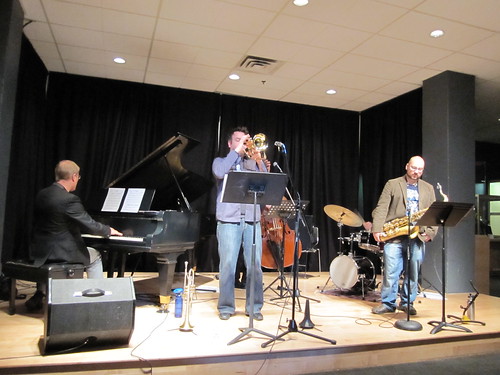
This concert featured Johnny Summers on trumpet and flugelhorn, Shane Statz on tenor sax, Sheldon Zandboer on piano, Brendan McElroy on bass and Karl Schwonik on drums. It was the group's first performance in a quintet configuration.
Jazz Arrangements of Classic Video Game Themes Played by the Runaway Five
The quintet opened the first half with two songs from the SNES game Earthbound (AKA "MOTHER 1+2"):"Sound Stone" and "Threed". This particular arrangement of the "Sound Stone" melody was quite lively, complete with stride piano. It featured solos by Shane, Johnny and and Sheldon.
In contrast, "Threed" was a laid back bossa nova. One of the neat moments in this arrangement was the transition between the flugelhorn and tenor sax solos. There was a lovely dialogue between the two instruments, which weaved and bobbed like someone floating aimlessly in the pool or ocean. I could have sworn I heard a "quote" from "Rainy Days and Mondays" by The Carpenters for a fraction of a second.
Next game on the set list was SimCity 3000, which is known for its jazz and new age soundtrack. "Updown Town" was a toe-tapping medium upswing. The trumpet solo began in the lower registered with shots that gradually led the listeners higher and higher. This was followed by an extremely chromatic piano solo, complete with rapid-fire blues riffs and shakes. After a very catchy vamp, the tenor sax solo gradually built up higher and higher, like a skyscraper.
"Into the Darkness" from Final Fantasy IVwas a lazy jazz waltz. The ensemble played upon the rhythmic ostinato from the introduction, working it into their solos. The flugelhorn solo was soft and mournful. In contrast, the tenor sax rose and fell like waves. The piano solo had punchy riffs and crunchy chords, while the bass solo played upon the theme, leading the audience deeper and deeper, lower and lower into blackness.
Another highlight from the first set was "Love Song" from BioWare's Dragon Age. This slow jazz waltz featured a beautiful duet between the flugelhorn and tenor sax. The sax solo began simply, who lush long tones, but the rhythm grew in complexity, building the tension. In contrast, the piano solo featured tender chords that rose and fell like a sigh. It too gradually grew in intensity with crunchier harmonies. The gradual deconstruction of the theme was a neat effect, just before leading the audience back to the head.
Three more video game themes were performed in the first set. "Buy Something Will Ya" (Earthbound) was a moderate swing number. "Zelda's Lullaby" (Zelda), which showcased the flugelhorn and piano. The Runaway Five closed the first set with the "Overworld Theme" from Super Mario Bros 2.
Soul Jazz, Ragtime and Swing Video Game Music in The Runaway Five's All Ages Concert
The Runaway Five did their best to make the audience forget the miserable weather outside with "Koopa Troopa Beach" from Super Mario Kart 64. Was I the only one pretending to drive my Mario Kart around the beach during the performance? I hope not.
The tenor sax solo was wavy, with splashes up into the higher register. The flugelhorn solo kept the mood high and bright, not just with playing in the higher register, but with the introduction of a different rhythm. The piano took that rhythm and changed it even more. When the head returned to lead us back to the finish line, it was a nostalgic moment.
Another highlight from the second half of the show was "Muscle Soul" from Battlefield Bad Company 2 Vietnam (Hill 137). This isn't a game I'd normally play, so hearing this theme was my introduction to the music of Anders Lewen.
This number opened with the bass and drums vamping on that opening riff until one by one, the rest of the company stepped in. The trumpet solo traversed a wide range, like a unit marching to their next mission. The sax solo was as soulful as the original recording. The piano solo had a little Motown, a little funk and a hint of disco.
The Runaway Five closed the show with "Air Platform - The Athletic Rag" from Super Mario World. The quintet had fun playing around with the two main themes from this classic video game. The trumpet solo used the A theme as a springboard to new riffs.
The tenor sax took the last rhythms played by the trumpet and then improvised on the B theme, then back to the A theme before tossing it to the piano, where we heard a chromatic treatment of the B theme, complete with zippy runs. The drum solo was playful, exploring different rhythmic and timbre combinations.
Three more VG themes were featured in the second set, including the "Figaro Castle Theme" from Final Fantasy III (VI), "Green Hill Zone" from Sonic the Hedgehog 2 opened with the drums and music from Street Fighter.
About The Runaway Five
Founded by Brendan McElroy, the Runaway Five performs jazz music arrangements of classic video games, including Super Mario Bros., Final Fantasy and Zelda. In 2008 and 2009, the group performed at Massey Hall in Toronto during the Video Games Live tour. The ensemble members change, increasing or decreasing depending upon the needs of the show.
The Runaway Five performed an intimate concert open to all ages on Saturday, April 6, 2013 at the National Music Centre. The interplay between the musicians was a delight to hear, while the themes left the audience feeling nostalgic about games past and present.
If you missed the show, you can check out some of group's earlier performances on their Youtube Channel. The Runaway Five will perform later this year. Details to follow.
Popular Portable Keyboards
To follow up on my "Choosing a Digital Piano or Electric Keyboard" post I did some digging around to find out which portable keyboards are popular on the market right now.
Last week, I posted about Choosing a Digital Piano or Electric Keyboard. To follow up, I thought I'd check out what some of the popular portable keyboards are currently in the market. Plus, I'm a little curious to see where mine are on the list. Here goes:
Portable Keyboards with 61 Keys
Yamaha YPT-230 Premium Keyboard Pack with Headphones, Power Supply, and Stand
Casio LK165 Lighted Key Premium Keyboard Pack with Headphones, Power Supply, and Stand
Casio CTK-2300 61-Key Premium Portable Keyboard Package with Headphones, Stand and Power Supply
Digital Pianos with 76 Keys
Yamaha YPG-235 76-key Portable Grand Graded-Action USB Keyboard
Casio WK-225 76-Key Premium Portable Keyboard Package with Headphones, Stand and Power Supply
Digital Pianos with 88 Keys
I limited the list to digital keyboards with 61 full-sized keys or more. It isn't bad to start with 61 and it's perfectly fine when you're composing or jamming, although 76 keys would be better. However, if you're taking piano lessons, ideally, you want the full 88 keys.
These portable keyboards made Amazon's Best Sellers in Musical Instrument Keyboards. The list contains more items than keyboards, so I pulled the most popular keyboards on the list.
Now, how did mine do?

My Yamaha DGX-230 Keyboard ranked #57 on the list. Considering that the list contains everything from accessories as well as keyboards, that's not too shabby at all.


As for my Yamaha CP33 Stage Piano, it's not one that a beginner student would get. As the name implies ("stage piano"), it's geared for performance. It ranked #45 under Digital Pianos.
Social Media Links
archives
- #YYCArts 32
- #YYCEvents 39
- Collaborative Music 25
- Community 11
- Composing & Arranging 6
- Entertainment 139
- Entrepreneurship 53
- Freebies 3
- Gardening 1
- Geeking Out 65
- Health & Wellness 120
- Improvisation 25
- Interviews 28
- Learning Music 188
- Martial Arts 13
- Memorization 7
- Music 230
- Music Careers 9
- Music Education 196
- Music Examinations 7
- Music Exploration 55
- Music Gigs 14
- Music Lessons 6
- Music Performance 32
- Music Theory 13
- Musical Instruments 12
- Musician Health 19
- Pets 57
- Piano Technique 12
- Practicing Music 120
- Productivity 20
- Professional Development 11
- Recommendations & Reviews 93
- Recreation 71
- Social Media 6
- Spirituality 10
- Studio Management 33
- Studio Technology 50
- Teaching Music 146
FOLLOW THE STUDIO on Instagram


Affiliate Links
As a Sheetmusicplus and CD Japan affiliate, I earn from qualifying purchases. The earnings help fund the Studio’s blog and YouTube channels. Your support is greatly appreciated.


FOLLOW Budo no Tabi on Instagram