THE MUSICAL MUSE
Blog dedicated to music education, practice tips, health
&
wellness, and geeking out.

Face and Neck Stretches for Musicians
Doing regular neck and face stretching exercises improves musician health, leading to increased flexibility, dexterity, coordination and blood circulation.
Doing regular neck and face stretching exercises improves musician health, leading to increased flexibility, dexterity, coordination and blood circulation. Musicians are prone to injuries stemming from tension, poor posture, improper technique, repetitive strain and overuse. All musicians use their facial and neck muscles extensively, making them susceptible to Temporomandibular Joint (TMJ) Dysfunction and Thoracic Outlet Syndrome. These injuries can be prevented by incorporating stretching exercises for musicians into their daily routine.
How Musicians Should Stretch the Face and Neck Muscles
Musicians should stretch prior to practicing or performing. They should be done after the muscles have had a chance to warm up. For example, stretches can be done in the shower, after a shower or after doing some light exercises.
Musicians should take breaks during practice sessions to stretch. After drilling a “trouble spot” numerous times, it is advisable to do some stretches before tackling a new section or piece. Stretching backstage between performances is also beneficial.
Follow these seven exercises and refer to the photos below:

1 Big Mouth Stretch
Purpose: Loosen up the jaw muscles, increase blood circulation and help prevent TMJ Dysfunction.
Performance:
Begin with your head level and facing forward.
Sit in a comfortable position.
Breathe in, raise your eyebrows and open your mouth wide as wide as possible.
Close your mouth after exhaling while keeping your jaw centered.
Hold stretch for 5 – 10 seconds. Repeat up to 10 times.

2 The Squinch
Purpose: Increase blood flow and relax the muscles in the face and jaw.
Performance:
Begin with your head level and facing forward.
Sit in a relaxed position.
Exhale and “squinch” or “scrunch” your entire face.
Hold this position for three seconds then relax.
Repeat.

3 Isometric Jaw Exercise
Purpose: To relax the jaw muscles.
Performance:
Begin with your head level and facing forward.
Make a fist and place it directly underneath your chin.
As you slowly open your jaw, provide some resistance by gently pushing your fist upwards.
Hold this position for 10 seconds.
Release.
Repeat 10 times.
4 Lip Flutters
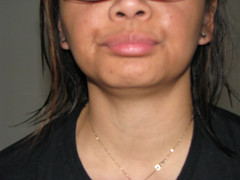
Purpose: Strengthen vocal folds and relax facial muscles.
Performance:
Keep your teeth slightly open, lips a little bit forward and face soft.
Take a low breath from the diaphragm.
Pretend to blow a bubble and allow the air in your lungs to make your lips vibrate.
Try to sustain the sound for as long as possible, until you run out of air.
Don’t pucker your lips.
Gently place your fingers on either side of your mouth if you are having trouble.
Repeat several times, trying the following variations: lip flutters without sound, staccato lip spurts without sound, lip flutters with sound (try to imitate a small motor purring), pitched lip flutters (flutter your lips while vocalizing a scale or a song).

5 Side Neck Stretch
Purpose: Relaxes your neck and shoulder muscles.
Performance:
Begin with your head level and facing forward.
Slowly tilt your head towards the right ear to stretch the left side.
Hold the stretch between 10 – 20 seconds.
Repeat, stretching the right side.
Stretch both sides at least two more times.
6 Front to Back Neck Stretch
Purpose: Relieves tension in your head, neck, back, hips and shoulders.
Performance:
Begin with your head level and facing forward.
Imagine that there is a small ball tucked under your chin.
Gently tilt your head downward, being mindful of your imaginary ball.
Hold this stretch for 5 – 10 seconds.
Repeat up to five times.
7 Side to Chin Neck Stretch
Purpose: Provides pain relief in your head, neck, back, hips and shoulders.
Performance:
Begin with your head level and facing forward.
Slowly tilt your head towards the right ear to stretch the left side.
Gently turn your chin downward towards your shoulder.
Hold the stretch between 10 – 20 seconds.
Repeat, stretching the right side.
Stretch both sides at least two more times.
Strive for a gentle stretch. Never stretch to the point of feeling pain. If your jaw makes any clicking or popping sounds when you open and close your jaw, consult a dentist before trying these exercises. Seek professional help from a doctor, physiotherapist or chiropractor if you need further guidance.
Dedicating as little as five minutes a day to stretching will ease tension, relieve jaw pain, ease neck pain and increase flexibility in musicians. If done regularly with proper technique, musicians can enjoy many years of pain-free and injury-free music-making.
Related Articles
Understanding Musician Injuries | Arm and Hand Stretches | Back and Shoulder Stretches
The Art of Practicing | Musician's Yoga: A Guide to Practice, Performance, and Inspiration | | Playing (Less) Hurt: An Injury Prevention Guide for Musicians
Understanding Musician Injuries
The Types, Causes and Prevention of Music-Related Injuries: Musicians are prone to injury from repeating a motion countless times when practicing. A better understanding of music injuries is vital for musicians' health.
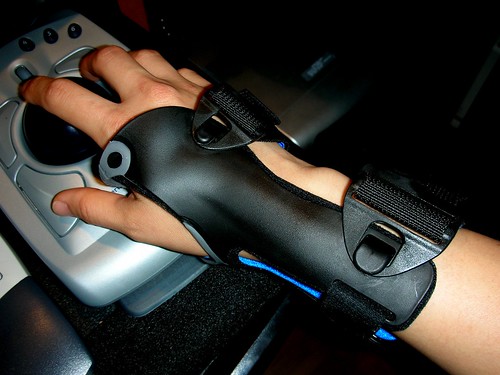
Musicians are prone to injury from repeating a motion countless times when practicing. A better understanding of music injuries is vital for musicians' health.
Common symptoms of a musician repetitive strain injury are similar to computer-related and speech-related injuries:
Numb fingers, arms, wrist, jaw, neck, shoulders and back
Shooting pain up the arms, shoulder and back
Cramping muscles or stiffness
Dull ache experienced in the fingers, arms, back, jaw, throat, wrist, shoulders and back
Hoarseness
If left unchecked, can become chronic conditions. They can potentially lead to long-term disability or end one’s musical career.
Common Types of Music Injuries
Common music-related injuries include:
Bursitis: inflammation of a bursa (fluid-filled sac which lubricates the movements of tendons, muscles and bones at joints)
Carpal Tunnel Syndrome: inflamed or irritated hand flexor tendons
Larynx Contact Ulcers: raw sores on the mucous membranes covering the cartilage attached to the vocal chords
Cubital Tunnel Syndrome: inflamed or irritated tendons affecting the inner side of the forearm and the pinky side of the hand
Laryngitis: inflammation of the larynx
De Quervain's Tenosynovitis: inflammation of the tendons on the side of the wrist beginning at the base of the thumb.
Tendinitis: inflammation of the tendons
Thoracic Outlet Syndrome: compression of the thoracic outlet, the nerve pathway and/or blood vessels between the base of the neck and the armpit
Trigger Finger: inflammation of the index finger tendons
Vocal Nodules & Polyps: small, inflammatory or fibrous growth on the vocal cords of people who strain their voices.
How Music Injuries are Caused
Overuse: Advanced musicians practice between one to ten hours a day.
Repetitive Strain: Musicians repeat a technical exercise or section of music countless times until it comes together.
Improper Posture: Some musicians slouch, sit too close or too far from their instrument and remain in the same position for long periods of time.
Non-Ergonomic Technique: Some musicians hold their body and/or instrument in an uncomfortable position, don’t move their hand and/or body in the direction that their fingers are moving, push their fingers or vocal chords beyond what they can comfortably do.
How to Prevent Music Injuries
Do Your Research: Find out more about the various types of music-related injuries.
Assess Your Instrument: Is your instrument the right size, shape, weight and height for you? Would an adjustable chair, footstool, strap or cushion make you more comfortable?
Know Your Body: Choose pieces that are reasonable for your body to play. If you have small fingers, playing repertoire that requires you to stretch beyond your finger span is a recipe for disaster. However, if you really want to learn a particular piece (or you need to learn it), make adjustments to make it easier to play. If you are a student, let your teacher know right away whether a piece or technical exercise is causing you pain.
Appraise Your Playing Technique: Is your body relaxed? Are your hands, arms, neck, head and core positioned to allow for fluid and comfortable playing or singing? Are you moving with the music? Are you using excess movements? Is your fingering logical and comfortable? Videotaping yourself is a valuable method to assess your playing technique.
Evaluate Your Non-Musical Activities: Desk and computer work, sports, dancing, carrying heavy objects (or dependents) and hobbies can adversely affect your body.
Do Warm-Up Exercises and Stretches: Musicians are sometimes called “small muscle athletes”. Stretching exercises and gentle warm-ups result in increased range of motion, strength, coordination and flexibility.
Take Breaks: One’s muscles, ears and vocal chords need regular breaks to return to their relaxed state. Not doing so tricks the body into thinking that “tense” is the “relaxed state”, resulting in chronic pain and stress.
Engage in Active Sitting: Most musicians remain in a seated position for extended periods of time. Active seating helps ease chronic back pain, promotes correct posture and maintains general health.
Seek Professional Advice: Speak to a doctor, chiropractor, massage therapist, Alexander Technique specialist, music instructor, otolaryngologist or ergonomic specialist for further information or treatment.
Be Proactive in Maintaining Musician Health
With an increased understanding of the types, causes and prevention of music injuries, musicians can be more proactive in maintaining their first instrument: the body. Musicians dedicated to maintaining musician health can look forward to many years of pain and injury-free music-making.
The Rest of My Series on Musician Injuries
Face and Neck Stretches for Musicians | Arm and Hand Stretches for Musicians | Back and Should Stretches for Musicians
Additional References:

The Art of Practicing: A Guide to Making Music from the Heart, Madeline Bruser (New York: Bell Tower, 1999)
Musicians' Injuries: Types and How to Avoid It, Espie Estrella
Musicians and Injuries, UN-L Engineering Electronics Shop, University of Nevada
Originally published on Suite101.com on November 20, 2009. All rights reserved by Rhona-Mae Arca.

Why Can't Musicians Wear Progressives for Music?
My Musicians and Progressives experiment wrapped up just over a week ago. I'm eagerly awaiting my snazzy purple frames, which will return to me as "normal" eyeglasses. Part of me has been mulling over exactly why so many musicians say that that it is impossible to use progressives for music and also, why I am in that 5 - 10% of people who had an adverse reaction to progressive lenses.
My Musicians and Progressives experiment wrapped up just over a week ago. I'm eagerly awaiting my snazzy purple frames, which will return to me as "normal" eyeglasses. Part of me has been mulling over exactly why so many musicians say that that it is impossible to use progressives for music and also, why I am in that 5 - 10% of people who had an adverse reaction to progressive lenses.
To answer that, I reviewed one of my clips from last week. In the span of of 70 seconds, my eyes flitted rapidly back and forth, up and down, left and right 70 times. In those 70 seconds, my eyes were looking at the music and the choir director from all regions of the lenses - top, middle, bottom, the far right and the far left. Peripheral vision was used just as much as looking at my subject head-on.
To do that with progressives resulted in my eyes looking through the long-range, intermediate and up-close reading range and well as the sides of the lenses that are essentially dead space repeatedly. Visual distortion occurred every time I moved my eyes, which is exactly what happened here:
With such rapid eye movement meeting with visual distortion, it's no wonder I got nauseous. Later in this clip, I tried moving my head as many times as my eyes would move normally in the span of a minute. Moving one's head that often in the span of a minute is also a recipe for nausea (and extremely impractical for a musician). I'd say it's also a recipe for whiplash and inexcusably sloppy playing.
That clip was just over one-minute. Ensemble rehearsals run anywhere between 90 minutes to three hours. To extrapolate, a musician's eyes may move rapidly at least 10,800 times in a three-hour rehearsal. Why was my nausea far worse than my music colleagues who have met with some success wearing their progressives in non-musical situations? I think it's because I use my eyes in a similar fashion when doing non-musical things. If I look at my main tasks in a given day, we can extrapolate how often my eyes rapidly flit around:
If my eyes shift 70 times in the span of 70 seconds, we can extrapolate that if read and play music for 60 minutes (my desired minimum, my max seems to be four hours), my eyes will shift 3,600 times in that hour.
I use my eyes in a similar fashion when I work on the computer, doing office studio work, writing, researching, transcribing or editing (text, audio and video). I work on the computer anywhere between three to seven hours a day. If I'm on the computer for five hours a day (my average), my eyes will shift 18, 000 times.
I use my eyes in a similar fashion when I drive. I drive between one to three hours a day. If I drive three hours in day, then my eyes will shift at least 10,800 times.
On average, I teach four hours a day. My vision usage is similar to the aforementioned situations. My eyes would then shift rapidly 14,400 times in that time span.
By my count, my eyes flit quickly - using all areas of my single-vision lenses and contacts an average of 46,800 times a day. This doesn't even include watching shows or operas with subtitles or playing a video game!
It's no wonder my nausea worsened as I forced myself to wear the progressives for longer periods at a time. It's no wonder I couldn't last a week. However, some of my music friends and colleagues wondered how I lasted as long as I did.

A Progressive Exception
For those of you who have been following my Musicians and Progressives Experiment, you'll be happy to hear that I did go to my optometrist's office today and asked for "normal glasses". I did learn a few interesting things that I can share:
For those of you who have been following my Musicians and Progressives Experiment, you'll be happy to hear that I did go to my optometrist's office today and asked for "normal glasses". I did learn a few interesting things that I can share:
My prescription is correct. Always good to know.
Approximately 5 - 10% of people in my age range (early 40s) do not adapt to progressives. It would appear that I am in that group.
This number (of patients who can't wear progressives) increases significantly as patients get older. If my memory serves correct, this number goes upwards to 20% for those in their mid-40s.
I seem to know a lot of people who can't wear progressives (oh wait, that's because I know many musicians and other creatives).
If you can't adapt to progressives, you can explore trifocals, bifocals and different pairs of single-vision lenses and/or contact lenses.
Therefore, my optometrist was being proactive by starting me on progressives early.
He doesn't feel that office progressives will do me any good at this point, as it's mostly for intermediate and up-close vision (at least, that's what I remember of the conversation). That shoots down my wish for progressives that only have long distance and intermediate range lenses (and then I'd use separate reading glasses). Interestingly enough, it's it's my "up-close" range (AKA, the range I hardly use) that's degenerating first (Note to self: exercise that range more).
I just heard from another music friend. He's a percussionist/conductor/teacher. His eye doctor is having him try trifocals INSTEAD of progressives. In fact, it was the optometrist who said, "
Progressives don't work for musicians
."
I remain hopeful that in time, progressive lens that don't severely limit the periphery will be developed. I look forward to the day that one pair of glasses/contacts will serve my and my fellow musicians' aging needs. That there will be a type of lens that I can wear without having to juggle multiple pairs of vision wear. Someday.
Back to today. I fell back on the non-adapt clasue. Ironically, the new pair is nearly identical in prescription to the single-vision glasses I'm wearing now. They are over four-years old, so they are a little beat up. The old pair will make a great back-up pair. The new pair will make a great dedicated music pair when the time comes to revisit multi-focal lens options.I could have tried bifocals today, but when it comes down to it, I just want normal glasses.
Quick Links to the Musicians and Progressives Experiment posts:
Musicians and Progressives Experiment: Pre-Experiment Control Videos
Musicians and Progressives Experiment Day 3A - Cleaning the Studio
Musicians and Progressives Experiment 3B - Office Work and Practicing Music Meltdown
Musicians and Progressives Experiment Day 4 - Driving Mini-Meltdown
Musicians and Progressives Experiment Day 5 - Office Work Meltdown
Musicians and Progressives Experiment Day 6A - Teaching Meltdown and Testing a Theory
Musicians and Progressives Experiment Day 6B - Confirming a Theory & Choir Rehearsal Meltdown

Post Musicians and Progressives Experiment Musings
This is my third day with my short-corridor progressives firmly closed in their case. It's been heavenly without the nausea. My appetite has returned in full force, I'm back to being my mostly even-keeled self. I've returned to my regular activities. I continue to receive feedback from various sources. Here are some of the comments that I've received from of of my piano students' parents:
This is my third day with my short-corridor progressives firmly closed in their case. It's been heavenly without the nausea. My appetite has returned in full force, I'm back to being my mostly even-keeled self. I've returned to my regular activities. I continue to receive feedback from various sources. Here are some of the comments that I've received from of of my piano students' parents:
In one family, the mother adjusted to the progressives but the father did not adapt. The mother actually has to juggle more than one pair - reading glasses and progressives. It sounds like she's even having challenges with her progressives and needs office progressives. The father, who drives trucks, now wears bifocals and I believe uses single-vision wear for driving.
Another parent, who learned music as a child, said "NO WAY!" when I told her that I was supposed to use my progressives to read and play music. She also juggles two pairs - office progressives and reading glasses.
One of my adult students detests her progressives. Not only can't she read her music but she's having trouble with her other daily activities. She is shopping for a new eye doctor who will work with her to explore other options.
Another parent said that the transition between the vision zones should be "seamless". His entire eye exam was computerized, so his readings were extremely accurate. Wow. I want that eye exam!

There is an addendum to my colleague Gwen Richardson Bartek's office progressives success story, "I am lucky with my optometrist. :) I teach his children piano lessons." That's so convenient! She added, "My "office" progressives work."
What it's boiling down to is that musicians and non-musicians alike aren't asked enough questions at the beginning about their daily vision needs. It's taken several tries for most of them and the ones with progressives still have to juggle another one or two pairs of glasses.>Nor are progressives for everyone.
Hindsight is 20/20. This is what I've learned: If you are told that you need progressives, do not feel pressured (and do not let them pressure you) into ordering them on the spot. Go home and do your research. Come back with questions. Do not place the order for them until:
You actually have the funds to pay for them.
You feel confident that your eye care practitioner understands your daily vision needs.
You are satisfied with the purchase and return policy.
Ask more questions and do your research.
If you feel that your concerns (and those of your esteemed colleagues) are being dismissed, listen to your gut and go get a second opinion (or try that fully computerized test that my students' father had). If you feel that you need to run an elaborate experiment just to make your daily vision needs understood, there's a huge disjunct.
Gwen's story and my optician-pianist colleague's recommendation of office progressives, namely the NIKON Home & Office Lenses, do give musicians a viable option as far as progressives go. Now, some will find that they must still use single-vision wear for their musical (and driving) needs. It depends on their musical instrument(s) and their playing environment. My colleagues - and my experiment affirms this - that standard and short-corridor progressives do not work for reading and playing music (at least for piano, singing, percussion, conducting and teaching). Those NIKONs may very well work for me. Although they may be passable in everyday situations, I do know that I may still need my current single-vision pair for music and driving; and that my older set of glasses can be used as reading glasses. I do recognize that my prescription has changed and that I may not be able to use my current single-vision lenses for everything.
Whether or not I try the Home & Office progressives really depends on if it costs me extra to get them (or to switch to non-adapts if even those do not work) and how my appointment goes. Otherwise, like I said before, I'd rather just get my non-adapts and be done with this.
Social Media Links
archives
- #YYCArts 32
- #YYCEvents 39
- Collaborative Music 25
- Community 11
- Composing & Arranging 6
- Entertainment 139
- Entrepreneurship 53
- Freebies 3
- Gardening 1
- Geeking Out 65
- Health & Wellness 120
- Improvisation 25
- Interviews 28
- Learning Music 188
- Martial Arts 13
- Memorization 7
- Music 230
- Music Careers 9
- Music Education 196
- Music Examinations 7
- Music Exploration 55
- Music Gigs 14
- Music Lessons 6
- Music Performance 32
- Music Theory 13
- Musical Instruments 12
- Musician Health 19
- Pets 57
- Piano Technique 12
- Practicing Music 120
- Productivity 20
- Professional Development 11
- Recommendations & Reviews 93
- Recreation 71
- Social Media 6
- Spirituality 10
- Studio Management 33
- Studio Technology 50
- Teaching Music 146
FOLLOW THE STUDIO on Instagram


Affiliate Links
As a Sheetmusicplus and CD Japan affiliate, I earn from qualifying purchases. The earnings help fund the Studio’s blog and YouTube channels. Your support is greatly appreciated.


FOLLOW Budo no Tabi on Instagram