THE MUSICAL MUSE
Blog dedicated to music education, practice tips, health
&
wellness, and geeking out.
Piano Parties: Giving music students a comfortable place to perform, learn and socialize
Piano parties are one of the popular events at my studio. This year's piano parties got off to a grand start with the Halloween Piano Party.
Last year, inspired by music educators who host social events and informal performances for their students, I jumped on this creative music teaching idea. I offered three piano parties to my students, which fast became one of the most popular events of the year. Last weekend, I hosted the first one of the 2013/14 year. It was a Halloween Piano Party. All of my students came in costume and brought treats to share. I supplied a meat and cheese tray, juice and games.
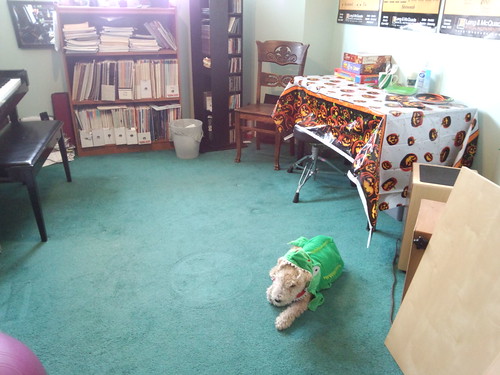
The students who arrived first created their own ice breaker. One of the questions was "If you could have a superpower, any super power in the world, what would it be?"
My students and I played one spooky song each. For most of us, we performed one of the pieces I assigned as a Sight-Reading Challenge. They did well.
Me, on the other hand, performed something I hadn't run through for a few days and had to compete with kids and canine assistant who were all excited about the arrival of two more students. It became a case study on playing with distractions.
Then, I introduced my music students to some tabletop games that most had never seen before. On one hand, I was thinking of giving them a break from music games. Later, after reading that my colleague, Diane Hidy often does puzzles with potential students, I realized that I had a golden opportunity to see how my students think.
We started with Labryinth. It's a 3D maze game, in which the players race to find the treasures. Of the four newbies, one caught on very quickly. Another couldn't care less, while the other two had an extremely tough time planning their moves because they couldn't seem to visualize what their next move should be. At least, not without someone (either myself or my other two students who have played the game before) pushing a tile in to show them possible cause and effects. It was a game where my visual, creative thinkers dominated.
The second game was the undisputed favourite: Tsuro. It's a tile-based game in which you try to be the last dragon flying on the board. Each tile contains four lines; four possible paths to follow. All of my students latched onto the concept fairly quickly. The two who struggled with Labyrinth had an easier time because they could fiddle with the tiles and pretend to lay it down to see where the path would lead.
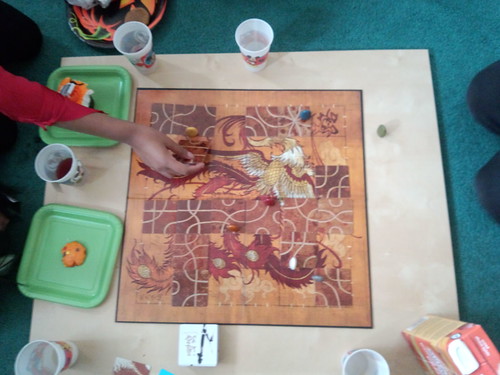
And yes, they started to think ahead, asking themselves: "If I put the tile down like this, what is my dragon's path?" Not all of them. One of them left things to chance.
The third game I introduced them to was King of Tokyo. It's a dice and card game in which monsters take pot shots of each other. The victor is either the first monster to reach 20 victory points, or the last monster standing.
One thing I learned with the games is not to spend too much time with the rules. I gave the kids the objective of the game, general actions and then had them jump in. With King of Tokyo, I explained what their dice rolls gave them, answered the questions about the cards and then let them decide what to do.
One student left King of Tokyo to return to Tsuro, leaving two boys and one girl. My female student was starting to think strategically but her monster was killed off early in the game. She too, returned to Tsuro.
That left the two boys who were looking forward to being monsters to enjoy an epic slugfest to their hearts' content. Neither were thinking of victory points, opting to just continually take pot shots at each other.
In short, I learned three things. First, the visual and creative thinkers were most successful at the games. Second, the ones who thought strategically were also my students who are more detail oriented and third, the one who didn't really care about strategy is also the one who has the most problems with timing. He was also the most enthusiastic about being a monster.
All in all, my music students had a fun time. They all cheered each other on when they performed. They ate a balance of sugar and healthier food and they thoroughly enjoyed themselves with the tabletop games.
I relished in the opportunity to give them a relaxed performance opportunity, another way to see how they think and to share with them some fun games that they could enjoy with their family and friends. The piano party continue to be one creative teaching idea that is worth repeating again and again.
When a student leaves: making the most of the time you have left
One of my students terminated lessons before the end of the year. We ended our time together by recording a CD.
One of my students terminated lessons. Really, it came as no surprise that his parents were pulling him out. Music lessons are not for everyone. Private lessons aren't for everyone. His parents have enrolled him in other activities, that I feel are a better fit for him. For his final month of lessons, I gave him a set of Halloween songs to work on. They didn't really stick. That's when I thought of making a CD. I asked my student to choose his three favourite songs and relearn them. If they weren't good enough to record, then they wouldn't make the cut. "No one wants to own a CD that sounds bad, do they?" I asked him.
He nailed his three songs on the first take. That gave us enough time to add some special effects to each of his tracks and burn the CD.
That was probably his strongest performance of that old folk melody.
We didn't have time to design a CD jacket or create any CD art. I'm sure that if he wants to, he can handle that on his own.
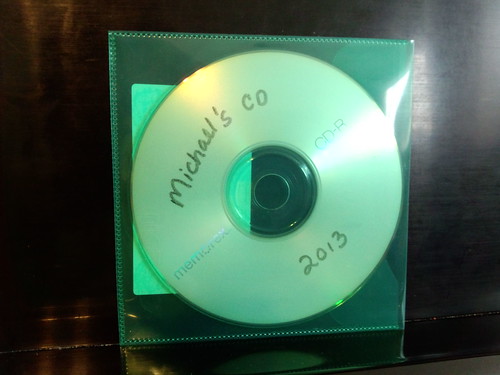
Our little CD project is a nice way to end lessons. It gives all of us a little souvenir of our time together. It was also a joy to hear my student rise to the challenge to get his pieces ready for recording.
On another note, this has inspired me to try this with a few other students. Perhaps with the challenge of a deadline, they too may rise to the challenge. If they wind up with something neat to present their parents for Christmas, Hanukkah or Kwanzaa, that would be a wonderful gift.
Music Practicing 101: The Looping Drill
The Looping Drill is one of my favourite drills since it can be used at any stage of music mastery.
The Looping Drill has become my favourite practice drill as of late. It is great to use at any stage of music mastery, the learning stage, troubleshooting, polishing, memorizing or reviewing. It is an effective way to practice only what needs more work.
Start by playing through your piece or technical exercise. When you hit a snag, play that bar five to seven times before moving onto the next one.
I find that usually by the third repetition, my fingers start to "get" it. However, it isn't until the fifth to seventh repetition that I start to consistently get it.
You can combine the looping practice drill with the Smarties Drill or any other drill to improve your accuracy and consistency. Here is a video demonstration of me using the looping drill:
I am in the process of revamping my Music Bag of Tricks, which are cards that show many of the practice drills my students and I use to achieve efficient and organized music practice. My gaming hobby is heavily influencing the design and set-up.
My Music Bag of Tricks will be tested by a handful of teachers and students before making them available to the general public. They will be available for music students, music teachers and any musician seeking for new ideas on how to practice music efficiently. Stay tuned!
The Sight-Reading Challenge
Drawing inspiration from Alessandra DiCienzo from the Ontario Registered Music Teachers' Association, I have launched a sight-reading challenge in my music studio.

One of the presenters at the CFMTA "Music Inspires" Teachers' Convention, Alessandra DeCienzo, gave an inspiring presentation called, "Love at First Sight". She shared several ideas and activities that she has used in her studio to improve sight-reading.
One of the ideas was a year-round sight-reading challenge. Each week, students would have a sight-reading assignment. Exam students participated in a less strenuous variation of this, completing their sight-reading assignments at their leisure.
I decided to do a variation of her weekly challenge this year. Instead of running it year-round, I have set four stages, which take place in October, December, February and April. That gives all of us a one-month reprieve to explore other areas.
All of us (yes, me too!) have a pin on my game board:

How the Sight-Reading Challenge Works
We all are starting approximately four levels below our current playing level. It is my hope that my students will be able to comfortably sight-read music at their current playing level by April, or get to one level below it. In the process, I also hope that my slower readers will be able to "level up".
This month, I have been assigning spooky music for sight-reading. My students have the option to officially learn the music once they've "cleared" the sight-reading challenge for a piece. Like Alessandra DiCienzo's students, my students are to play the piece once per practice, without any pauses or corrections.
If they can do that at their next lesson, then they've cleared the challenge of the week and move onto the next one. Some of my students are still on the first challenge, while others are already working on a bonus challenge.
As for incentives, they are working for treats. If they clear only one assignment in the month, they get a small candy. If they complete their four and choose up to three extra songs to do for the bonus challenge, they will the equivalent of a giant chocolate bar.
Repertoire Selection for the Sight-Reading Challenge
Selecting the pieces for the sight-reading challenge has been an adventure and a chore. Thankfully, Alessandra shared some excellent links. Plus I have a growing list of online music teaching resources to draw from. Here are some of them: IMSLP Petrucci Music Library, Wikifonia, Susan Paradis Piano Teaching Resources, G Major Music Theory and Debbie Dee. I keep track of my selections on a spreadsheet saved on Google Drive, complete with the URL's.
In December, we will explore seasonal music: Christmas, Hanukkah and Kwanzaa. We'll either do romantic or wintry music in February and spring-themed music in April.
I have found that this is a great way to introduce students to different styles of music, cultures and different notation (i.e., standard versus a lead sheet or a sheet of chords). In this way, I hope that my students learn that sight-reading doesn't have to be a chore. It can be an exciting adventure.
On Note-Tab Reminders in Music Lessons
I almost walked right past these in the store. These Post-it Note Tabs are a neat way to put important lesson reminders where my music students will look at them!
I'm sure that I'm not the only music teacher out there to bemoan the fact that many of their students do not read their assignment books. Or, that they do but only just before their lesson. Post-it flags work as bookmarks for songs, but I've had limited success with regular post-it notes. Until now.
Last week, I found Post-it Note Tabs at Staples. I decided to try them with students who do not check their homework book (the ones who don't check off their goal list to show what they worked on).
When I showed them to my Monday and Tuesday students, they got a bit excited. "That's really neat!" one said. "Yeah, that should work," said another.
I've started writing short phrases to jog their memory. If the student writes quickly enough, I ask them to write the reminders. We post it on one of their pieces that they are sure to practice. The little tab sticking out says, "Reminders", so it's hard to miss.

Seeing as they don't read their assignment books often, I simply jot down the song or exercise titles. Fingers crossed that this works!
Social Media Links
archives
- #YYCArts 32
- #YYCEvents 39
- Collaborative Music 25
- Community 11
- Composing & Arranging 6
- Entertainment 139
- Entrepreneurship 53
- Freebies 3
- Gardening 1
- Geeking Out 65
- Health & Wellness 120
- Improvisation 25
- Interviews 28
- Learning Music 188
- Martial Arts 13
- Memorization 7
- Music 230
- Music Careers 9
- Music Education 196
- Music Examinations 7
- Music Exploration 55
- Music Gigs 14
- Music Lessons 6
- Music Performance 32
- Music Theory 13
- Musical Instruments 12
- Musician Health 19
- Pets 57
- Piano Technique 12
- Practicing Music 120
- Productivity 20
- Professional Development 11
- Recommendations & Reviews 93
- Recreation 71
- Social Media 6
- Spirituality 10
- Studio Management 33
- Studio Technology 50
- Teaching Music 146
FOLLOW THE STUDIO on Instagram


Affiliate Links
As a Sheetmusicplus and CD Japan affiliate, I earn from qualifying purchases. The earnings help fund the Studio’s blog and YouTube channels. Your support is greatly appreciated.


FOLLOW Budo no Tabi on Instagram