THE MUSICAL MUSE
Blog dedicated to music education, practice tips, health
&
wellness, and geeking out.

Music Practicing 101 - Speed Learning
If you have to get something ready to perform and you have very little preparation time, you have to manage your time very efficiently to get the job done. This is where speed learning comes in.
If you have to get something ready to perform and you have very little preparation time, you have to manage your time very efficiently to get the job done. This is where speed learning comes in.
Speed learning techniques are useful for musicians
of any level and any age. There are several approaches to speed learning a piece of music, which I outline in my speed learning piano tutorial:
Regardless of your approach, there are a few common themes:
Have frequent mini-practices to get the music into your muscle memory, e.g. five 2-minute practices, or five 5-minute practices.
Know your theory! It's important to know where you are in the form of the piece (e.g., A section? Recap? Second verse?). It is equally just as important to know your harmony. More on that later.
Make it easier for yourself: Most people won't notice if you make a few modifications. Look for ways to simply patterns. Younger students can play solid chords instead of the fancier Alberti bass. Drop the doubled-notes. Go ahead scribble in the note-names for notes on the ledger lines. Write in the harmony (the chords).
Set your goals and tasks for each mini-practice: Which trouble spots are you going to work on? Which practice drill is the best for fixing it? You must strive to see and hear a significant improvement on that spot by the end of your mini-practice.
Use practice aids: Drag out that metronome from behind the piano. Prop up your iPod, tablet or smart phone by your instrument to play along to a recording of your piece. You can also record and review your progress.
By regularly doing "speed learning challenges" or "quick studies", you will notice that you will learn your "regular" pieces more quickly.
I'll have to ask my fellow music teachers if they have any other speed learning tips to share. Stay tuned!
Happy practicing!

Using Webcams in Music Lessons
Last year, I purchased an HD webcam for my music studio. My students, their parents and I have enjoyed how easy it is to take a quick video clip or photo of either a hand position or drilling a troublespot in their music.
Last year, I purchased an HD webcam for my music studio. My students, their parents and I have enjoyed how easy it is to take a quick video clip or photo of either a hand position or drilling a troublespot in their music. They get to review it as many times as they need to at home as an unlisted Youtube video.

Computer assisted instruction aids music practice. Photo by R-M Arca
Some of my piano parents really like the overhead camera as it gives them the same view that pianists see when they look at their hands.
This year, we are moving full-steam ahead with computer assisted instruction. Thanks to Memory Express and Best Buy, I was able to take advantage of their huge sale on webcams.
Webcam #2 is positioned to give that all important profile view. It's great for checking posture and ergonomic movement.
.jpg)
Technology in music can be as easy as a $30 HD webcam. Photo by R-M Arca.
It took a while for some of today's students to find Webcam #3. I have a few students who need the pedal view.
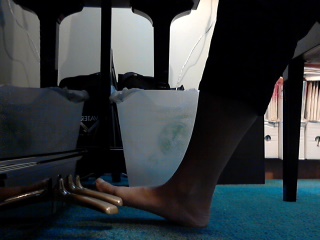
Having multiple camera views for computer assisted music lessons is ideal. Photo by R-M Arca.
My beginner piano students were pretty eager to test how well my computer could handle recording from two cameras simultaneously. It turned out all right. I'll have to fiddle around with the audio settings a bit, but at least my students and I are having fun with these toys as we explore the exciting world of music.Once we get a better handle on things, Skype piano coaching can't be too far away.

Music Practicing 101 - Finger Push Ups
This finger exercise is one I learned at one of my early piano lessons, many moons ago. It's a hand exercise to strengthen those musical fingers, especially our very weak finger #4.
This finger exercise is one I learned at one of my early piano lessons, many moons ago. It's a hand exercise to strengthen those musical fingers, especially our very weak finger #4.
I detested it during those early piano practices, but I must say, my Finger #4's are better because of it. My students and I have dubbed it "Finger Push Ups":
Music Group Class Round 1 Reflections
Well, students and teachers of Musespeak Studio and To the Wind Studio have survived the first round of music group classes with this new format. I learned three main lessons
Well, students and teachers of Musespeak Studio and To the Wind Studio have survived the first round of music group classes with this new format. I learned three main lessons:
I have gotten too complacent as far as teacher-student communications go. My students, their parents and I have an established rapport. I'm starting virtually from scratch with my brother's students. Sure, we've chatted at recitals, but a five-minute chat and teaching in 90-minute stretches are two totally different things.
It is important to over-plan and have several back-up activities up your sleeve. My pacing for one of the group classes was perfect. One was all right but could use a few more activities, while the other - well we raced through my lesson plan and I wound up flying by the seat of my pants for a very long time. I have Divine inspiration to thank for the "Let's Make Up a Story with Sound" exercise that I did with yesterday's students when improvising.
When teaching at another studio, have a studio contact list on hand in case you need to contact a parent in the case of an emergency or behavioural issue.
Overall, it was a positive experience. I've learned which students I need to be firm with and which ones I can recruit to take more of a mentoring role with the junior students.
I enjoyed teaching four lovely girls basic conducting gestures and beat patterns. They giggled a lot and had a great rapport with each other.
The "Get into The Groove" class challenged me the most. I will need to plan more rhythm exercises, especially ones where they split off into smaller groups. As for the stubborn ones - let's just say that I'm just as good, if not better at digging in my heels. "The Art of Practicing" also wound up being a great group of music students who were very engaged. In discussing how to practice music, we discussed stretching as well as their learning styles and practicing challenges (e.g. "When I Don't Feel Like Practicing"). The conversation also lead to areas I had not thought of incorporating into my presentation - and they should be. Thanks to them, talking about how to practice when injured and speed learning will be incorporated into my presentation. I look forward to the next round of music group classes.
Music Practice Tips Online
There are a growing number of resources online to help music students with how to practice. As each music educator has a unique background, each has something to bring to the table - to you - the music student.
There are a growing number of resources online to help music students with how to practice. As each music educator has a unique background, each has something to bring to the table - to you - the music student.
This is a short list of some websites that I recommend to my students:
Check out Chris Foley's series, "31 Days to Better Practicing" on The Collaborative Piano Blog.
Social Media Links
archives
- #YYCArts 32
- #YYCEvents 39
- Collaborative Music 25
- Community 11
- Composing & Arranging 6
- Entertainment 139
- Entrepreneurship 53
- Freebies 3
- Gardening 1
- Geeking Out 65
- Health & Wellness 120
- Improvisation 25
- Interviews 28
- Learning Music 188
- Martial Arts 13
- Memorization 7
- Music 230
- Music Careers 9
- Music Education 196
- Music Examinations 7
- Music Exploration 55
- Music Gigs 14
- Music Lessons 6
- Music Performance 32
- Music Theory 13
- Musical Instruments 12
- Musician Health 19
- Pets 57
- Piano Technique 12
- Practicing Music 120
- Productivity 20
- Professional Development 11
- Recommendations & Reviews 93
- Recreation 71
- Social Media 6
- Spirituality 10
- Studio Management 33
- Studio Technology 50
- Teaching Music 146
FOLLOW THE STUDIO on Instagram

Affiliate Links
As a Sheetmusicplus and CD Japan affiliate, I earn from qualifying purchases. The earnings help fund the Studio’s blog and YouTube channels. Your support is greatly appreciated.


FOLLOW Budo no Tabi on Instagram