THE MUSICAL MUSE
Blog dedicated to music education, practice tips, health
&
wellness, and geeking out.
Music Practicing 101: The Looping Drill
The Looping Drill is one of my favourite drills since it can be used at any stage of music mastery.
The Looping Drill has become my favourite practice drill as of late. It is great to use at any stage of music mastery, the learning stage, troubleshooting, polishing, memorizing or reviewing. It is an effective way to practice only what needs more work.
Start by playing through your piece or technical exercise. When you hit a snag, play that bar five to seven times before moving onto the next one.
I find that usually by the third repetition, my fingers start to "get" it. However, it isn't until the fifth to seventh repetition that I start to consistently get it.
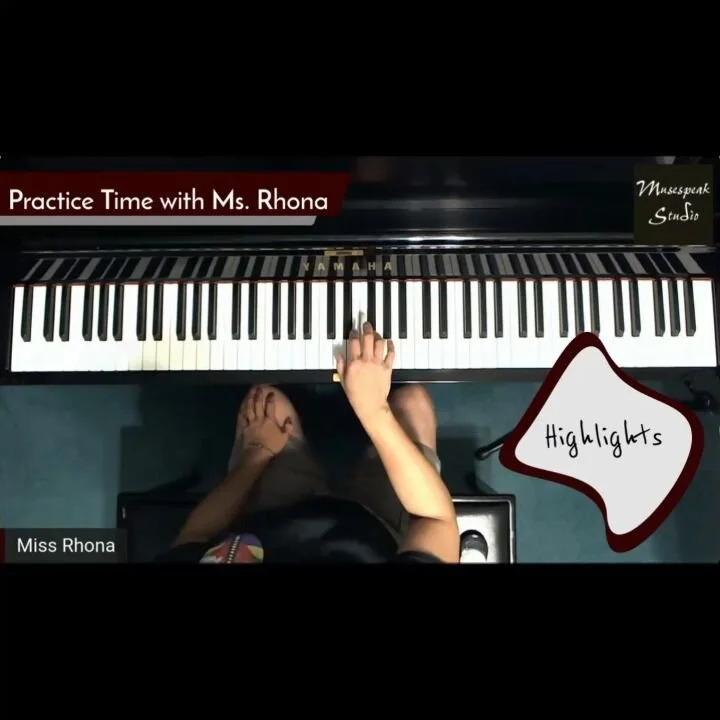
You can combine the looping practice drill with the Smarties Drill or any other drill to improve your accuracy and consistency. Here is a video demonstration of me using the looping drill:
I am in the process of revamping my Music Bag of Tricks, which are cards that show many of the practice drills my students and I use to achieve efficient and organized music practice. My gaming hobby is heavily influencing the design and set-up.
My Music Bag of Tricks will be tested by a handful of teachers and students before making them available to the general public. They will be available for music students, music teachers and any musician seeking for new ideas on how to practice music efficiently. Stay tuned!
Training Students to Become Active Listeners
Teaching my students how to become active listeners is tedious but a necessary step in teaching them how to practice more efficiently.

When I was growing up, I studied piano with Miss Mahaffy. She took me from Grade 3 to Grade 9 piano. After running though a piece, she would usually comment on how I did. More often than not, my dynamics were flat or my playing was choppy. Then she'd ask me, "Did you listen to what you just did?" Usually, I'd say, "No," or "Not really." She would dutifully write, "Listen to yourself!" in my assignment book.
Fast forward to 2013. After hearing a student, usually I ask them, "What did you think? How did you sound?" Their response is eerily similar, "I don't know. I wasn't listening." To which I reply, "Well how do you know if you're getting any better if you don't listen to what you're saying?"
My strategy to teach my students to become active listeners is two-fold. I rely heavily on the technology on hand: my YouTube Music Exploration Play List and Record & Review.
Every week, I highlight a "Clip of the Week". I've been doing this for several years now. My students have an Active Listening Handout, although I really should just keep one at the piano to save time. While watching and listening to the clip, I ask them questions such as, "What instruments do you hear?", "What's the tempo like?", "Is the song major, minor or something else?" and "What's the articulation?"
The one thing that I've been employing more regularly is recording my students and having them listen to themselves.I record them onto my computer using Audacity. Any recording device will do: mp3 player, camera or phone.
I ask them to draw a star on any spot in the score in which they heard a bobble. Some students are really good at it, so I just have to talk about various practice drills and the end goal.
I have a group of students who don't really listen to themselves when they play. However, they realize what needs work only when we do the Record and Review.
Unfortunately, many of my students are weak in this area, and I want to fix that. Sometimes, I have to record them playing through a spot, record myself playing the same spot and have them compare the sound and the waveforms.
With guided questions (and a few replays), I can usually get my students to pick out one trouble spot that I'd like them to work on for the week. Once we select the most critical issue, I have them pull out their Bag of Tricks so that we can work on that spot.
This evening, I recorded a nine-year old student as she drilled a trouble spot. I played each recording for her and asked her to assess herself. We probably spent 10 minutes recording and reviewing until I felt confident that she knew what to listen for at home and that her practices will be better organized.
Basically, I'm walking my students through how to practice music efficiently. It's very tedious, especially when you take into account that I've been doing this with most of my students for the past couple of weeks. I do feel that this will pay off in the end. If I can successfully teach my students active listening skills, then they have a better chance of succeeding at self-regulated practicing.
It is my hope that well before the end of the school year, when I ask them, "What did you think? How did you sound?", they all will be able to assess their playing accurately and objectively. Then, I can focus on helping them progress with their musicianship and expression.
Making a Practice Schedule
Some times and links to help you organize your music practice schedule.
Hi gang! Sorry for the lack of updates. My Wordpress upgrade went wonky and everything was down for a while, but we're back with new practice tips and tricks. The key to making progress with any activity is frequency. That's why dance, sports and martial arts groups train three or more times a week.
As a musician, a lot of that training has to be done at home, mostly on your own. You need to manage your practice routine - an not just because you don't want your parents or your music teacher nagging you about it. You have to want to get better, which means that you need a practice plan and a practice schedule.
Here are some websites I've tracked down with some tips on setting up a practice routine, as well as some sites that have practice logs:
Establishing Good Practice Habits (FYI: He's right - practice your arpeggios!)
Making the Best Use of Limited Practice Time
Music Practice Schedule Template
The Power of a Practice Schedule
The Musician's Way - Downloads (I think I'm going to try out the Practice/Creativity Log)
Now if you're an aural learner, that is you learn by listening, then record your practices regularly and review them. If you're a visual learner, record a video of yourself. It's as easy as grabbing your smartphone, tablet, camera or iPod Touch.
6 Steps to Self-Regulated Practicing
According to super-cool professor Dr. John Picone, there are six steps to self-regulated practicing. Master these and you will learn your music quickly and efficiently.
Last month, I attended a national music teachers' convention. It was my first time as an attendee (versus when I was a organizing committee member). One session that really resonated with me was Dr. John Picone's Steps to Parnassus: Guiding Young Musicians to Self-Regulated Practicing.
He was such a dynamic presenter and had wonderful ideas. I hope that one day, the Alberta Registered Music Teachers' Association or the Alberta Piano Teachers' Association could bring him out here to do a session for music teachers AND music students.
He shared a lot of information and examples with us. I will just highlight six main points for you try to incorporate into your at-home practicing. They are, what Dr. Picone referred to as "Six Dimensions of Self-Regulated Learning":
Take charge of your environment: Is your pet pestering you when you practice? Does your little sister come and bash on the keys while you are at your instrument? Or is your practice area in the same room as the television? You need to, perhaps with some help from your parents, create a practice space in which you can actually get some quality practice time in. Get rid of those distractions!
Manage your Time and Setting Goals: This past year, I introduced my students to the concept of "speed learning". To force them to think about time management, I used the countdown timer. If you only have 10 minutes, then you need to have a solid plan of attack. Pick a chunk of music that's do-able in 10 minutes. How much can you learn in 10 minutes? Or fix? The clearer you are with your plan, the more productive your practice will be.
Record and Review: Record and Review is something I encourage my students to do regularly. I think some do but not all. There's a lot going on when we play a piece or technical exercise. How else are you going to know if you're making any progress at home unless you listen to what you just did? If your iPod records, then use it. Or a tablet, computer, phone or other recording device.
Seek out resources on your own: Can't remember what "subito" means? You know technology more than your parents and teachers do. Google it! Or get a music dictionary app.
You have a repertoire of strategies and you know how to use them: One drill I grew up on was "Drill this 10 times". I'd get tired by five. My students have some more creative practice drills in their arsenal (e.g. Smarties Drill, the Every Other Bar Drill and the Fill in the Blanks Drill for starters). Regardless of what practice drills you have been taught, you have to know when to use them and how to use them. Now that would require you to read your music notebook, wouldn't it?
Motivation: There's external motivation (e.g. you have a music exam next week and you don't want to fail) and internal motivation (you simply want to do well). It doesn't matter how often your teacher asks you to practice more or how often your parents yell at you to practice - if you don't want to do it, it's not going to happen as well as it should. However, you need to really think hard about whether you don't want to practice because you've hit a snag or because you really hate music, but that's a separate topic.
The video that Dr. Picone showed us was of a seven-year old boy. He didn't really play much in the practice clip, but he didn't need to. He spent about a minute asking his mother to take the family dog into another room. Then, he spent a couple of minutes planning out what he was going to practice.
Once he selected a piece, he took another minute to skim through it. His finger traced over the notes. He stopped and looked at a tricky rhythm. After a moment's thought, he pulled out his music notebook to read his teacher's practice suggestions for that rhythm. Then, he remembered that he had a recording of that part of his lesson, so he listened to it. He checked his clock. Then, the clapped out the rhythm a few times. Checked his time again and then did a run-through at the piano - slowly. He tried it a few times before running through the whole piece.
If a seven-year old can master self-regulated, or organized practicing, you can too.
Advice on Music Exams, Cramming and Number Games
Sometimes, our music students are still scrambling to get ready for their music exams. If you're like my one Grade 9 piano student who has been trying to memorize his Brahms' Intermezzo, it's too late.
Sometimes, our music students are still scrambling to get ready for their music exams. If you're like my one Grade 9 piano student who has been trying to memorize his Brahms' Intermezzo, it's too late. You need to start looking at the numbers and focusing your energy on the areas where it is do-able to in the time you have left to prepare. Take a look at what he'll be doing at his Gr. 9 partial examination through Conservatory Canada:
List C (Romantic): 10 marks
List D (Late Romantic to Contemporary Classical): 10 marks
Studies (2): 10 marks (worth 5 apiece)
Technical Tests: 14 marks
Memory: 2 marks (1 for List C and 1 for List D)
Now take a look at what examiners are looking to award Honours (70 - 79%)
consistent tempo
clean rhythms
clean notes
technical facility
clear dynamic contrasts
some articulation
a sense of phrasing
good tone
sense of musical style
Memory needs lots of time for the music to settle (and performances). As you can see, memorization is only worth one mark for his Intermezzo. I asked him if he wanted to sacrifice the 70ish marks he'd get for all of the above for that one measly memory mark. For a piece that's not completely secure, there is a good chance that these things will crumble under the pressure of an exam.
If you're like my student, you're better off focusing on getting the basics as stated above. If those are secure, you can still walk away with Honours or even First Class Honours.
Technique is a big area. It's worth 14 - 16 marks alone, depending upon the grade and the music conservatory you are following. If your technical facility is lacking, examiners will penalize you. This is not an area to cram in at the last minute.
Sight-reading, rhythm and ear training are crammable - to a degree. If this is truly a weak spot for you, then it is an area you need to work on throughout the year, not just one week before your exam. However, bear in mind that sight-reading is worth 10 marks (clapping and playing), while ear and rhythm training are worth 10 marks. Those are easy marks to give away but just as easy to keep with some consistent practice.
I used to panic over melody playback (worth four marks). In hindsight, I should have focussed on nailing my intervals, chords and cadences more (worth six marks). That, combined with my clap backs, would have balanced the scales a bit.
To wrap up, when you're trying to play the "numbers game" with your exam marks, keep in mind the following:
Beef up the foundation (the basics) of the areas that are worth the most marks.
If you know that one area is going to be wobbly no matter what, then look at the other elements in that section and try to strengthen those areas.
Just guess on the wobbly areas. You may get partial marks.
Speak with your teacher if you have any questions on this or need more advice. The mark breakdown for each grade is listed in the conservatory syllabi.
Sources: Conservatory Canada Piano Syllabus & Royal Conservatory of Music Examiner's Guidelines for Assessment of Repertoire.
Memory needs lots of time for the music to settle (and performances). As you can see, memorization is only worth one mark for his Intermezzo. I asked him if he wanted to sacrifice the 60 or so marks he'd get for having most of the notes, rhythm and the tempo there for that one measly memory mark. For a piece that's not completely secure, there is a good chance that things will fall apart under the pressure of an exam.
Social Media Links
archives
- #YYCArts 32
- #YYCEvents 39
- Collaborative Music 25
- Community 11
- Composing & Arranging 6
- Entertainment 139
- Entrepreneurship 53
- Freebies 3
- Gardening 1
- Geeking Out 65
- Health & Wellness 120
- Improvisation 25
- Interviews 28
- Learning Music 188
- Martial Arts 13
- Memorization 7
- Music 230
- Music Careers 9
- Music Education 196
- Music Examinations 7
- Music Exploration 55
- Music Gigs 14
- Music Lessons 6
- Music Performance 32
- Music Theory 13
- Musical Instruments 12
- Musician Health 19
- Pets 57
- Piano Technique 12
- Practicing Music 120
- Productivity 20
- Professional Development 11
- Recommendations & Reviews 93
- Recreation 71
- Social Media 6
- Spirituality 10
- Studio Management 33
- Studio Technology 50
- Teaching Music 146
FOLLOW THE STUDIO on Instagram


Affiliate Links
As a Sheetmusicplus and CD Japan affiliate, I earn from qualifying purchases. The earnings help fund the Studio’s blog and YouTube channels. Your support is greatly appreciated.


FOLLOW Budo no Tabi on Instagram