THE MUSICAL MUSE
Blog dedicated to music education, practice tips, health
&
wellness, and geeking out.
Taiko Drumming: Working the Brain and Body
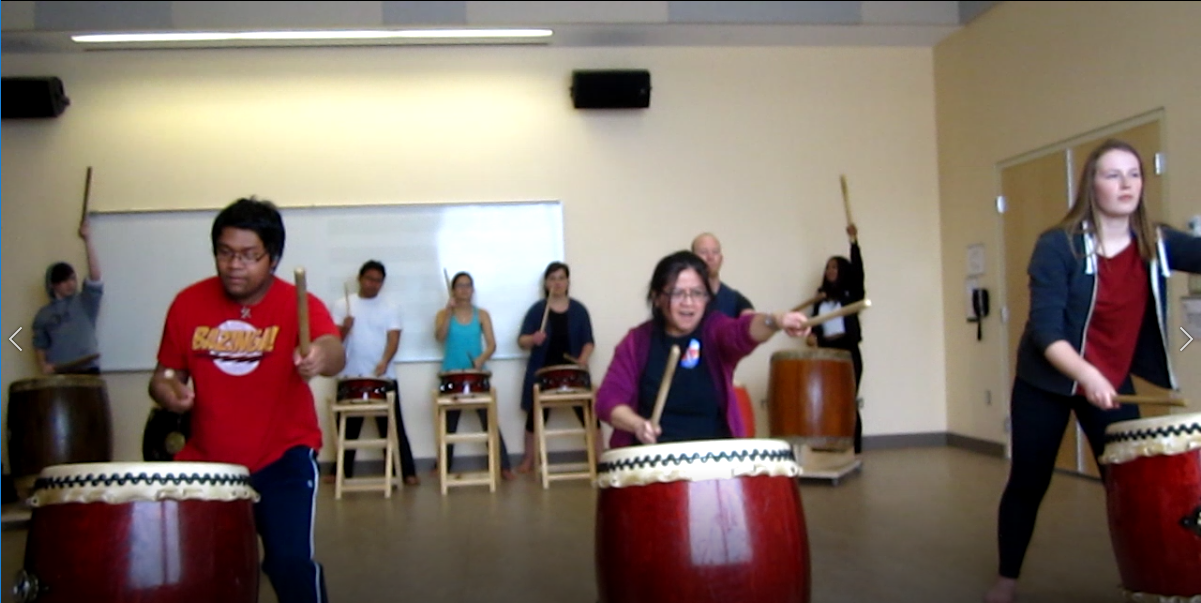
Last weekend, some of my studio families, friends and I took a beginner taiko drumming workshop. It might sound like an unusual activity for a piano studio, but music is music, regardless of instrument. Besides, nothing challenges your sense of rhythm and coordination like playing percussion in a group.
Last weekend, some of my studio families, friends and I took a beginner taiko drumming workshop. It might sound like an unusual activity for a piano studio, but music is music, regardless of instrument. Besides, nothing challenges your sense of rhythm and coordination like playing percussion in a group.
The first time I heard taiko drumming live was at the Calgary Omatsuri, featuring the Midnight Taiko Kai. I was immediately drawn to the driving rhythms, the synchronicity amongst the ensemble members, and the martial arts like discipline.
That was several years ago. I have since gotten to know two members of Midnight Taiko though other musical endeavours, thus making it rather easy to set up a custom taiko workshop through the Mount Royal Conservatory.
Taiko and Brain Games
We had a three-hour workshop let by Paula Midori Niekar sensei, Artistic Director of Midnight Taiko. She started us off with various brain exercises based on the Rock, Paper, Scissors game to wake up our foggy brains:
After a few minutes, we added the rest of our body to the mix, scooting up and down the floor. It was challenging.
Next, we learned basic techniques for holding the drumsticks (bachi) and our stance (kamae). The latter reminded me our our long stance for one of the martial arts I practice.
Testing our Endurance with Taiko
We learned a couple of basic patterns by ear and by rote, which is traditionally how taiko is taught. Then, we moved on to the Oroshi, which is the "Come check out what we're doing!" pattern.
Finally, we learned Isami Goma, which is a song I have heard Midnight Taiko perform. It translates to "Courageous War Horse." It's quite a long piece, so we had to learn it in sections and went through countless repetitions.
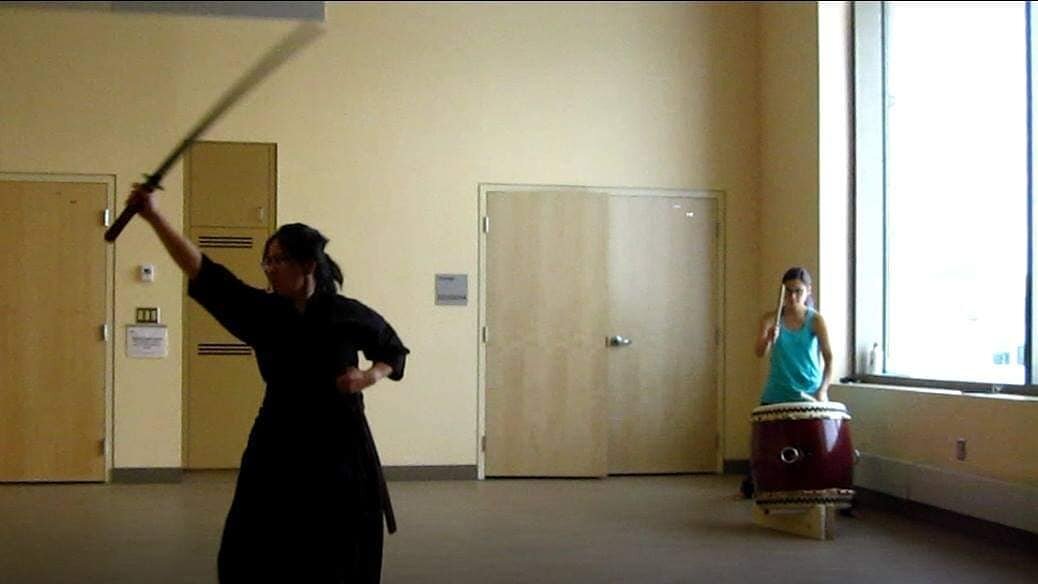
It really tested our memory, coordination and physical endurance. Finally, we had it decent enough to record:
Unfortunately, the sound quality isn't the greatest. My poor camera mic just couldn't handle all that percussion. Next time, I'll bring my Handy Zoom and adjust the mic levels and set-up appropriately.
My students and their parents enjoyed themselves immensely. Afterwards, they expressed the desire to do another taiko workshop next year.
Opening the workshop up to my piano parents and friends made for a wonderful studio community activity. As some of you know, social interaction with other "piano geeks" was one thing that was missing from my musical education growing up. It became an integral part to my musical studies at university. Group activities are an important part of my studio for these reasons, along with giving my students varied ways to enjoy music.
どうも ありがとう ございました to Paula Midori Niekar, Lisa Macleod and the Mount Royal Conservatory. If you'd like to try your hand at taiko, check out the taiko programs at MRU. If you'd like to hear taiko live, check out Midnight Taiko in concert on March 17, 2018.
Using Music Practice Plans
The bottom line is that it’s not how much time you practise on your instrument for, but how you manage your practice time, and how often. You can save a lot of time in the long run if you have a practice plan and goals, and if you have ideas on how to reach them.

It seems like my junior and senior high school students are becoming busier and busier. Last month, I dedicated an entire week to developing and experimenting with various practice plans for my students, depending upon their learning style and their schedule. These are two practice plans that my students and I developed to help them practice more efficiently:
Practice Plan #1: Rotating Practice Plans
Some students needed the more visually appealling list, while others were fine with a scribbled down list. The gist is that you divide your music assignment list into three different practice plans.
This is Emily's practice plan from last month:
Here is Claire's practice plan from last month:
This is a trick I learned at university: pair up a more difficult piece (or assignment) with an easier one. If you lump all the “not-so-fun” tasks into one day, that makes for a not-so-enjoyable and therefore, “I’m-not-going-to-practise-very-well” kind of day.
Most of my students alternate between Plans A and B. Plan C is usually is the “I don’t have a lot of time” list.
Practice Plan #2: Practice Ideas Based on How Much Time You Have
This is meant to show students that you can have an extremely productive and focussed practice in under five-minutes. You simply adjust your Practice Plan based on the amount of time you have.
This is Wendy's practice plan from last month:
Note that that these are presented as "practice ideas". This particular group wanted the freedom to pick and choose what they were going to work on, choosing from this list:
My students and I have timed how quickly they can fix a trouble spot using some of the drills and drill combos from Maestro's Music Tricks, a gamer-inspired practice aid that they inspired me to create. The average seems to be three minutes, but some have been able to fix a trouble spot in under two.
The bottom line is that it’s not how much time you practise on your instrument for, but how you manage your practice time, and how often. You can save a lot of time in the long run if you have a practice plan and goals, and if you have ideas on how to reach them.
Music Practice Tip: All Musicians Should Sing the Music
This music practice tip is something I should get my students to do more regularly: sing the music. Too often, we get hung up on the mechanics of music, that is, the notes and the rhythm. Well, that’s all good and dandy, but we’re not robots. When we bring music to life, we are telling a story through sound and silence.
This music practice tip is something I should get my students to do more regularly: sing the music. Too often, we get hung up on the mechanics of music, that is, the notes and the rhythm. Well, that’s all good and dandy, but we’re not robots. When we bring music to life, we are telling a story through sound and silence.
At university, one of my piano teachers told me that if I couldn’t sing the opening phrase of the Chopin Impromptu in G-flat Major, I had no business playing the piece. I thought she was joking. She wasn’t.
Through that exercise, I learned phrasing and expression. I learned where Chopin wanted the climax and where he wanted me (or any pianist) to pull back. I learned where to breathe.
Another benefit is that you internalize the music. Strangely, I learned this with interval ear training. It took work, but I drilled playing a note and singing a certain interval above or below it.
I applied this to my last piano exam, Level 7 in Conservatory Canada’s Contemporary Idioms syllabus, which I took a few years ago. I scored the highest I ever have in my piano exam history.
All I could think of was, “Why didn’t I do this when I was younger?” I would have aced ear training!
Musician Graehme Floyd lists several benefits to singing and internalizing the music with your voice. The top three should be enough to convince you: internalizing your music by singing cuts down on your learning time, your memorization time and boosts your confidence on stage. You can read the rest in his article, “Every Musician Should Sing”.
To read more about this music practice tip, check out: Robert Rawlins, Ph. D.’s article “Young Instrumentalists Should Learn to Sing So They can Learn to Hear” and “Learning to Listen: Dame Emma Kirkby's Collaborative Technique” by Jessica Chow.
Music planning sheets for teens and tweens
My high school students and I developed these music planning sheets to help keep them on track. They help me see where we need to be at a glance, too.
This year, I have several tweens and teens in my studio. Some are preparing for a piano exam, while others are studying music for recreation. One common trait among the majority of them is that they have problems staying on track, that is, time management.
I have vacillated from creating a simple exam preparation timeline to a highly detailed list of goals and milestones. Neither have worked particularly well. Last month, I created a six-week project worksheet and a learning timeline.
As a team, I speak with each of my students to build the learning timeline on Google Docs. Afterwards, I share the link with both the parent and student, granting them viewing and commenting rights. Here’s a screenshot of my student W.’s learning timeline. She’s preparing for her Grade 8 classical piano exam through Conservatory Canada:
Using the learning timeline, we proceeded to break down her learning goals using the six-week project worksheet. So far, she says it’s helped her stay on track more than any other assignment sheet we’ve used in our time together. Here are two of her planning sheets:
My student N. is in Grade 12 at school, so practice time is extremely limited. She isn’t preparing for a piano exam. This is what her learning timeline looks like for this half of the school year:
This is a picture of one of her planning sheets:
My students have been using these music planning sheets since mid-December. So far, they like that they contain just the “right” amount of information. They can see their goals for the week and each month at a glance.
Students and music teachers, if you’d like to download the six-week planning worksheet for educational use, you may do so by clicking here. It works well for recreational music students as well as students preparing for a music exam. Here's a link to view the year-planner.
Music Education Apps for Android - 2014 edition
Back in September, I shared some music education apps for iPad, iPhone and iPod Touch. Now, it’s Android’s turn. Here are some great music education apps for Android that I've come across.
Back in September, I shared some music education apps for iPad, iPhone and iPod Touch. Now, it’s Android’s turn. These are some of the best music education apps for Android that I have found. I have tried all of these on my phone, tablet (or both). Music Note Flashcards, Sight-Reading and Music Theory Apps for Android
Music Note Flashcards is a simple, free app for music students who need to work on their note recognition. Unfortunately, you can’t specify the testing range and there is no way to keep track of your progress.
Music Note Quiz is also a free note-reading Android app. I like how you can select your testing range: treble clef, bass clef, or the grand staff. You can also choose to repeat cards.
Music Tutor Sight Read Lite (FREE): Now this is what I’m looking for in terms of a music lesson and practice tool! With the free version, students can test their sight-reading. There are three game modes: timed tests, study and learn. I tested out the timed mode. A note appears on the grand staff. Players must quickly press the correct key. You can specify how long the test will be as well as the naming conventions (standard notation versus solfège). There is a note-writing mode as well. It scores your accuracy.
The full version of Music Tutor Sight Read ($2.99) also quizzes key signatures. What I really like about this app is that is tests keyboard geography. For instance, is that note G4 or G5?
I cannot believe that My Piano Assistant is a free app. This is a great app, not just for music students, but teachers and all types of pianists. If you are having trouble with your chords or scales, just punch in what the chord is and the app shows and plays you the notes. So, next time you’re baffled by an F7 chord with a flat 13th, worry no more. If you keep mixing up jazz minor with melodic minor, check out exactly how they differ.
Piano Sight Read is another free note-reading app. It’s not as fancy as Music Tutor Sight Read. It has two modes of play: practice and examination. You can’t specify the test range. It probably displays better on a phone versus my tablet. My score went down because I wanted to play the correct pitch on the keyboard and couldn't with such a small keyboard (just short of an octave).
Simply Music is a neat app. You know the card game, “Memory”? Well, this is Memory: the music version! There are four levels of difficulty. You can select if you want to pair up note to note or note to letter name. You can also select which clef. All this for free!
Ear Training and Rhythm Drills Apps for Android
Perfect Ear was one of the first apps I downloaded onto my smartphone and tablet. Musicians can test how well they can identify scales, chords and intervals by sight. They can also see how well they can recognize scales, intervals, chords and cadences by ear. If you upgrade to Perfect Ear Pro ($0.99) you can get more options for for singing intervals and recognizing cadences.
Perfect Ear 2 was released earlier this month. The free version has 20 different tests, whereas the Pro version has approximately 100 tests. It’s quite a step up from Perfect Ear 1.0. In addition to the music tests above, there are also interval comparison, rhythm reading, rhythm dictation and pitch training. You can use the standard tests or create a custom test.
It also contains a scales dictionary and theory articles. Soon, it will have the Circle of Fifths.
The newest version has a beautiful design. It’s also a smaller app than Perfect Ear Free.
With Rhythm Sheep Free, learn music, players have to successfully tap back the rhythm they hear. There are 40 levels to try out. The full version ($1.27) has up to 230 levels.
Recording and Backing Track Apps for Android
iOS devices have the edge over Android as far as recording, mixing, sequencing and editing go. This is for several reasons. The main ones are: latency issues (playback delay), processor and connectivity issues (Android devices aren’t OTG compliant nor MIDI class ready at this point).
In a pinch, I use the Smart Voice Recorder. You can change the sample rate (recording quality). The thing is, the sound quality depends on how good the mic is. However, for recording and reviewing your practices, it will do the trick. You can share your files easily as well.
With iReal b Pro ($10.99), you get a mobile band. Download the chord charts for over 1,200 songs available in the forums. Or, enter in the chord progression for any song, choose your instruments, tempo and style and play away. Instead of using a metronome, why not try practicing with a virtual band?
Metronome Apps for Android
I have been searching for an Android equivalent to MetroTimer. It’s my favourite app on my iPod Touch. My students and I giggle over the cartoon voice counting out the beats.
The one metronome app for Android that is like it is Metronome Beats. I had it on my smartphone for the longest time. Like the free version of MetroTimer, you don’t have as many sound options, subdivisions or time signatures to choose from. For $2.95, you can upgrade to Metronome Beats Pro. This has all the time signatures and different sound options. If you’d rather listen to claves or a cowbell instead of the regular metronome sound, go for it!
Before I got my tablet, I was looking for apps that could multi-task and didn’t take up a lot of memory. I found this free Metronome and Tuner app, called Soundcorset. You can’t change the metronome sound, but you can change the number of beats per bar, the beat subdivision and use the tap tempo function.
There are countless other music education apps out there for both iOS and Android devices. One of the most comprehensive lists I have come across is by David Brian Williams, Ph.D. Click on the link to see his recommendations of Tablet and Smartphone Apps for Music Education: Android and iOS.
Social Media Links
archives
- #YYCArts 32
- #YYCEvents 39
- Collaborative Music 25
- Community 11
- Composing & Arranging 6
- Entertainment 139
- Entrepreneurship 53
- Freebies 3
- Gardening 1
- Geeking Out 65
- Health & Wellness 120
- Improvisation 25
- Interviews 28
- Learning Music 188
- Martial Arts 13
- Memorization 7
- Music 230
- Music Careers 9
- Music Education 196
- Music Examinations 7
- Music Exploration 55
- Music Gigs 14
- Music Lessons 6
- Music Performance 32
- Music Theory 13
- Musical Instruments 12
- Musician Health 19
- Pets 57
- Piano Technique 12
- Practicing Music 120
- Productivity 20
- Professional Development 11
- Recommendations & Reviews 93
- Recreation 71
- Social Media 6
- Spirituality 10
- Studio Management 33
- Studio Technology 50
- Teaching Music 146
FOLLOW THE STUDIO on Instagram


Affiliate Links
As a Sheetmusicplus and CD Japan affiliate, I earn from qualifying purchases. The earnings help fund the Studio’s blog and YouTube channels. Your support is greatly appreciated.


FOLLOW Budo no Tabi on Instagram